Brachytherapy Treatment Planning System Market Size, Share & Demand Report By Component (Software Solutions, Services, Cloud-Based Planning Platforms), By Application (Prostate Cancer Treatment, Cervical Cancer Treatment, Breast Cancer Treatment, Gynecological Cancer Treatment, Other Oncology Applications), By End Use (Hospitals, Specialty Cancer Centers, Ambulatory Radiotherapy Centers, Academic and Research Institutes), By Region & Segment Forecasts, 2026–2034
USD 3950
Market Overview
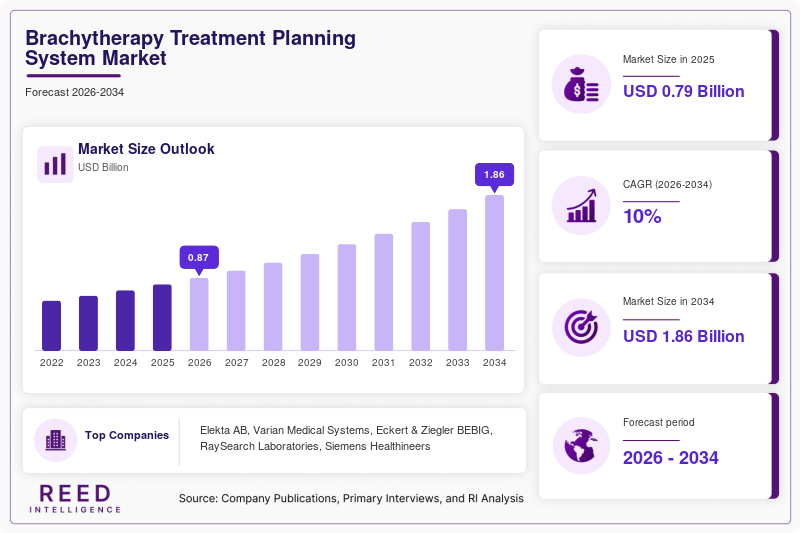
The global Brachytherapy Treatment Planning System Market size was valued at approximately USD 0.785 billion in 2026 and is projected to reach nearly USD 1.68 billion by 2034, expanding at a CAGR of 10.0% during the forecast period from 2026 to 2034. The market continues to gain momentum as healthcare providers increasingly adopt advanced radiation oncology technologies for precision-focused cancer treatment. Brachytherapy treatment planning systems are becoming essential in oncology centers because they improve dose calculation accuracy, streamline workflow efficiency, and support personalized radiation therapy planning. Rising cancer prevalence across aging populations and the increasing burden of cervical, prostate, breast, and gynecological cancers are further contributing to market expansion.
The growing integration of artificial intelligence and image-guided radiotherapy technologies has supported global market growth. Healthcare institutions are investing in advanced planning software capable of handling real-time imaging, adaptive treatment planning, and automated contouring. Hospitals and specialty cancer centers are also modernizing oncology infrastructure to reduce treatment errors and improve clinical outcomes. In addition, favorable reimbursement frameworks in developed healthcare systems and rising awareness regarding minimally invasive cancer therapies continue to strengthen market demand.
Key Highlights
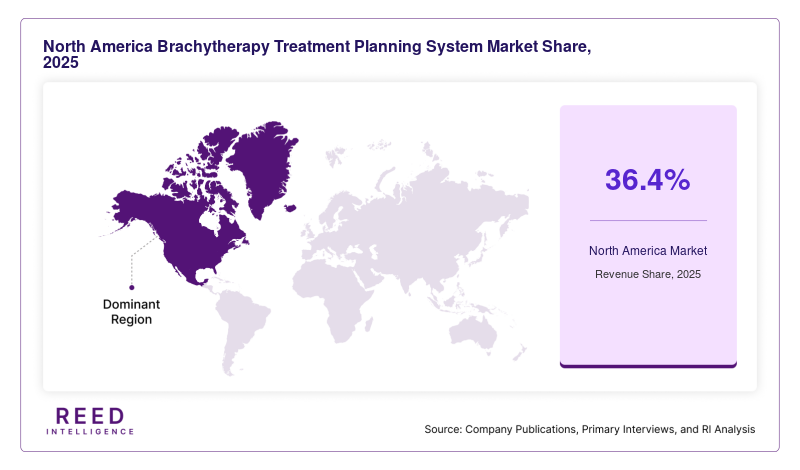
- North America dominated the market with a 36.4% share in 2025, while Asia Pacific is expected to grow at the fastest CAGR of 11.8% during 2026–2034.
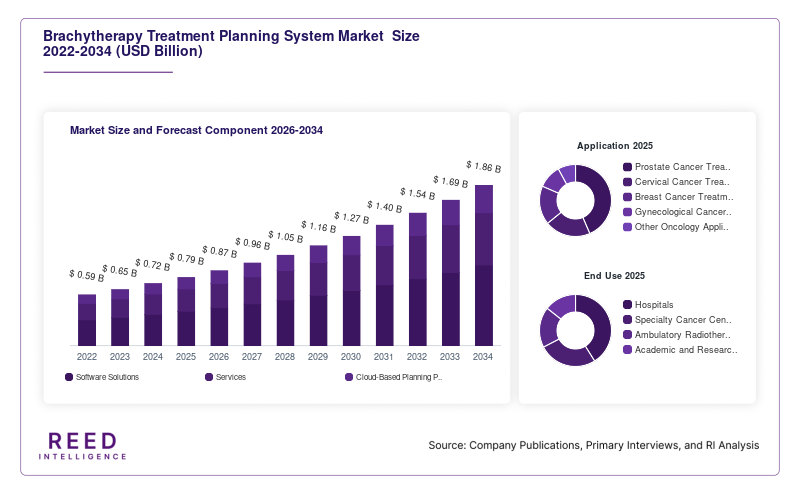
- By component, software solutions accounted for the largest share of 57.6%, while cloud-based planning platforms are projected to grow at a CAGR of 12.6%.
- By application, prostate cancer treatment led with a 39.8% share, whereas cervical cancer treatment is expected to expand at a CAGR of 11.9%.
- By end use, hospitals represented the dominant segment with a 52.1% share, while specialty cancer centers are forecast to grow at a CAGR of 12.1%.
- The United States remained the dominant country, with market values of USD 248 million in 2024 and USD 274 million in 2025.
Market Trends
Integration of Artificial Intelligence in Radiation Dose Planning
Artificial intelligence integration has emerged as a major trend within the Brachytherapy Treatment Planning System Market. Healthcare providers are adopting AI-supported planning platforms that automate contouring, optimize radiation dose distribution, and improve treatment workflow management. These systems reduce the time required for treatment planning while enhancing clinical consistency. Oncology centers are increasingly using machine learning algorithms to analyze imaging data and recommend treatment parameters based on patient-specific anatomy. This trend is improving operational efficiency in high-volume cancer treatment facilities where quick planning and precision are essential. Software vendors are introducing AI-driven adaptive planning tools that support real-time modifications during therapy sessions. Growing demand for precision medicine and data-driven oncology care is expected to encourage additional investments in intelligent treatment planning technologies over the coming years.
Expansion of Image-Guided and Cloud-Based Oncology Platforms
The adoption of image-guided brachytherapy and cloud-enabled planning platforms is reshaping radiation oncology practices worldwide. Hospitals and cancer treatment centers are moving toward integrated systems that combine MRI, CT, and ultrasound imaging with treatment planning software to improve visualization accuracy during radiation delivery. Cloud-based deployment models are also gaining traction because they support centralized data access, remote collaboration, and scalable oncology workflow management. Multi-site healthcare networks are implementing connected platforms that allow specialists to review treatment plans from different locations. This trend is particularly important in regions facing shortages of experienced radiation oncologists. Vendors are focusing on cybersecurity, interoperability, and real-time analytics to support expanding demand for digital oncology ecosystems. The combination of imaging innovation and cloud connectivity is expected to increase treatment efficiency and patient throughput.
Market Drivers
Increasing Global Cancer Burden and Demand for Precision Oncology
The increasing incidence of cancer worldwide is one of the primary factors driving the Brachytherapy Treatment Planning System Market. Rising cases of prostate cancer, cervical cancer, breast cancer, and gynecological malignancies are creating strong demand for advanced radiation therapy technologies. Healthcare providers are prioritizing precision oncology solutions that improve treatment outcomes while minimizing damage to healthy tissues. Brachytherapy treatment planning systems support accurate radiation dose calculation and help clinicians customize treatment strategies according to tumor size and patient anatomy. Aging populations across developed and emerging economies are further contributing to the rising number of oncology procedures. Governments and healthcare organizations are also expanding cancer screening and treatment programs, which is increasing the adoption of advanced radiotherapy planning platforms in hospitals and specialty cancer centers.
Technological Advancements in Radiation Oncology Infrastructure
Continuous technological progress in radiation oncology infrastructure is supporting market expansion across global healthcare systems. Modern treatment planning systems now include advanced imaging integration, automated workflow management, and adaptive treatment capabilities. These features improve planning efficiency and reduce procedural delays in oncology departments. Healthcare providers are investing in digital treatment planning technologies to improve patient safety and operational productivity. Vendors are also developing software capable of supporting multiple brachytherapy modalities, including high-dose-rate and low-dose-rate procedures. The growing availability of MRI-compatible applicators and real-time imaging tools has further strengthened treatment precision. In addition, increased healthcare spending in emerging markets is enabling hospitals to modernize radiation oncology departments and replace outdated planning systems with advanced digital platforms.
Market Restraint
High Capital Costs and Limited Access in Developing Healthcare Systems
The high cost associated with advanced brachytherapy treatment planning systems remains a major restraint affecting market penetration in several developing economies. Implementation of sophisticated oncology software requires substantial investment in imaging systems, radiation therapy equipment, information technology infrastructure, and workforce training. Smaller hospitals and regional cancer centers often face budget limitations that restrict adoption of advanced planning platforms. In addition, maintenance expenses, software upgrade costs, and licensing requirements can increase operational burdens for healthcare providers. Limited availability of skilled radiation oncologists and medical physicists further slows implementation in low-resource healthcare environments.
Many developing countries continue to prioritize basic oncology infrastructure rather than specialized digital planning systems. Delayed reimbursement approvals and inconsistent healthcare funding also create barriers to technology procurement. For example, several public hospitals across parts of Africa and Latin America still rely on conventional radiotherapy systems with limited digital integration because of infrastructure constraints. These challenges reduce the pace of adoption despite growing cancer prevalence. Market participants are therefore focusing on modular software solutions, subscription-based pricing models, and cloud deployment strategies to improve affordability and accessibility for healthcare institutions with restricted budgets.
Market Opportunities
Rising Healthcare Investments Across Emerging Asian Economies
Emerging Asian economies present substantial growth opportunities for the Brachytherapy Treatment Planning System Market. Governments across countries such as India, China, Indonesia, and Vietnam are increasing investments in cancer care infrastructure to address the growing burden of oncology cases. Public healthcare modernization programs are encouraging hospitals to adopt advanced radiotherapy technologies and digital treatment planning platforms. Rising disposable income and expanding health insurance coverage are also improving patient access to specialized oncology services. International healthcare organizations and private investors are supporting the establishment of modern cancer treatment centers equipped with advanced imaging and radiation therapy systems.
The expansion of medical tourism in several Asian countries is further contributing to market demand. Many regional healthcare providers are focusing on improving treatment quality to attract international patients seeking cost-effective oncology care. Vendors entering these markets are developing localized software interfaces and affordable deployment models to strengthen adoption rates. Partnerships between healthcare institutions and technology companies are expected to accelerate the installation of advanced brachytherapy planning systems across emerging economies.
Growth Potential for Remote and Cloud-Enabled Oncology Collaboration
The increasing adoption of remote healthcare technologies is creating new opportunities for cloud-enabled brachytherapy treatment planning systems. Oncology providers are seeking collaborative platforms that allow radiation specialists to review and modify treatment plans remotely. This capability is becoming increasingly valuable in regions facing shortages of experienced medical physicists and radiation oncologists. Cloud-based systems support centralized patient data management, real-time plan sharing, and faster clinical decision-making across geographically dispersed healthcare networks.
The trend toward tele-oncology services is also supporting demand for flexible treatment planning solutions. Hospitals and specialty cancer centers are implementing digital platforms that improve coordination between diagnostic imaging teams, oncologists, and radiotherapy departments. Vendors are introducing cybersecurity-focused cloud solutions that comply with evolving healthcare data protection standards. The growing use of artificial intelligence analytics and predictive treatment modeling within cloud platforms is expected to further expand market potential. As healthcare systems continue adopting connected digital infrastructure, remote treatment planning capabilities are likely to become a standard feature in modern radiation oncology environments.
Segmental Analysis
By Component
Software solutions represented the dominant subsegment within the component category and accounted for approximately 57.6% of market revenue in 2024. The growing reliance on advanced oncology software for accurate dose calculation, treatment simulation, and workflow management has strengthened demand for integrated planning platforms. Hospitals and specialty cancer centers increasingly prefer software systems capable of supporting multiple imaging modalities and real-time treatment adjustments. The integration of artificial intelligence, automated contouring, and adaptive planning features has further improved clinical efficiency. Healthcare providers are focusing on software upgrades that reduce planning errors and improve patient-specific treatment precision. The growing shift toward digital healthcare infrastructure and data-driven oncology practices continues to support strong adoption of sophisticated treatment planning software across both developed and emerging healthcare systems.
Cloud-based planning platforms are projected to record the fastest growth within the component segment, expanding at a CAGR of 12.6% during the forecast period. Healthcare institutions are increasingly adopting cloud-enabled systems because they support remote collaboration, centralized data management, and scalable oncology workflow integration. Multi-site healthcare networks benefit from improved accessibility and reduced dependency on local hardware infrastructure. Vendors are introducing subscription-based deployment models that lower upfront investment requirements for smaller healthcare facilities. In addition, cloud technologies support faster software updates and improved cybersecurity management. The increasing demand for tele-oncology services and remote treatment review capabilities is expected to accelerate the adoption of cloud-based planning solutions, particularly in regions facing shortages of experienced radiation oncology professionals.
By Application
Prostate cancer treatment accounted for the largest share within the application segment, representing nearly 39.8% of global market revenue in 2024. The high prevalence of prostate cancer, particularly among aging male populations, has significantly increased demand for precision-focused brachytherapy procedures. Brachytherapy treatment planning systems play an essential role in optimizing radiation dose placement while minimizing exposure to surrounding healthy tissues. Healthcare providers are increasingly adopting advanced planning platforms that support image-guided prostate brachytherapy and automated dose optimization. Improvements in diagnostic imaging and patient monitoring technologies have also contributed to wider acceptance of minimally invasive treatment approaches. The availability of reimbursement support for prostate cancer treatment in developed healthcare systems further strengthens market growth across this application segment.
Cervical cancer treatment is expected to witness the fastest growth, with a projected CAGR of 11.9% from 2026 to 2034. Rising cervical cancer incidence in developing economies and expanding government-led cancer screening programs are increasing demand for advanced radiation therapy planning technologies. Healthcare organizations are emphasizing early-stage diagnosis and targeted treatment to improve survival rates among female patients. Brachytherapy remains an important treatment option for cervical cancer because of its ability to deliver high radiation doses directly to tumor sites. Vendors are developing specialized planning software with improved imaging integration and adaptive treatment capabilities to support gynecological oncology procedures. Increasing investments in women’s healthcare infrastructure are expected to further strengthen growth opportunities within this segment.
By End Use
Hospitals represented the dominant end-use subsegment and accounted for approximately 52.1% of the global Brachytherapy Treatment Planning System Market in 2024. Large hospitals continue to serve as primary centers for cancer diagnosis and radiation oncology treatment because they possess advanced infrastructure and multidisciplinary clinical teams. These healthcare institutions are investing in integrated oncology platforms that combine imaging, treatment planning, and patient management systems within a unified workflow environment. The increasing volume of cancer patients and rising demand for precision radiotherapy procedures are encouraging hospitals to modernize oncology departments with advanced planning technologies. In addition, favorable reimbursement frameworks and government healthcare funding in developed regions continue supporting equipment procurement and software adoption across hospital-based oncology facilities.
Specialty cancer centers are expected to register the fastest growth within the end-use segment, expanding at a CAGR of 12.1% during the forecast period. These centers are increasingly focusing on personalized oncology care and advanced radiotherapy techniques to improve patient outcomes. Specialty facilities often prioritize the adoption of innovative treatment planning technologies because they handle complex cancer cases requiring high levels of precision. The growing trend toward outpatient cancer treatment and dedicated oncology networks is supporting expansion across this segment. In addition, partnerships between private healthcare investors and oncology service providers are accelerating the establishment of technologically advanced cancer treatment centers. Rising patient preference for specialized oncology institutions with shorter treatment waiting times is expected to further contribute to market growth.
Regional Analysis
North America
North America accounted for approximately 36.4% of the global Brachytherapy Treatment Planning System Market in 2025 and is expected to maintain a stable growth trajectory throughout the forecast period. The regional market is projected to expand at a CAGR of 9.4% from 2026 to 2034 due to the strong presence of advanced oncology infrastructure and widespread adoption of precision radiation therapy technologies. Healthcare providers across the United States and Canada continue investing in modern radiotherapy planning software that improves clinical efficiency and patient outcomes. The region also benefits from favorable reimbursement structures and high healthcare spending.
The United States remained the dominant contributor within North America due to its advanced cancer treatment ecosystem and extensive presence of leading radiation oncology companies. One major growth factor supporting the country’s market expansion is the rapid adoption of artificial intelligence-assisted treatment planning systems across academic hospitals and specialty oncology centers. Increasing cancer prevalence, combined with rising investments in integrated imaging technologies, is encouraging healthcare institutions to replace legacy systems with advanced digital planning platforms that support adaptive and image-guided brachytherapy procedures.
Europe
Europe represented a significant share of the Brachytherapy Treatment Planning System Market in 2025 and is projected to witness consistent expansion during the forecast period. The regional market is anticipated to grow at a CAGR of 8.8% between 2026 and 2034. Demand is being supported by increasing government initiatives focused on improving cancer care infrastructure and expanding access to precision oncology treatment. Several European healthcare systems are emphasizing early diagnosis and advanced radiotherapy techniques to reduce long-term cancer mortality rates. The presence of established medical device manufacturers and strong regulatory standards further supports regional market development.
Germany remained the dominant country within the European market because of its technologically advanced healthcare sector and extensive network of radiation oncology centers. A unique growth factor driving the German market is the increasing integration of MRI-guided brachytherapy planning systems in university hospitals and specialized cancer institutes. Healthcare providers are focusing on treatment personalization and workflow optimization to improve clinical outcomes. In addition, growing collaboration between research institutions and software developers is accelerating innovation in adaptive treatment planning technologies across the country.
Asia Pacific
Asia Pacific is expected to record the fastest growth in the Brachytherapy Treatment Planning System Market, with a projected CAGR of 11.8% from 2026 to 2034. The region accounted for nearly 24.6% of global market revenue in 2025 and continues to benefit from rapidly expanding healthcare infrastructure. Increasing cancer prevalence, rising healthcare expenditure, and improving access to oncology services are major factors driving regional demand. Governments across China, India, Japan, and South Korea are prioritizing investments in advanced cancer treatment technologies to address growing patient volumes and strengthen national healthcare capabilities.
China emerged as the dominant country within Asia Pacific due to its large patient population and extensive healthcare modernization initiatives. A major growth factor supporting the Chinese market is the rapid expansion of public and private cancer treatment centers equipped with digital radiotherapy planning systems. Healthcare providers are increasingly adopting integrated imaging and treatment software to improve precision and patient management efficiency. In addition, government support for domestic medical technology manufacturing is encouraging local innovation and increasing accessibility to advanced oncology platforms across urban and regional healthcare facilities.
Middle East & Africa
The Middle East & Africa region is gradually strengthening its position within the Brachytherapy Treatment Planning System Market as healthcare systems invest in specialized oncology infrastructure. The market in this region is projected to expand at a CAGR of 8.2% during the forecast period. Rising awareness regarding cancer diagnosis and treatment, combined with improving healthcare accessibility, is supporting demand for advanced radiotherapy technologies. Several Gulf countries are increasing investments in modern cancer care facilities to reduce dependence on overseas treatment services. Private healthcare providers are also adopting advanced oncology software to improve treatment efficiency.
Saudi Arabia remained the leading country in the regional market because of significant government investments in healthcare modernization and cancer treatment expansion. One unique growth factor supporting market development is the country’s focus on establishing integrated smart hospitals with digital oncology departments. Healthcare institutions are adopting advanced treatment planning systems capable of supporting image-guided and adaptive brachytherapy procedures. Increasing collaboration with international medical technology providers is further contributing to the availability of advanced radiation oncology solutions across the country.
Latin America
Latin America accounted for a smaller but steadily expanding share of the Brachytherapy Treatment Planning System Market in 2025 and is expected to witness stable growth over the forecast period. The regional market is anticipated to grow at a CAGR of 8.5% from 2026 to 2034. Increasing investments in public healthcare infrastructure and rising awareness regarding early cancer treatment are supporting regional market development. Several countries are expanding oncology service networks to address increasing cancer incidence rates. The adoption of digital treatment planning technologies is gradually improving as hospitals modernize radiotherapy departments.
Brazil remained the dominant country in Latin America because of its relatively advanced healthcare infrastructure and large oncology patient base. A major growth factor driving the Brazilian market is the increasing participation of private healthcare providers in cancer treatment modernization projects. Hospitals are implementing advanced treatment planning systems to improve workflow efficiency and reduce treatment delays. In addition, rising collaboration between public hospitals and international medical technology companies is expanding access to precision oncology solutions in major urban healthcare centers.
Competitive Landscape
The competitive landscape of the Brachytherapy Treatment Planning System Market is characterized by technological innovation, strategic collaborations, and continuous software enhancement initiatives. Leading companies are focusing on expanding product capabilities through artificial intelligence integration, adaptive planning technologies, and cloud-enabled workflow management systems. Market participants are also strengthening partnerships with hospitals, cancer research institutes, and imaging technology providers to improve treatment accuracy and operational efficiency.
Elekta AB remains one of the leading companies in the market due to its strong radiation oncology portfolio and global distribution network. The company recently introduced upgraded treatment planning capabilities designed to support adaptive brachytherapy workflows and advanced imaging integration. Other major players such as Varian Medical Systems, Eckert & Ziegler BEBIG, and RaySearch Laboratories are also investing in software modernization and interoperability improvements. Several vendors are emphasizing cloud deployment models and cybersecurity enhancements to support digital healthcare transformation. Competition is expected to intensify as emerging companies introduce cost-effective planning platforms targeting healthcare institutions in developing markets.
Key Players
- Elekta AB
- Varian Medical Systems
- Eckert & Ziegler BEBIG
- RaySearch Laboratories
- Siemens Healthineers
- Philips Healthcare
- GE HealthCare
- Isoray Inc.
- Accuray Incorporated
- Theragenics Corporation
- Panacea Medical Technologies
- CIVCO Radiotherapy
- Oncentra
- Mirada Medical
- Brainlab AG
Recent Developments
- Elekta AB introduced an upgraded adaptive brachytherapy planning module in 2025 designed to improve real-time dose optimization and imaging integration capabilities.
- Varian Medical Systems expanded its cloud-connected oncology workflow platform in 2024 to support collaborative treatment planning across multi-site healthcare networks.
- RaySearch Laboratories partnered with regional oncology centers in Asia Pacific during 2025 to strengthen adoption of AI-supported brachytherapy planning technologies.
- Siemens Healthineers launched enhanced MRI-compatible oncology imaging solutions aimed at improving precision-guided brachytherapy procedures in specialty cancer centers.
- Panacea Medical Technologies expanded its radiation oncology software deployment capabilities across emerging markets to support affordable cancer treatment infrastructure modernization.
Brachytherapy Treatment Planning System Market Segments
Component
- Software Solutions
- Services
- Cloud-Based Planning Platforms
Application
- Prostate Cancer Treatment
- Cervical Cancer Treatment
- Breast Cancer Treatment
- Gynecological Cancer Treatment
- Other Oncology Applications
End Use
- Hospitals
- Specialty Cancer Centers
- Ambulatory Radiotherapy Centers
- Academic and Research Institutes
By Region
- North America
- Europe
- APAC
- Middle East and Africa
- LATAM