Braiding Equipment Market Size, Share & Demand Report By Type (Horizontal Braiding Machines, Vertical Braiding Machines), By Material Type (Metal Wire, Carbon Fiber, Glass Fiber, Textile Yarn), By Application (Automotive, Aerospace, Medical, Industrial), By End-Use Industry (Manufacturing, Healthcare, Energy, Construction), By Region & Segment Forecasts, 2025–2034
USD 3950
Market Overview
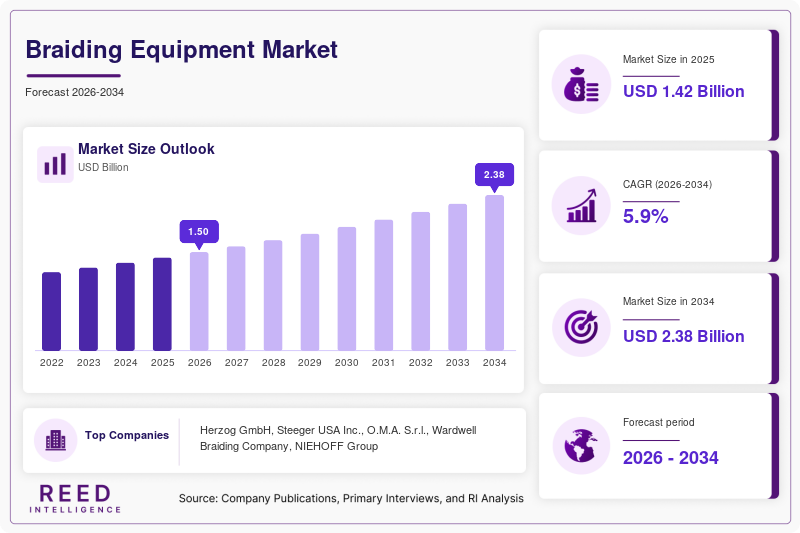
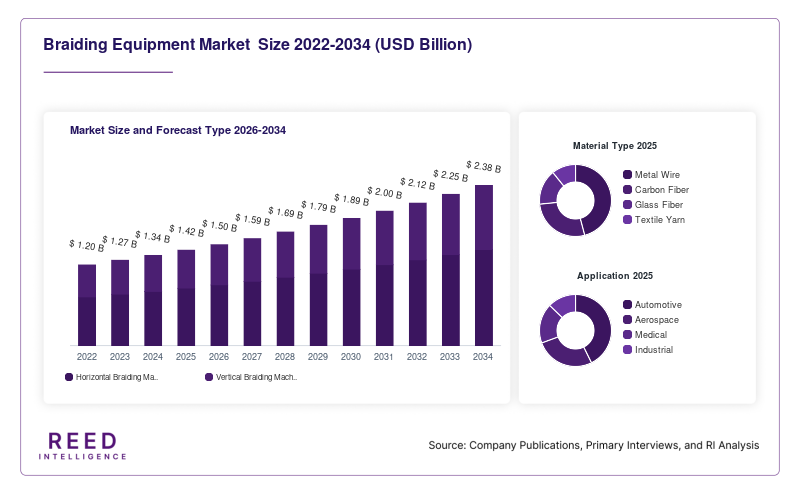
The global Braiding Equipment Market size was valued at USD 1.42 billion in 2025 and is projected to reach USD 2.38 billion by 2034, expanding at a CAGR of 5.9% during 2025–2034. The market growth is primarily supported by the increasing demand for high-performance braided materials across industries such as automotive, aerospace, medical devices, and textile manufacturing. Braiding equipment plays a critical role in producing reinforced hoses, cables, and composite structures, which are widely used in industrial and consumer applications.
One key global factor supporting the expansion of the Braiding Equipment Market is the growing shift toward lightweight and durable materials in manufacturing processes. Industries are increasingly adopting braided composites due to their superior strength-to-weight ratio, flexibility, and durability, which enhances the demand for advanced braiding machinery.
Key Highlights
- Asia Pacific dominated the market with 38.6% share in 2025, while the region is projected to grow at the fastest CAGR of 6.8%.
- The horizontal braiding machines segment led with 46.2% share, while vertical braiding machines are expected to grow at a CAGR of 6.5%.
- Automotive application dominated with 34.7% share, while medical applications are projected to grow at a CAGR of 7.1%.
- The U.S. remained the dominant country with a market value of USD 310 million in 2025, expected to reach USD 326 million in 2026.
Market Trends
Increasing Adoption of Automated Braiding Systems
Automation is emerging as a significant trend in the Braiding Equipment Market. Manufacturers are integrating programmable logic controllers (PLCs) and robotics into braiding machines to enhance production efficiency and reduce human error. Automated systems enable precise control over braid patterns, tension, and speed, improving product consistency. This trend is particularly prominent in high-volume industries such as automotive and aerospace, where precision and scalability are critical.
Rising Demand for Advanced Composite Braiding
The use of braiding equipment for advanced composite manufacturing is gaining momentum. Industries are shifting toward carbon fiber and glass fiber braided structures for applications requiring high strength and low weight. Braiding technology allows complex geometries and enhanced structural integrity, making it suitable for aerospace components, wind energy systems, and high-performance sports equipment. This trend is expected to reshape product innovation and expand the application scope of braiding equipment globally.
Market Drivers
Expansion of Automotive and Aerospace Manufacturing
The growth of automotive and aerospace sectors is driving the Braiding Equipment Market. These industries require high-performance braided components such as hoses, cables, and reinforcement structures. With increasing production of electric vehicles and aircraft, the demand for lightweight and durable materials is rising, thereby boosting the adoption of braiding equipment.
Growing Demand for Medical Textiles
The medical sector is increasingly utilizing braided structures for applications such as surgical sutures, stents, and catheters. Braiding equipment enables the production of flexible, durable, and biocompatible medical components. The rise in healthcare expenditure and advancements in minimally invasive procedures are contributing to the growing demand for medical-grade braiding equipment.
Market Restraint
High Initial Investment and Maintenance Costs
A major restraint in the Braiding Equipment Market is the high capital investment required for advanced machinery. Modern braiding systems with automation and digital controls involve significant upfront costs, which can be a barrier for small and medium-sized enterprises. Additionally, maintenance and operational costs, including skilled labor requirements and spare parts, add to the overall expenditure.
The complexity of advanced machines also necessitates specialized training for operators, further increasing costs. These financial challenges may limit market penetration in developing regions and hinder the adoption of technologically advanced equipment. As a result, some manufacturers continue to rely on conventional systems, slowing overall market modernization.
Market Opportunities
Growth in Renewable Energy Applications
The increasing adoption of renewable energy systems presents a significant opportunity for the Braiding Equipment Market. Braided components are used in wind turbine blades, solar panel wiring, and energy storage systems. As global investments in renewable energy continue to rise, the demand for specialized braiding equipment is expected to increase, supporting market expansion.
Emergence of Smart and Connected Machinery
The integration of IoT and smart technologies in braiding equipment is creating new growth opportunities. Smart machines enable real-time monitoring, predictive maintenance, and data-driven optimization of production processes. These features enhance efficiency and reduce downtime, making them attractive to manufacturers seeking improved productivity. The adoption of Industry 4.0 practices is expected to drive innovation and create new revenue streams in the market.
Segmental Analysis
By Type
Horizontal braiding machines dominated the Braiding Equipment Market with a 46.2% share in 2025. These machines are widely used due to their versatility and ability to handle various materials and applications. Their efficiency in producing complex braided structures has made them a preferred choice across industries.
Vertical braiding machines are expected to grow at the fastest CAGR of 6.5% during the forecast period. Their ability to produce high-density and precision braids makes them suitable for specialized applications, particularly in aerospace and medical sectors.
By Material Type
Metal wire braiding equipment held the largest share of 41.5% in 2025, driven by its extensive use in industrial and automotive applications. Metal braids provide strength and durability, making them ideal for reinforcement purposes.
Carbon fiber braiding equipment is projected to grow at a CAGR of 7.0%. The increasing adoption of lightweight composite materials in aerospace and automotive industries is driving the demand for carbon fiber braiding.
By Application
Automotive applications dominated the market with a 34.7% share in 2025, supported by the high demand for braided hoses, cables, and reinforcement structures. The need for durable and flexible components in vehicles has contributed to this dominance.
Medical applications are expected to grow at the fastest CAGR of 7.1%. The increasing use of braided structures in medical devices, such as stents and catheters, is driving this growth.
By End-Use Industry
Manufacturing industries accounted for the largest share of 39.2% in 2025, as braiding equipment is widely used in producing industrial components and materials.
The renewable energy sector is projected to grow at a CAGR of 6.9%, driven by the increasing use of braided components in energy systems.
Regional Analysis
North America
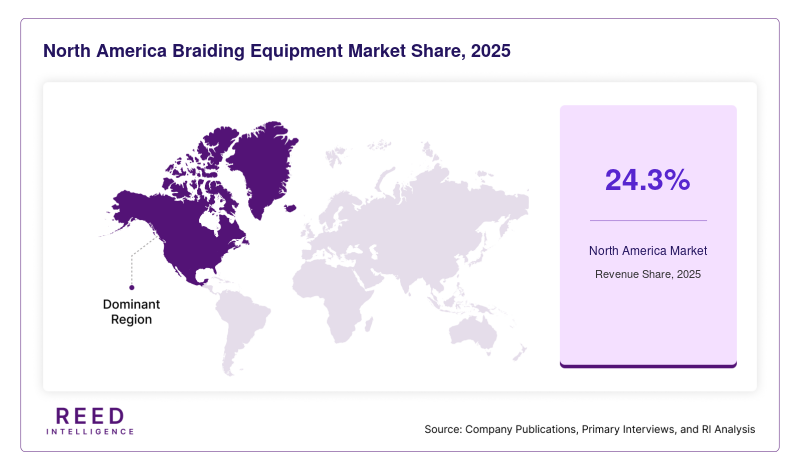
North America accounted for 24.3% of the Braiding Equipment Market share in 2025 and is expected to grow at a CAGR of 5.2% during the forecast period. The region’s growth is driven by the strong presence of aerospace and automotive manufacturing industries. Increasing investments in advanced manufacturing technologies are supporting the adoption of modern braiding equipment.
The United States dominated the regional market due to its well-established industrial base and focus on innovation. The country’s emphasis on high-performance materials and advanced production techniques has driven demand for braiding equipment, particularly in aerospace and defense applications.
Europe
Europe held 21.7% market share in 2025 and is projected to expand at a CAGR of 5.5%. The region benefits from a strong manufacturing ecosystem and emphasis on quality standards. The adoption of advanced textile machinery is contributing to steady market growth.
Germany emerged as the leading country, driven by its robust engineering and automotive industries. The country’s focus on precision manufacturing and industrial automation has increased the demand for high-quality braiding equipment.
Asia Pacific
Asia Pacific dominated the Braiding Equipment Market with 38.6% share in 2025 and is anticipated to grow at the fastest CAGR of 6.8%. Rapid industrialization, expanding manufacturing sectors, and increasing investments in infrastructure are key growth factors.
China led the regional market due to its large-scale manufacturing capabilities and growing demand for industrial machinery. The country’s focus on enhancing production efficiency and adopting advanced technologies has significantly contributed to market growth.
Middle East & Africa
The Middle East & Africa accounted for 7.4% of the market share in 2025 and is expected to grow at a CAGR of 5.1%. The region is witnessing gradual industrial development and increasing investments in infrastructure projects.
United Arab Emirates dominated the market due to its growing industrial sector and focus on diversification. The country’s investments in manufacturing and construction have driven demand for braiding equipment.
Latin America
Latin America held 8.0% market share in 2025 and is projected to grow at a CAGR of 5.3%. The region’s growth is supported by expanding industrial activities and increasing adoption of modern machinery.
Brazil led the regional market due to its developing manufacturing sector and rising demand for industrial equipment. The country’s focus on improving production capabilities has supported the adoption of braiding equipment.
Competitive Landscape
The Braiding Equipment Market is moderately competitive, with several global and regional players focusing on technological advancements and product innovation. Companies are investing in automation, smart technologies, and customized solutions to strengthen their market position.
A leading player, Herzog GmbH, has maintained its position through continuous innovation and a strong product portfolio. The company recently introduced advanced automated braiding systems designed for high-precision applications, enhancing its competitive edge.
Other key players are focusing on strategic partnerships, mergers, and expansions to increase their global footprint. The competitive environment is characterized by the presence of established manufacturers and emerging companies offering specialized solutions.
Key Players
- Herzog GmbH
- Steeger USA Inc.
- O.M.A. S.r.l.
- Wardwell Braiding Company
- NIEHOFF Group
- Mayer & Cie. GmbH
- Kyang Yhe Delicate Machine Co., Ltd.
- Xuzhou Henghui Braiding Machine Co., Ltd.
- Spirka Schnellflechter GmbH
- OMET S.r.l.
- Taiyo Seiki Iron Works Co., Ltd.
- Changzhou Runfengyuan Textile Machinery Manufacturing Co., Ltd.
- Shanghai Dahe Packaging Machinery Co., Ltd.
- Jiangsu Jinlong Technology Co., Ltd.
- New England Butt Company
Recent Developments
- In 2024, Herzog GmbH launched a new series of automated braiding machines with enhanced digital control systems.
- In 2023, Steeger USA expanded its production capacity to meet growing demand in North America.
- In 2024, Kyang Yhe introduced eco-efficient braiding equipment designed to reduce energy consumption.
- In 2023, Wardwell Braiding Company developed high-speed braiding machines for industrial applications.
- In 2024, Spirka Schnellflechter GmbH focused on integrating IoT capabilities into its product line.
Braiding Equipment Market Segments
Type
- Horizontal Braiding Machines
- Vertical Braiding Machines
Material Type
- Metal Wire
- Carbon Fiber
- Glass Fiber
- Textile Yarn
Application
- Automotive
- Aerospace
- Medical
- Industrial
End-Use Industry
- Manufacturing
- Healthcare
- Energy
- Construction
Distribution Channel
- Direct Sales
- Distributors & Dealers
- Online Sales
By Region
- North America
- Europe
- APAC
- Middle East and Africa
- LATAM