Brain Abscess Drug Market Size, Share Demand Report By Drug Class (Cephalosporins, Glycopeptides, Metronidazole, Antifungal Drugs, Combination Therapy), By Route of Administration (Intravenous, Oral), By Pathogen Type (Bacterial, Fungal, Parasitic), By Distribution Channel (Hospital Pharmacies, Retail Pharmacies, Specialty Pharmacies), By End User (Hospitals, Neurology Clinics, Ambulatory Care Centers), By Region & Segment Forecasts, 2026–2034
USD 3950
Market Overview
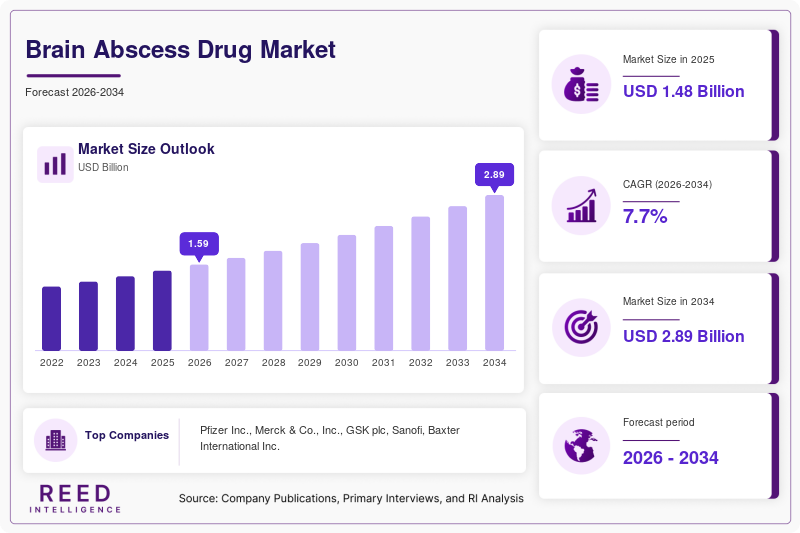
The global Brain Abscess Drug Market size was valued at USD 1.48 billion in 2026 and is projected to reach USD 2.67 billion by 2034, expanding at a CAGR of 7.7% during the forecast period from 2026 to 2034. The market is progressing steadily due to the increasing incidence of neurological infections linked to bacterial, fungal, and parasitic pathogens, especially in immunocompromised populations. Rising hospital admissions for severe intracranial infections and improved diagnostic imaging capabilities have supported earlier detection, thereby increasing treatment volumes across both developed and emerging healthcare systems.
A major global factor supporting market expansion is the growing burden of antimicrobial-resistant central nervous system infections. As resistant strains of Streptococcus, Staphylococcus, and anaerobic bacteria become more prevalent, healthcare providers are shifting toward advanced broad-spectrum and combination drug regimens. In addition, expanding neurosurgical infrastructure and improved access to intravenous antimicrobial therapies in tertiary hospitals are contributing to broader market penetration.
Key Highlights:
- North America held 38% share in 2025, while Asia Pacific is projected to grow at the fastest CAGR of 8.5% (2026–2034).
- By drug class, antibiotics dominated with 52% share, while antifungal agents represent the fastest-growing subsegment (8.8% CAGR).
- By end-use, hospitals accounted for 72% share, whereas specialty clinics represent the fastest-growing subsegment (7.8% CAGR).
- The United States market value stood at ~USD 410 million in 2024 and reached ~USD 435 million in 2025, driven by advanced neurocritical care infrastructure and high diagnosis rates.
Market Trends
Expansion of Combination Antimicrobial Therapy Protocols
A notable trend in the Brain Abscess Drug Market is the increasing adoption of multidrug treatment regimens combining third-generation cephalosporins, metronidazole, and vancomycin. Physicians are favoring combination protocols due to polymicrobial etiology in many brain abscess cases. This trend is reducing treatment failure rates and improving pathogen coverage in empiric therapy before microbiological confirmation.
Shift Toward CNS-Penetrating Precision Antibiotics
Drug manufacturers are increasingly developing formulations designed for higher cerebrospinal fluid penetration. Precision antibiotics with optimized pharmacokinetics are gaining relevance as clinicians seek targeted therapies that minimize systemic toxicity while improving intracranial efficacy. Liposomal delivery systems and extended-release intravenous formulations are becoming more visible in hospital formularies, particularly in tertiary neurological centers.
Another supporting trend is digital integration in infectious disease management. AI-assisted diagnostic platforms are helping identify pathogen-specific treatment pathways faster, allowing clinicians to match patients with more effective antimicrobial therapies. This trend is expected to improve prescription accuracy and reduce prolonged hospitalization associated with delayed intervention.
Market Drivers
Rising Incidence of Immunocompromised Neurological Patients
Increasing cases of HIV-associated infections, organ transplant recipients, and oncology patients undergoing immunosuppressive therapy are driving demand in the Brain Abscess Drug Market. These patient groups face elevated susceptibility to opportunistic CNS infections, requiring prolonged and specialized antimicrobial regimens.
Advancements in Neuroimaging and Early Diagnosis
Expanded access to MRI diffusion imaging and contrast-enhanced CT scans has improved early-stage diagnosis of brain abscesses. Faster detection is directly increasing treatment initiation rates, which boosts prescription volume for targeted antibiotics and antifungal agents. Early intervention reduces mortality risk and has strengthened clinical reliance on pharmaceutical treatment before surgical drainage in selected cases.
Market Restraint
Limited Drug Penetration Across the Blood-Brain Barrier
One of the primary restraints in the Brain Abscess Drug Market is the difficulty many antimicrobial agents face in achieving effective concentrations inside abscess cavities and infected brain tissues. The blood-brain barrier restricts penetration of several standard antibiotics, limiting therapeutic efficacy.
This challenge often necessitates prolonged intravenous administration, increasing hospitalization costs and creating compliance barriers in lower-resource settings. In rural and underdeveloped healthcare systems, lack of access to advanced CNS-penetrating drugs may delay optimal therapy, constraining market expansion despite rising disease burden.
Market Opportunities
Development of Novel Broad-Spectrum CNS Antibiotics
Pharmaceutical innovation in next-generation antibiotics specifically engineered for intracranial infections presents significant growth opportunity. Molecules with improved penetration and lower neurotoxicity are likely to capture increasing market share as resistance patterns evolve.
Expansion in Emerging Hospital Markets
Expanding tertiary care hospital networks in India, Brazil, Indonesia, and South Africa are creating new commercial opportunities. As these nations strengthen neurology and infectious disease infrastructure, procurement of advanced brain abscess drug therapies is expected to rise steadily.
Public-private collaborations in infectious disease treatment funding are also likely to create wider reimbursement access, accelerating drug adoption in previously underserved markets.
Segmental Analysis
By Drug Class
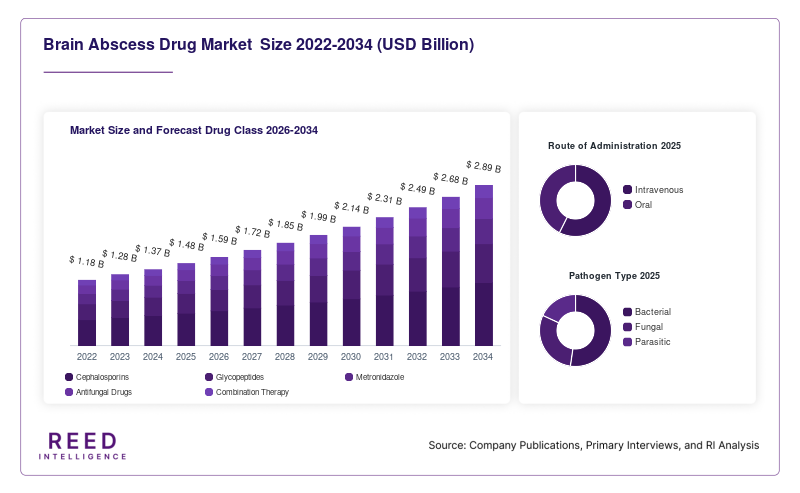
Cephalosporins dominated the Brain Abscess Drug Market in 2025 with 31.2% share, driven by their widespread use in first-line empiric treatment protocols. Their broad-spectrum activity and established hospital familiarity supported dominance.
Antifungal combination therapy will grow fastest at 10.1% CAGR through 2034 due to increasing fungal brain abscess incidence among immunocompromised patients. Rising invasive fungal infections will expand demand for dual-action antifungal regimens.
By Route of Administration
Intravenous drugs held the leading share of 72.8% in 2025 because severe brain abscess treatment requires immediate systemic therapeutic concentrations under inpatient monitoring.
Oral maintenance therapy will expand at 8.9% CAGR as step-down outpatient treatment models gain adoption. Transition-to-home recovery protocols will support greater use of extended oral regimens after acute stabilization.
By Pathogen Type
Bacterial infection therapies accounted for the largest share at 68.5% in 2025, reflecting the predominance of bacterial etiology in diagnosed cases worldwide.
Fungal infection therapies will grow fastest at 9.8% CAGR due to increasing opportunistic infections in transplant and oncology populations. Specialized antifungal prescribing is expected to rise with improved pathogen screening.
By Distribution Channel
Hospital pharmacies dominated with 74.3% share in 2025 because most treatment occurs in inpatient tertiary care settings under supervised intravenous protocols.
Specialty pharmacy channels will register fastest growth at 8.7% CAGR as outpatient infusion and long-term maintenance care models expand. Home-care antimicrobial dispensing networks will strengthen this segment.
By End User
Hospitals led the market with 69.9% share in 2025 owing to concentration of neurosurgical and infectious disease management capabilities in acute-care institutions.
Neurology specialty clinics will grow fastest at 8.4% CAGR as post-discharge follow-up and prolonged infection monitoring shift toward outpatient specialty centers with integrated imaging access.
Regional Analysis
North America
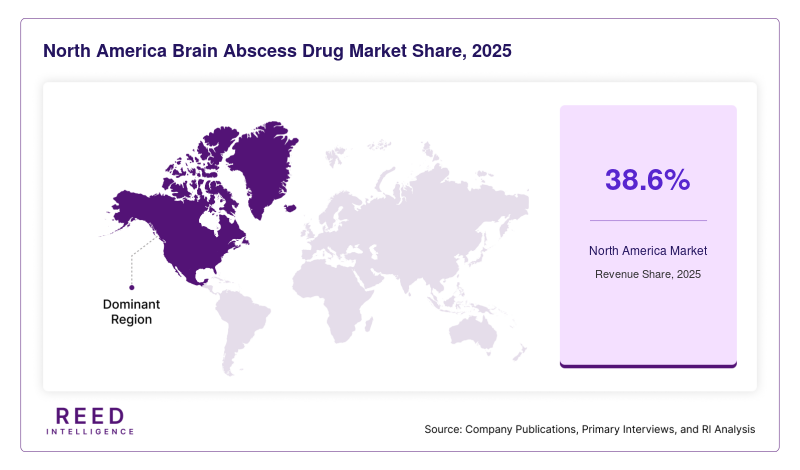
North America accounted for 38.6% of the Brain Abscess Drug Market in 2025 and will grow at a CAGR of 7.2% through 2034. The region benefited from strong infectious disease surveillance systems, high neurocritical care availability, and widespread access to intravenous antimicrobial therapies.
The United States remained the dominant country due to rapid integration of pathogen-specific susceptibility testing in tertiary hospitals. Expanded use of molecular microbiology panels has accelerated drug selection precision, reducing treatment delays and increasing demand for specialized CNS antibiotics.
Europe
Europe held 26.4% market share in 2025 and will expand at a CAGR of 7.0% during the forecast period. Regional growth was supported by centralized infectious disease reimbursement frameworks and high adoption of standardized treatment protocols.
Germany led the European market due to its advanced hospital antibiotic stewardship infrastructure. Strong collaboration between neurology departments and infectious disease specialists has improved early therapy initiation rates, increasing drug utilization consistency.
Asia Pacific
Asia Pacific represented 20.8% of the Brain Abscess Drug Market in 2025 and will record the fastest CAGR of 9.4% through 2034. Growth will be driven by rising CNS infection burden, expanding tertiary hospitals, and increasing antimicrobial procurement budgets.
China dominates the region due to rapid expansion of neurosurgical hospitals and growing investments in advanced diagnostic imaging. Increased government funding for infectious disease management is expected to strengthen market penetration in provincial healthcare systems.
Middle East & Africa
Middle East & Africa captured 7.1% share in 2025 and will grow at 8.1% CAGR through 2034. The region is benefiting from gradual improvements in acute neurological care infrastructure.
Saudi Arabia leads regional demand due to modernization of public hospital neurology units. Expanded insurance coverage for severe infectious disease hospitalization is improving access to advanced intravenous treatment regimens.
Latin America
Latin America accounted for 7.1% of the market in 2025 and will grow at 7.8% CAGR through 2034. Growth is supported by rising diagnosis rates in urban infectious disease centers and broader antimicrobial access.
Brazil dominated the region because of increased public investment in tertiary referral hospitals. National antimicrobial procurement reforms are improving availability of broad-spectrum CNS-targeted therapies across metropolitan treatment centers.
Competitive Landscape
The Brain Abscess Drug Market is moderately consolidated, with multinational pharmaceutical firms and specialty anti-infective manufacturers competing through product efficacy, CNS penetration profiles, and hospital partnerships. Leading companies are focusing on antimicrobial resistance 대응 strategies and new formulation approvals.
Pfizer Inc. remains the market leader due to its extensive hospital anti-infective portfolio and global distribution strength. In 2025, the company expanded a CNS-penetrating injectable antibiotic line for severe intracranial infections. Other major players include Merck & Co., GSK plc, Sanofi, and Baxter International, each strengthening their neuroinfectious treatment pipelines through formulation upgrades and regional licensing agreements.
Key Players List
- Pfizer Inc.
- Merck & Co., Inc.
- GSK plc
- Sanofi
- Baxter International Inc.
- Teva Pharmaceutical Industries Ltd.
- Cipla Ltd.
- Sun Pharmaceutical Industries Ltd.
- Novartis AG
- Fresenius Kabi AG
- Dr. Reddy’s Laboratories
- Viatris Inc.
- Aurobindo Pharma Ltd.
- Hikma Pharmaceuticals PLC
- Lupin Limited
Recent Developments
- Increasing research into nanoparticle-based antibiotic delivery systems targeting CNS infections.
- Expansion of hospital antimicrobial stewardship programs across North America and Europe.
- Rising clinical trials evaluating combination therapies for resistant brain abscess cases.
- Pharmaceutical companies expanding CNS infection portfolios through acquisitions and partnerships.
- Growing adoption of rapid molecular diagnostics enabling targeted therapy selection.
Brain Abscess Drug Market Segments
Drug Class
- Cephalosporins
- Glycopeptides
- Metronidazole
- Antifungal Drugs
- Combination Therapy
Route of Administration
- Intravenous
- Oral
Pathogen Type
- Bacterial
- Fungal
- Parasitic
Distribution Channel
- Hospital Pharmacies
- Retail Pharmacies
- Specialty Pharmacies
End User
- Hospitals
- Neurology Clinics
- Ambulatory Care Centers
By Region
- North America
- Europe
- APAC
- Middle East and Africa
- LATAM