Brain Tissue Oxygen Monitoring System Market Size, Share & Demand Report By Type (Invasive Monitoring Systems, Non-Invasive Monitoring Systems), By Application (Traumatic Brain Injury, Stroke, Subarachnoid Hemorrhage, Others), By End-Use (Hospitals, Ambulatory Surgical Centers, Specialty Clinics) & Segment Forecasts, 2025–2034
USD 3950
Market Overview
The Brain Tissue Oxygen Monitoring System Market size is witnessing steady expansion due to the rising burden of neurological disorders and the increasing demand for advanced neurocritical care technologies. In 2025, the global market size is estimated at USD 210 million, and it is projected to reach USD 225 million in 2026. By 2034, the market is forecasted to grow to approximately USD 410 million, registering a compound annual growth rate (CAGR) of 6.8% during 2025–2034.
Brain tissue oxygen monitoring systems are widely used in intensive care units (ICUs) to assess cerebral oxygenation in patients suffering from traumatic brain injuries (TBI), stroke, and other critical neurological conditions. The increasing incidence of road accidents and brain injuries across emerging economies is a major factor driving the adoption of these systems. Additionally, the growing geriatric population, which is more susceptible to neurological disorders, is further contributing to market growth.
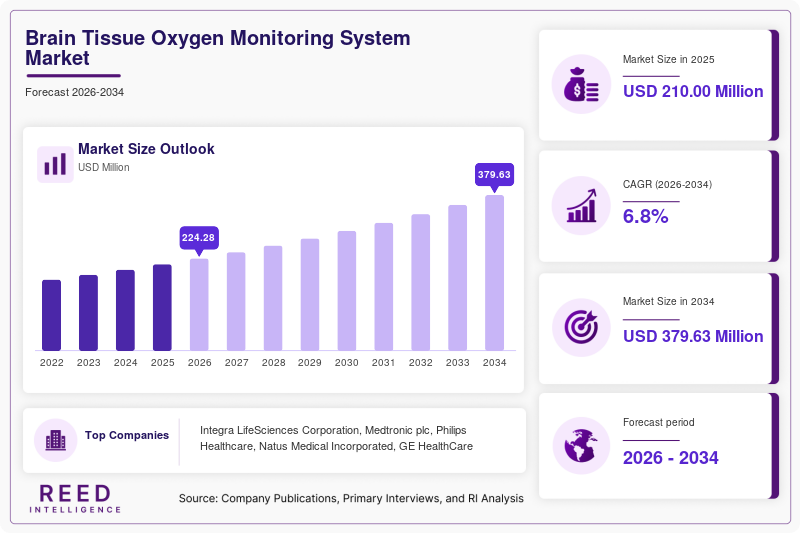
Key Highlights
- Market size projected to reach USD 410 million by 2034
- CAGR of 6.8% from 2025 to 2034
- Increasing prevalence of traumatic brain injuries and stroke
- Growing adoption of advanced neurocritical care technologies
- Rising healthcare investments in emerging economies
Market Trends
Integration of Multimodal Monitoring Systems
A prominent trend in the Brain Tissue Oxygen Monitoring System Market is the integration of brain oxygen monitoring with other neurological monitoring modalities such as intracranial pressure (ICP) and cerebral blood flow monitoring. Healthcare providers are increasingly adopting multimodal systems to obtain a comprehensive understanding of a patient’s neurological status. These integrated systems enable clinicians to make more informed decisions by correlating multiple physiological parameters in real time. This trend is particularly significant in advanced healthcare settings, where precision and rapid response are critical. Additionally, the integration improves workflow efficiency and reduces the need for multiple standalone devices, thereby optimizing ICU space and resources.
Shift Toward Minimally Invasive and Wireless Technologies
Another important trend is the growing preference for minimally invasive and wireless brain tissue oxygen monitoring systems. Manufacturers are focusing on developing compact, user-friendly devices that reduce patient discomfort and the risk of infection. Wireless technologies are gaining traction as they allow continuous monitoring without restricting patient mobility. These innovations are especially beneficial in long-term monitoring scenarios and post-operative care. Moreover, the incorporation of digital interfaces and remote monitoring capabilities is enabling healthcare providers to track patient data more efficiently. This trend aligns with the broader shift toward patient-centric care and technological modernization in healthcare systems.
Market Drivers
Rising Incidence of Traumatic Brain Injuries and Neurological Disorders
The increasing incidence of traumatic brain injuries (TBI) and neurological disorders is a primary driver of the Brain Tissue Oxygen Monitoring System Market. Road traffic accidents, falls, and sports-related injuries are leading causes of TBI globally. These conditions require continuous monitoring of brain oxygen levels to prevent secondary brain damage. Additionally, the growing prevalence of stroke and neurodegenerative diseases is increasing the demand for advanced monitoring solutions. Healthcare providers are emphasizing early diagnosis and intervention, which necessitates the use of reliable monitoring systems. This rising disease burden is expected to sustain long-term demand for brain tissue oxygen monitoring technologies.
Advancements in Critical Care Infrastructure and Technology
Technological advancements and the expansion of critical care infrastructure are significantly contributing to market growth. Hospitals are increasingly investing in advanced ICU equipment to improve patient outcomes and reduce mortality rates. Modern brain tissue oxygen monitoring systems offer enhanced accuracy, real-time data analysis, and seamless integration with electronic health records. These features are improving clinical decision-making and operational efficiency. Furthermore, government initiatives and private investments aimed at strengthening healthcare systems, particularly in emerging economies, are driving the adoption of advanced monitoring technologies. As healthcare facilities continue to modernize, the demand for sophisticated neuro-monitoring systems is expected to grow steadily.
Market Restraint
High Cost of Devices and Limited Accessibility
One of the key restraints in the Brain Tissue Oxygen Monitoring System Market is the high cost associated with these devices and their limited accessibility in low- and middle-income regions. Advanced monitoring systems require significant investment in terms of procurement, maintenance, and training of healthcare professionals. This cost barrier restricts adoption, especially in smaller hospitals and rural healthcare settings. Additionally, reimbursement challenges in certain healthcare systems further limit widespread usage. For example, hospitals in developing regions may prioritize essential medical equipment over specialized monitoring systems due to budget constraints. This results in uneven market penetration and slower growth in cost-sensitive regions. Moreover, the need for skilled personnel to operate these systems adds another layer of complexity, further hindering adoption in under-resourced healthcare facilities.
Market Opportunities
Expansion in Emerging Markets
Emerging economies present significant growth opportunities for the Brain Tissue Oxygen Monitoring System Market. Countries in Asia Pacific, Latin America, and the Middle East are investing heavily in healthcare infrastructure to address the growing burden of critical illnesses. Increasing government initiatives to improve emergency and trauma care are driving demand for advanced monitoring systems. Additionally, rising awareness about neurocritical care and improving access to healthcare services are supporting market expansion. Manufacturers are focusing on introducing cost-effective solutions tailored to these markets, which is expected to enhance adoption rates. The growing presence of private healthcare providers in these regions further contributes to market growth.
Development of Portable and Home-Based Monitoring Solutions
The development of portable and home-based brain tissue oxygen monitoring systems offers another promising opportunity. With the increasing emphasis on remote patient monitoring and telemedicine, there is a growing demand for devices that can be used outside hospital settings. Portable systems enable continuous monitoring for patients recovering from neurological conditions, reducing the need for prolonged hospital stays. This not only improves patient convenience but also reduces healthcare costs. Additionally, advancements in wearable technology and sensor miniaturization are enabling the development of innovative monitoring solutions. These developments are expected to open new avenues for market growth and expand the scope of applications.
Segmental Analysis
By Type
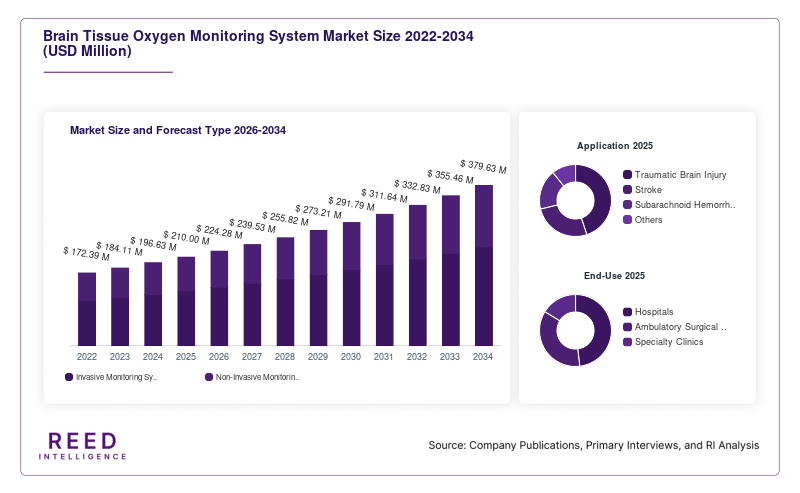
The invasive monitoring systems segment dominated the Brain Tissue Oxygen Monitoring System Market in 2024, accounting for approximately 65% of the market share. These systems are widely used in critical care settings due to their high accuracy and reliability. Invasive methods involve direct measurement of brain tissue oxygen levels, providing precise data that is essential for managing severe neurological conditions. Hospitals prefer these systems for patients with traumatic brain injuries and those undergoing neurosurgery. The strong clinical evidence supporting their effectiveness further contributes to their dominance in the market.
The non-invasive monitoring systems segment is expected to grow at the fastest CAGR of 7.5% during the forecast period. This growth is driven by the increasing demand for safer and more patient-friendly monitoring solutions. Non-invasive systems reduce the risk of infection and complications associated with invasive procedures. Additionally, advancements in sensor technology and imaging techniques are improving the accuracy of non-invasive methods. The growing focus on patient comfort and the rising adoption of wearable medical devices are also contributing to the rapid growth of this segment.
By Application
The traumatic brain injury (TBI) segment held the largest share of the market in 2024, accounting for around 48%. TBI is one of the leading causes of mortality and disability worldwide, necessitating continuous monitoring of brain oxygen levels. Brain tissue oxygen monitoring systems play a crucial role in managing TBI by helping clinicians detect hypoxia early and اتخاذ appropriate interventions. The high incidence of road accidents and sports injuries is driving the demand for these systems in TBI management.
The stroke segment is anticipated to grow at the highest CAGR of 7.2% during the forecast period. The increasing prevalence of stroke, particularly among the aging population, is a key factor driving this growth. Early detection and monitoring of cerebral oxygen levels are critical in stroke management to prevent further brain damage. Advances in diagnostic technologies and increased awareness about stroke management are further supporting the growth of this segment.
By End-Use
Hospitals dominated the market in 2024, accounting for approximately 70% of the total share. Hospitals are the primary users of brain tissue oxygen monitoring systems due to the availability of advanced infrastructure and skilled healthcare professionals. Intensive care units and neurosurgical departments rely heavily on these systems for patient monitoring. The increasing number of hospital admissions related to neurological conditions is further driving the demand in this segment.
Ambulatory surgical centers (ASCs) are expected to register the fastest CAGR of 7.0% during the forecast period. The growing trend toward outpatient surgeries and minimally invasive procedures is driving the adoption of monitoring systems in ASCs. These centers are increasingly equipped with advanced medical technologies to provide high-quality care. The cost-effectiveness and convenience offered by ASCs are attracting more patients, thereby boosting the demand for brain tissue oxygen monitoring systems in this segment.
Regional Analysis
North America
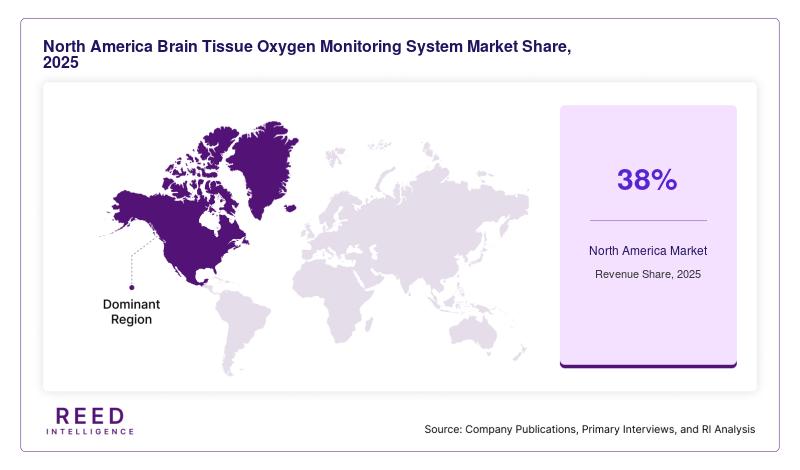
North America accounted for the largest share of the Brain Tissue Oxygen Monitoring System Market in 2025, with approximately 38% of the global market. The region is expected to maintain its dominance, growing at a CAGR of 6.2% during the forecast period. The presence of advanced healthcare infrastructure and high adoption of innovative medical technologies are key factors supporting market growth. Additionally, the increasing prevalence of neurological disorders and strong healthcare expenditure contribute to sustained demand.
The United States dominates the North American market due to its well-established healthcare system and high investment in research and development. A unique growth factor in this region is the widespread adoption of multimodal monitoring systems in intensive care units. Hospitals are increasingly integrating brain oxygen monitoring with other diagnostic tools to enhance patient outcomes, which is driving market expansion.
Europe
Europe held a significant market share of around 27% in 2025 and is projected to grow at a CAGR of 6.0% over the forecast period. The region benefits from a strong focus on healthcare quality and patient safety. Government initiatives aimed at improving critical care services and increasing funding for medical research are supporting market growth.
Germany leads the European market, driven by its advanced medical infrastructure and emphasis on technological innovation. A unique growth factor in Europe is the increasing adoption of standardized clinical protocols for neurocritical care. These protocols encourage the use of brain tissue oxygen monitoring systems, thereby boosting market demand across the region.
Asia Pacific
Asia Pacific is expected to witness the fastest growth, with a CAGR of 7.8% during the forecast period, and accounted for approximately 20% of the market in 2025. Rapid urbanization, increasing healthcare expenditure, and a growing patient population are key factors driving market growth in this region.
China dominates the Asia Pacific market due to its large population and expanding healthcare infrastructure. A unique growth factor is the increasing number of trauma cases resulting from road accidents and industrial injuries. This has led to a higher demand for advanced monitoring systems in emergency and critical care settings.
Middle East & Africa
The Middle East & Africa region accounted for around 8% of the market in 2025 and is projected to grow at a CAGR of 6.5%. The region is gradually adopting advanced medical technologies as healthcare systems continue to develop. Increasing government investments in healthcare infrastructure are supporting market growth.
Saudi Arabia leads the market in this region, driven by significant investments in healthcare modernization. A unique growth factor is the rising number of specialized hospitals and trauma centers equipped with advanced monitoring technologies. This is enhancing the adoption of brain tissue oxygen monitoring systems.
Latin America
Latin America held a market share of approximately 7% in 2025 and is expected to grow at a CAGR of 6.3%. The region is experiencing gradual improvements in healthcare infrastructure and increasing awareness of advanced medical technologies.
Brazil dominates the Latin American market due to its large healthcare sector and growing investments in critical care facilities. A unique growth factor is the expansion of private healthcare providers, which are increasingly adopting advanced monitoring systems to improve patient outcomes and attract a larger patient base.
Competitive Landscape
The Brain Tissue Oxygen Monitoring System Market is moderately consolidated, with a few key players holding a significant share. Companies are focusing on product innovation, strategic partnerships, and geographic expansion to strengthen their market position. Continuous investment in research and development is enabling manufacturers to introduce advanced and cost-effective solutions.
Integra LifeSciences is considered a leading player in the market due to its comprehensive product portfolio and strong global presence. The company has recently introduced enhanced monitoring systems with improved accuracy and integration capabilities. Other major players are also investing in technological advancements to stay competitive. The market is characterized by intense competition, with companies striving to differentiate their products through innovation and quality.
Key Players List
- Integra LifeSciences Corporation
- Medtronic plc
- Philips Healthcare
- Natus Medical Incorporated
- GE HealthCare
- Edwards Lifesciences Corporation
- Masimo Corporation
- Nonin Medical, Inc.
- Nihon Kohden Corporation
- Compumedics Limited
- NeuroWave Systems Inc.
- Spiegelberg GmbH & Co. KG
- Raumedic AG
- Sophysa SA
- Ornim Medical
Recent Developments
- In 2024, Integra LifeSciences launched an upgraded brain oxygen monitoring system with enhanced real-time analytics capabilities.
- In 2023, Medtronic introduced a minimally invasive monitoring solution aimed at improving patient safety and comfort.
- In 2024, Philips Healthcare expanded its neuro-monitoring product line with integrated multimodal monitoring features.
Brain Tissue Oxygen Monitoring System Market Segments
Type
- Invasive Monitoring Systems
- Non-Invasive Monitoring Systems
Application
- Traumatic Brain Injury
- Stroke
- Subarachnoid Hemorrhage
- Others
End-Use
- Hospitals
- Ambulatory Surgical Centers
- Specialty Clinics
By Region
- North America
- Europe
- APAC
- Middle East and Africa
- LATAM