Brand Licensing Market Size, Share & Trends Analysis Report By Property Type (Entertainment & Characters, Corporate Brands, Sports, Fashion, Publishing, Celebrity, Music & Art, Other Properties), By Product Category (Toys & Games, Apparel & Accessories, Home & Lifestyle, Food & Beverage, Publishing & Stationery, Software, Video Games & Apps, Other Products), By Distribution Channel (Mass Merchandisers & Department Stores, Specialty Retail, E-commerce & Social Commerce, Direct-to-Consumer & Exper
USD 3950
Brand Licensing Market Size
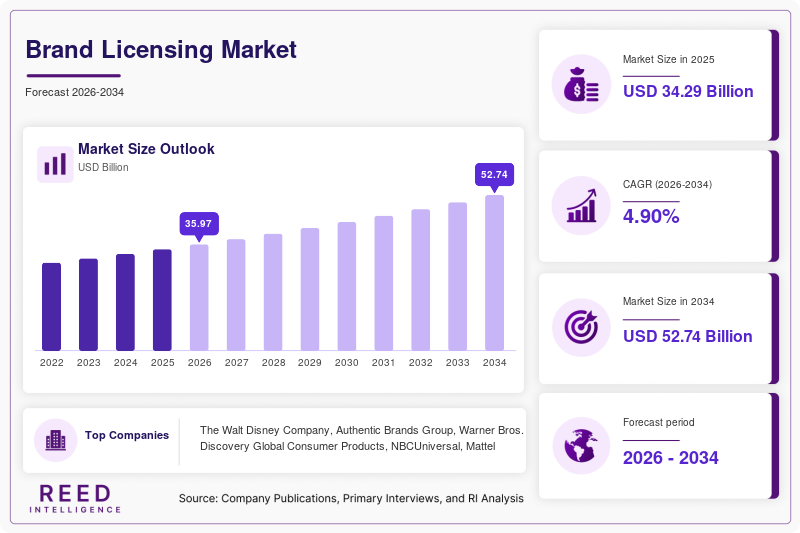
The global brand licensing market is valued at USD 34.29 Billion in 2025 and USD 35.97 Billion in 2026. The market is projected to reach USD 52.74 Billion by 2034, registering a 4.90% CAGR during the forecast period.
The brand licensing market comprises commercial arrangements under which a brand owner or other intellectual-property holder grants a third party the right to use protected intellectual property on products, services, experiences or commercial activities in exchange for agreed compensation, generally including royalties and contractual guarantees. Licensing International describes licensing as a brand-expansion mechanism connecting licensors and licensees across property types, product categories, territories and consumer demographics.
The market encompasses entertainment characters, corporate trademarks, sports properties, fashion brands, publishing properties, celebrity identities, music, art and collegiate properties. Licensing International's latest global study reported USD 389.8 Billion in retail sales of licensed merchandise and services in 2025, up 5.45% from 2024. The study covered 51 countries, seven major regions and licensing information from 1,068 companies, illustrating the scale and diversification of the global ecosystem.
Brand Licensing Market Drivers
Strong consumer attachment to entertainment, sports and recognizable brands continues to support licensed-product demand
Licensing converts existing brand awareness into additional consumer touchpoints. Licensing International's 2026 study found that licensed merchandise and services generated USD 389.8 Billion in retail sales during 2025, with entertainment/characters, sports and publishing among the strongest-growing property categories.
The economics become particularly attractive when an intellectual property already has an established fan base. Licensees can enter a category using recognized characters, logos, stories or visual identities rather than developing consumer awareness from scratch.
This is visible in recent partnerships such as Mattel and BBC Studios' Bluey agreement, which places Bluey characters across Barbie, Hot Wheels, Fisher-Price, Polly Pocket and UNO.
Licensing is expanding across digital commerce, social commerce and experiential channels
The traditional licensing model centered on physical retail, but the distribution environment is increasingly digital.
Licensing International's 2026 study found that online retail represented 32% of global licensed retail sales in 2025 and that 16% of online licensed sales were generated through social media platforms. This is expanding the ways in which licensed products can reach consumers and lowering the dependence on physical retail distribution.
The same digital shift is encouraging licensing of gaming, software, mobile applications and social-media properties. Licensing International reported software, video games and apps as its fastest-growing product category in 2025 at 12.5%.
At the physical end of the spectrum, brands are also moving into location-based entertainment. Outfit7's September 2026 agreement with IMG Licensing will develop Talking Tom & Friends opportunities across theme parks, live shows, family entertainment centers, restaurants, attractions and immersive experiences.
Licensors are increasingly monetizing one IP across multiple categories and geographies
Modern licensing strategies increasingly treat an intellectual property as a platform rather than a single product.
Disney's 2026 Licensing Expo strategy demonstrates this shift, connecting characters and stories with fashion, food, music, sports, wellness and experiences and working with licensees across more than 180 countries and over 100 product categories.
Authentic Brands Group provides another model. The company operates a portfolio of more than 50 brands with over 2,000 licensing partners across 150 countries and has continued expanding through regional operating partnerships, marketplace agreements and brand acquisitions.
This multi-territory approach can extend the commercial life of established IP while allowing local licensees to adapt products, pricing, distribution and marketing to regional demand.
Brand Licensing Market Restraints
Licensing programs require strict quality, brand-control and contractual governance
The value of a licensed property depends heavily on maintaining brand consistency. Licensing International notes that licensors generally provide style guidelines, approve products and packaging, support marketing and oversee licensee relationships, while licensees assume financial obligations and must meet agreed product and marketing standards.
As licensing programs expand across more product categories and territories, approval processes become more complicated. Delays can affect launch timing, seasonal merchandise, entertainment releases and retailer commitments.
Brand owners also face reputational exposure if a licensee's product, advertising or consumer experience fails to meet the standards associated with the underlying property.
Licensees face financial and demand risk when product performance does not match expectations
Licensees typically incur royalties, guarantees, advances, product-development expenditure and marketing costs before they know how consumers will respond.
Licensing International identifies financial risk as a central concern for licensees because a product can fail even when the underlying brand is well known.
The risk is amplified when a property has a short relevance window, such as a theatrical release or temporary cultural trend. Licensees must therefore synchronize production and distribution with entertainment calendars, fan demand, retail cycles and inventory requirements.
Brand Licensing Market Opportunities
AI, gaming and digital entertainment are creating new licensing categories
Gaming and AI-mediated consumer engagement are expanding the potential commercial life of intellectual property.
Licensing International reported 12.5% growth for software, video games and apps in 2025, while character and entertainment licensing growth was supported by anime and video-game properties.
This creates opportunities for licensors to move characters and brands into interactive games, downloadable content, digital collectibles, virtual experiences, social platforms and AI-enabled fan interactions.
The continued expansion of LEGO's gaming collaborations illustrates this convergence. In September 2026, LEGO revealed its first PlayStation set, based on the original PlayStation console and controller, with built-in references to Gran Turismo and Ape Escape.
Regional e-commerce partnerships can accelerate licensing penetration in emerging markets
Digital marketplaces allow licensors to enter new markets without building a wholly owned retail infrastructure.
Authentic Brands Group's May 2026 partnership with Mercado Libre provides an example. The collaboration launched Authentic's Reebok, Champion, Aéropostale, Nine West, Nautica and Dockers brands on Mercado Libre in Mexico and was designed to support localized brand expansion through marketplace, logistics, financial-services and advertising infrastructure.
The opportunity is particularly relevant to APAC, LATAM and other markets where local digital platforms can provide consumer access, fulfillment and marketing capabilities alongside international IP.
Property Type Analysis
Entertainment & Characters remains the dominant property type because franchises can extend across the widest set of consumer categories
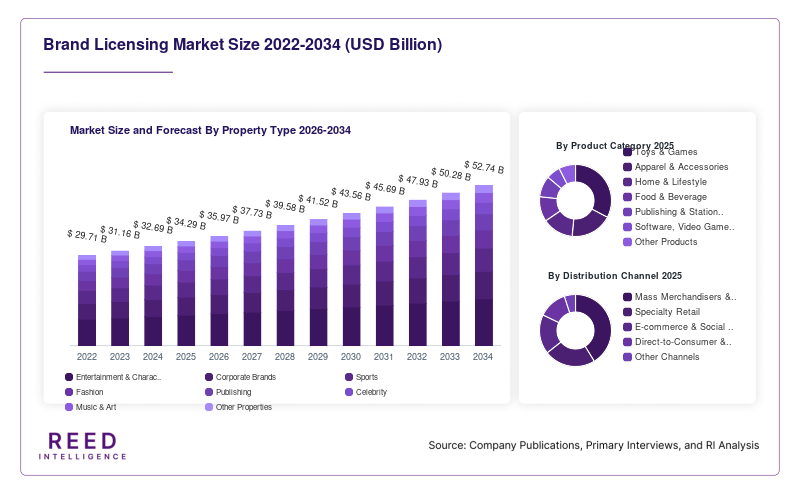
The Entertainment & Characters segment accounts for 42% of the global market in 2026 and is projected to register a 5.80% CAGR.
The segment includes film, television, streaming, animation, anime, video-game, social-media and character properties. Licensing International reported USD 161.8 Billion in 2025 licensed retail sales for the category and noted that anime, video games, comics and social-media properties together represented 34% of category licensing revenue.
Its strength comes from the ability of successful properties to support toys, apparel, publishing, food, home products, collectibles, games and experiences.
Sports is the fastest-growing major property type as fandom expands across apparel, collectibles and experiences
The Sports segment accounts for 12% of the global market in 2026 and is projected to register a 7.10% CAGR, making it the fastest-growing major property type.
Licensing International reported 8.5% growth for sports licensing in 2025, taking licensed retail sales to USD 44.4 Billion. The category's expansion is supported by professional leagues, teams, major events, collegiate sports and athlete-linked brands.
Product Category Analysis
Toys & Games remains the dominant licensed product category because characters, stories and sports identities translate naturally into play products
The Toys & Games segment accounts for 28% of the global market in 2026 and is projected to register a 4.60% CAGR.
Licensing International reported USD 46.4 Billion in licensed toy sales in 2025 and associated the category's continued performance partly with adult and “kidult” purchasing.
The category benefits from strong character recognition and the ability to convert film, television, gaming and sports fandom into physical play.
Software, Video Games & Apps is the fastest-growing major product category as licensing moves deeper into digital entertainment
The Software, Video Games & Apps segment accounts for 16% of the global market in 2026 and is projected to register a 9.20% CAGR, making it the fastest-growing major product category.
Licensing International reported 12.5% growth for this product category in 2025, making it the fastest-growing product category in its global study. Gaming also creates opportunities for ongoing monetization through downloadable content, character skins, digital collectibles, mobile applications and cross-media experiences.
Apparel & Accessories remains a core licensing category because brands can be translated quickly into visible lifestyle products
The segment is projected to register a 4.80% CAGR.
Licensed apparel encompasses sports jerseys, character clothing, fashion collaborations, footwear, bags, headwear and accessories.
The category benefits from both entertainment and sports licensing and can support premium limited editions, seasonal capsules and designer collaborations.
Distribution Channel Analysis
Mass Merchandisers & Department Stores remain the dominant channel because large retailers provide global scale and broad consumer reach
The Mass Merchandisers & Department Stores segment accounts for 34% of the global market in 2026 and is projected to register a 4.30% CAGR.
Large retailers remain important because they can support high-volume launches linked to entertainment releases, seasonal events, sports seasons and major cultural moments.
The channel is particularly important for toys, apparel, home products and consumer packaged goods.
E-commerce & Social Commerce is the fastest-growing major distribution channel as digital discovery and direct purchasing converge
The E-commerce & Social Commerce segment accounts for 31% of the global market in 2026 and is projected to register a 7.20% CAGR, making it the fastest-growing major distribution channel.
Licensing International reported that online retail represented 32% of global licensed retail sales in 2025 and that 16% of online licensed sales came through social commerce. Authentic's Mercado Libre partnership demonstrates how licensors and brand owners are using regional marketplaces to expand product availability while combining digital storefronts with local fulfillment, advertising and payments infrastructure.
Brand Licensing Market Regional Analysis
North America Brand Licensing Market
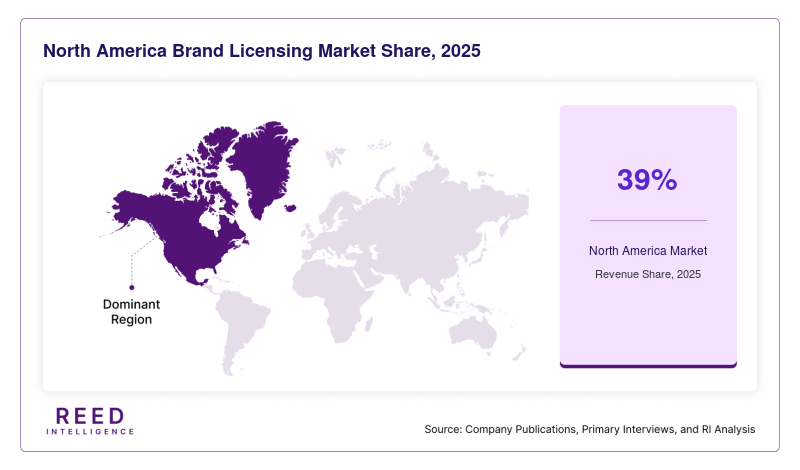
North America remains the dominant regional market because of its mature licensing ecosystem, concentration of global licensors and licensees, high consumer awareness of entertainment and sports properties, and strong retail and e-commerce infrastructure.
The North America region accounts for 39% of the global market in 2026 and is projected to register a 4.50% CAGR.
The United States and Canada were responsible for 59% of worldwide licensed-goods consumption in Licensing International's 2023 study, equivalent to USD 210.3 Billion in licensed merchandise and services.
The region also remains an innovation center for multi-category programs, with Disney, Mattel, Hasbro, Warner Bros. Discovery, Authentic Brands Group and numerous specialist agencies developing global licensing portfolios.
APAC Brand Licensing Market
APAC is the fastest-growing regional market as anime, gaming, consumer electronics, e-commerce, sports fandom and locally developed entertainment properties expand licensing opportunities.
The APAC region accounts for 27% of the global market in 2026 and is projected to register a 6.20% CAGR, making it the fastest-growing regional market.
Licensing International reported that North Asia was the fastest-growing geographic region in its 2025 study, increasing 14.1% as Japan, South Korea and China benefited from growth in box office, video games and anime streaming content. South Asia/PAC also grew 5.3%.
Recent activity illustrates the region's increasing strategic importance. Authentic is building localized marketplace and operating-partner networks, while LEGO and Pokémon continue expanding product collaborations across Asian markets.
Europe Brand Licensing Market
Europe is projected to register a 4.80% CAGR, supported by established entertainment, sports, fashion and publishing properties and strong specialty retail and e-commerce infrastructure.
Licensing International reported European licensed consumer-product sales of USD 79.3 Billion in 2024, representing 3.4% growth, with both Western and Eastern Europe contributing.
The region also has a mature network of licensing agencies and retailers, making it important for multi-territory launches and localized category extensions.
Middle East and Africa Brand Licensing Market
The Middle East and Africa market is projected to register a 5.50% CAGR, supported by expanding retail infrastructure, entertainment investment, tourism, sports, hospitality and premium consumer markets.
The region is also gaining importance for location-based entertainment and lifestyle licensing. Saudi Arabia's Vision 2030 development agenda has helped increase attention from licensors, licensees and licensing organizations, with Licensing International supporting the region through dedicated industry initiatives.
LATAM Brand Licensing Market
LATAM is projected to register a 6.00% CAGR, supported by expanding e-commerce, sports fandom, entertainment consumption and increasing adoption of international lifestyle brands.
Licensing International identified LATAM as one of the faster-growing geographic markets in its 2025 study, with licensed merchandise and services increasing 7.6%.
Authentic Brands Group's May 2026 partnership with Mercado Libre provides a current example of international brands building localized digital distribution in Mexico.
Brand Licensing Market Competitive Landscape
The brand licensing market is characterized by competition among global entertainment companies, sports organizations, corporate brand owners, fashion houses, toy companies, licensing agencies and intellectual-property management platforms.
The Walt Disney Company operates one of the industry's most extensive consumer-products and licensing businesses. Disney Consumer Products stated in 2026 that its licensing operation spans more than 100 product categories and over 180 countries and is increasingly organized around lifestyle pillars including fashion, food, music, wellness, sports and entertainment.
Authentic Brands Group uses an asset-light brand-development and licensing model. Its portfolio includes more than 50 brands, and the company works with more than 2,000 licensing partners across 150 countries. Its 2026 strategy includes acquisitions, regional operating partnerships, marketplace expansion and digital commerce.
Key Market Players
- The Walt Disney Company
- Authentic Brands Group
- Warner Bros. Discovery Global Consumer Products
- NBCUniversal
- Mattel
- Hasbro
- The Pokémon Company International
- LEGO Group
- Sanrio
- Paramount Global
- Sony Pictures Entertainment
- Moonbug Entertainment
- Peanuts Worldwide
- Spin Master
- WildBrain
- IMG Licensing
- CAA Brand Management
- Beanstalk
- Global Icons
- JAKKS Pacific
Recent Developments
September 2026 – Mattel and BBC Studios entered a multi-year global licensing partnership for Bluey. The agreement brings Bluey into five Mattel franchises—Barbie, Hot Wheels, Fisher-Price, Polly Pocket and UNO—with products spanning figures, playsets, dolls, vehicles and games beginning in fall 2026.
September 2026 – LEGO revealed its first-ever LEGO PlayStation set. The 1,911-piece product recreates the original PlayStation console and controller and includes buildable references to Gran Turismo and Ape Escape. LEGO Insiders access begins October 1, 2026, followed by broader availability October 4.
Brand Licensing Market Segments
By Property Type
- Entertainment & Characters
- Corporate Brands
- Sports
- Fashion
- Publishing
- Celebrity
- Music & Art
- Other Properties
By Product Category
- Toys & Games
- Apparel & Accessories
- Home & Lifestyle
- Food & Beverage
- Publishing & Stationery
- Software, Video Games & Apps
- Other Products
By Distribution Channel
- Mass Merchandisers & Department Stores
- Specialty Retail
- E-commerce & Social Commerce
- Direct-to-Consumer & Experiential
- Other Channels
By Region
- North America
- Europe
- APAC
- Middle East and Africa
- LATAM