Breast Cancer Core Needle Biopsy Market Size, Share & Demand Report By Type (Image-Guided Core Needle Biopsy, Vacuum-Assisted Biopsy), By Product (Biopsy Needles, Guidance Systems, Accessories), By Guidance Technique (Ultrasound-Guided, Stereotactic-Guided, MRI-Guided), By End-Use (Hospitals, Diagnostic Centers, Ambulatory Surgical Centers), By Region & Segment Forecasts, 2025–2034
USD 3950
Market Overview
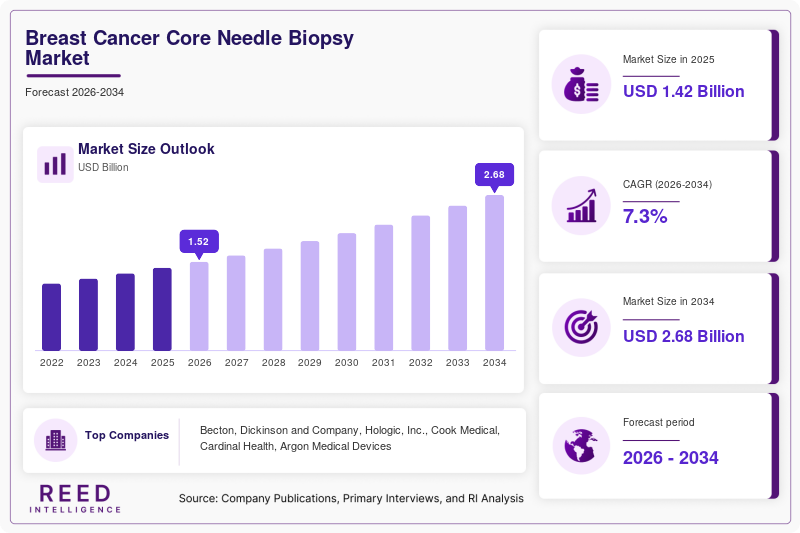
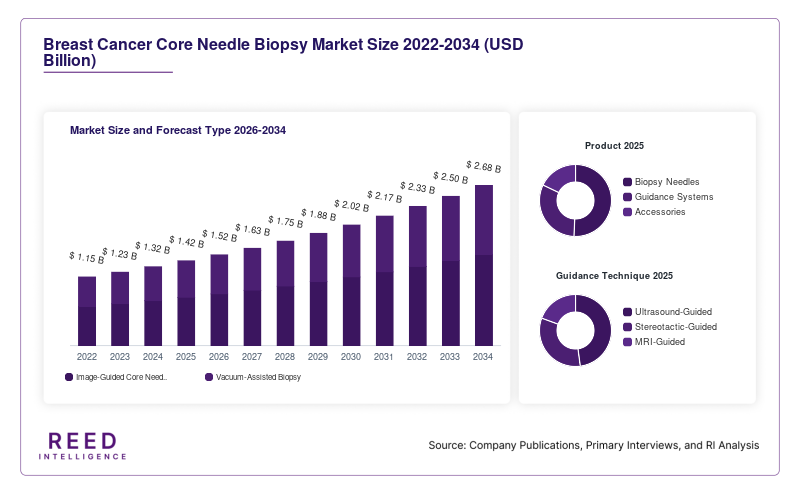
The global Breast Cancer Core Needle Biopsy Market size was valued at approximately USD 1.42 billion in 2025 and is projected to reach USD 2.68 billion by 2034, expanding at a CAGR of 7.3% during the forecast period (2025–2034). The market has experienced steady expansion due to the growing emphasis on early cancer detection and minimally invasive diagnostic techniques. Core needle biopsy has become a preferred diagnostic method because it offers higher accuracy compared to fine needle aspiration while avoiding the invasiveness of surgical biopsies.
A key global factor supporting market growth is the increasing adoption of structured breast cancer screening programs across developed and emerging economies. Governments and healthcare organizations are promoting early diagnosis to reduce mortality rates, which has significantly increased the demand for efficient biopsy techniques.
Key Highlights
- North America dominated the market with a 38.6% share in 2025, while Asia Pacific is projected to register the fastest growth at a CAGR of 9.1%.
- Image-guided biopsy procedures led the segment with 62.4% share, while vacuum-assisted biopsy is expected to grow fastest at a CAGR of 8.5%.
- Hospitals accounted for the largest end-use segment with 54.2% share, while ambulatory surgical centers are projected to grow at a CAGR of 8.8%.
- The United States remained the dominant country, with market values of USD 510 million in 2025 and USD 545 million in 2026.
Market Trends
Increasing Adoption of Image-Guided Biopsy Procedures
The Breast Cancer Core Needle Biopsy Market is witnessing a strong shift toward image-guided biopsy procedures, particularly ultrasound and stereotactic-guided techniques. These methods provide enhanced accuracy, enabling clinicians to target suspicious lesions more precisely. The growing integration of advanced imaging technologies with biopsy systems is improving diagnostic confidence and reducing repeat procedures. This trend is further supported by healthcare providers aiming to streamline diagnostic workflows and improve patient outcomes.
Rising Preference for Minimally Invasive Diagnostic Techniques
Patients and healthcare providers are increasingly favoring minimally invasive procedures over traditional surgical biopsies. Core needle biopsy offers reduced recovery time, minimal scarring, and lower procedural costs. As healthcare systems focus on cost efficiency and patient-centric care, this trend is expected to intensify. The growing availability of outpatient diagnostic services is also contributing to the increased adoption of these procedures across both developed and emerging markets.
Market Drivers
Growing Prevalence of Breast Cancer Globally
The rising incidence of breast cancer is a primary driver of the Breast Cancer Core Needle Biopsy Market. Increasing lifestyle changes, aging populations, and genetic predispositions have contributed to a higher number of breast cancer cases worldwide. As early diagnosis remains critical for effective treatment, the demand for reliable biopsy techniques continues to rise. Core needle biopsy plays a vital role in confirming diagnoses, thereby driving its widespread adoption.
Expansion of Diagnostic Healthcare Infrastructure
The continuous expansion of healthcare infrastructure, particularly in emerging economies, is significantly contributing to market growth. Governments and private organizations are investing in advanced diagnostic facilities to improve healthcare accessibility. The establishment of specialized cancer diagnostic centers and the integration of advanced biopsy technologies into hospitals have increased the availability of core needle biopsy procedures, supporting market expansion.
Market Restraint
Risk of Procedural Complications and Diagnostic Limitations
Despite its advantages, the Breast Cancer Core Needle Biopsy Market faces challenges related to procedural risks and limitations. Complications such as bleeding, infection, and sampling errors can impact diagnostic accuracy and patient outcomes. In certain cases, insufficient tissue samples may require repeat procedures or additional surgical biopsies, increasing patient discomfort and healthcare costs.
Additionally, variability in practitioner expertise and lack of standardized protocols in some regions can lead to inconsistent results. These factors may reduce patient confidence and limit the adoption of core needle biopsy in certain healthcare settings. Addressing these challenges through improved training, standardized procedures, and technological enhancements remains crucial for sustained market growth.
Market Opportunities
Integration of Artificial Intelligence in Diagnostic Imaging
The integration of artificial intelligence (AI) with imaging systems presents a significant opportunity for the Breast Cancer Core Needle Biopsy Market. AI algorithms can assist in identifying suspicious lesions, improving targeting accuracy during biopsy procedures. This advancement has the potential to reduce diagnostic errors and enhance clinical decision-making, making biopsy procedures more efficient and reliable.
Growth in Emerging Markets
Emerging economies offer substantial growth opportunities due to increasing healthcare investments and rising awareness about early cancer detection. Countries in Asia Pacific, Latin America, and the Middle East are witnessing improvements in healthcare infrastructure and diagnostic capabilities. The expansion of private healthcare providers and government initiatives aimed at cancer screening are expected to drive demand for core needle biopsy procedures in these regions.
Segmental Analysis
By Type
Image-guided core needle biopsy dominated the Breast Cancer Core Needle Biopsy Market, accounting for 62.4% of the market share in 2025. This dominance was attributed to its superior accuracy and ability to precisely target suspicious lesions. The increasing use of ultrasound and stereotactic guidance has enhanced diagnostic efficiency, making image-guided procedures the preferred choice among healthcare providers.
Vacuum-assisted biopsy is expected to be the fastest-growing subsegment, projected to expand at a CAGR of 8.5%. This growth will be driven by its ability to collect larger tissue samples, reducing the need for repeat procedures. The technology’s effectiveness in diagnosing complex cases will further support its adoption.
By Product
Biopsy needles held the largest share, accounting for 48.7% in 2025, due to their essential role in core needle biopsy procedures. The demand for high-quality, precision-engineered needles has increased as healthcare providers aim to improve diagnostic outcomes.
Biopsy guidance systems are anticipated to grow at the fastest rate, with a CAGR of 8.9%. The increasing integration of advanced imaging technologies with guidance systems will enhance procedural accuracy and efficiency, driving segment growth.
By End-Use
Hospitals dominated the market with a 54.2% share in 2025, supported by their comprehensive diagnostic capabilities and access to advanced medical technologies. The presence of skilled professionals and integrated healthcare services has made hospitals the primary setting for biopsy procedures.
Ambulatory surgical centers are expected to grow at a CAGR of 8.8%, driven by the increasing preference for outpatient procedures. These centers offer cost-effective and convenient diagnostic services, making them an attractive option for patients.
By Guidance Technique
Ultrasound-guided biopsy emerged as the dominant subsegment, accounting for 46.5% of the market share in 2025. Its real-time imaging capabilities and non-invasive nature have made it widely adopted in clinical practice.
MRI-guided biopsy is projected to grow at the fastest rate, with a CAGR of 9.3%. The increasing use of MRI for detecting complex lesions and improving diagnostic accuracy will drive its adoption in the coming years.
Regional Analysis
North America
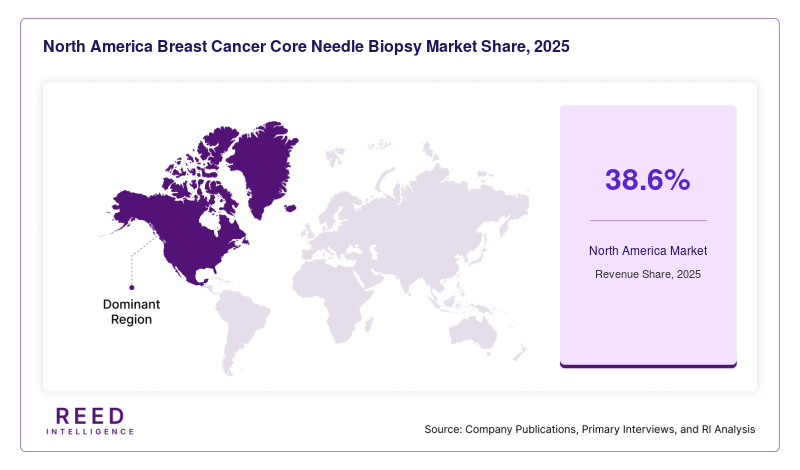
North America accounted for 38.6% of the Breast Cancer Core Needle Biopsy Market share in 2025 and is expected to grow at a CAGR of 6.8% during the forecast period. The region benefited from advanced healthcare infrastructure, widespread screening programs, and high awareness levels regarding early cancer detection. Favorable reimbursement policies and the availability of skilled healthcare professionals further supported market growth.
The United States dominated the regional market due to its strong focus on preventive healthcare and early diagnosis. The presence of well-established diagnostic centers and continuous adoption of advanced biopsy technologies contributed significantly to market expansion. Additionally, ongoing research initiatives aimed at improving diagnostic accuracy have reinforced the country’s leadership position.
Europe
Europe held a 27.4% share of the Breast Cancer Core Needle Biopsy Market in 2025 and is projected to grow at a CAGR of 6.5%. The region experienced steady growth due to organized screening programs and government support for cancer diagnosis and treatment. Countries such as Germany, France, and the UK have implemented national screening initiatives that have increased the demand for biopsy procedures.
Germany emerged as the dominant country in the region, driven by its advanced healthcare system and strong emphasis on early detection. The country’s investment in diagnostic technologies and the presence of skilled professionals have contributed to its market growth.
Asia Pacific
Asia Pacific represented 21.8% of the market share in 2025 and is expected to register the fastest growth with a CAGR of 9.1%. The region’s growth is driven by increasing healthcare expenditure, rising awareness about breast cancer, and expanding diagnostic infrastructure.
China led the regional market due to its large population base and growing focus on healthcare development. Government initiatives to promote cancer screening and the rapid expansion of diagnostic facilities have significantly contributed to market growth in the country.
Middle East & Africa
The Middle East & Africa accounted for 6.2% of the market share in 2025 and is projected to grow at a CAGR of 7.0%. The region has experienced gradual growth due to improving healthcare infrastructure and increasing awareness about cancer diagnosis.
Saudi Arabia emerged as the dominant country in this region, supported by government investments in healthcare modernization. The establishment of specialized diagnostic centers and the adoption of advanced medical technologies have driven market growth.
Latin America
Latin America held 6.0% of the Breast Cancer Core Needle Biopsy Market share in 2025 and is expected to grow at a CAGR of 7.2%. The region’s growth has been supported by improving healthcare access and increasing awareness of breast cancer screening.
Brazil dominated the regional market due to its expanding healthcare system and growing adoption of advanced diagnostic procedures. Government initiatives to improve cancer detection and the presence of private healthcare providers have contributed to market development.
Competitive Landscape
The Breast Cancer Core Needle Biopsy Market is moderately competitive, with several established players focusing on product innovation and strategic collaborations. Leading companies are investing in advanced biopsy technologies and expanding their global presence to strengthen their market positions.
BD (Becton, Dickinson and Company) is a key market leader, known for its comprehensive portfolio of biopsy products. The company recently introduced advanced biopsy systems designed to enhance procedural accuracy and efficiency, reinforcing its leadership position.
Other prominent players are actively engaged in product development and partnerships to expand their market reach. The competitive landscape is characterized by continuous innovation and the introduction of technologically advanced solutions aimed at improving diagnostic outcomes.
Key Players List
- Becton, Dickinson and Company
- Hologic, Inc.
- Cook Medical
- Cardinal Health
- Argon Medical Devices
- Devicor Medical Products
- Olympus Corporation
- Medtronic plc
- Boston Scientific Corporation
- Siemens Healthineers
- GE HealthCare
- Fujifilm Holdings Corporation
- Leica Biosystems
- Danaher Corporation
- Merit Medical Systems
Recent Developments
- In 2024, a leading medical device company launched an advanced vacuum-assisted biopsy system to improve tissue sampling accuracy.
- In 2023, several companies expanded their product portfolios with AI-integrated imaging solutions for biopsy guidance.
- In 2024, strategic collaborations between diagnostic centers and technology providers increased access to advanced biopsy procedures.
Breast Cancer Core Needle Biopsy Market Segments
Type
- Image-Guided Core Needle Biopsy
- Vacuum-Assisted Biopsy
Product
- Biopsy Needles
- Guidance Systems
- Accessories
Guidance Technique
- Ultrasound-Guided
- Stereotactic-Guided
- MRI-Guided
End-Use
- Hospitals
- Diagnostic Centers
- Ambulatory Surgical Centers
By Region
- North America
- Europe
- APAC
- Middle East and Africa
- LATAM