Breast Prosthesis Market Size, Share, Demand Report By Product Type (Silicone Breast Prostheses, Foam Breast Prostheses, Gel Breast Prostheses, Customized 3D Printed Prostheses), By Distribution Channel (Retail Pharmacies, Hospital Pharmacies,Specialty Stores), By End User (Hospitals & Oncology Centers, Homecare Settings, Rehabilitation Clinics), By Region & Segment Forecasts, 2026–2034
USD 3950
Market Overview
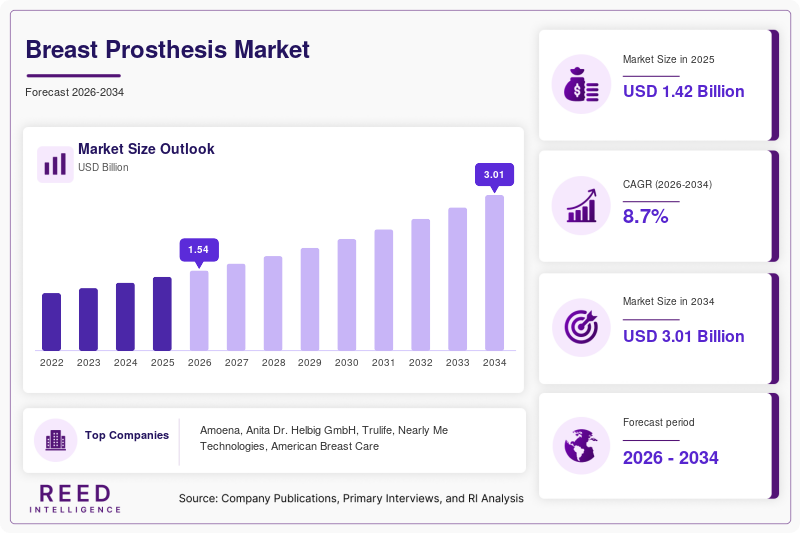
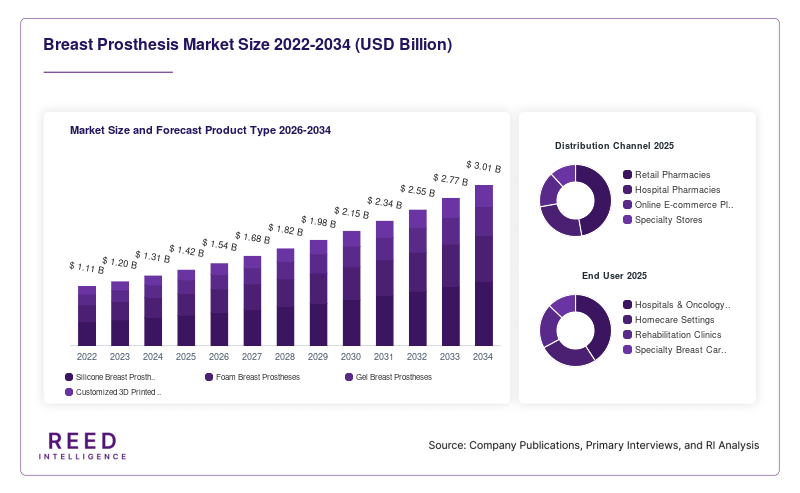
The Breast Prosthesis Market market is projected to be valued at USD 1.42 billion in 2026 and is anticipated to reach USD 2.78 billion by 2034, expanding at a CAGR of 8.7% during the forecast period (2026–2034). Growth in the market is primarily supported by the increasing global incidence of breast cancer and the rising number of mastectomy procedures performed annually. Additionally, improved awareness regarding post-surgical breast reconstruction options has encouraged more patients to adopt external prosthetic solutions as part of physical and emotional rehabilitation. Technological improvements in silicone-based prostheses, lightweight materials, and customized fittings have further strengthened adoption across both developed and emerging economies.
A key global factor supporting market expansion is the growing emphasis on post-cancer quality-of-life improvement programs led by healthcare institutions and non-profit organizations. These initiatives are increasing accessibility to breast prosthetic products, especially in regions where reconstructive surgery is less affordable or less commonly adopted.
Key Highlights
- North America dominated the market with a 34.6% share in 2025.
- Asia Pacific is expected to grow at the fastest CAGR of 9.8% during 2026–2034.
- By product type, silicone breast prostheses accounted for the largest share of 62.1%, while lightweight foam prostheses are projected to grow at a CAGR of 10.4%.
- By distribution channel, retail pharmacies led with a 45.3% share, whereas online channels are expected to expand at a CAGR of 11.6%.
- The United States remained the dominant country, with market values of USD 420 million in 2024 and USD 455 million in 2025.
Market Trends
Rising Adoption of Custom-Fitted Prosthetic Solutions
The Breast Prosthesis Market is witnessing a growing shift toward custom-fitted and patient-specific prosthetic solutions designed to improve comfort and aesthetics. Manufacturers are increasingly offering personalized sizing options based on body scans and advanced measurement technologies. This trend is particularly relevant among post-mastectomy patients seeking natural symmetry and improved confidence in daily wear. The integration of 3D scanning technologies in prosthesis design has further enhanced product accuracy, reducing discomfort and skin-related complications. Healthcare providers are also collaborating with manufacturers to ensure better fitting solutions, especially in oncology rehabilitation centers.
Increasing Preference for Lightweight and Breathable Materials
Another significant trend shaping the market is the rising demand for lightweight, hypoallergenic, and breathable prosthetic materials. Traditional heavy silicone designs are being replaced with gel-based and foam-filled alternatives that offer enhanced mobility and reduced heat retention. This shift is driven by younger patient demographics and active lifestyle requirements. Manufacturers are investing in advanced polymer research to develop products that replicate natural breast movement while ensuring long-term durability. The growing awareness of skin sensitivity issues post-surgery is also encouraging the use of medical-grade, skin-friendly materials in prosthesis production.
Market Drivers
Rising Incidence of Breast Cancer and Mastectomy Procedures
The increasing global burden of breast cancer remains one of the strongest drivers of the Breast Prosthesis Market. A significant proportion of patients undergoing mastectomy opt for external breast prostheses as a non-invasive reconstruction alternative. This demand is particularly strong in regions where surgical reconstruction is either financially inaccessible or medically unsuitable. Government-led screening programs and early diagnosis initiatives are also contributing to higher survival rates, subsequently increasing the population of prosthesis users. Additionally, healthcare systems are integrating prosthetic solutions into post-treatment care pathways, further supporting market expansion.
Growing Awareness of Post-Surgical Rehabilitation and Aesthetic Recovery
Awareness regarding post-mastectomy rehabilitation has improved significantly over the past decade, driven by patient advocacy groups and healthcare campaigns. Breast prostheses are increasingly recognized as essential tools for psychological recovery and body image restoration. Insurance coverage expansion in several developed economies has also made prosthetic devices more accessible. Furthermore, oncology clinics are actively educating patients about available external reconstruction options, thereby increasing adoption rates. This growing focus on holistic cancer care is expected to continue driving market demand globally.
Market Restraint
High Cost of Advanced Prosthetic Products and Limited Reimbursement in Emerging Regions
One of the key restraints in the Breast Prosthesis Market is the relatively high cost of advanced silicone-based and custom-fitted prosthetic products. While developed countries often provide partial insurance coverage, many emerging economies lack structured reimbursement frameworks. This creates affordability challenges for a large patient base, limiting market penetration. Additionally, premium prostheses with advanced ergonomic designs and skin-friendly coatings are often priced beyond the reach of average consumers. The absence of standardized healthcare funding policies in several developing regions further restricts adoption, particularly among rural populations with limited access to oncology rehabilitation services.
Market Opportunities
Expansion of E-Commerce and Direct-to-Consumer Distribution Channels
The rapid growth of e-commerce platforms presents a major opportunity for the Breast Prosthesis Market. Online retail channels enable discreet purchasing, which is a significant consideration for many patients. Digital platforms also provide access to a wider variety of products, including international brands and customized prosthetic solutions. Subscription-based fitting services and virtual consultation tools are further enhancing consumer convenience. Manufacturers are increasingly investing in direct-to-consumer strategies to reduce distribution costs and improve market reach, particularly in underserved regions.
Technological Advancements in 3D Printing and Prosthetic Customization
The adoption of 3D printing technology is creating new opportunities for innovation in prosthetic design and manufacturing. This technology allows for precise customization based on patient anatomy, improving comfort and aesthetic outcomes. It also reduces production time and material waste, making prosthetic solutions more cost-effective in the long term. Research institutions and medical device companies are collaborating to develop next-generation prostheses with enhanced flexibility and lifelike texture. As accessibility to 3D printing improves globally, this technology is expected to significantly reshape the competitive landscape.
Segmental Analysis
Product Type Segment
Silicone breast prostheses dominated the market with a 62.1% share in 2024, driven by their natural appearance, durability, and widespread availability. These products are preferred in both clinical and retail settings due to their realistic texture and long-term usability. Hospitals and specialty clinics often recommend silicone-based solutions for post-mastectomy patients requiring stable external reconstruction.
Lightweight foam prostheses are expected to register the fastest CAGR of 10.4%, supported by increasing demand for comfort-oriented and active-lifestyle-compatible products. These prostheses are particularly favored among younger patients and those in hot climates due to their breathability and reduced weight.
Distribution Channel Segment
Retail pharmacies accounted for a 45.3% share in 2024, benefiting from strong hospital referral systems and immediate product availability. Patients often rely on pharmacy-based fitting services for initial prosthesis selection following surgery.
Online distribution channels are projected to grow at a CAGR of 11.6%, driven by increasing digital healthcare adoption and discreet purchasing preferences. E-commerce platforms offer wider product variety and virtual fitting consultations, improving accessibility in remote areas.
End-User Segment
Hospitals and oncology centers held a 48.7% share in 2024, as they serve as the primary point of care for mastectomy patients. These institutions play a critical role in recommending and fitting prosthetic solutions during post-operative recovery.
Homecare settings are expected to grow at a CAGR of 9.9%, supported by rising preference for self-managed rehabilitation and improved availability of user-friendly prosthetic products designed for independent use.
Regional Analysis
North America
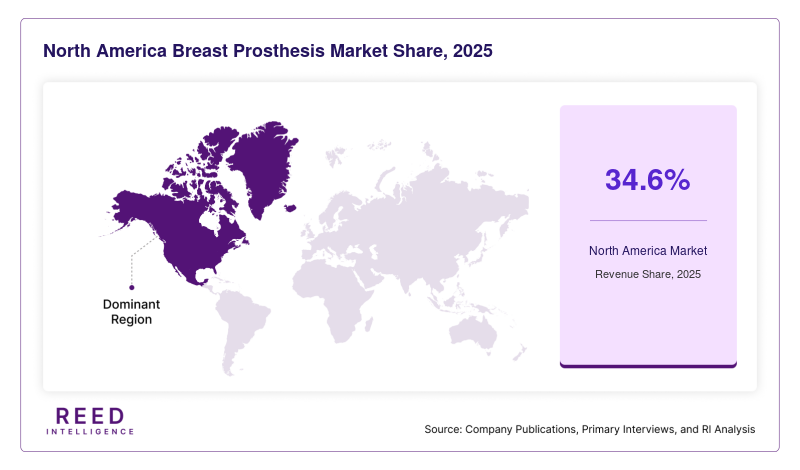
North America accounted for approximately 34.6% of the global Breast Prosthesis Market in 2025, and is projected to grow at a CAGR of 8.1% from 2026 to 2034. The region benefits from advanced healthcare infrastructure and strong insurance coverage policies that support post-mastectomy care.
The United States is the dominant country in this region, driven by a high prevalence of breast cancer and strong adoption of advanced prosthetic technologies. Increased awareness campaigns and availability of specialized oncology rehabilitation centers further strengthen regional demand.
Europe
Europe held around 27.3% market share in 2025, with a forecast CAGR of 7.9% through 2034. Strong public healthcare systems and widespread cancer screening programs contribute to steady demand.
Germany leads the European market due to its advanced medical device industry and high patient awareness. Government-funded breast cancer rehabilitation initiatives significantly enhance prosthesis adoption rates across hospitals and clinics.
Asia Pacific
Asia Pacific captured 21.8% market share in 2025 and is expected to grow at the fastest CAGR of 9.8%. Rising healthcare investments and increasing cancer diagnosis rates are key growth drivers.
China is the dominant country, supported by expanding healthcare infrastructure and growing awareness of breast cancer recovery options. Increasing urbanization and medical tourism are also contributing to demand growth.
Middle East & Africa
The region accounted for 8.4% market share in 2025, with a CAGR of 7.5% expected through 2034. Limited healthcare accessibility remains a challenge, but gradual improvements are supporting market expansion.
South Africa leads the region due to relatively better oncology care facilities and awareness initiatives. Growing NGO involvement in cancer support programs is also improving prosthesis availability.
Latin America
Latin America held 7.9% share in 2025 and is projected to grow at a CAGR of 7.8%. Increasing healthcare investments and rising cancer awareness campaigns are key contributors.
Brazil dominates the regional market, driven by expanding public healthcare coverage and increasing adoption of post-mastectomy rehabilitation products. Urban healthcare centers are playing a critical role in improving accessibility.
Competitive Landscape
The Breast Prosthesis Market is moderately consolidated with key players focusing on innovation, comfort enhancement, and global expansion strategies. Leading companies include Amoena, Anita Dr. Helbig GmbH, Trulife, Nearly Me Technologies, and CR Brasseur. Amoena holds a strong position due to its extensive product portfolio and global distribution network. Recent developments include the introduction of ultra-light silicone prostheses with improved skin compatibility and moisture control features, aimed at enhancing patient comfort and usability.
Key Players List
- Amoena
- Anita Dr. Helbig GmbH
- Trulife
- Nearly Me Technologies
- CR Brasseur
- ABC Breast Care
- American Breast Care
- Amoena USA Corporation
- Wear Ease Inc.
- Awestome Medical
- Groth Medical
- L&R USA
- Clara Prosthetics
- Evoshape Medical
- SurgiCare Solutions
Recent Developments
- Manufacturers are increasingly investing in 3D scanning-based fitting systems to improve prosthesis customization accuracy. Several companies have launched digital fitting applications that allow patients to determine size and shape requirements remotely. This development is improving accessibility, particularly in rural and semi-urban regions.
- In 2025, leading firms expanded their production facilities in Asia Pacific to meet rising regional demand. This expansion strategy focuses on reducing supply chain costs and improving product availability in emerging markets.
- Recent collaborations between medical device companies and oncology rehabilitation centers have resulted in integrated care programs that include prosthesis fitting as part of post-mastectomy treatment pathways, improving patient recovery outcomes.
Breast Prosthesis Market Segments
Product Type
- Silicone Breast Prostheses
- Foam Breast Prostheses
- Gel Breast Prostheses
- Customized 3D Printed Prostheses
Distribution Channel
- Retail Pharmacies
- Hospital Pharmacies
- Online E-commerce Platforms
- Specialty Stores
End User
- Hospitals & Oncology Centers
- Homecare Settings
- Rehabilitation Clinics
- Specialty Breast Care Centers
By Region
- North America
- Europe
- APAC
- Middle East and Africa
- LATAM