Breath Analyzer Market Size, Share, Demand & Growth Analysis Report By Technology Type (Semiconductor-Based Breath Analyzers, Infrared Breath Analyzers, IoT-Enabled Smart Breath Analyzers), By Application (Law Enforcement & Road Safety, Healthcare Diagnostics), By End Use (Healthcare Institutions, Corporate & Industrial Sector, Individual Consumers), By Region & Segment Forecasts, 2026–2034
USD 3950
Market Overview
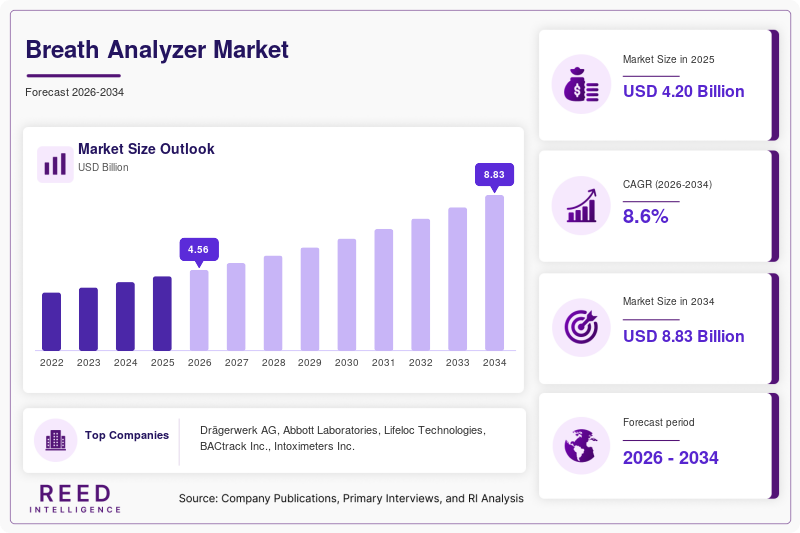
The Breath Analyzer Market size is valued at approximately USD 4.2 billion in 2026 and is projected to reach nearly USD 8.1 billion by 2034, expanding at a CAGR of 8.6% during 2026–2034. Growth in the market is primarily driven by increasing global enforcement of alcohol consumption regulations, rising adoption of portable diagnostic devices, and expanding use of breath analysis technology in healthcare screening applications. The integration of semiconductor-based gas sensors and advanced fuel cell technology has significantly improved detection accuracy, enabling wider adoption across law enforcement agencies, hospitals, and industrial safety programs.
One of the key global factors supporting market growth is the strengthening of road safety laws and workplace compliance standards across both developed and emerging economies. Governments are increasingly deploying digital breath analyzers integrated with cloud-based reporting systems, improving traceability and enforcement efficiency. Additionally, technological advancements in non-invasive medical diagnostics are expanding applications beyond alcohol detection into disease screening, including asthma monitoring and gastrointestinal infection detection. These developments are enhancing the commercial scope of the Breath Analyzer Market across multiple industries.
Key Highlights
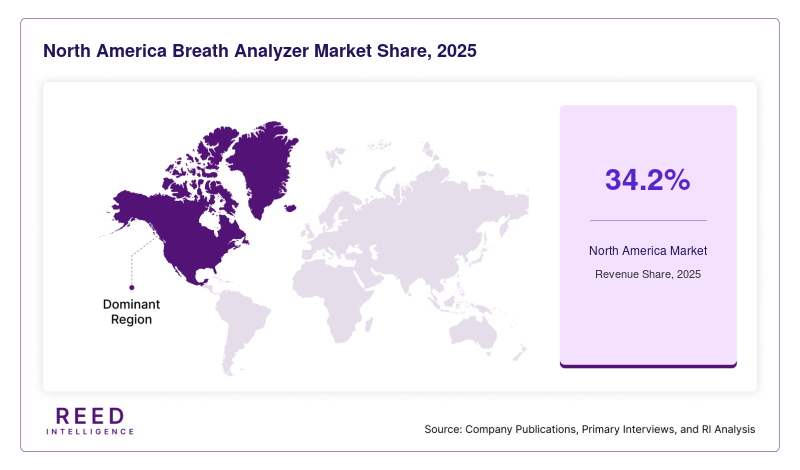
- North America dominated the market with a 34.2% share in 2025.
- Asia Pacific is expected to grow at the fastest CAGR of 11.4% during 2026–2034.
- By technology type, fuel cell-based analyzers accounted for the largest share of 39.1%.
- while semiconductor sensor-based devices are projected to grow at a CAGR of 12.2%.
- By application, law enforcement led with a 44.6% share.
- whereas healthcare diagnostics is expected to expand at a CAGR of 10.9%.
- The United States remained the dominant country, with market values of USD 610 million in 2024 and USD 660 million in 2025.
Market Trends
Increasing Integration of Digital Connectivity and IoT-Enabled Breath Analyzers
The Breath Analyzer Market is witnessing a significant transformation with the integration of IoT-enabled and Bluetooth-connected devices. Modern breath analyzers are increasingly being designed to transmit real-time data to centralized monitoring platforms, enabling law enforcement agencies and healthcare providers to track results instantly and maintain digital records. This connectivity improves operational efficiency, reduces manual reporting errors, and supports large-scale compliance monitoring programs. In workplace safety environments, connected breath analyzers are used for automated screening systems that link directly with HR and safety management software. This trend is further supported by advancements in mobile health technologies and the rising adoption of smartphone-based diagnostic accessories.
Expansion of Non-Invasive Medical Diagnostic Applications
Another key trend shaping the Breath Analyzer Market is the expansion of non-invasive diagnostic applications beyond alcohol detection. Breath analysis is increasingly being used for medical conditions such as diabetes monitoring through acetone detection, Helicobacter pylori infection screening, and early-stage respiratory disease identification. Healthcare institutions are adopting advanced breath analyzers to reduce dependency on blood-based testing, improving patient comfort and reducing turnaround time for diagnostic results. Research institutions are also investing in breathomics, which analyzes volatile organic compounds in human breath for disease prediction. This trend is expected to significantly broaden the market scope, particularly in preventive healthcare and personalized medicine applications.
Market Drivers
Rising Government Enforcement of Road Safety and Alcohol Regulations
The Breath Analyzer Market is strongly driven by stringent government regulations aimed at reducing alcohol-related road accidents. Many countries have implemented mandatory breath testing for drivers suspected of intoxication, leading to widespread deployment of portable breath analyzers by law enforcement agencies. Increased penalties for driving under the influence and the introduction of zero-tolerance policies in several regions have further boosted demand. Additionally, transportation companies and logistics operators are incorporating breath testing protocols into employee safety programs. These regulatory frameworks are encouraging continuous procurement of both handheld and fixed breath analyzer systems, strengthening overall market demand across public and private sectors.
Growing Adoption in Industrial Workplace Safety Programs
Another major driver supporting the Breath Analyzer Market is the increasing emphasis on workplace safety, particularly in high-risk industries such as mining, construction, oil and gas, and manufacturing. Employers are deploying breath analyzers to ensure compliance with alcohol-free workplace policies, reducing the risk of accidents and operational disruptions. The integration of breath testing into occupational health programs is becoming standard practice in several countries, particularly in regions with strict labor safety regulations. Additionally, automation of screening processes through biometric and digital authentication systems is enhancing efficiency. This growing adoption across industrial sectors is contributing significantly to sustained market expansion.
Market Restraint
Accuracy Limitations and Environmental Interference Challenges
Despite technological advancements, the Breath Analyzer Market faces challenges related to measurement accuracy and environmental interference. Variations in temperature, humidity, and exposure to certain chemicals can affect sensor performance, leading to inconsistent readings. Semiconductor-based devices, in particular, may produce false positives under certain conditions, which limits their reliability in critical enforcement scenarios. These limitations can result in legal disputes or require repeated testing, increasing operational costs for agencies. Additionally, calibration requirements and device maintenance add to the total cost of ownership. These technical constraints continue to act as a restraint on widespread adoption, especially in highly regulated environments where precision is essential.
Market Opportunities
Advancements in Breathomics and Disease Detection Technologies
The emerging field of breathomics presents a major opportunity for the Breath Analyzer Market. Researchers are increasingly identifying volatile organic compounds in human breath that are linked to diseases such as cancer, asthma, and metabolic disorders. This has opened pathways for developing advanced breath analyzers capable of early disease detection and continuous health monitoring. Pharmaceutical companies and medical device manufacturers are investing in R&D to commercialize these technologies. The ability to provide real-time, non-invasive diagnostic insights is expected to revolutionize preventive healthcare, significantly expanding the market beyond traditional alcohol detection applications.
Expansion in Emerging Economies and Smart City Initiatives
Emerging economies represent a significant growth opportunity due to increasing investments in public safety infrastructure and smart city projects. Governments in Asia Pacific, Latin America, and the Middle East are deploying advanced traffic monitoring systems that integrate breath analyzers with AI-based surveillance tools. These systems help improve road safety enforcement efficiency and reduce manual intervention. Additionally, rising urbanization and increasing vehicle ownership rates are creating higher demand for roadside testing equipment. The expansion of healthcare infrastructure in these regions also supports adoption in clinical diagnostics, making emerging economies a key growth frontier for the Breath Analyzer Market.
Segmental Analysis
Technology Type Segment
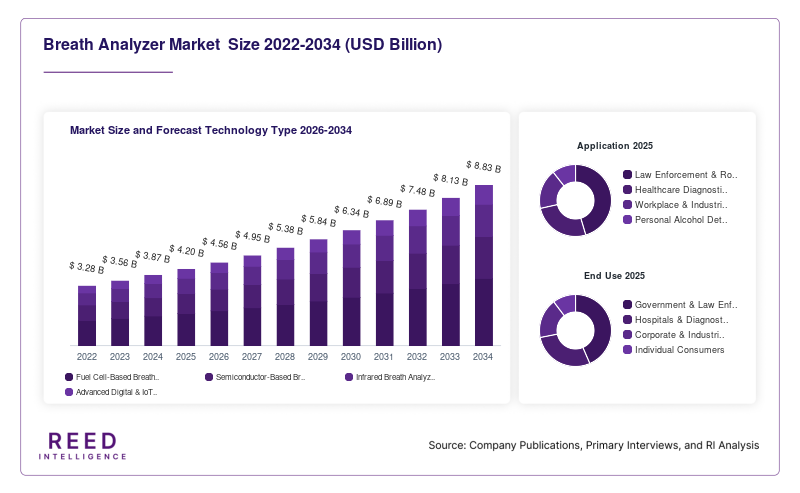
Fuel cell-based breath analyzers dominated the market with a 2024 share of 39.1%, driven by their high accuracy, reliability, and widespread use in law enforcement applications. These devices are preferred for evidential testing due to their precision and ability to maintain performance over long operational cycles. Their adoption is particularly strong in developed regions with strict legal standards for alcohol testing.
Semiconductor-based analyzers are expected to be the fastest-growing subsegment, expanding at a CAGR of 12.2% during 2026–2034. Growth is supported by lower cost, portability, and increasing use in personal and workplace safety applications. Technological improvements are reducing false positives, making them more suitable for broader commercial adoption.
Application Segment
Law enforcement accounted for the largest share of 44.6% in 2024, driven by mandatory alcohol testing regulations and widespread deployment of roadside screening devices. Police departments globally rely on handheld breath analyzers for rapid field testing and enforcement of DUI laws.
Healthcare diagnostics is the fastest-growing application segment with a CAGR of 10.9%, supported by increasing use of breath analysis for disease detection and monitoring. Hospitals and diagnostic centers are adopting non-invasive testing methods to improve patient experience and reduce testing time.
End-Use Segment
Government and law enforcement agencies held a dominant 41.3% share in 2024, due to continuous procurement of breath analyzers for traffic control and regulatory enforcement. These agencies require high-precision devices for evidential testing purposes.
Corporate and industrial end-use is the fastest-growing segment with a CAGR of 10.6%, driven by workplace safety compliance requirements. Industries are integrating breath testing systems into routine employee screening processes to ensure operational safety and regulatory adherence.
Regional Analysis
North America
North America accounted for approximately 34.2% of the Breath Analyzer Market share in 2025, with a projected CAGR of 8.1% during 2026–2034. The region benefits from strict DUI enforcement laws and widespread adoption of advanced breath testing devices across law enforcement agencies and healthcare institutions. The presence of established manufacturers and strong technological infrastructure further supports market development.
The United States leads the regional market, driven by continuous upgrades in police enforcement equipment and workplace safety regulations. A key growth factor is the increasing integration of digital breath analyzers with cloud-based data management systems used in transportation and corporate safety programs.
Europe
Europe held nearly 27.5% market share in 2025, with a forecast CAGR of 7.8% during 2026–2034. Strong regulatory frameworks and road safety initiatives across EU member states support demand for breath analyzers in both public and private sectors. The region also emphasizes workplace alcohol testing in transportation and logistics industries.
Germany leads the European market due to advanced automotive safety regulations and widespread industrial safety compliance systems. Increasing adoption of portable breath testing devices in corporate environments is further strengthening regional growth.
Asia Pacific
Asia Pacific accounted for around 23.8% market share in 2025, and is expected to grow at the fastest CAGR of 11.4% during 2026–2034. Rapid urbanization, increasing vehicle ownership, and expanding healthcare infrastructure are major growth drivers in the region. Governments are also strengthening traffic enforcement regulations.
China dominates the regional market, supported by large-scale deployment of smart surveillance and traffic monitoring systems. A key growth factor is the integration of AI-enabled breath analyzers into smart city infrastructure and public safety programs.
Middle East & Africa
The Middle East & Africa held approximately 8.3% market share in 2025, with a CAGR of 7.5% during 2026–2034. Growing investments in transportation safety and increasing adoption of alcohol testing in commercial sectors are supporting market expansion.
Saudi Arabia leads the region due to rising investments in road safety infrastructure and airport security systems. Expansion of large-scale construction projects is also increasing demand for workplace alcohol testing solutions.
Latin America
Latin America accounted for nearly 6.2% market share in 2025, with a projected CAGR of 7.9% during 2026–2034. Increasing road safety awareness and regulatory enforcement are driving adoption across Brazil, Argentina, and Mexico.
Brazil dominates the regional market due to strict traffic laws and increasing deployment of portable breath analyzers in law enforcement agencies. Growth is further supported by rising public awareness of alcohol-related road safety risks.
Competitive Landscape
The Breath Analyzer Market is moderately consolidated with the presence of several global and regional manufacturers focusing on technological innovation and product diversification. Key players include Drägerwerk AG, Abbott Laboratories, Lifeloc Technologies, BACtrack, and Intoximeters. These companies are investing in digital connectivity, sensor miniaturization, and AI-based analytics to improve device accuracy and usability.
Drägerwerk AG remains a leading player, supported by its strong portfolio of professional-grade breath testing systems. A recent development includes the expansion of its digital breath analysis platform integrated with cloud-based data storage for law enforcement applications.
Key Players
- Drägerwerk AG
- Abbott Laboratories
- Lifeloc Technologies
- BACtrack Inc.
- Intoximeters Inc.
- Quest Products Inc.
- Lion Laboratories Ltd.
- Andatech Pty Ltd.
- AlcoPro Inc.
- Alcohol Countermeasure Systems Corp.
- MPD Inc.
- CMI Inc.
- Shenzhen Ztsense Technology
Recent Developments
- A leading manufacturer introduced AI-enabled breath analyzers with cloud connectivity for real-time law enforcement reporting and data analytics integration.
- Several companies expanded production facilities in Asia Pacific to meet rising demand for portable breath testing devices in emerging markets.
- A healthcare technology firm launched a clinical-grade breath analyzer designed for early disease screening using volatile organic compound detection technology.
Breath Analyzer Market Segments
Technology Type
- Fuel Cell-Based Breath Analyzers
- Semiconductor-Based Breath Analyzers
- Infrared Breath Analyzers
- Advanced Digital & IoT-Enabled Breath Analyzers
Application
- Law Enforcement & Road Safety
- Healthcare Diagnostics & Disease Screening
- Workplace & Industrial Safety Compliance
- Personal Alcohol Detection Devices
End Use
- Government & Law Enforcement Agencies
- Hospitals & Diagnostic Centers
- Corporate & Industrial Sector
- Individual Consumers
By Region
- North America
- Europe
- APAC
- Middle East and Africa
- LATAM