Brewster Window Market Size, Share & Demand Report By Material Type (Fused Silica, Sapphire, Calcium Fluoride, Quartz, Other Materials), By Application (Laser Systems, Spectroscopy, Optical Communication, Scientific Research, Medical Devices), By End Use (Industrial Manufacturing, Research and Academic Institutions, Healthcare, Aerospace and Defense, Telecommunications), By Region & Segment Forecasts, 2026–2034
USD 3950
Market Overview
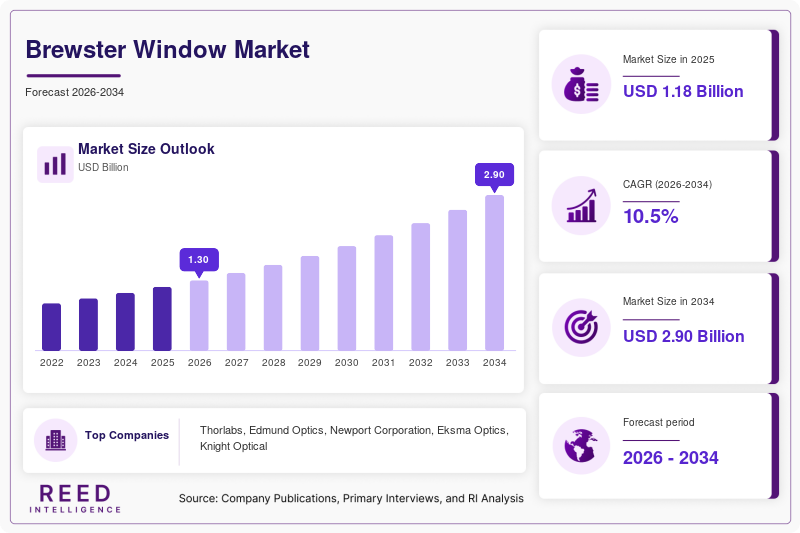
The global Brewster Window Market size was valued at USD 1.18 billion in 2026 and is projected to reach USD 2.63 billion by 2034, expanding at a CAGR of 10.5% during the forecast period from 2026 to 2034. The market is witnessing stable expansion due to the growing deployment of optical systems across industrial laser equipment, spectroscopy instruments, aerospace devices, and scientific research applications. Brewster windows are increasingly used in high-performance laser cavities and optical communication systems because they reduce reflection losses for polarized light and improve transmission efficiency. The rising focus on precision optics in semiconductor manufacturing and photonics research has also contributed to broader product adoption across developed and emerging economies.
The market is benefiting from sustained investments in photonics infrastructure and advanced laboratory technologies. Increasing use of high-power lasers in medical diagnostics, defense systems, and material processing applications has accelerated demand for Brewster windows manufactured with durable fused silica and crystal materials. In addition, the integration of automation and miniaturized optical systems in industrial environments has encouraged manufacturers to develop compact and high-temperature-resistant Brewster window solutions. Growing research activities in universities and national laboratories are further strengthening long-term market demand.
Key Highlights
- North America dominated the market with a 34.2% share in 2025.
- Asia Pacific is expected to grow at the fastest CAGR of 11.8% during 2026–2034.
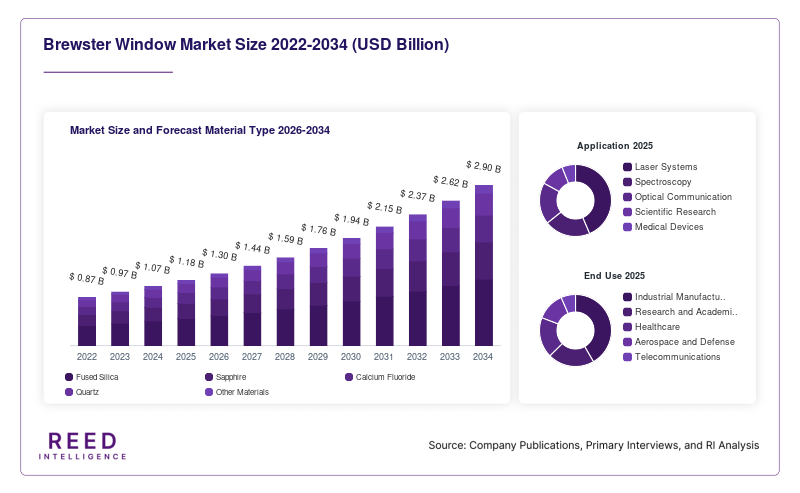
- By material type, fused silica accounted for the largest share of 39.6%, while sapphire-based Brewster windows are projected to grow at a CAGR of 12.1%.
- By application, laser systems led with a 44.3% share, whereas spectroscopy applications are expected to expand at a CAGR of 11.5%.
- The United States remained the dominant country, with market values of USD 420 million in 2024 and USD 465 million in 2025.
Market Trends
Increasing Integration of Brewster Windows in High-Power Laser Systems
The increasing use of high-power laser systems across manufacturing, defense, healthcare, and scientific applications is emerging as a major trend in the Brewster Window Market. Industries involved in laser cutting, welding, engraving, and additive manufacturing are adopting optical components that improve transmission efficiency and reduce energy loss. Brewster windows are preferred in these systems because they minimize reflective losses for polarized beams and support stable laser operation. The growth of industrial automation and precision machining activities has significantly increased the installation of advanced laser equipment, particularly in semiconductor and electronics manufacturing facilities. As laser intensity requirements continue to rise, manufacturers are developing Brewster windows with enhanced thermal resistance and improved durability to support continuous industrial operations.
Growing Demand for Precision Optical Components in Research Laboratories
Research institutions and photonics laboratories are increasingly investing in precision optical systems for spectroscopy, quantum computing, and advanced imaging applications. This trend is supporting higher demand for Brewster windows that provide improved optical clarity and polarization control. Universities and government-funded laboratories are expanding optical research capabilities to support innovation in telecommunications, aerospace, and life sciences. The shift toward miniaturized optical devices and compact experimental systems has also encouraged the development of lightweight and custom-designed Brewster windows. In addition, rising investments in scientific instrumentation across Asia Pacific and Europe are creating opportunities for optical component suppliers to introduce specialized products designed for high-frequency and ultraviolet wavelength applications.
Market Drivers
Expansion of the Global Photonics and Semiconductor Industries
The rapid expansion of the photonics and semiconductor sectors is driving growth in the Brewster Window Market. Semiconductor fabrication facilities rely heavily on laser-based systems for lithography, inspection, and precision material processing. Brewster windows play a critical role in these systems by enabling efficient light transmission and reducing optical interference. Increasing production of microelectronics, integrated circuits, and advanced sensors has strengthened demand for high-quality optical components worldwide. Governments in the United States, China, South Korea, and Germany are investing in semiconductor manufacturing capabilities, which is supporting the installation of sophisticated optical equipment. This broader industrial transformation is expected to sustain demand for Brewster windows across manufacturing and research applications throughout the forecast period.
Rising Adoption of Optical Technologies in Medical and Defense Applications
Medical imaging systems, laser surgery equipment, and defense-grade optical communication systems are increasingly incorporating Brewster windows due to their polarization efficiency and low reflective properties. In healthcare, laser technologies are widely used in ophthalmology, dermatology, and surgical diagnostics, increasing the need for durable optical materials capable of maintaining stable performance under high-intensity conditions. Similarly, defense organizations are investing in advanced targeting systems, surveillance equipment, and directed-energy technologies that require precision optical components. The expansion of aerospace and satellite communication programs is also contributing to demand. Manufacturers are responding by introducing Brewster windows with improved resistance to vibration, heat, and environmental stress for mission-critical applications.
Market Restraint
High Manufacturing Costs and Technical Complexity Limiting Broader Adoption
The Brewster Window Market faces challenges associated with high manufacturing costs and strict precision requirements. Production of Brewster windows involves advanced polishing techniques, specialized coating technologies, and highly controlled fabrication processes to ensure optical accuracy. These requirements increase overall production expenses and limit affordability for smaller laboratories and low-budget industrial users. In addition, the availability of substitute optical components in lower-cost applications can reduce adoption in price-sensitive markets. Complex integration requirements in laser systems and spectroscopy instruments further increase operational costs for end users. For example, industries operating older laser infrastructure may require extensive modifications to integrate Brewster windows effectively. This technical complexity can delay procurement decisions and restrict market penetration in developing regions with limited optical engineering capabilities.
Market Opportunities
Rising Investments in Quantum Computing and Advanced Optical Communication
The development of quantum computing and next-generation optical communication systems presents substantial opportunities for the Brewster Window Market. Quantum research facilities require highly accurate optical components capable of maintaining stable polarization and reducing transmission losses. Brewster windows are increasingly being incorporated into quantum optics experiments and photonic communication networks due to their efficiency in managing polarized light. Governments and private technology companies are investing heavily in quantum infrastructure, especially in North America, Europe, and East Asia. The growth of fiber-optic communication systems and high-speed data transfer networks is also creating demand for advanced optical assemblies. This environment is encouraging manufacturers to develop specialized Brewster windows optimized for infrared and ultraviolet wavelength applications.
Expansion of Scientific Research Infrastructure in Emerging Economies
Emerging economies are increasing investments in scientific research facilities, laboratory modernization, and higher education institutions, creating favorable growth opportunities for optical component suppliers. Countries such as India, Brazil, and the United Arab Emirates are expanding research initiatives related to photonics, aerospace engineering, and biomedical sciences. This trend is increasing procurement of spectroscopy instruments, laser systems, and optical testing equipment that rely on Brewster windows for performance optimization. Local manufacturing incentives and public-private research partnerships are also supporting regional market expansion. Furthermore, the growing availability of custom optical fabrication services is helping manufacturers address application-specific requirements across industrial and academic research environments.
Segmental Analysis
By Material Type
Fused silica emerged as the dominant subsegment in the Brewster Window Market and accounted for 39.6% of the global share in 2024. The segment benefits from superior optical transparency, low thermal expansion, and high resistance to laser-induced damage. Fused silica Brewster windows are widely used in industrial laser systems, spectroscopy instruments, and photonics research applications because they maintain optical stability under high-intensity operating conditions. Manufacturers prefer fused silica due to its durability and compatibility with ultraviolet and infrared wavelength applications. The growing installation of precision laser systems in semiconductor manufacturing and medical diagnostics has further strengthened segment demand. In addition, the availability of customized fused silica components for research laboratories and industrial automation systems continues to support long-term market expansion.
Sapphire-based Brewster windows are projected to register the fastest CAGR of 12.1% during the forecast period. Sapphire materials are gaining popularity because of their exceptional hardness, thermal conductivity, and resistance to chemical corrosion. These characteristics make them suitable for harsh industrial environments and aerospace applications where optical systems operate under extreme temperatures and pressure conditions. Increasing use of high-power laser systems in defense technologies and advanced manufacturing facilities is driving adoption of sapphire Brewster windows. The growth of aerospace communication systems and scientific instrumentation requiring durable optical components is also supporting segment expansion. Furthermore, manufacturers are investing in advanced crystal processing technologies to improve the affordability and optical performance of sapphire-based products.
By Application
Laser systems represented the leading application segment in the Brewster Window Market and held a 44.3% share in 2024. Brewster windows are widely integrated into laser cavities and beam delivery systems because they minimize reflective losses and improve polarization efficiency. Industrial sectors such as automotive manufacturing, semiconductor fabrication, and electronics processing rely heavily on laser systems for precision operations, creating strong demand for high-performance optical components. Medical laser technologies used in surgery, dermatology, and ophthalmology are also contributing to segment growth. Increasing deployment of fiber lasers and solid-state lasers across industrial automation environments has further accelerated demand for Brewster windows. In addition, rising investments in photonics research and defense laser systems continue to support the dominance of this application segment.
Spectroscopy applications are expected to grow at the fastest CAGR of 11.5% during the forecast period due to increasing demand for precise analytical and measurement technologies. Spectroscopy systems require high-quality optical components to ensure accurate wavelength transmission and stable polarization characteristics. Growing investments in pharmaceutical research, environmental testing, and material science laboratories are supporting the adoption of advanced spectroscopy instruments worldwide. The expansion of academic research programs focused on quantum optics and chemical analysis is also creating demand for specialized Brewster windows optimized for ultraviolet and infrared applications. Furthermore, rising emphasis on laboratory automation and high-resolution analytical systems is encouraging manufacturers to develop compact and customized optical components tailored for spectroscopy equipment.
By End Use
Industrial manufacturing accounted for the largest share of the Brewster Window Market in 2024, contributing approximately 41.2% of global revenue. The segment benefits from widespread use of laser technologies in cutting, welding, engraving, and precision machining applications. Manufacturing companies are increasingly integrating advanced optical systems to improve operational efficiency and reduce production errors. Brewster windows are essential in these systems because they enhance light transmission and reduce reflection-related energy losses. Rapid growth in electronics manufacturing and semiconductor fabrication has significantly strengthened demand for optical components across industrial facilities. In addition, rising adoption of automated production systems and smart manufacturing technologies is encouraging investments in advanced laser equipment that incorporates high-performance Brewster windows.
Research and academic institutions are anticipated to witness the fastest CAGR of 11.9% during the forecast period. Universities, government laboratories, and scientific organizations are expanding investments in photonics, quantum computing, and spectroscopy research programs. These facilities require precision optical components capable of supporting advanced experimental systems and high-frequency optical applications. Increasing public funding for scientific innovation and laboratory modernization is driving procurement of sophisticated laser and spectroscopy equipment. Demand is particularly strong in countries investing heavily in research infrastructure, including China, the United States, Germany, and India. Furthermore, collaboration between academic institutions and private technology companies is accelerating the development of specialized optical solutions designed for emerging photonics and quantum communication applications.
Regional Analysis
North America
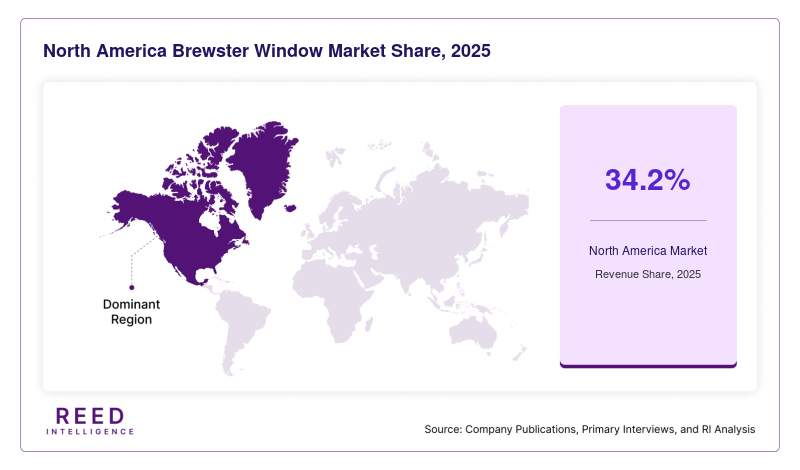
North America accounted for 34.2% of the global Brewster Window Market share in 2025 and is expected to maintain a steady CAGR of 9.8% during the forecast period. The region benefits from strong investments in laser technology, aerospace systems, and semiconductor manufacturing. The presence of major photonics companies and advanced research laboratories continues to support demand for high-performance optical components. Increased deployment of industrial automation systems and precision laser equipment across manufacturing facilities has strengthened product adoption throughout the United States and Canada.
The United States remains the dominant country in the regional market due to its extensive defense research infrastructure and advanced semiconductor ecosystem. Federal funding for photonics innovation and quantum computing programs has encouraged the adoption of sophisticated optical systems. The country is also witnessing rising demand for Brewster windows in medical laser applications and aerospace communication systems. Growth is further supported by collaborations between universities, defense agencies, and optical equipment manufacturers focused on high-efficiency laser technologies.
Europe
Europe represented a significant share of the Brewster Window Market in 2025 and is projected to grow at a CAGR of 9.6% through 2034. The regional market is supported by strong industrial manufacturing capabilities and increasing investments in scientific instrumentation. Germany, France, and the United Kingdom continue to expand research activities related to spectroscopy, photonics, and optical engineering. The growing adoption of laser-based manufacturing systems in automotive and electronics production facilities has also strengthened regional demand for Brewster windows.
Germany leads the European market due to its advanced industrial automation sector and strong presence of optical equipment manufacturers. The country has established a robust ecosystem for photonics innovation supported by engineering institutions and industrial research centers. Demand for Brewster windows is increasing in semiconductor processing equipment and precision measurement systems. In addition, Germany’s growing investments in laser-based medical technologies are contributing to stable product demand across healthcare applications.
Asia Pacific
Asia Pacific is anticipated to register the fastest CAGR of 11.8% during the forecast period due to rapid industrialization and expanding semiconductor manufacturing activities. Countries such as China, Japan, South Korea, and India are investing heavily in photonics research and laser technology infrastructure. Rising electronics production and increasing adoption of industrial automation systems are creating strong demand for optical components. The region is also witnessing growth in scientific research spending, particularly in optical communication and material science applications.
China dominates the Asia Pacific market because of its extensive semiconductor production capabilities and increasing investments in photonics manufacturing. The country has rapidly expanded its laser equipment industry to support electronics production, automotive manufacturing, and industrial automation. Government-backed research initiatives in quantum communication and optical engineering are also contributing to market growth. Domestic manufacturers are increasingly focusing on localized optical component production to reduce import dependency and strengthen technological competitiveness.
Middle East & Africa
The Middle East & Africa region is experiencing gradual growth in the Brewster Window Market and is forecast to expand at a CAGR of 8.4% through 2034. Increasing investments in scientific research institutions and industrial modernization programs are supporting demand for optical technologies. Countries within the Gulf region are focusing on diversifying their economies through investments in advanced manufacturing, aerospace, and healthcare technologies. These initiatives are creating opportunities for optical component suppliers and laser system manufacturers.
The United Arab Emirates remains the dominant country within the regional market due to its growing investments in aerospace engineering and advanced research facilities. The country is expanding laboratory infrastructure and promoting technology-focused development initiatives to strengthen industrial innovation. Demand for Brewster windows is also rising in medical diagnostics and academic research applications. Government support for smart manufacturing projects and scientific collaboration programs is expected to encourage long-term adoption of advanced optical systems.
Latin America
Latin America accounted for a smaller but steadily growing share of the Brewster Window Market in 2025 and is expected to register a CAGR of 8.9% during the forecast period. The market is supported by increasing industrial automation activities and expanding scientific research capabilities across major economies. Universities and technical institutes are investing in spectroscopy equipment and photonics laboratories, supporting demand for optical components. Rising adoption of laser technologies in mining, healthcare, and industrial processing applications is also contributing to regional growth.
Brazil leads the Latin American market due to its growing industrial base and expanding scientific research ecosystem. The country has increased investments in optical engineering programs and laboratory modernization projects across public institutions. Demand for Brewster windows is rising in industrial laser systems used for manufacturing and mineral processing operations. In addition, partnerships between universities and technology companies are encouraging the development of photonics research initiatives and advanced optical testing facilities.
Competitive Landscape
The Brewster Window Market is moderately consolidated, with leading companies focusing on product innovation, material optimization, and strategic partnerships to strengthen market presence. Major manufacturers are investing in advanced polishing technologies and customized optical fabrication processes to meet growing industrial and research demands. Companies are also expanding production capabilities to address increasing adoption of laser systems and spectroscopy equipment worldwide.
Thorlabs remains one of the leading participants in the market due to its broad portfolio of precision optical components and strong distribution network across research and industrial sectors. The company recently expanded its custom optics manufacturing capabilities to support high-power laser applications. Other notable market participants include Edmund Optics, Newport Corporation, Eksma Optics, and Knight Optical. These companies are focusing on expanding regional operations and introducing advanced optical materials designed for ultraviolet and infrared wavelength applications.
Key Players
- Thorlabs
- Edmund Optics
- Newport Corporation
- Eksma Optics
- Knight Optical
- CVI Laser Optics
- Laser Components
- OptoSigma
- EKSPLA
- MKS Instruments
- Shanghai Optics
- Lambda Research Optics
- Holmarc Opto-Mechatronics
- Alkor Technologies
- Crystran Ltd
Recent Developments
- In 2025, Edmund Optics introduced a new series of ultraviolet-resistant Brewster windows designed for high-frequency spectroscopy systems.
- In 2024, Thorlabs expanded its optical fabrication facility to increase production capacity for custom laser optics and Brewster window assemblies.
- In 2025, OptoSigma launched compact Brewster windows optimized for miniaturized photonics and quantum communication applications.
Brewster Window Market Segments
Material Type
- Fused Silica
- Sapphire
- Calcium Fluoride
- Quartz
- Other Materials
Application
- Laser Systems
- Spectroscopy
- Optical Communication
- Scientific Research
- Medical Devices
End Use
- Industrial Manufacturing
- Research and Academic Institutions
- Healthcare
- Aerospace and Defense
- Telecommunications
By Region
- North America
- Europe
- APAC
- Middle East and Africa
- LATAM