Bricklaying Robot Market Size, Share & Demand Report By Robot Type (Semi-Autonomous Bricklaying Robots, AI-Enabled Adaptive Robots), By Application (Residential Construction, Commercial Construction, Industrial Construction, Infrastructure Construction), By End Use (Small and Medium-Sized Construction Companies, Government Construction Agencies), By Region & Segment Forecasts, 2026–2034
USD 3950
Market Overview
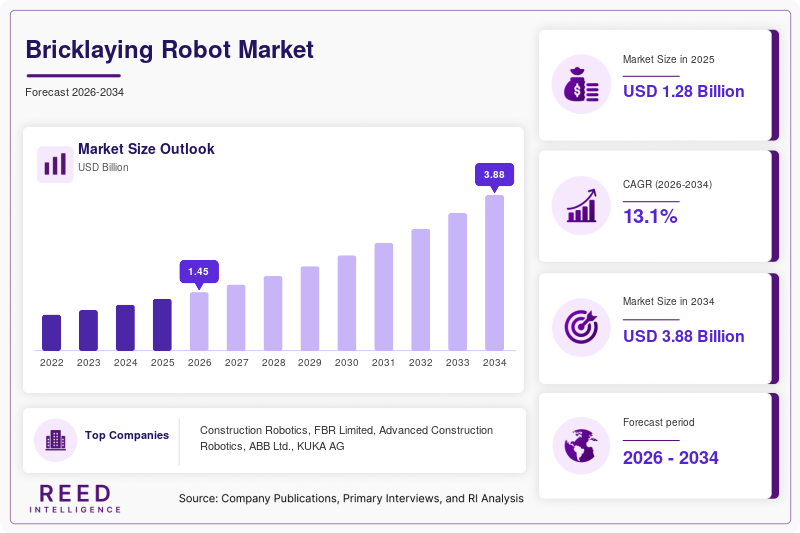
Bricklaying Robot Market size was valued at USD 1.28 billion in 2026 and is projected to reach USD 3.42 billion by 2034, expanding at a CAGR of 13.1% during 2026–2034. The market is gaining momentum as construction companies increasingly adopt automation technologies to address labor shortages, improve productivity, and enhance project consistency. Bricklaying robots are designed to automate repetitive masonry tasks, enabling contractors to complete projects faster while maintaining quality standards. Growing investments in smart construction practices and digital transformation across the building sector are creating favorable conditions for market expansion.
A major global factor supporting market growth is the increasing shortage of skilled construction workers. Many developed and developing economies face an aging workforce and rising labor costs, prompting contractors to invest in robotic systems that can perform masonry work with greater speed and accuracy. Bricklaying robots help reduce dependency on manual labor while improving workplace safety and minimizing material wastage. In addition, advancements in artificial intelligence, machine vision, and autonomous navigation technologies are enhancing the operational efficiency of robotic masonry systems.
Key Highlights
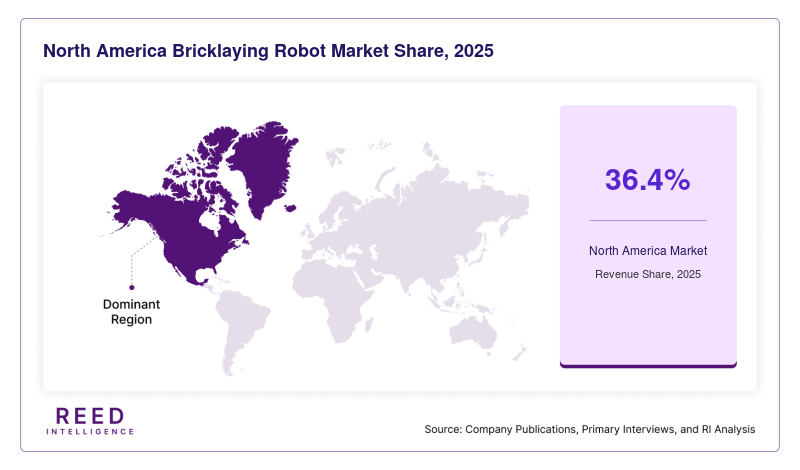
- North America dominated the market with a 36.4% share in 2025.
- while Asia Pacific is expected to grow at the fastest CAGR of 15.3% during 2026–2034.
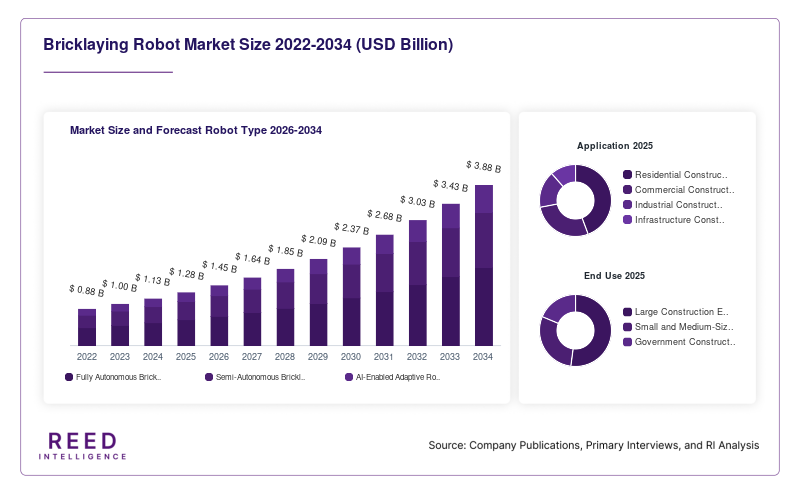
- By robot type, fully autonomous bricklaying robots accounted for the largest share of 42.8%.
- while AI-enabled adaptive robots are projected to grow at a CAGR of 16.8%.
- By application, commercial construction led with a 45.1% share.
- whereas infrastructure construction is expected to expand at a CAGR of 15.9%.
- The United States remained the dominant country, with market values of USD 368 million in 2024 and USD 417 million in 2025.
Market Trends
Integration of Artificial Intelligence and Machine Vision Systems
The integration of artificial intelligence and machine vision technologies is emerging as a significant trend in the Bricklaying Robot Market. Modern robotic systems are increasingly equipped with advanced cameras, sensors, and AI-powered software that enable real-time analysis of construction environments. These capabilities allow robots to identify brick placement positions, detect obstacles, and adjust operational parameters automatically. Construction firms are adopting these solutions to improve precision and reduce material wastage. AI-enabled robots can also generate performance analytics that help project managers optimize workflows. As construction projects become more complex and timelines become tighter, demand for intelligent robotic systems capable of autonomous decision-making continues to increase across residential, commercial, and industrial building applications.
Growing Adoption of Robotics in Modular and Smart Construction
The expansion of modular construction and smart building practices is reshaping the demand landscape for bricklaying robots. Developers are increasingly embracing automated construction methods to improve project efficiency and reduce completion times. Bricklaying robots are being integrated into digitally connected construction ecosystems where building information modeling, robotics, and automated material handling systems operate together. This trend is particularly evident in large urban development projects where speed and consistency are critical. The ability of robotic systems to operate continuously with minimal downtime aligns well with modular construction objectives. As governments and private organizations invest in smart cities and sustainable infrastructure, robotic masonry technologies are expected to become a standard component of modern construction processes.
Market Drivers
Rising Construction Labor Shortages Across Major Economies
The shortage of skilled masonry workers is a major factor driving growth in the Bricklaying Robot Market. Construction industries across North America, Europe, and parts of Asia are facing increasing difficulties in recruiting and retaining qualified labor. Aging workforces, declining interest in manual construction careers, and rising wage expectations are creating significant operational challenges for contractors. Bricklaying robots provide an effective solution by automating repetitive and labor-intensive tasks. These systems enable companies to maintain productivity levels despite workforce constraints. Large contractors are increasingly investing in robotic solutions to ensure project continuity and reduce dependency on labor availability. As labor shortages persist globally, the adoption of automated bricklaying technologies is expected to accelerate significantly.
Increasing Focus on Construction Efficiency and Cost Optimization
Construction companies are under growing pressure to complete projects faster while controlling costs and maintaining quality standards. Bricklaying robots address these requirements by improving productivity, reducing human errors, and minimizing material waste. Automated masonry systems can work consistently over extended periods, enabling faster project completion compared to traditional methods. This efficiency translates into lower operational expenses and improved project profitability. Furthermore, contractors benefit from enhanced predictability in project timelines and resource allocation. As competition within the construction sector intensifies, organizations are prioritizing investments in technologies that offer measurable productivity gains. Consequently, the economic advantages associated with robotic masonry solutions continue to drive market expansion across multiple construction segments.
Market Restraint
High Initial Investment and Integration Challenges
The relatively high acquisition and implementation cost of bricklaying robots remains a significant restraint for market growth. Advanced robotic systems require substantial capital investment, making adoption challenging for small and medium-sized construction firms. Beyond equipment costs, organizations must invest in employee training, software integration, maintenance programs, and infrastructure modifications. These additional expenses can extend return-on-investment timelines and discourage adoption among budget-conscious contractors. Furthermore, integrating robotic systems into traditional construction workflows often requires operational restructuring and process adjustments. Construction sites vary significantly in design, terrain, and environmental conditions, creating challenges for standardized robotic deployment. For example, smaller residential projects may not generate sufficient productivity gains to justify the cost of automation. As a result, while large contractors continue to embrace robotic technologies, widespread adoption across all market segments may be constrained until equipment affordability improves and implementation complexity decreases.
Market Opportunities
Expansion of Smart City and Infrastructure Development Projects
The increasing number of smart city initiatives and large-scale infrastructure projects presents substantial growth opportunities for the Bricklaying Robot Market. Governments worldwide are investing heavily in transportation networks, public buildings, housing developments, and urban modernization programs. These projects often involve extensive masonry work that can benefit from automation. Bricklaying robots help accelerate construction schedules while maintaining consistency and reducing labor requirements. The demand for efficient construction methods is particularly strong in rapidly urbanizing regions where infrastructure needs continue to expand. As public and private investments in urban development increase, contractors are likely to adopt robotic solutions to meet ambitious project timelines and quality expectations. This trend creates long-term opportunities for manufacturers and technology providers operating in the market.
Emerging Demand from Developing Economies
Developing economies represent an attractive opportunity for future market growth. Countries across Asia Pacific, Latin America, and parts of the Middle East are experiencing rapid urbanization and increasing construction activity. Rising investments in residential housing, commercial real estate, and industrial facilities are generating strong demand for advanced construction technologies. As awareness of robotic construction solutions grows, contractors in these regions are beginning to evaluate automation as a means of improving productivity and addressing labor management challenges. Government initiatives supporting industrial modernization and digital transformation further enhance market prospects. The gradual reduction in robotic system costs and increasing availability of localized support services are expected to encourage adoption among regional construction firms, creating new revenue streams for market participants over the forecast period.
Segmental Analysis
By Robot Type
Fully autonomous bricklaying robots represented the dominant subsegment, accounting for approximately 42.8% of market share in 2024. These systems are capable of performing brick placement, alignment, and mortar application with minimal human intervention. Construction companies favor fully autonomous robots because they deliver consistent productivity and quality outcomes while reducing labor requirements. Large commercial and industrial projects particularly benefit from these systems due to their ability to operate continuously across extended construction schedules. Improvements in navigation systems, machine vision capabilities, and robotic arm precision have further strengthened adoption. As construction firms prioritize efficiency and workforce optimization, demand for fully autonomous solutions continues to expand across developed and emerging markets.
AI-enabled adaptive robots are projected to be the fastest-growing subsegment, advancing at a CAGR of 16.8% through 2034. These robots incorporate artificial intelligence algorithms that enable dynamic adaptation to varying site conditions, structural designs, and material specifications. Their ability to learn from operational data and optimize performance makes them particularly attractive for complex construction projects. Contractors increasingly prefer adaptive systems because they improve flexibility while maintaining high accuracy levels. Growing investments in AI development and digital construction platforms are accelerating technological innovation within this segment. As project complexity increases and construction companies seek greater operational intelligence, AI-enabled adaptive robots are expected to experience substantial demand growth throughout the forecast period.
By Application
Commercial construction held the largest share of the market, accounting for approximately 45.1% in 2024. The segment includes office buildings, retail centers, hospitality facilities, educational institutions, and healthcare infrastructure. Commercial developers often operate under strict deadlines and budget constraints, making robotic masonry solutions highly attractive. Bricklaying robots help accelerate project execution while ensuring consistent construction quality. The growing demand for logistics centers, mixed-use developments, and urban commercial infrastructure further supports adoption. Large-scale commercial projects typically involve repetitive masonry tasks, making them well-suited for automation. As commercial real estate investment continues to expand globally, the application of robotic bricklaying systems within this segment is expected to remain significant.
Infrastructure construction is anticipated to be the fastest-growing application segment, registering a CAGR of 15.9% during 2026–2034. This growth is driven by rising government spending on transportation facilities, public buildings, utilities, and urban development projects. Infrastructure developments often require large volumes of masonry work, creating favorable conditions for robotic deployment. Bricklaying robots help improve project efficiency, reduce labor dependency, and enhance construction consistency across extensive project sites. The increasing focus on smart cities and sustainable infrastructure further strengthens demand. As governments worldwide prioritize infrastructure modernization and economic development, robotic masonry technologies are expected to play an increasingly important role in project execution.
By End Use
Large construction enterprises dominated the market, capturing approximately 58.3% share in 2024. These organizations possess the financial resources and technical capabilities required to implement advanced robotic systems effectively. Large contractors often manage complex projects involving substantial masonry workloads, making automation investments economically viable. The ability to improve productivity, reduce labor costs, and maintain predictable project schedules has encouraged widespread adoption within this segment. Additionally, large enterprises frequently participate in infrastructure, commercial, and industrial projects where robotic solutions deliver significant operational benefits. Continued emphasis on digital transformation and competitive differentiation is expected to sustain demand among major construction firms.
Small and medium-sized construction companies are projected to emerge as the fastest-growing end-use segment, expanding at a CAGR of 14.7% through 2034. Declining technology costs, improved financing options, and growing awareness of automation benefits are encouraging adoption among smaller contractors. Manufacturers are introducing more flexible and scalable robotic systems designed specifically for medium-scale construction projects. These solutions enable smaller organizations to improve productivity without making excessive capital investments. Furthermore, increasing labor shortages are affecting contractors of all sizes, creating incentives to explore automation technologies. As accessibility improves and implementation barriers decline, adoption among small and medium-sized enterprises is expected to increase steadily.
Regional Analysis
North America
North America accounted for approximately 36.4% of the Bricklaying Robot Market in 2025 and continues to represent the largest regional market. The region is projected to expand at a CAGR of 12.4% through 2034, supported by strong investments in construction automation and digital building technologies. Contractors across the United States and Canada are increasingly adopting robotic masonry systems to address labor shortages and improve project efficiency. Growing demand for commercial buildings, logistics facilities, and residential developments further supports market growth across the region.
The United States remains the dominant country within North America. A key growth factor is the widespread shortage of skilled masonry workers, which has encouraged contractors to explore automation solutions. Major construction companies are investing in robotic technologies to maintain project schedules and reduce labor-related uncertainties. Increasing adoption of smart construction platforms and advanced building information modeling systems is also contributing to higher deployment rates of bricklaying robots throughout the country.
Europe
Europe represented nearly 28.1% of the global market in 2025 and is expected to register a CAGR of 12.7% during the forecast period. The region benefits from a mature construction industry that increasingly emphasizes productivity, sustainability, and technological innovation. Construction firms are implementing robotic solutions to comply with strict efficiency requirements and reduce operational costs. Demand is particularly strong in urban redevelopment projects, infrastructure modernization initiatives, and commercial construction activities across major economies.
Germany remains the leading market within Europe. A unique growth factor is the country's strong industrial automation ecosystem, which supports the development and deployment of advanced robotics technologies. German construction companies are leveraging automation expertise from the manufacturing sector to improve construction processes. Government initiatives promoting digital transformation and sustainable building practices are also accelerating investment in robotic masonry solutions throughout the national construction industry.
Asia Pacific
Asia Pacific held approximately 22.5% market share in 2025 and is anticipated to record the fastest CAGR of 15.3% between 2026 and 2034. Rapid urbanization, population growth, and expanding infrastructure investments are creating significant opportunities for robotic construction technologies. Countries throughout the region are witnessing increasing demand for residential complexes, commercial buildings, and public infrastructure projects. Construction firms are adopting automation to improve productivity and manage rising labor costs effectively.
China dominates the Asia Pacific market. One distinctive growth factor is the country's large-scale smart city development initiatives, which emphasize advanced construction technologies and digital infrastructure. Chinese developers are increasingly integrating robotics into construction workflows to accelerate project completion and enhance quality consistency. Strong government support for automation and technological innovation continues to create favorable conditions for market expansion across the country.
Middle East & Africa
The Middle East & Africa region accounted for approximately 7.4% of the market in 2025 and is expected to grow at a CAGR of 13.6% through 2034. Large-scale urban development projects, tourism infrastructure investments, and industrial construction activities are driving regional demand. Governments are increasingly adopting modern construction technologies to improve efficiency and support ambitious development agendas. Bricklaying robots are gaining attention as tools capable of reducing project timelines and enhancing productivity.
The United Arab Emirates is the leading country in the region. A unique growth factor is the government's emphasis on futuristic construction methods and smart infrastructure development. Several major urban projects incorporate advanced automation technologies to achieve sustainability and efficiency objectives. The country's commitment to technological innovation is encouraging construction companies to evaluate and deploy robotic masonry systems on large-scale projects.
Latin America
Latin America captured approximately 5.6% of the global market in 2025 and is projected to expand at a CAGR of 12.1% during the forecast period. The region's construction sector is gradually modernizing, supported by investments in residential housing, commercial facilities, and public infrastructure. Although adoption remains at an early stage compared to developed markets, awareness of robotic construction technologies continues to increase. Contractors are seeking solutions that improve productivity and reduce dependence on fluctuating labor availability.
Brazil leads the Latin American market. A notable growth factor is the country's ongoing urban housing development initiatives, which require efficient and scalable construction methods. Large metropolitan areas continue to experience demand for affordable housing and commercial infrastructure. Construction companies are increasingly exploring automation technologies to improve project economics and address labor productivity challenges, supporting future growth of bricklaying robot adoption across the country.
Competitive Landscape
The Bricklaying Robot Market is moderately consolidated, with technology developers and construction automation companies competing through innovation, strategic partnerships, and geographic expansion. Market participants are focusing on enhancing robotic accuracy, AI integration, and autonomous capabilities to improve construction productivity. Product development remains a key competitive strategy as manufacturers seek to differentiate their solutions through advanced software, machine vision systems, and real-time analytics capabilities.
Construction Robotics remains a leading market participant due to its established robotic masonry platforms and strong presence in North America. The company recently introduced upgraded AI-driven navigation features designed to improve brick placement precision and operational flexibility. Other notable companies continue to invest in research and development initiatives aimed at reducing equipment costs and expanding application capabilities.Strategic collaborations between robotics manufacturers, construction firms, and software providers are becoming increasingly common. These partnerships help accelerate technology adoption and improve integration with digital construction workflows. Market competition is expected to intensify as new entrants introduce innovative solutions and emerging markets present additional growth opportunities.
Key Players
- Construction Robotics
- FBR Limited
- Advanced Construction Robotics
- ABB Ltd.
- KUKA AG
- FANUC Corporation
- Yaskawa Electric Corporation
- Husqvarna Group
- Brokk AB
- Built Robotics
- Ekso Bionics
- Boston Dynamics
- Dusty Robotics
- Fastbrick Robotics
- Kawasaki Heavy Industries Ltd.
Recent Developments
- Construction Robotics launched an enhanced bricklaying platform featuring AI-assisted alignment technology for improved masonry accuracy.
- FBR Limited expanded pilot deployments of autonomous bricklaying systems across large residential construction projects in Asia Pacific.
- ABB Ltd. introduced upgraded robotic control software designed to improve integration between construction robots and digital project management platforms.
- Advanced Construction Robotics partnered with major contractors to accelerate adoption of automated masonry solutions in commercial building projects.
- KUKA AG developed new machine vision enhancements that improve robotic brick placement performance under varying construction site conditions.
Bricklaying Robot Market Segments
Robot Type
- Fully Autonomous Bricklaying Robots
- Semi-Autonomous Bricklaying Robots
- AI-Enabled Adaptive Robots
Application
- Residential Construction
- Commercial Construction
- Industrial Construction
- Infrastructure Construction
End Use
- Large Construction Enterprises
- Small and Medium-Sized Construction Companies
- Government Construction Agencies
By Region
- North America
- Europe
- APAC
- Middle East and Africa
- LATAM