Bridge Bearing Market Size, Share & Demand Report By Type (Elastomeric Bridge Bearings, Pot Bearings), By Material (Steel Bearings, Rubber Bearings, Composite Material Bearings, PTFE Bearings), By Application (Highway Bridges, Railway Bridges, Pedestrian Bridges), By Load Capacity (Light Load Bearings, Medium Load Bearings, Heavy Load Bearings) By Region & Segment Forecasts, 2026–2034
USD 3950
Market Overview
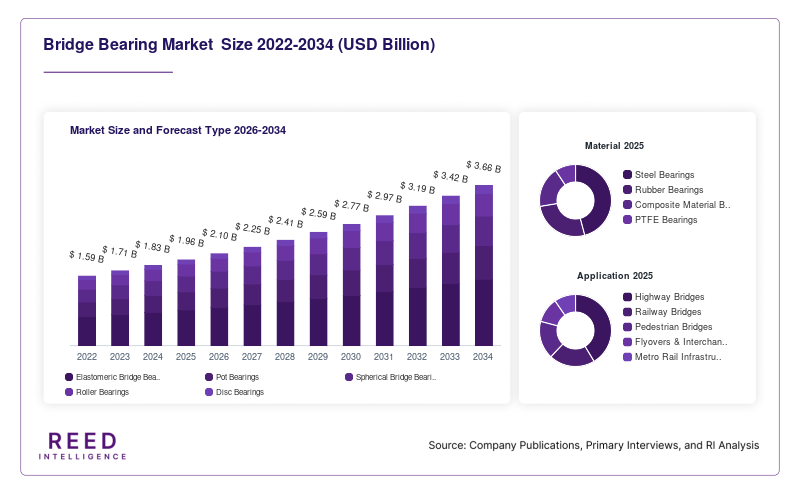
The Bridge Bearing Market size was valued at USD 1.96 billion in 2026 and is projected to reach USD 3.41 billion by 2034, expanding at a CAGR of 7.2% during the forecast period (2026–2034). The global Bridge Bearing Market growth was supported by increasing investments in transportation infrastructure modernization across developed and emerging economies. Governments and private infrastructure developers increasingly focused on enhancing bridge durability, structural safety, and seismic resistance, which accelerated the adoption of advanced bridge bearing systems worldwide.
Bridge bearings play a critical role in supporting bridge structures by transferring loads and accommodating movements caused by thermal expansion, seismic activity, and traffic vibration. The rising construction of highway bridges, railway bridges, flyovers, and urban transit infrastructure strengthened the demand for elastomeric, pot, and spherical bridge bearings across global markets.
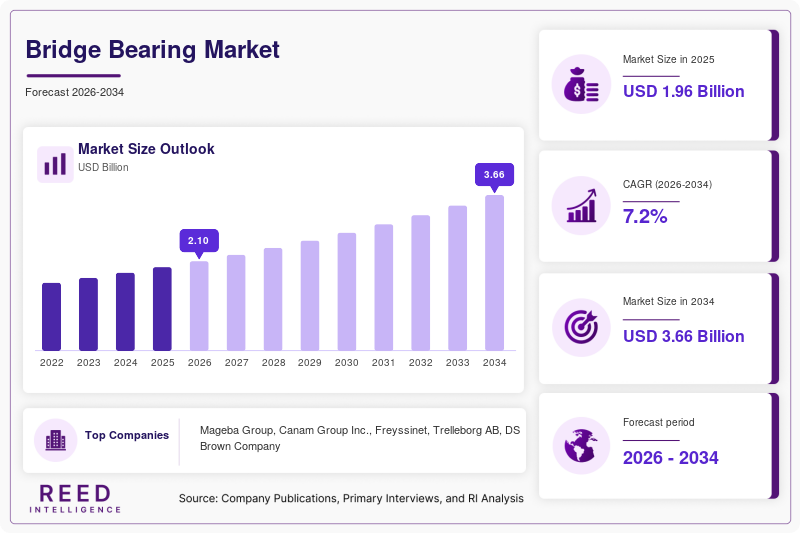
Key Highlights
- Asia Pacific accounted for 39.4% of the global Bridge Bearing Market share in 2025, while the Middle East & Africa is projected to register the fastest CAGR of 8.4% during the forecast period.
- Among type segments, elastomeric bridge bearings held the dominant share of 42.7% in 2025, whereas spherical bridge bearings are expected to grow at a CAGR of 8.8% through 2034.
- By material, steel bearings represented the leading segment with 36.9% market share in 2025, while composite material bearings are anticipated to expand at a CAGR of 9.1%.
- By application, highway bridges captured 48.3% market share in 2025, whereas railway bridges are projected to grow at a CAGR of 8.2% during the assessment period.
- The China Bridge Bearing Market was valued at USD 342 million in 2024 and reached USD 371 million in 2025 due to large-scale transportation infrastructure projects.
Market Trends
Increasing Adoption of Seismic Isolation Bearing Systems
The adoption of seismic isolation bearing systems emerged as a major trend influencing the Bridge Bearing Market. Infrastructure authorities increasingly integrated advanced bridge bearings capable of absorbing seismic shocks and minimizing structural damage during earthquakes.
Countries located in seismic-prone regions increasingly implemented updated bridge safety standards and structural resilience regulations. This trend accelerated demand for spherical and lead rubber bridge bearings across highway and railway infrastructure projects.
Growing Preference for Maintenance-Free Bearing Technologies
The growing preference for maintenance-free bridge bearing technologies significantly shaped the Bridge Bearing Market outlook. Infrastructure operators increasingly adopted corrosion-resistant and self-lubricating bearing systems to reduce inspection frequency and long-term operational expenses.
Manufacturers focused on developing advanced polymer coatings, stainless steel components, and durable elastomeric materials capable of extending bridge service life. This trend supported the broader adoption of low-maintenance bridge bearing systems globally.
Market Drivers
Expansion of Transportation Infrastructure Development
The rapid expansion of transportation infrastructure projects globally significantly supported the Bridge Bearing Market growth. Governments increased investments in highways, metro rail systems, expressways, and smart city infrastructure to improve connectivity and transportation efficiency.
Bridge bearings became essential components in large-scale bridge construction projects due to their ability to enhance structural stability and movement accommodation. Growing public infrastructure budgets further accelerated market demand.
Rising Demand for Bridge Rehabilitation and Maintenance
Increasing bridge rehabilitation and maintenance activities worldwide contributed substantially to the growth of the Bridge Bearing Market. Aging bridge infrastructure in several developed economies created demand for replacement and retrofit bearing systems.
Infrastructure authorities increasingly upgraded existing bridge structures with advanced bearings capable of improving load distribution and structural performance. This trend strengthened product demand across maintenance and reconstruction projects.
Market Restraint
High Installation and Replacement Costs
High installation and replacement costs associated with advanced bridge bearing systems restrained broader market growth. Large bridge projects often require specialized engineering expertise, customized bearing solutions, and complex installation procedures.
In addition, maintenance shutdowns and replacement activities can increase project costs and operational disruptions, particularly for aging transportation infrastructure.
Market Opportunities
Growth of High-Speed Rail Infrastructure
The increasing development of high-speed rail infrastructure is expected to create significant opportunities for the Bridge Bearing Market. Railway bridge systems require advanced bearings capable of handling high dynamic loads and vibration control.
Countries investing in intercity rail connectivity and urban transit modernization are expected to increase demand for high-performance bridge bearing systems during the forecast period.
Expansion of Smart Bridge Monitoring Systems
The integration of smart bridge monitoring systems is projected to support new growth opportunities across the market. Infrastructure operators increasingly deploy sensor-enabled bearing systems capable of monitoring structural movement, stress levels, and maintenance conditions in real time.
The adoption of digital infrastructure management technologies is expected to strengthen demand for technologically advanced bridge bearing products.
Segmental Analysis
By Type
Elastomeric Bridge Bearings Dominated the Market
Elastomeric bridge bearings accounted for 42.7% of the global Bridge Bearing Market share in 2025. These bearings gained widespread adoption due to their cost efficiency, durability, and ability to accommodate rotational and translational movement.
Infrastructure developers increasingly preferred elastomeric bearings for highway and urban bridge projects because of their low maintenance requirements and simplified installation process.
Spherical Bridge Bearings to Witness Fastest Growth
Spherical bridge bearings are projected to grow at a CAGR of 8.8% during the forecast period. Their superior load-bearing capacity and enhanced seismic resistance capabilities are expected to increase adoption across large-span bridges and railway infrastructure projects.
Increasing focus on structural safety and long-span bridge engineering will further support segment growth globally.
By Material
Steel Bearings Held the Largest Share
Steel bearings represented 36.9% of the Bridge Bearing Market share in 2025. These products maintained strong demand due to their high structural strength and suitability for heavy-load bridge applications.
Infrastructure authorities increasingly utilized steel bridge bearings in highway and railway projects requiring enhanced durability and load distribution performance.
Composite Material Bearings to Register Rapid Growth
Composite material bearings are anticipated to grow at a CAGR of 9.1% during the forecast period. Their lightweight properties, corrosion resistance, and reduced maintenance needs are expected to support increasing adoption.
The growing preference for advanced construction materials and sustainable infrastructure solutions will strengthen segment expansion.
By Application
Highway Bridges Accounted for the Largest Share
Highway bridges captured 48.3% of the global Bridge Bearing Market share in 2025. Increasing investments in road transportation infrastructure and bridge expansion projects supported extensive use of bridge bearings across highway applications.
Bridge bearings played a critical role in managing traffic-induced structural movement and ensuring long-term bridge stability.
Railway Bridges to Witness Accelerated Growth
Railway bridges are expected to grow at a CAGR of 8.2% through 2034. The increasing construction of metro rail systems and high-speed rail corridors is projected to strengthen demand for advanced bridge bearing technologies.
Growing investments in railway modernization and freight transportation efficiency will further support segment growth.
By Load Capacity
Medium Load Bearings Dominated the Market
Medium load bearings accounted for 44.5% of the global Bridge Bearing Market share in 2025. These bearings gained significant adoption across urban bridges and standard highway infrastructure projects.
Their balanced load-handling capability and cost-effectiveness supported extensive use across medium-span bridge structures.
Heavy Load Bearings to Grow Steadily
Heavy load bearings are projected to grow at a CAGR of 7.8% during the forecast period. Increasing construction of long-span bridges and freight transportation corridors is expected to drive demand for high-capacity bridge bearings.
Enhanced structural performance requirements and rising traffic volumes will contribute to segment expansion.
Regional Analysis
North America
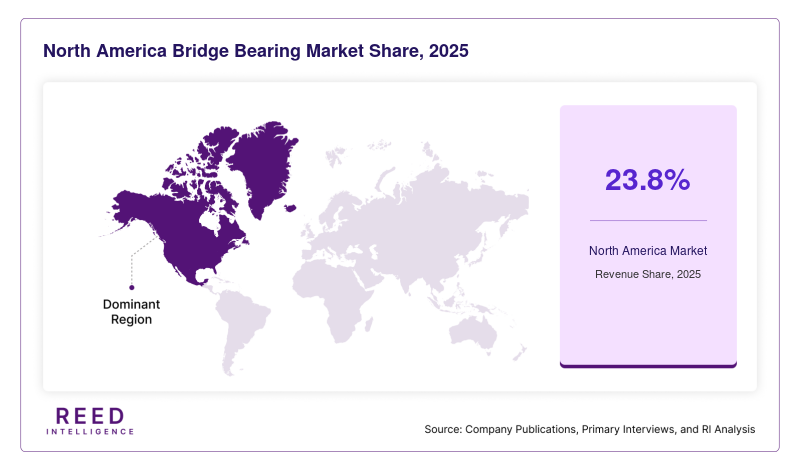
North America accounted for 23.8% of the global Bridge Bearing Market share in 2025 and is projected to grow at a CAGR of 6.5% during the forecast period. The region benefited from increasing investments in bridge rehabilitation and transportation infrastructure modernization.
The United States dominated the regional market due to the large number of aging bridges requiring structural retrofitting and bearing replacement. Government funding initiatives for infrastructure renewal supported consistent market demand.
Canada also experienced stable growth due to expansion of highway infrastructure and railway bridge improvement projects.
Europe
Europe held 21.6% of the global Bridge Bearing Market share in 2025 and is anticipated to grow at a CAGR of 6.8% through 2034. The region maintained steady growth due to increasing investments in railway modernization and sustainable transportation infrastructure.
Germany represented the dominant country market owing to its extensive highway network and advanced bridge engineering standards. Growing emphasis on seismic-resistant infrastructure further supported demand for high-performance bridge bearings.
France and Italy also contributed to regional market growth through urban transportation expansion and bridge renovation programs.
Asia Pacific
Asia Pacific accounted for 39.4% of the global Bridge Bearing Market share in 2025 and is forecast to register a CAGR of 7.9% during the assessment period. The region benefited from rapid urbanization, industrialization, and extensive transportation infrastructure construction.
China dominated the regional market due to large-scale bridge construction projects and continuous investments in expressways, railways, and smart transportation systems. Government infrastructure development programs significantly strengthened product demand.
India emerged as a rapidly growing market due to expansion of highway corridors, metro rail projects, and bridge modernization initiatives. Japan and South Korea also maintained strong market presence through advanced seismic-resistant infrastructure development.
Middle East & Africa
The Middle East & Africa represented 8.1% of the global Bridge Bearing Market share in 2025 and is expected to expand at the fastest CAGR of 8.4% during the forecast period. Increasing investments in urban infrastructure and transportation connectivity supported regional market growth.
Saudi Arabia dominated the regional market due to large-scale smart city development and transportation infrastructure projects. Investments in highway expansion and urban mobility systems increased demand for advanced bridge bearings.
The United Arab Emirates also experienced notable market growth through bridge construction and logistics infrastructure modernization initiatives.
Latin America
Latin America captured 7.1% of the global Bridge Bearing Market share in 2025 and is projected to grow at a CAGR of 6.7% through 2034. The region benefited from infrastructure modernization and rising investments in road connectivity projects.
Brazil dominated the regional market due to increasing bridge rehabilitation activities and transportation infrastructure development. Government investments in freight transportation corridors supported market demand.
Mexico and Argentina also contributed to regional expansion through highway bridge construction and railway infrastructure improvement programs.
Competitive Landscape
The Bridge Bearing Market remained moderately competitive with companies focusing on advanced material development, seismic-resistant technologies, and infrastructure project expansion. Manufacturers emphasized long-term durability, maintenance reduction, and customized engineering solutions to strengthen market positioning.
Market Leader
Mageba Group maintained a leading position in the Bridge Bearing Market due to its extensive infrastructure engineering expertise and diversified bearing product portfolio. The company recently expanded its seismic isolation bearing solutions for large-scale transportation infrastructure projects.
Other Major Players
- Canam Group Inc. focused on advanced bridge structural support systems.
- Freyssinet expanded its bridge rehabilitation and bearing replacement services.
- Trelleborg AB developed advanced elastomeric bridge bearing technologies.
- DS Brown Company strengthened its bridge maintenance and expansion joint product portfolio.
Key Players List
- Mageba Group
- Canam Group Inc.
- Freyssinet
- Trelleborg AB
- DS Brown Company
- Granor Rubber & Engineering Pty Ltd
- Canam Bridges
- Zaoqiang Dacheng Rubber Co., Ltd.
- Hengshui Jingtong Rubber Co., Ltd.
- EKSPAN Ltd.
- FIP Industriale
- D.S. Brown
- CSM Structures
- VSL International Ltd.
- KantaFlex
Recent Developments
- In 2025, Mageba Group expanded its seismic bridge bearing product line for high-speed rail applications.
- In 2024, Trelleborg AB introduced advanced corrosion-resistant elastomeric bridge bearings.
- In 2025, Freyssinet secured infrastructure modernization contracts for bridge rehabilitation projects in Europe.
- In 2024, DS Brown Company launched sensor-enabled bridge bearing monitoring systems.
- In 2025, Canam Group Inc. increased production capacity for heavy-load bridge support systems.
Bridge Bearing Market Segments
Type
- Elastomeric Bridge Bearings
- Pot Bearings
- Spherical Bridge Bearings
- Roller Bearings
- Disc Bearings
Material
- Steel Bearings
- Rubber Bearings
- Composite Material Bearings
- PTFE Bearings
Application
- Highway Bridges
- Railway Bridges
- Pedestrian Bridges
- Flyovers & Interchanges
- Metro Rail Infrastructure
Load Capacity
- Light Load Bearings
- Medium Load Bearings
- Heavy Load Bearings
By Region
- North America
- Europe
- APAC
- Middle East and Africa
- LATAM