Bridge Monitoring System Market Size, Share & Demand Report By Component (Hardware (Sensors, Data Acquisition Systems), Software, Services), By Application (Structural Health Monitoring, Fatigue Monitoring, Corrosion Monitoring, Load Monitoring), By End-Use (Transportation Infrastructure, Government & Municipal, Private Infrastructure), By Region & Segment Forecasts, 2026–2034
USD 3950
Market Overview
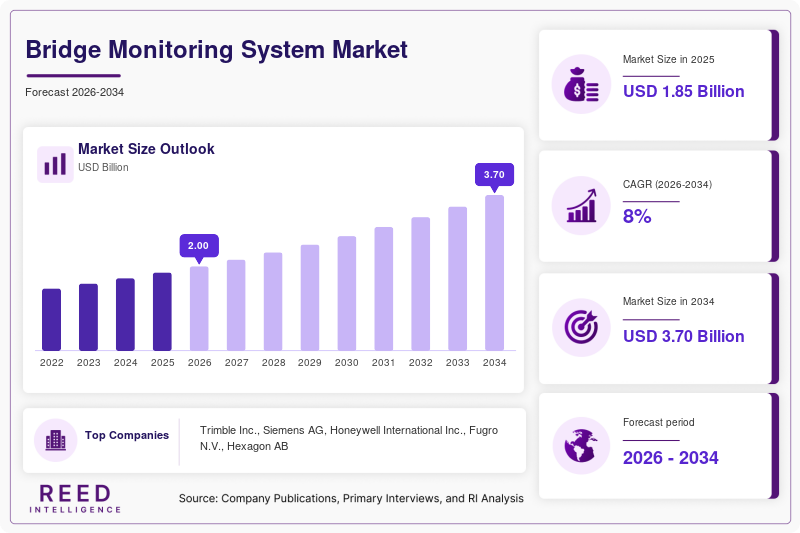
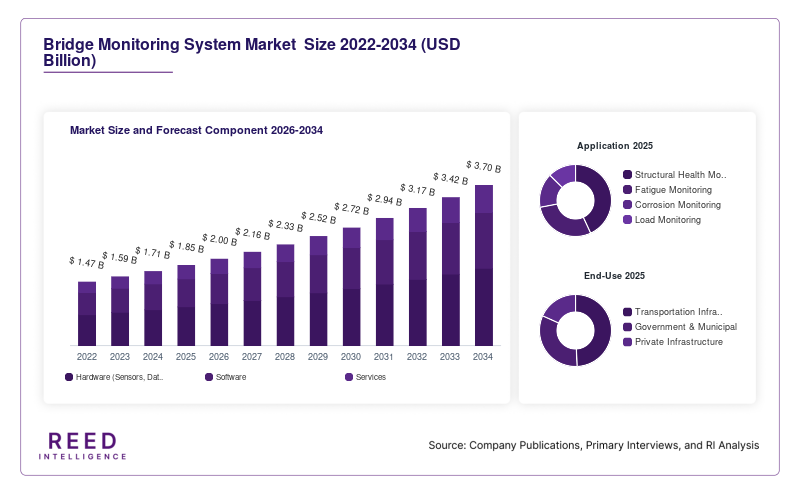
The Bridge Monitoring System Market was valued at approximately USD 1.85 billion in 2026 and is projected to reach USD 3.42 billion by 2034, expanding at a CAGR of 8.0% during the forecast period (2026–2034). The market growth is primarily supported by increasing investments in infrastructure modernization and safety compliance across developed and emerging economies. Governments and private stakeholders are prioritizing the integration of advanced monitoring technologies to ensure structural integrity, reduce maintenance costs, and extend the lifecycle of bridges.
A key global factor driving this market is the aging infrastructure across major economies, particularly in North America and Europe. Many bridges built decades ago are approaching or exceeding their intended design life, necessitating continuous structural health monitoring systems. These systems provide real-time data through sensors, enabling predictive maintenance and minimizing risks of structural failures. Additionally, rapid urbanization and increased transportation demand are accelerating the construction of new bridges, further supporting market expansion.
Key Highlights
- North America dominated the market with a 33.8% share in 2025.
- Asia Pacific is expected to grow at the fastest CAGR of 10.6% during 2026–2034.
- By component, hardware (sensors) accounted for the largest share of 40.2%, while software solutions are projected to grow at a CAGR of 11.5%.
- By application, structural health monitoring led with a 42.3% share, whereas fatigue monitoring is expected to expand at a CAGR of 10.9%.
- The United States remained the dominant country, with market values of USD 520 million in 2024 and USD 575 million in 2025.
Market Trends
Integration of IoT and Smart Sensors in Bridge Monitoring Systems
The adoption of IoT-enabled smart sensors is transforming the Bridge Monitoring System Market by enabling real-time data collection and analysis. These sensors continuously monitor parameters such as strain, vibration, temperature, and displacement, providing infrastructure managers with accurate and actionable insights. The integration of wireless communication technologies reduces installation complexity and improves system scalability. Additionally, cloud-based platforms allow centralized data storage and remote access, facilitating faster decision-making. Governments are increasingly investing in smart city initiatives, where intelligent bridge monitoring systems play a crucial role in ensuring infrastructure safety. This trend is expected to strengthen as sensor costs decline and connectivity technologies improve, making advanced monitoring systems more accessible across mid-sized infrastructure projects.
Shift Toward Predictive Maintenance Using AI and Data Analytics
Another key trend shaping the market is the shift from traditional inspection methods to predictive maintenance powered by artificial intelligence and advanced analytics. AI algorithms analyze historical and real-time data to detect anomalies and predict potential structural failures before they occur. This reduces unplanned maintenance costs and enhances operational efficiency. Infrastructure authorities are adopting digital twins and simulation models to visualize bridge performance under different conditions. These technologies enable better resource allocation and improve safety outcomes. The growing availability of big data and advancements in machine learning models are expected to further accelerate this trend, making predictive maintenance a standard practice in bridge monitoring systems globally.
Market Drivers
Increasing Investments in Infrastructure Rehabilitation and Safety Compliance
Governments worldwide are allocating significant budgets for the rehabilitation and maintenance of aging infrastructure, which is a major driver for the Bridge Monitoring System Market. Many bridges built during the mid-20th century are now experiencing structural degradation due to environmental stress, heavy traffic loads, and material fatigue. Regulatory bodies are enforcing stricter safety standards, requiring continuous monitoring of bridge conditions. This has led to increased adoption of advanced monitoring systems that provide real-time insights into structural performance. Public-private partnerships are also contributing to market growth by enabling large-scale infrastructure projects. These investments ensure long-term safety and reliability, making bridge monitoring systems an essential component of modern infrastructure management.
Growth in Transportation Networks and Urbanization
Rapid urbanization and expanding transportation networks are driving the demand for new bridges and related monitoring systems. Emerging economies are witnessing significant infrastructure development to support economic growth and population expansion. As new bridges are constructed, integrating monitoring systems from the design phase is becoming a standard practice. This proactive approach helps reduce maintenance costs and improves operational efficiency over the bridge lifecycle. Additionally, increasing traffic volumes and heavy freight transportation are putting additional stress on bridge structures, necessitating continuous monitoring. The combination of new construction and the need for efficient traffic management is fueling the adoption of advanced bridge monitoring technologies across global markets.
Market Restraint
High Initial Installation and Maintenance Costs
The high cost associated with the installation and maintenance of bridge monitoring systems remains a significant restraint for market growth. Advanced systems require sophisticated sensors, data acquisition units, communication networks, and software platforms, all of which contribute to high upfront expenses. For small and medium-sized infrastructure projects, these costs can be prohibitive, limiting adoption. Additionally, ongoing maintenance and calibration of sensors add to operational expenditures. In developing regions, budget constraints and limited technical expertise further hinder market penetration. For example, municipalities with constrained funding may prioritize basic repairs over investing in advanced monitoring technologies. While long-term cost savings from predictive maintenance are evident, the initial investment barrier continues to challenge widespread adoption. Efforts to reduce costs through technological advancements and economies of scale are expected to mitigate this restraint over time, but it remains a key concern for stakeholders in the near term.
Market Opportunities
Expansion of Smart City Initiatives Globally
The increasing adoption of smart city initiatives presents a significant opportunity for the Bridge Monitoring System Market. Governments are investing in intelligent infrastructure systems that integrate real-time monitoring and data analytics. Bridge monitoring systems are a critical component of these initiatives, ensuring the safety and efficiency of transportation networks. The deployment of connected sensors and centralized control systems enables seamless integration with other urban infrastructure elements. This creates opportunities for solution providers to develop scalable and interoperable systems. As smart city projects expand across Asia Pacific, the Middle East, and Latin America, demand for advanced bridge monitoring technologies is expected to grow substantially.
Adoption of Wireless and Low-Cost Monitoring Solutions
The development of wireless and cost-effective monitoring solutions is opening new growth avenues in the market. Traditional wired systems are often expensive and complex to install, especially in remote or challenging environments. Wireless technologies reduce installation time and costs, making monitoring systems more accessible. Innovations in energy-efficient sensors and battery technologies are further enhancing system performance. These advancements are particularly beneficial for developing regions, where budget constraints limit the adoption of traditional systems. Companies focusing on affordable and scalable solutions are likely to gain a competitive advantage. This trend is expected to drive market penetration across untapped regions and smaller infrastructure projects.
Segmental Analysis
By Component
The hardware segment, particularly sensors, dominated the Bridge Monitoring System Market with a share of approximately 40.2% in 2024. Sensors play a critical role in capturing real-time data related to structural performance, including strain, vibration, and environmental conditions. The increasing demand for accurate and continuous monitoring is driving the adoption of advanced sensor technologies. Fiber optic sensors, accelerometers, and strain gauges are widely used due to their reliability and precision. The integration of these sensors with data acquisition systems enhances overall system performance. Infrastructure authorities are prioritizing investments in high-quality hardware components to ensure long-term durability and efficiency. This dominance is expected to continue as sensor technologies evolve and become more cost-effective.
The software segment is projected to be the fastest-growing, with a CAGR of 11.5% during the forecast period. Software solutions enable data analysis, visualization, and predictive maintenance, making them an essential component of modern monitoring systems. The increasing adoption of cloud-based platforms and AI-driven analytics is driving growth in this segment. These solutions allow infrastructure managers to make data-driven decisions and optimize maintenance strategies. The growing focus on digital transformation and smart infrastructure is further supporting the adoption of advanced software solutions.
By Application
Structural health monitoring emerged as the dominant application segment, accounting for a share of 42.3% in 2024. This segment involves continuous monitoring of bridge conditions to detect structural issues and ensure safety. The increasing emphasis on preventive maintenance and regulatory compliance is driving demand for structural health monitoring systems. These systems provide real-time insights into bridge performance, enabling timely interventions. Governments and infrastructure operators are prioritizing investments in this segment to enhance safety and reduce maintenance costs.
Fatigue monitoring is expected to be the fastest-growing application segment, with a CAGR of 10.9%. This segment focuses on detecting material fatigue caused by repetitive stress and environmental factors. The growing need to extend the lifespan of aging infrastructure is driving demand for fatigue monitoring solutions. Advanced technologies such as AI and predictive analytics are enhancing the effectiveness of these systems. This segment is gaining traction as infrastructure managers seek to minimize risks and improve operational efficiency.
By End-Use
The transportation infrastructure segment dominated the market, accounting for a significant share in 2024. This includes highways, railways, and urban bridges, where monitoring systems are essential for ensuring safety and reliability. The increasing volume of traffic and heavy freight transportation is driving demand for advanced monitoring solutions. Governments are investing in transportation infrastructure to support economic growth, further boosting this segment.
The government and municipal segment is expected to grow at the fastest CAGR during the forecast period. This growth is driven by increasing public investments in infrastructure development and maintenance. Governments are adopting advanced monitoring technologies to ensure compliance with safety regulations and improve asset management. The focus on smart city initiatives and digital transformation is further supporting growth in this segment.
Regional Analysis
North America
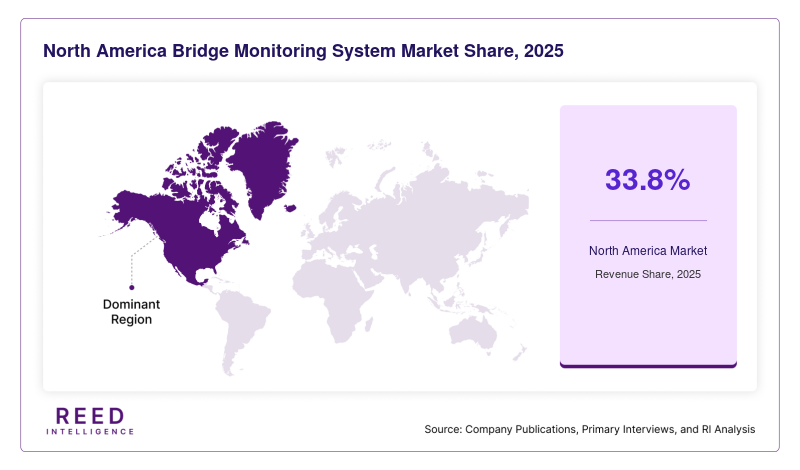
North America accounted for approximately 33.8% of the Bridge Monitoring System Market share in 2025 and is expected to maintain steady growth with a CAGR of 7.8% during the forecast period. The region’s growth is driven by extensive investments in infrastructure rehabilitation and the adoption of advanced monitoring technologies. Government initiatives focused on improving transportation safety and reducing maintenance costs are supporting market expansion. The presence of established technology providers further strengthens the regional market landscape.
The United States dominates the North American market due to its large inventory of aging bridges and strong regulatory framework. A unique growth factor is the implementation of federal infrastructure programs that mandate structural health monitoring for critical assets. These initiatives are encouraging the adoption of real-time monitoring systems, ensuring improved safety and operational efficiency across the country.
Europe
Europe held a significant market share of around 27.5% in 2025 and is projected to grow at a CAGR of 7.5% during 2026–2034. The region’s focus on sustainable infrastructure and strict safety regulations is driving the adoption of bridge monitoring systems. Countries are investing in digital infrastructure solutions to enhance asset management and reduce maintenance costs.
Germany leads the European market due to its advanced engineering capabilities and strong emphasis on infrastructure modernization. A key growth factor is the integration of smart technologies in transportation networks. Government initiatives promoting digital transformation are further accelerating the adoption of monitoring systems across the region.
Asia Pacific
Asia Pacific is expected to be the fastest-growing region, with a CAGR of 10.6% during the forecast period, capturing around 22.3% market share in 2025. Rapid urbanization and increasing infrastructure development are driving market growth. Governments are investing heavily in transportation networks to support economic expansion.
China dominates the regional market due to large-scale infrastructure projects and government investments. A unique growth factor is the rapid adoption of smart city initiatives, which include advanced monitoring systems for bridges. This is significantly boosting demand for innovative and scalable solutions.
Middle East & Africa
The Middle East & Africa region accounted for approximately 9.1% of the market share in 2025 and is expected to grow at a CAGR of 8.4%. Infrastructure development projects and investments in smart cities are driving market growth. Governments are focusing on improving transportation networks and ensuring structural safety.
Saudi Arabia is a key market in the region, driven by large-scale infrastructure projects. A unique growth factor is the integration of monitoring systems in newly constructed bridges as part of long-term urban development plans. This proactive approach is supporting market expansion.
Latin America
Latin America held a market share of around 7.3% in 2025 and is projected to grow at a CAGR of 8.1% during the forecast period. The region is witnessing increased investments in infrastructure modernization and maintenance. Governments are focusing on improving transportation efficiency and safety.
Brazil dominates the regional market due to its extensive transportation network. A unique growth factor is the growing adoption of cost-effective monitoring solutions to address budget constraints. This is encouraging the deployment of scalable systems across the region.
Competitive Landscape
The Bridge Monitoring System Market is characterized by the presence of several global and regional players competing on technology, innovation, and service offerings. Leading companies are focusing on developing advanced monitoring solutions that integrate IoT, AI, and cloud computing. Strategic partnerships and collaborations are common, enabling companies to expand their market presence and enhance product portfolios.
A key leader in the market is Trimble Inc., known for its advanced sensor technologies and integrated monitoring solutions. The company recently introduced a new cloud-based platform for real-time infrastructure monitoring, enhancing data accessibility and predictive capabilities. Other major players are investing in research and development to improve system accuracy and scalability. The competitive landscape is expected to remain dynamic, with companies focusing on innovation and strategic expansion to gain a competitive edge.
Key Players
- Trimble Inc.
- Siemens AG
- Honeywell International Inc.
- Fugro N.V.
- Hexagon AB
- Geokon Inc.
- Campbell Scientific Inc.
- Kistler Group
- Nova Metrix LLC
- COWI A/S
- Acellent Technologies Inc.
- Sixense Group
- Digitexx Data Systems Inc.
- RST Instruments Ltd.
- Structural Monitoring Systems Plc
Recent Developments
- In 2025, Trimble Inc. launched a cloud-based infrastructure monitoring platform to enhance real-time data analytics.
- In 2024, Siemens AG introduced an AI-driven bridge monitoring solution for predictive maintenance.
- In 2025, Hexagon AB expanded its sensor portfolio with advanced wireless monitoring devices for infrastructure applications.
Bridge Monitoring System Market Segments
Component
- Hardware (Sensors, Data Acquisition Systems)
- Software
- Services
Application
- Structural Health Monitoring
- Fatigue Monitoring
- Corrosion Monitoring
- Load Monitoring
End-Use
- Transportation Infrastructure
- Government & Municipal
- Private Infrastructure
By Region
- North America
- Europe
- APAC
- Middle East and Africa
- LATAM