Broadcasting Digital TV Market Size, Share & Demand Report By Broadcasting Technology (Digital Terrestrial Television (DTT), Digital Cable Television, IPTV Broadcasting, Hybrid Digital Broadcasting), By Content Type (Entertainment Broadcasting, Educational Broadcasting, Interactive and On-Demand Content), By End User (Residential Viewers, Commercial Viewing Facilities, Government Institutions, Hospitality and Tourism Facilities), By Region & Segment Forecasts, 2026–2034
USD 3950
Market Overview
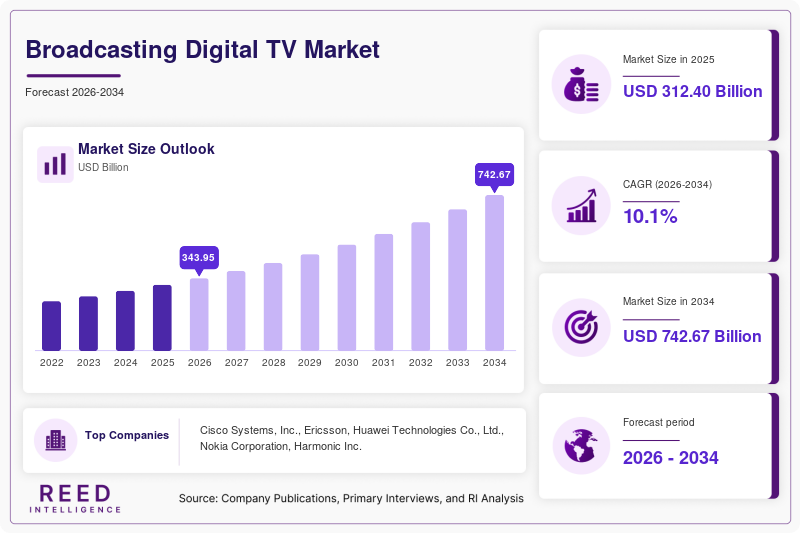
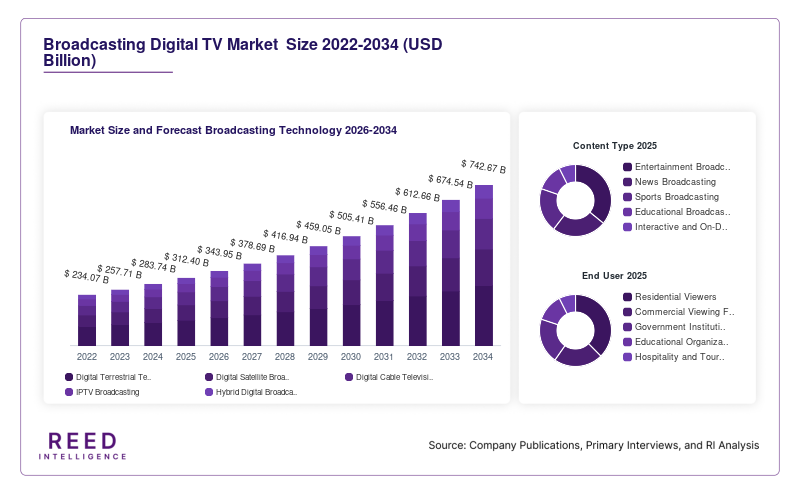
The global Broadcasting Digital TV Market size was valued at USD 312.4 billion in 2026 and is projected to reach USD 671.8 billion by 2034, expanding at a CAGR of 10.1% during 2026–2034. The market continues to evolve as broadcasters, network operators, and content providers transition from traditional analog systems toward digital transmission technologies capable of delivering enhanced picture quality, wider channel availability, and interactive viewing experiences.
A major global factor supporting market growth is the increasing consumption of high-definition and ultra-high-definition video content across television networks and digital broadcasting platforms. Consumers are demanding better visual quality, multi-device accessibility, and personalized viewing experiences. This shift has encouraged broadcasters to invest in advanced transmission infrastructure, cloud-based broadcasting systems, digital compression technologies, and next-generation content delivery networks.
Key Highlights
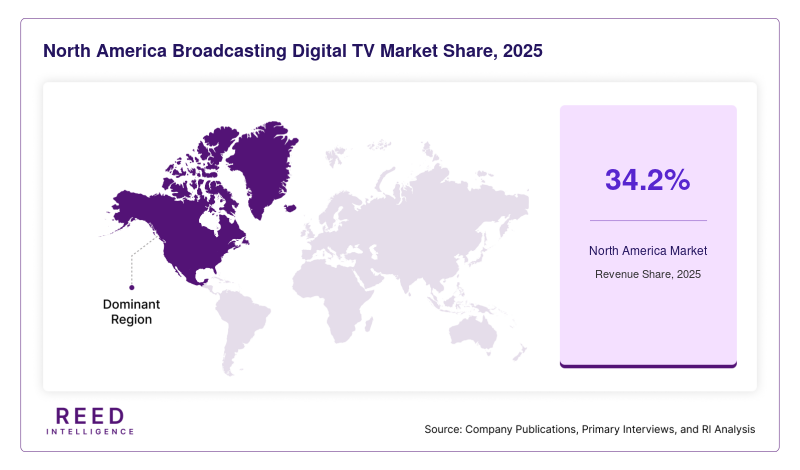
- North America dominated the market with a 34.2% share in 2025.
- while Asia Pacific is expected to grow at the fastest CAGR of 11.8% during 2026–2034.
- By broadcasting technology, Digital Terrestrial Television (DTT) accounted for the largest share of 39.1%.
- while Hybrid Digital Broadcasting is projected to grow at a CAGR of 12.7%.
- By content type, Entertainment Broadcasting led with a 43.4% share.
- whereas Interactive and On-Demand Content is expected to expand at a CAGR of 13.1%.
- By end user, Residential Viewers held the largest share of 68.3%.
- while Commercial Viewing Facilities are anticipated to grow at a CAGR of 10.9%.
- The United States remained the dominant country, with market values of USD 82.7 billion in 2024 and USD 89.6 billion in 2025.
Market Trends
Integration of Hybrid Broadcasting and Broadband Services
The Broadcasting Digital TV Market is witnessing substantial adoption of hybrid broadcasting systems that combine traditional broadcast transmission with internet-based content delivery. This trend is transforming viewer experiences by allowing seamless access to live television, catch-up programming, interactive applications, and personalized content recommendations through a single platform. Broadcasters are increasingly deploying hybrid architectures to enhance audience engagement while maintaining the reliability of conventional transmission systems. The growing availability of high-speed broadband networks and connected television devices supports this transformation. Hybrid broadcasting also enables targeted advertising capabilities, improving monetization opportunities for broadcasters and content providers while creating more relevant viewing experiences for consumers across developed and emerging markets.
Expansion of Ultra-High-Definition and Immersive Viewing Experiences
Another notable trend is the rapid deployment of ultra-high-definition broadcasting technologies. Television networks are investing heavily in 4K and emerging 8K broadcasting capabilities to meet rising consumer expectations for superior image quality. Broadcasters are also incorporating advanced audio technologies, immersive graphics, and enhanced sports coverage features to differentiate content offerings. As production costs decline and display technology becomes more affordable, viewers are increasingly adopting compatible devices. This trend is encouraging broadcasters to upgrade transmission infrastructure and content production workflows. The transition toward immersive viewing experiences is expected to influence content creation strategies, advertising models, and audience engagement practices throughout the forecast period.
Market Drivers
Rising Demand for High-Quality Digital Content
Consumer demand for superior entertainment experiences continues to drive growth in the Broadcasting Digital TV Market. Audiences increasingly prefer high-definition and ultra-high-definition programming that offers improved visual clarity and audio performance. The proliferation of large-screen televisions and connected home entertainment systems has elevated expectations for broadcast quality. Sports events, live concerts, and premium entertainment programming particularly benefit from digital broadcasting capabilities. Broadcasters are responding through investments in advanced encoding technologies, digital transmission systems, and content production facilities. These investments improve service quality while supporting audience retention. As digital content consumption continues to expand globally, broadcasters are expected to increase technology spending to remain competitive and satisfy evolving viewer preferences.
Government-Led Digital Broadcasting Initiatives
Government initiatives aimed at modernizing national broadcasting infrastructure represent another major growth driver. Many countries continue to implement digital migration programs that encourage the replacement of analog transmission systems with digital broadcasting networks. These initiatives improve spectrum utilization, support additional channel availability, and enhance broadcasting efficiency. Regulatory agencies are also introducing policies that encourage technological upgrades and wider digital television accessibility. Public investments in communication infrastructure further support market expansion. In several emerging economies, government-backed programs are helping rural populations gain access to digital television services. Such initiatives create opportunities for equipment manufacturers, broadcasters, and service providers while accelerating overall market development.
Market Restraint
High Infrastructure Modernization Costs
Despite favorable growth prospects, the Broadcasting Digital TV Market faces challenges associated with infrastructure modernization costs. The transition toward advanced digital broadcasting systems often requires significant capital investments in transmission equipment, production facilities, signal processing technologies, and network management platforms. Smaller broadcasters may struggle to finance these upgrades, particularly in regions with limited advertising revenue or slower digital adoption rates.
The challenge becomes more significant when broadcasters attempt to implement ultra-high-definition transmission capabilities, cloud-based broadcasting platforms, and advanced audience analytics systems simultaneously. Operational expenses related to workforce training, maintenance, cybersecurity, and technology integration can further increase financial pressure. For example, regional broadcasting companies transitioning from legacy analog infrastructure may require extensive network upgrades before achieving desired service quality improvements. These financial constraints can delay modernization projects and reduce the pace of digital broadcasting adoption in certain markets.
Market Opportunities
Growth of Digital Television Services in Emerging Economies
Emerging economies present substantial opportunities for market participants. Many developing countries continue to experience rising television penetration rates, expanding middle-class populations, and increasing demand for diverse digital content offerings. Government-supported digital migration programs are encouraging broadcasters to invest in modern transmission infrastructure and expand service coverage. As household purchasing power improves, demand for smart televisions and digital receivers is increasing. These developments create favorable conditions for broadcasting technology providers, equipment manufacturers, and content producers. Market participants that establish strategic partnerships with regional broadcasters and telecommunications operators can benefit from expanding viewer bases and infrastructure development initiatives across rapidly growing economies.
Adoption of Artificial Intelligence in Broadcasting Operations
Artificial intelligence is creating new opportunities throughout the broadcasting ecosystem. Broadcasters are increasingly deploying AI-powered solutions for content scheduling, audience analysis, advertisement placement, and automated production workflows. These technologies help improve operational efficiency while reducing manual intervention requirements. AI can also support personalized content recommendations and viewer engagement strategies, enabling broadcasters to enhance audience retention. As competition intensifies among content providers, data-driven decision-making capabilities become increasingly valuable. The integration of artificial intelligence with digital broadcasting infrastructure is expected to generate new revenue streams, improve content monetization strategies, and strengthen overall market competitiveness during the forecast period.
Segmental Analysis
By Broadcasting Technology
Digital Terrestrial Television (DTT) emerged as the dominant subsegment, accounting for approximately 39.1% of market share in 2024. The segment's leadership is primarily attributed to widespread deployment across developed and developing economies. DTT provides efficient spectrum utilization, improved picture quality, and broader channel availability compared to traditional analog systems. Governments worldwide have supported DTT adoption through digital migration programs aimed at modernizing broadcasting infrastructure. Broadcasters benefit from lower operating costs and enhanced transmission capabilities, making DTT a preferred technology for large-scale content distribution. The availability of affordable receiver devices and increasing consumer awareness continue to strengthen adoption rates across residential and commercial viewing environments.
Hybrid Digital Broadcasting is anticipated to be the fastest-growing subsegment, expanding at a CAGR of 12.7% during the forecast period. Growth is driven by increasing integration between traditional broadcasting networks and broadband internet services. Hybrid systems enable interactive applications, on-demand content access, personalized advertising, and enhanced audience engagement features. Broadcasters are adopting these solutions to remain competitive in an evolving media landscape characterized by changing viewer preferences. The proliferation of connected televisions and high-speed internet infrastructure further supports adoption. As content providers seek innovative monetization strategies and improved viewer experiences, hybrid broadcasting technologies are expected to experience substantial demand across global markets.
By Content Type
Entertainment Broadcasting represented the largest content category, accounting for approximately 43.4% of total market revenue in 2024. Entertainment programming remains the primary driver of audience engagement across digital television platforms. Broadcasters continue investing heavily in television series, movies, reality shows, and live entertainment events to attract viewers and advertisers. The increasing availability of high-definition and ultra-high-definition content further enhances the appeal of entertainment broadcasting. Consumer preferences for diverse content libraries and localized programming also support segment growth. Broadcasters are leveraging advanced production technologies to improve content quality and maintain audience loyalty in increasingly competitive media environments.
Interactive and On-Demand Content is projected to register the fastest CAGR of 13.1% through 2034. Consumers increasingly expect flexible viewing options that allow content access at their convenience. Broadcasters are responding by integrating digital television services with interactive applications, personalized recommendations, and cloud-based content libraries. Advancements in data analytics enable providers to better understand viewer behavior and optimize content offerings. The growing popularity of connected television platforms and hybrid broadcasting models supports demand for interactive services. These capabilities help broadcasters improve user engagement, generate targeted advertising revenue, and strengthen competitiveness within the evolving digital media ecosystem.
By End User
Residential Viewers accounted for the largest market share, representing approximately 68.3% of global revenue in 2024. Household television consumption remains the primary application for digital broadcasting services. Rising adoption of smart televisions, increasing demand for premium content, and improvements in broadcasting quality continue to drive segment growth. Consumers increasingly seek immersive viewing experiences supported by high-definition and ultra-high-definition content. Broadcasters are expanding content portfolios and investing in advanced transmission technologies to meet evolving household entertainment preferences. The segment also benefits from ongoing digital migration initiatives and broader access to digital television infrastructure across developed and emerging markets.
Commercial Viewing Facilities are expected to witness the fastest growth, advancing at a CAGR of 10.9% during the forecast period. This segment includes hotels, restaurants, sports venues, educational institutions, transportation hubs, and corporate facilities that rely on digital broadcasting services. Growing demand for premium entertainment experiences and real-time information distribution is encouraging investments in advanced broadcasting systems. Businesses increasingly deploy high-quality digital television solutions to improve customer experiences and engagement levels. Expansion of tourism infrastructure, commercial real estate development, and public information networks further supports demand. These factors collectively position commercial viewing facilities as a significant growth opportunity within the Broadcasting Digital TV Market.
Regional Analysis
North America
North America accounted for approximately 34.2% of the global Broadcasting Digital TV Market in 2025 and continues to maintain a leading position due to advanced broadcasting infrastructure and strong consumer demand for premium digital content. The region is projected to grow at a CAGR of 9.3% during the forecast period. Broadcasters continue investing in ultra-high-definition transmission systems, cloud broadcasting solutions, and audience analytics technologies. The presence of major media companies and technology providers supports ongoing innovation across the regional broadcasting landscape.
The United States remains the dominant country within the region. A unique growth factor is the extensive commercialization of sports broadcasting technologies that require high-capacity digital transmission systems. Broadcasters increasingly utilize advanced production capabilities to deliver enhanced viewing experiences during major sporting events. Strong advertising expenditure, widespread smart television adoption, and continuous investments in digital infrastructure further contribute to market growth across the country.
Europe
Europe represented nearly 27.4% of global market revenue in 2025 and is expected to register a CAGR of 8.8% through 2034. The region benefits from established digital broadcasting standards, strong regulatory support, and high household television penetration rates. Broadcasters across European countries continue upgrading networks to support high-definition and ultra-high-definition content delivery. Demand for multilingual content and regional broadcasting services also contributes to market expansion.
Germany leads the European market due to its advanced broadcasting ecosystem and significant investments in digital media infrastructure. A unique growth factor is the region's emphasis on public broadcasting modernization programs that encourage technology adoption and network upgrades. Broadcasters increasingly invest in energy-efficient transmission systems and digital production facilities, supporting long-term market development while improving operational performance across broadcasting networks.
Asia Pacific
Asia Pacific held approximately 24.6% of the Broadcasting Digital TV Market in 2025 and is projected to record the fastest CAGR of 11.8% between 2026 and 2034. Rapid urbanization, growing disposable incomes, and expanding access to digital entertainment services are driving market growth. Governments across the region continue implementing digital migration initiatives, encouraging broadcasters to modernize infrastructure and improve service coverage. Rising demand for localized content further supports investment in broadcasting capabilities.
China dominates the regional market due to its extensive broadcasting network and large television audience base. A unique growth factor is the rapid expansion of smart city initiatives that integrate advanced communication and broadcasting infrastructure. Investments in 5G-enabled media distribution, digital content production facilities, and next-generation transmission technologies are creating favorable conditions for sustained market expansion throughout the forecast period.
Middle East & Africa
The Middle East & Africa region accounted for approximately 7.2% of global revenue in 2025 and is expected to grow at a CAGR of 9.9% through 2034. Increasing investments in communication infrastructure and media development initiatives are supporting market growth. Several countries continue transitioning toward digital broadcasting systems to improve content accessibility and transmission efficiency. Growing demand for educational, entertainment, and cultural programming further contributes to market development.
The United Arab Emirates serves as the leading market within the region. A unique growth factor is the country's strong focus on media innovation and smart broadcasting infrastructure development. Government-supported technology initiatives encourage broadcasters to adopt advanced digital transmission systems and content delivery platforms. These investments strengthen broadcasting capabilities while supporting broader digital transformation objectives across the media sector.
Latin America
Latin America captured nearly 6.6% of the global market in 2025 and is forecast to expand at a CAGR of 9.1% during the study period. The region is experiencing steady growth as broadcasters upgrade infrastructure and expand digital television accessibility. Rising consumer demand for high-quality entertainment content and increased adoption of digital television receivers continue supporting market development. Regulatory initiatives promoting digital broadcasting migration also contribute to industry expansion.
Brazil remains the dominant country in the region. A unique growth factor is the strong popularity of locally produced television programming that drives demand for enhanced broadcasting capabilities. Broadcasters continue investing in digital production facilities and transmission networks to improve content quality and reach broader audiences. These developments are expected to strengthen market growth across the Latin American broadcasting ecosystem.
Competitive Landscape
The Broadcasting Digital TV Market is characterized by the presence of global technology providers, broadcasting equipment manufacturers, media companies, and digital infrastructure specialists. Market participants focus on product innovation, strategic partnerships, cloud-based broadcasting solutions, and network modernization initiatives to strengthen their competitive positions.
Cisco Systems, Inc. remains a leading market participant due to its extensive portfolio of broadcasting network solutions, content delivery technologies, and digital infrastructure capabilities. The company continues investing in software-defined broadcasting architectures and cloud-native media delivery platforms. Other major companies are expanding capabilities through acquisitions, technology collaborations, and artificial intelligence integration.
Recent industry developments have focused on ultra-high-definition broadcasting deployment, cloud-based content distribution platforms, and hybrid television technologies. Companies are increasingly emphasizing automation, data analytics, and audience engagement solutions to improve operational efficiency and create new revenue opportunities. Competitive intensity is expected to remain strong as broadcasters continue modernizing infrastructure and expanding digital service offerings worldwide.
Key Players
- Cisco Systems, Inc.
- Ericsson
- Huawei Technologies Co., Ltd.
- Nokia Corporation
- Harmonic Inc.
- Evertz Microsystems Ltd.
- Rohde & Schwarz GmbH & Co. KG
- Grass Valley
- CommScope Holding Company, Inc.
- ATEME
- Synamedia
- Imagine Communications
- MediaKind
- Belden Inc.
Recent Developments
- Cisco Systems introduced an advanced cloud-native broadcasting platform designed to improve content distribution efficiency and scalability for digital television operators.
- Ericsson expanded its digital media solutions portfolio through enhanced AI-driven content management capabilities aimed at improving broadcaster operational performance.
- Harmonic launched a next-generation video delivery solution supporting ultra-high-definition broadcasting and advanced compression technologies for improved bandwidth utilization.
- MediaKind announced strategic partnerships with regional broadcasters to accelerate deployment of hybrid television services and interactive viewing applications.
- Rohde & Schwarz expanded its digital transmission infrastructure offerings with upgraded broadcasting systems supporting emerging television standards and enhanced network reliability.
Broadcasting Digital TV Market Segments
Broadcasting Technology
- Digital Terrestrial Television (DTT)
- Digital Satellite Broadcasting
- Digital Cable Television
- IPTV Broadcasting
- Hybrid Digital Broadcasting
Content Type
- Entertainment Broadcasting
- News Broadcasting
- Sports Broadcasting
- Educational Broadcasting
- Interactive and On-Demand Content
End User
- Residential Viewers
- Commercial Viewing Facilities
- Government Institutions
- Educational Organizations
- Hospitality and Tourism Facilities
By Region
- North America
- Europe
- APAC
- Middle East and Africa
- LATAM