The global Bromoacetic Acid Market size was valued at USD 285.4 million in 2024 and is projected to reach USD 468.7 million by 2033, expanding at a CAGR of 5.7% (2025–2034). This report provides comprehensive market analysis, trends, forecasts, and insights across type, application, end-use industry, and regions.
USD 3950
Market Overview
The Bromoacetic Acid Market size was valued at USD 285.4 million in 2024 and is projected to reach USD 468.7 million by 2033, expanding at a CAGR of 5.7% from 2025 to 2034. The market growth is supported by the increasing utilization of bromoacetic acid as a chemical intermediate across pharmaceutical synthesis, agrochemical formulations, and specialty chemical manufacturing. Its reactivity and bromine substitution capability make it an essential reagent in producing active pharmaceutical ingredients, herbicides, and specialty esters.
One global factor supporting the expansion of the Bromoacetic Acid Market sizeis the increasing complexity of pharmaceutical manufacturing processes. Pharmaceutical companies are adopting advanced intermediates to enhance reaction efficiency and yield in drug synthesis. Bromoacetic acid plays a critical role in alkylation and esterification reactions used in producing several drug molecules and fine chemicals. As pharmaceutical research and contract manufacturing activities expand globally, the demand for specialty chemical intermediates continues to rise, strengthening the market outlook.
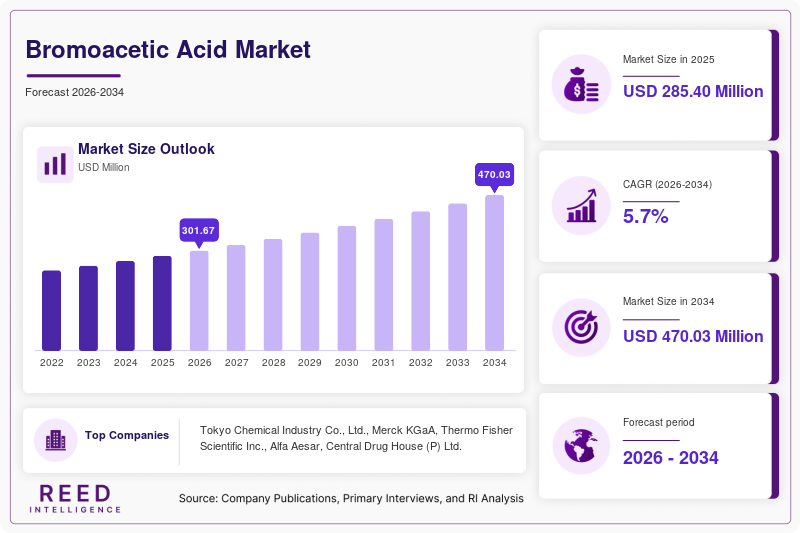
Key Highlights
- Asia Pacific dominated the market with 41.3% share in 2025, while Latin America is projected to register the fastest CAGR of 6.4% during 2025–2034.
- By Type, Industrial Grade accounted for the largest share in 2024, while Pharmaceutical Grade will grow the fastest at a 6.6% CAGR.
- By Application, Pharmaceutical Intermediates led the market share in 2024, while Agrochemical Intermediates will record the fastest growth at 6.8% CAGR.
- China remained the dominant country, with market value reaching USD 63.8 million in 2024 and USD 67.5 million in 2025.
Market Trends
Expansion of Specialty Chemical Manufacturing
The Bromoacetic Acid Marketis witnessing increasing demand due to the expansion of specialty chemical manufacturing facilities. Specialty chemicals require high-performance intermediates that enable precise molecular modifications. Bromoacetic acid is widely used to introduce bromine functionality in chemical synthesis processes. As industries such as pharmaceuticals, coatings, and advanced materials adopt specialized chemical formulations, manufacturers are increasing production capacities to meet growing demand. This trend is particularly visible in emerging manufacturing hubs where chemical production infrastructure is expanding.
Shift Toward High-Purity Chemical Intermediates
Another notable trend shaping the Bromoacetic Acid Market growthis the increasing focus on high-purity intermediates. Pharmaceutical and laboratory research applications require reagents with strict purity standards to ensure reliable results. As regulatory requirements for pharmaceutical production become more stringent, chemical suppliers are investing in purification technologies and quality control systems. High-purity bromoacetic acid grades are therefore gaining traction in research laboratories and drug development programs, contributing to a gradual shift in product portfolios across the market.
Market Drivers
Increasing Demand from Pharmaceutical Synthesis
The pharmaceutical sector remains a significant driver of the Bromoacetic Acid Market size. Bromoacetic acid is widely used as a key intermediate in synthesizing several pharmaceutical compounds. Its ability to facilitate substitution reactions makes it valuable in manufacturing complex molecules used in drug formulations. As pharmaceutical research expands and global drug production increases, chemical intermediates that support efficient synthesis processes are gaining importance. The expansion of contract development and manufacturing organizations is also contributing to increased demand.
Rising Production of Agrochemical Intermediates
Agricultural productivity demands have increased the need for efficient crop protection solutions. Bromoacetic acid is used as an intermediate in producing certain herbicides and agrochemical compounds. As global agricultural activities intensify and farmers adopt improved crop management practices, the demand for chemical intermediates used in agrochemical production continues to grow. Chemical manufacturers are therefore strengthening supply chains for brominated intermediates, which supports market expansion.
Market Restraint
Handling Risks and Chemical Safety Concerns
One of the key restraints in the Bromoacetic Acid Marketinvolves safety concerns related to handling and storage. Bromoacetic acid is a highly reactive compound and requires controlled manufacturing, transportation, and storage environments. Improper handling may pose risks to workers and manufacturing equipment. As a result, chemical producers must implement strict safety protocols and specialized infrastructure to maintain product stability and worker safety. These requirements can increase operational costs and limit production scalability in certain regions.
Market Opportunities
Growth in Contract Chemical Manufacturing
Contract chemical manufacturing is expanding as pharmaceutical and specialty chemical companies outsource intermediate production. This creates new opportunities for the Bromoacetic Acid Market, as contract manufacturers require reliable supplies of chemical reagents for synthesis processes. The increasing adoption of outsourcing models allows chemical suppliers to establish long-term supply agreements with contract manufacturers, supporting stable market growth.
Development of Advanced Laboratory Reagents
Research institutions and biotechnology companies increasingly rely on specialized reagents for chemical and biochemical studies. Bromoacetic acid derivatives are used in biochemical modification processes and laboratory experiments. As global research funding increases and biotechnology innovation accelerates, demand for laboratory-grade reagents is expected to rise. This creates opportunities for manufacturers to develop customized high-purity bromoacetic acid products designed specifically for research applications.
Segmental Analysis
By Type
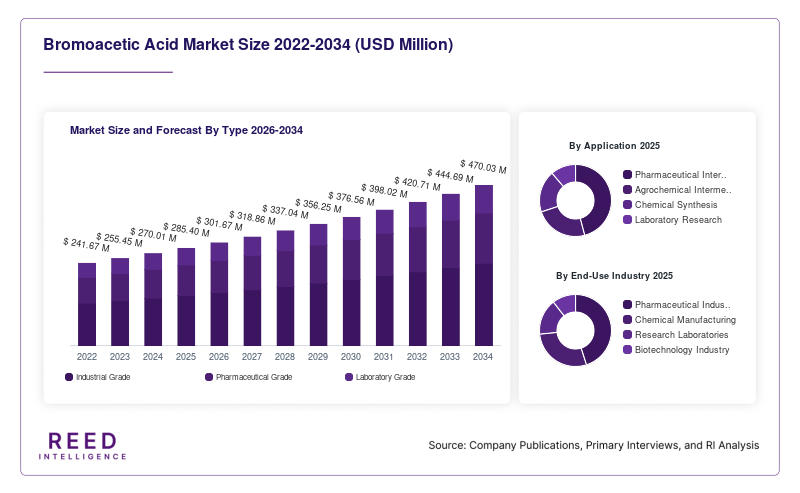
Industrial grade bromoacetic acid dominated the Bromoacetic Acid Market sharein 2024, accounting for 58.6% of total revenue. This grade is widely used in chemical manufacturing processes where high-volume production and moderate purity requirements are acceptable. Industrial grade bromoacetic acid serves as a precursor in producing several brominated compounds and specialty chemical intermediates.
Pharmaceutical grade bromoacetic acid will expand at a CAGR of 6.6% through 2034. This growth will be driven by the need for high-purity reagents in pharmaceutical synthesis. Drug manufacturing processes require controlled reaction conditions and precise chemical inputs to maintain product consistency. Pharmaceutical-grade intermediates therefore command increasing demand in research laboratories and drug development facilities.
By Application
Pharmaceutical intermediates represented the largest application segment with 46.1% market share in 2024. Bromoacetic acid plays a role in synthesizing several complex organic molecules used in pharmaceutical manufacturing. The compound enables substitution reactions that allow researchers to introduce functional groups into drug molecules.
Agrochemical intermediates will record the fastest CAGR of 6.8% during the forecast period. This growth will be influenced by the rising need for efficient crop protection chemicals. Agrochemical producers are increasing production of herbicides and specialized crop management chemicals. Bromoacetic acid will continue to be used as a building block in these formulations.
By End-Use Industry
The pharmaceutical industry held 39.4% share of the Bromoacetic Acid Market in 2024. Drug manufacturers require various chemical intermediates to synthesize complex compounds used in medications. Bromoacetic acid’s chemical reactivity enables efficient modification of organic molecules, making it suitable for pharmaceutical synthesis processes.
Research laboratories will grow at a CAGR of 6.5% during 2025–2034. Academic institutions, biotechnology firms, and industrial research centers increasingly conduct advanced chemical experiments. Laboratory researchers rely on specialized reagents to perform organic synthesis and biochemical modification processes. This will expand demand for laboratory-grade bromoacetic acid.
Regional Analysis
North America
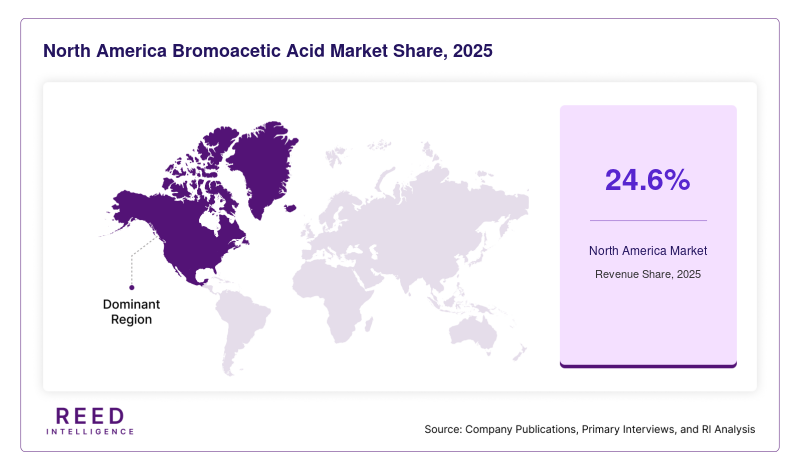
North America accounted for 24.6% of the global Bromoacetic Acid Market share in 2025. The regional market had demonstrated steady growth due to the presence of advanced chemical manufacturing infrastructure and established research facilities. The market will expand at a CAGR of 5.3% between 2025 and 2034. Growth prospects are supported by increasing demand for specialty chemical intermediates used in laboratory research and chemical synthesis applications.
The United Statesdominated the North American market. One factor contributing to the country’s market growth is the strong presence of research laboratories and chemical innovation centers. Universities and industrial laboratories frequently use brominated reagents in experimental chemistry and materials research. As research institutions continue expanding laboratory capabilities, the demand for specialized reagents such as bromoacetic acid will increase steadily.
Europe
Europe held approximately 22.8% share of the Bromoacetic Acid Market in 2025. The region had a stable chemical manufacturing base supported by advanced regulatory frameworks and well-developed supply chains. The market will grow at a CAGR of 5.1% through 2034. European manufacturers focus on producing specialty chemicals for high-value industrial applications, which contributes to steady consumption of brominated intermediates.
Germanyemerged as the dominant country in Europe. The country’s strong chemical manufacturing sector supports demand for advanced intermediates used in specialty chemical formulations. German chemical producers often emphasize precision manufacturing and process optimization. This approach increases the use of specialized reagents in chemical synthesis, strengthening the demand for bromoacetic acid in industrial applications.
Asia Pacific
Asia Pacific represented the largest share of the Bromoacetic Acid Market at 41.3% in 2025. Rapid industrialization and the expansion of chemical production facilities across emerging economies had strengthened the region’s market presence. The regional market will grow at a CAGR of 6.0% during 2025–2034, driven by increasing production of specialty chemicals and chemical intermediates.
Chinaremained the leading country in the region. A key growth factor is the country’s extensive chemical manufacturing ecosystem, which includes large-scale production of brominated compounds and specialty reagents. Chinese manufacturers have established integrated supply chains that support efficient production and distribution of chemical intermediates. The availability of large-scale manufacturing facilities allows suppliers to meet both domestic and international demand.
Middle East & Africa
The Middle East & Africa accounted for 6.4% of the global Bromoacetic Acid Market share in 2025. The region had shown moderate development in chemical production capacity. The market will expand at a CAGR of 5.6% through 2034. Growth prospects are linked to increasing investments in industrial chemical production and infrastructure development.
Saudi Arabialed the regional market. The country has invested in expanding its chemical production sector as part of broader industrial diversification initiatives. Large-scale petrochemical and chemical complexes support the development of intermediate chemical manufacturing. These facilities create opportunities for producing and distributing brominated compounds such as bromoacetic acid.
Latin America
Latin America accounted for 4.9% share of the Bromoacetic Acid Market in 2025. Although relatively smaller in size, the regional market had demonstrated gradual expansion due to the development of chemical processing industries. The market will grow at the fastest CAGR of 6.4% during 2025–2034.
Brazilemerged as the dominant country within the region. The country’s chemical manufacturing sector continues to expand with increasing investment in industrial production facilities. Brazil’s chemical companies are focusing on supplying intermediates for various industrial processes. This expanding industrial ecosystem contributes to steady demand for brominated reagents used in chemical synthesis.
Competitive Landscape
The Bromoacetic Acid Marketis moderately consolidated, with several global chemical manufacturers supplying brominated intermediates to pharmaceutical, chemical, and research industries. Companies focus on improving product purity, expanding manufacturing capacity, and strengthening distribution networks.
Tokyo Chemical Industry Co., Ltd.remains one of the leading suppliers due to its extensive portfolio of laboratory reagents and specialty chemicals. The company recently expanded its high-purity chemical intermediate production capabilities to support pharmaceutical research applications.
Other key players emphasize strategic partnerships with chemical distributors and research institutions to improve product availability. Continuous investment in chemical synthesis technology and quality assurance systems remains essential for maintaining competitive positioning in the global market.
Key Players List
- Tokyo Chemical Industry Co., Ltd.
- Merck KGaA
- Thermo Fisher Scientific Inc.
- Alfa Aesar
- Central Drug House (P) Ltd.
- Toronto Research Chemicals
- Acros Organics
- Loba Chemie Pvt. Ltd.
- Spectrum Chemical Manufacturing Corp.
- Santa Cruz Biotechnology Inc.
- TCI America
- Oakwood Chemical
- Apollo Scientific Ltd.
- Sisco Research Laboratories Pvt. Ltd.
- Biosynth Ltd.
Recent Developments
- 2024: Tokyo Chemical Industry expanded its reagent purification facility to enhance production of high-purity brominated intermediates.
- 2023: Merck KGaA introduced upgraded laboratory reagent packaging to improve storage stability of reactive chemicals.
- 2023: Thermo Fisher Scientific expanded distribution of specialty reagents across Asia Pacific laboratories.
- 2022: Spectrum Chemical Manufacturing enhanced its pharmaceutical-grade chemical production capabilities.
- 2022: Toronto Research Chemicals expanded its catalog of organic intermediates used in pharmaceutical synthesis.
Bromoacetic Acid Market Segments
By Type
- Industrial Grade
- Pharmaceutical Grade
- Laboratory Grade
By Application
- Pharmaceutical Intermediates
- Agrochemical Intermediates
- Chemical Synthesis
- Laboratory Research
By End-Use Industry
- Pharmaceutical Industry
- Chemical Manufacturing
- Research Laboratories
- Biotechnology Industry
By Region
- North America
- Europe
- APAC
- Middle East and Africa
- LATAM