Bronchial Hyperreactivity Market Size, Share Demand Report By Drug Class (Inhaled Corticosteroids (ICS), Bronchodilators, Leukotriene Modifiers, Biologics), By Diagnosis Method (Pulmonary Function Tests (PFTs), Fractional Exhaled Nitric Oxide (FeNO) Testing, Bronchial Provocation Tests), By Route of Administration (Inhalation, Oral, Injectable), By End-User (Hospitals, Clinics, Homecare Settings), By Region & Segment Forecasts, 2026–2034
USD 3950
Market Overview
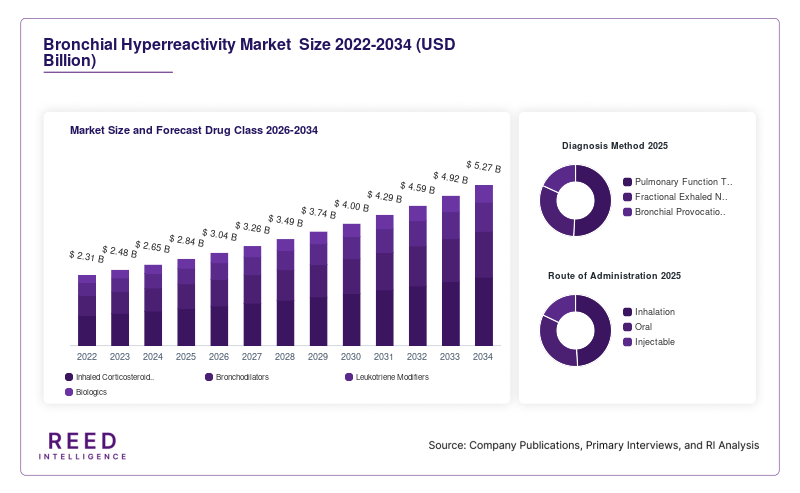
The Bronchial Hyperreactivity Market size was valued at approximately USD 2.84 billion in 2026 and is projected to reach USD 4.92 billion by 2034, expanding at a CAGR of 7.1% during the forecast period (2026–2034). The market is gaining steady momentum due to the increasing prevalence of respiratory disorders characterized by airway sensitivity, including asthma and chronic obstructive pulmonary conditions.
A major global factor supporting the growth of the Bronchial Hyperreactivity Market is the rising burden of air pollution and environmental allergens, which has significantly increased the incidence of airway inflammation and hypersensitivity reactions worldwide. Urbanization and industrial emissions continue to contribute to worsening air quality, thereby increasing the demand for effective diagnostic and therapeutic solutions.
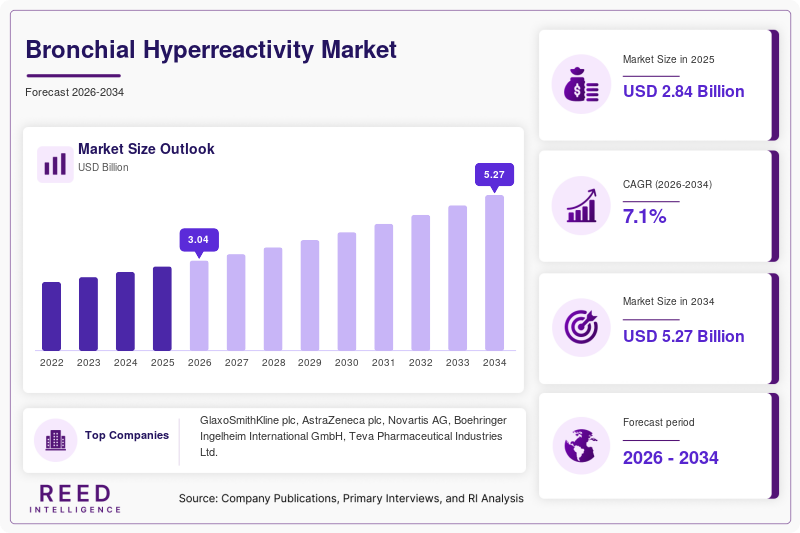
Key Highlights
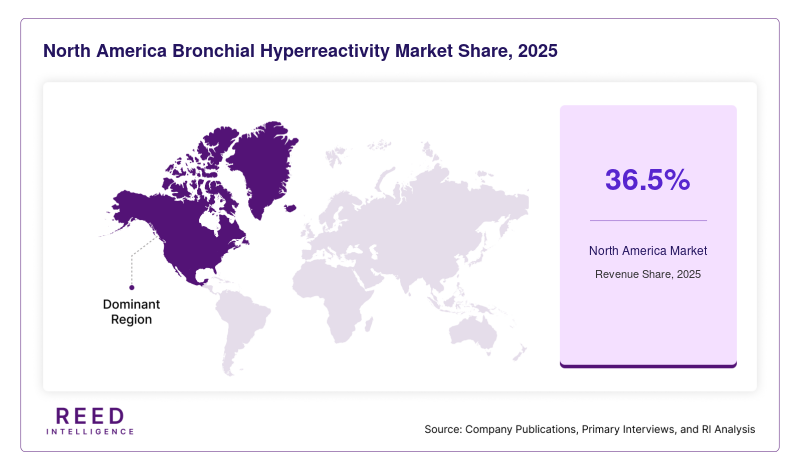
- North America dominated the market with a share of 36.5% in 2025, while Asia Pacific is expected to register the fastest growth at a CAGR of 8.4%.
- By drug class, Inhaled Corticosteroids (ICS) held the leading share of 41.2% in 2025, whereas Biologics are projected to grow at a CAGR of 9.3%.
- By diagnosis method, Pulmonary Function Tests (PFTs) accounted for the largest share of 48.6% in 2025, while Fractional Exhaled Nitric Oxide (FeNO) Testing is expected to expand at a CAGR of 8.9%.
- The United States, the dominant country, recorded a market value of USD 812 million in 2024, which increased to USD 846 million in 2025, supported by high diagnosis rates and advanced healthcare infrastructure.
Market Trends
Increasing Adoption of Biologic Therapies
The Bronchial Hyperreactivity Market is experiencing a shift toward targeted biologic therapies designed to address specific inflammatory pathways. These therapies offer improved efficacy for patients with severe or treatment-resistant conditions, leading to increased adoption among healthcare providers.
Growth of Non-Invasive Diagnostic Technologies
Non-invasive diagnostic tools are gaining traction due to their ability to detect airway inflammation with minimal patient discomfort. Technologies such as FeNO testing and advanced spirometry devices are becoming integral to early diagnosis and disease monitoring.
Market Drivers
Rising Prevalence of Respiratory Disorders
The growing incidence of asthma and related respiratory conditions is a primary driver of the Bronchial Hyperreactivity Market. Factors such as pollution, smoking, and occupational exposure are contributing to increased disease prevalence globally.
Advancements in Treatment Modalities
Continuous advancements in pharmacological treatments and inhalation therapies are enhancing patient outcomes. The development of combination therapies and long-acting formulations is driving adoption and improving disease management.
Market Restraint
High Cost of Advanced Therapies
The cost associated with biologic treatments and advanced diagnostic procedures remains a significant restraint in the Bronchial Hyperreactivity Market, limiting accessibility in low- and middle-income regions.
Market Opportunities
Expansion of Personalized Medicine
The shift toward personalized medicine offers significant opportunities in the Bronchial Hyperreactivity Market. Tailored treatment approaches based on patient-specific biomarkers can improve therapeutic outcomes and reduce adverse effects.
Increasing Healthcare Access in Emerging Markets
Improved healthcare infrastructure and rising awareness in emerging economies present growth opportunities. Governments and private organizations are investing in respiratory care, driving demand for diagnostic and treatment solutions.
Segmental Analysis
By Drug Class
Inhaled Corticosteroids (ICS) dominated the Bronchial Hyperreactivity Market with a 41.2% share in 2025, owing to their effectiveness in reducing airway inflammation.
Biologics are projected to grow at a CAGR of 9.3%, supported by their targeted action and increasing use in severe cases.
By Diagnosis Method
Pulmonary Function Tests (PFTs) held the largest share of 48.6% in 2025, as they are widely used for diagnosing airway responsiveness.
Fractional Exhaled Nitric Oxide (FeNO) Testing is expected to grow at a CAGR of 8.9%, driven by its non-invasive nature and ability to detect inflammation early.
By Route of Administration
Inhalation therapy dominated the market with a 63.7% share in 2025, due to its direct delivery to the lungs and rapid action.
Oral administration is anticipated to grow at a CAGR of 6.6%, supported by patient convenience and ease of use.
By End-User
Hospitals accounted for the largest share of 52.4% in 2025, driven by access to advanced diagnostic and treatment facilities.
Homecare settings are expected to grow at a CAGR of 7.8%, supported by the increasing adoption of portable diagnostic devices and self-management therapies.
Regional Analysis
North America
North America accounted for 36.5% of the market share in 2025 and is expected to grow at a CAGR of 6.8% during the forecast period. The United States dominated the region due to high healthcare spending and widespread adoption of advanced respiratory treatments.
Europe
Europe held a 25.4% market share in 2025 and is projected to grow at a CAGR of 6.5%. Germany emerged as the dominant country, supported by strong healthcare systems and increasing focus on respiratory disease management.
Asia Pacific
Asia Pacific captured 22.7% of the market share in 2025 and is expected to grow at the fastest CAGR of 8.4%. China dominated the region due to rising pollution levels and increasing awareness about respiratory health.
Middle East & Africa
The Middle East & Africa region held 8.1% of the market share in 2025 and is anticipated to grow at a CAGR of 7.2%. The United Arab Emirates led the region, driven by investments in healthcare infrastructure and diagnostic capabilities.
Latin America
Latin America accounted for 7.3% of the market share in 2025 and is expected to grow at a CAGR of 7.0%. Brazil dominated the region due to its expanding healthcare sector and increasing focus on chronic disease management.
Competitive Landscape
The Bronchial Hyperreactivity Market is characterized by a mix of established pharmaceutical companies and emerging biotech firms. GlaxoSmithKline plc leads the market with a strong portfolio of respiratory therapies and continuous investment in research and development. AstraZeneca and Novartis AG are key players, focusing on innovative biologic treatments and inhalation therapies. Boehringer Ingelheim contributes significantly through its advanced respiratory drug portfolio.
Teva Pharmaceutical Industries Ltd. is also active, offering generic and branded products to expand market reach. Companies are prioritizing product innovation, strategic collaborations, and geographic expansion to strengthen their positions. Recent developments include the launch of new biologic therapies and advancements in inhalation delivery systems, which are expected to shape the competitive landscape of the Bronchial Hyperreactivity Market.
Key Players List
- GlaxoSmithKline plc
- AstraZeneca plc
- Novartis AG
- Boehringer Ingelheim International GmbH
- Teva Pharmaceutical Industries Ltd.
- Sanofi S.A.
- Roche Holding AG
- Merck & Co., Inc.
- Pfizer Inc.
- Cipla Limited
- Sun Pharmaceutical Industries Ltd.
- Mylan N.V.
- Dr. Reddy’s Laboratories Ltd.
- Chiesi Farmaceutici S.p.A.
- Hikma Pharmaceuticals PLC
Recent Developments
- In 2025, GlaxoSmithKline launched a new inhaled therapy targeting airway inflammation.
- AstraZeneca introduced an advanced biologic treatment for severe asthma patients.
- Novartis expanded its respiratory drug portfolio with a focus on personalized medicine.
- Boehringer Ingelheim invested in research for improved inhalation delivery systems.
- Teva Pharmaceutical Industries enhanced its generic respiratory drug offerings to increase market accessibility.
Bronchial Hyperreactivity Market Segments
Drug Class
- Inhaled Corticosteroids (ICS)
- Bronchodilators
- Leukotriene Modifiers
- Biologics
Diagnosis Method
- Pulmonary Function Tests (PFTs)
- Fractional Exhaled Nitric Oxide (FeNO) Testing
- Bronchial Provocation Tests
Route of Administration
- Inhalation
- Oral
- Injectable
End-User
- Hospitals
- Clinics
- Homecare Settings
By Region
- North America
- Europe
- APAC
- Middle East and Africa
- LATAM