Bubble Wrap Machine Market Size, Share, Demand Report By Machine Type (Semi-Automatic Bubble Wrap Machines, Portable Bubble Wrap Machines), By Application (E-commerce Packaging, Electronics Packaging, Pharmaceutical Packaging, Industrial Packaging), By End-Use Industry (Logistics and Transportation, Retail) By Region & Segment Forecasts, 2026–2034
USD 3950
Market Overview
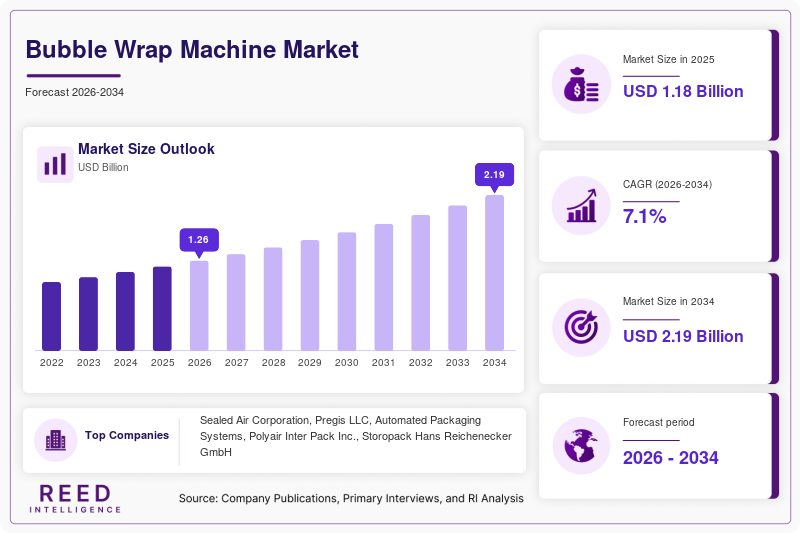
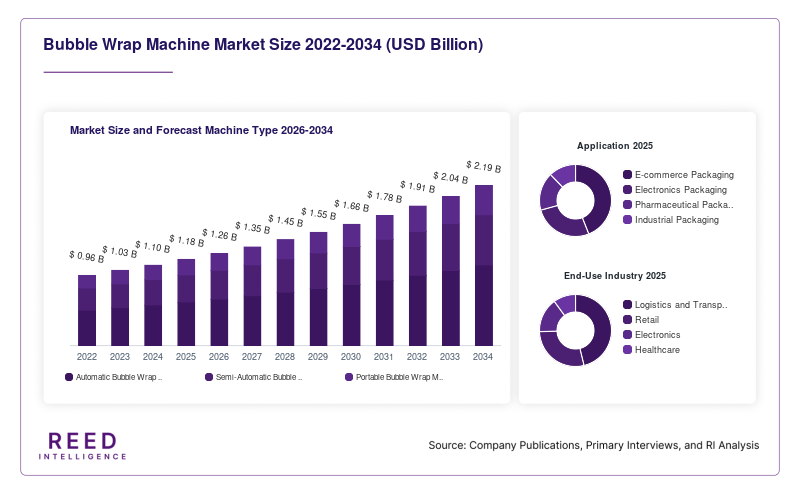
The Bubble Wrap Machine Market size was valued at approximately USD 1.18 billion in 2026 and is projected to reach USD 2.05 billion by 2034, expanding at a CAGR of 7.1% during the forecast period (2026–2034). The market has experienced steady growth due to the increasing demand for protective packaging solutions across industries such as e-commerce, electronics, automotive, and pharmaceuticals. Bubble wrap machines play a critical role in on-demand packaging production, enabling manufacturers and logistics providers to reduce storage costs while ensuring product safety during transportation.
One of the key global factors supporting market growth is the rapid expansion of e-commerce and cross-border trade. The surge in online retail activity has led to a growing need for efficient, cost-effective, and scalable packaging systems. Bubble wrap machines allow businesses to produce packaging materials in-house, minimizing dependency on pre-manufactured packaging and reducing overall operational costs. This trend has significantly contributed to the adoption of automated and semi-automated bubble wrap machines across warehouses and distribution centers worldwide.
Key Highlights
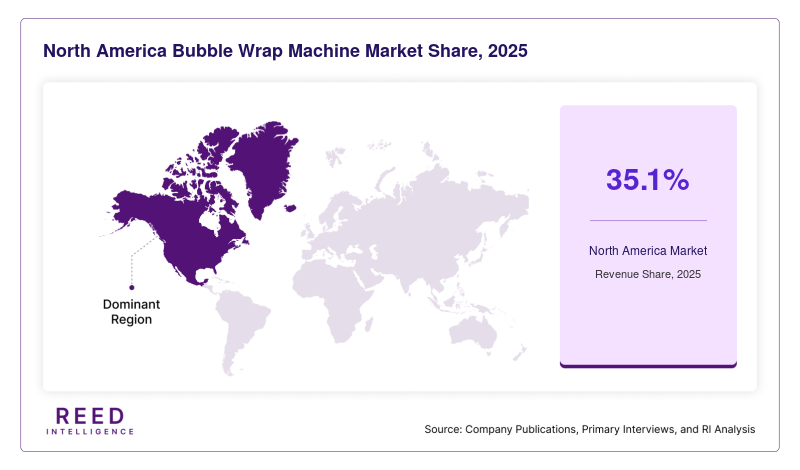
- North America dominated the market with a 35.1% share in 2025.
- Asia Pacific is expected to grow at the fastest CAGR of 8.6% during 2026–2034.
- By machine type, automatic bubble wrap machines accounted for the largest share of 42.8%, while portable bubble wrap machines are projected to grow at a CAGR of 9.3%.
- By application, e-commerce packaging led with a 44.6% share, whereas pharmaceutical packaging is expected to expand at a CAGR of 8.9%.
- The United States remained the dominant country, with market values of USD 390 million in 2024 and USD 425 million in 2025.
Market Trends
Growing adoption of on-demand packaging systems
The market is witnessing a steady shift toward on-demand packaging systems, which allow companies to produce bubble wrap as needed rather than storing bulk quantities. This trend is gaining traction among small and medium enterprises that aim to optimize storage space and reduce material waste. On-demand machines also improve operational efficiency by minimizing packaging downtime and ensuring a consistent supply of protective materials. Furthermore, these systems support customization, enabling businesses to produce bubble wrap of varying sizes and thickness based on specific product requirements. The integration of digital controls and user-friendly interfaces has further enhanced adoption across industries.
Integration of automation and smart technologies
Automation and smart technologies are reshaping the bubble wrap machine landscape. Manufacturers are increasingly incorporating features such as IoT-enabled monitoring, predictive maintenance, and automated film feeding systems. These advancements help reduce manual intervention and improve production efficiency. Smart bubble wrap machines can track usage patterns, optimize material consumption, and alert operators to potential maintenance issues, reducing downtime. Additionally, integration with warehouse management systems allows seamless coordination between packaging and logistics operations. This trend is particularly prominent in large-scale distribution centers and fulfillment hubs, where speed and accuracy are critical for meeting customer expectations.
Market Drivers
Expansion of e-commerce and logistics sectors
The rapid growth of e-commerce and logistics sectors has significantly driven demand for bubble wrap machines. As online retail continues to expand, businesses are under pressure to deliver products safely and efficiently. Bubble wrap remains one of the most reliable protective packaging materials due to its cushioning properties and versatility. Companies are increasingly investing in bubble wrap machines to produce packaging materials in-house, reducing reliance on external suppliers and improving supply chain efficiency. The rise of same-day and next-day delivery services has further amplified the need for quick and reliable packaging solutions, making bubble wrap machines an essential component of modern logistics infrastructure.
Rising demand for cost-efficient packaging solutions
Cost efficiency has become a critical factor for businesses operating in competitive markets. Bubble wrap machines offer a practical solution by enabling companies to produce packaging materials on demand, reducing storage and transportation costs associated with pre-made bubble wrap. These machines also minimize material wastage, as users can produce only the required quantity. Additionally, advancements in machine design have improved energy efficiency, further lowering operational costs. The ability to customize bubble wrap dimensions and thickness adds to their appeal, allowing businesses to optimize packaging for different products while maintaining cost control. This has driven widespread adoption across various industries.
Market Restraint
High initial investment and maintenance costs
One of the primary challenges facing the bubble wrap machine market is the relatively high initial investment required for advanced equipment. Small and medium-sized enterprises often find it difficult to justify the upfront cost, especially when compared to purchasing pre-manufactured bubble wrap. Additionally, maintenance and repair costs can add to the financial burden, particularly for automated machines with complex components. Regular servicing and the need for skilled technicians can increase operational expenses over time. This restraint can slow adoption in price-sensitive markets, where businesses prioritize short-term cost savings over long-term efficiency gains. Despite these challenges, manufacturers are working to develop more affordable and user-friendly solutions to address this issue.
Market Opportunities
Increasing focus on sustainable packaging solutions
Sustainability has become a major focus in the packaging industry, creating new opportunities for bubble wrap machine manufacturers. Companies are exploring eco-friendly materials, such as biodegradable films and recycled plastics, to produce bubble wrap with reduced environmental impact. Bubble wrap machines that support these materials are gaining popularity among environmentally conscious businesses. Governments and regulatory bodies are also encouraging the adoption of sustainable packaging through policies and incentives. This shift presents an opportunity for manufacturers to innovate and develop machines compatible with green materials, catering to the growing demand for sustainable packaging solutions across industries.
Growing demand in emerging economies
Emerging economies present significant growth opportunities for the bubble wrap machine market. Rapid industrialization, urbanization, and the expansion of retail and e-commerce sectors in countries across Asia, Latin America, and Africa are driving demand for efficient packaging solutions. Businesses in these regions are increasingly adopting bubble wrap machines to improve packaging quality and reduce operational costs. The rising middle-class population and increasing consumer spending further support market growth. Additionally, government initiatives aimed at boosting manufacturing and logistics infrastructure are creating a favorable environment for market expansion. Manufacturers are focusing on these regions to tap into untapped potential and strengthen their global presence.
Segmental Analysis
By Machine Type
Automatic bubble wrap machines dominated the market, accounting for 42.8% of the share in 2024. These machines are widely used in large-scale operations due to their ability to produce high volumes of bubble wrap with minimal human intervention. They offer consistent quality and improved efficiency, making them ideal for industries such as e-commerce, electronics, and logistics. The integration of advanced features such as digital controls and automated film feeding systems further enhances their appeal.
Portable bubble wrap machines are expected to grow at the fastest CAGR of 9.3% during the forecast period. Their compact size and ease of use make them suitable for small businesses and on-site packaging requirements. The increasing demand for flexible and mobile packaging solutions is driving their adoption. These machines allow businesses to produce bubble wrap as needed, reducing storage requirements and improving operational efficiency.
By Application
E-commerce packaging emerged as the dominant application segment, holding a 44.6% share in 2024. The rapid growth of online retail has increased the need for reliable protective packaging solutions. Bubble wrap machines enable e-commerce companies to produce packaging materials in-house, ensuring a consistent supply and reducing costs. The ability to customize packaging based on product size and fragility further supports this segment’s dominance.
Pharmaceutical packaging is expected to grow at the fastest CAGR of 8.9% during the forecast period. The need to protect sensitive medical products during transportation has driven demand for high-quality packaging solutions. Bubble wrap machines play a crucial role in ensuring product safety and compliance with regulatory standards. The growth of the pharmaceutical industry and increasing focus on product integrity are key factors driving this segment.
By End-Use Industry
The logistics and transportation sector held the largest share of 39.7% in 2024. This segment relies heavily on protective packaging to ensure the safe delivery of goods. Bubble wrap machines are widely used in warehouses and distribution centers to produce packaging materials on demand. The increasing volume of shipments and the need for efficient packaging solutions have contributed to this segment’s dominance.
The electronics industry is projected to grow at the fastest CAGR of 8.4% during the forecast period. The need to protect delicate electronic components during shipping has driven demand for bubble wrap packaging. The growth of consumer electronics and the increasing complexity of electronic devices further support this segment. Bubble wrap machines provide a reliable solution for producing customized packaging that meets the specific requirements of electronic products.
Regional Analysis
North America
North America held a dominant share of 35.1% in 2025 and is expected to maintain steady growth with a CAGR of 6.5% during the forecast period. The region benefits from a well-established e-commerce sector and advanced logistics infrastructure, which drive demand for efficient packaging solutions. The presence of major market players and continuous technological advancements further support market growth.
The United States remains the leading country in this region, driven by its large-scale e-commerce operations and strong industrial base. A unique growth factor is the increasing adoption of automation in warehouses, where companies are integrating bubble wrap machines with automated packaging lines to enhance efficiency and reduce labor costs.
Europe
Europe accounted for a significant market share of 27.4% in 2025 and is projected to grow at a CAGR of 6.8% during the forecast period. The region's focus on sustainability and stringent environmental regulations have influenced the adoption of eco-friendly packaging solutions. This has led to increased demand for advanced bubble wrap machines capable of processing recyclable materials.
Germany stands out as the dominant country in Europe, supported by its strong manufacturing sector and emphasis on innovation. A unique growth factor is the region’s push toward circular economy practices, encouraging businesses to adopt packaging solutions that minimize waste and promote recycling.
Asia Pacific
Asia Pacific is expected to witness the fastest growth, with a CAGR of 8.6% during the forecast period, and held a market share of 23.9% in 2025. The region’s rapid industrialization and expanding e-commerce sector are key drivers of market growth. Increasing investments in logistics infrastructure further support the adoption of bubble wrap machines.
China dominates the Asia Pacific market, driven by its massive manufacturing base and growing online retail industry. A unique growth factor is the rise of cross-border e-commerce, which has increased the need for reliable packaging solutions to ensure product safety during international shipping.
Middle East & Africa
The Middle East & Africa region held a smaller share of 7.2% in 2025 but is expected to grow at a CAGR of 6.3% during the forecast period. The region is gradually adopting advanced packaging technologies as industries modernize and expand. Growth is supported by increasing investments in logistics and retail sectors.
The United Arab Emirates is the dominant country in this region, benefiting from its strategic location as a global trade hub. A unique growth factor is the rapid development of logistics and warehousing infrastructure, which drives demand for efficient packaging solutions, including bubble wrap machines.
Latin America
Latin America accounted for 6.4% of the market share in 2025 and is projected to grow at a CAGR of 6.6% during the forecast period. The region is experiencing steady growth due to the expansion of retail and manufacturing sectors. Increasing adoption of automated packaging solutions is also contributing to market development.
Brazil leads the market in Latin America, supported by its large consumer base and growing e-commerce industry. A unique growth factor is the increasing investment in local manufacturing, which drives demand for cost-effective and efficient packaging solutions to support domestic production.
Competitive Landscape
The bubble wrap machine market is moderately competitive, with several global and regional players competing to expand their market presence. Key companies focus on product innovation, technological advancements, and strategic partnerships to strengthen their position. The market leader, Sealed Air Corporation, maintains a strong presence due to its extensive product portfolio and continuous investment in research and development.
Recent developments include the introduction of energy-efficient and eco-friendly bubble wrap machines, which cater to the growing demand for sustainable packaging solutions. Companies are also focusing on expanding their distribution networks and entering emerging markets to tap into new growth opportunities. Collaboration with e-commerce and logistics companies has become a common strategy to enhance market reach and improve customer engagement.
Key Players List
- Sealed Air Corporation
- Pregis LLC
- Automated Packaging Systems
- Polyair Inter Pack Inc.
- Storopack Hans Reichenecker GmbH
- Fromm Packaging Systems
- Rajoo Engineers Limited
- UFlex Limited
- Hunan Zekun Packaging Technology
- Wenzhou Zhuding Machine Co. Ltd.
- Shenzhen Dingchuang Machinery
- AirPack Systems
- Green Light Packaging
- Cushion Pack GmbH
- Qingdao Ausense Packing Equipment
Recent Developments
- Several companies have introduced bubble wrap machines compatible with biodegradable films, supporting sustainability initiatives across industries.
- Manufacturers have launched compact and portable machines designed for small businesses, enabling cost-effective adoption of on-demand packaging solutions.
- Strategic partnerships between packaging companies and e-commerce firms have been established to develop customized packaging solutions and improve operational efficiency.
Bubble Wrap Machine Market Segments
Machine Type
- Automatic Bubble Wrap Machines
- Semi-Automatic Bubble Wrap Machines
- Portable Bubble Wrap Machines
Application
- E-commerce Packaging
- Electronics Packaging
- Pharmaceutical Packaging
- Industrial Packaging
End-Use Industry
- Logistics and Transportation
- Retail
- Electronics
- Healthcare
By Region
- North America
- Europe
- APAC
- Middle East and Africa
- LATAM