Budd Chiari Syndrome Treatment Market Size, Share & Demand Report By Treatment Type (Anticoagulant Therapy, Thrombolytic Therapy, Interventional Procedures, Surgical Treatment), By Diagnosis Method (Imaging Techniques, Laboratory Testing, Genetic Testing), By End-Use (Hospitals, Specialty Clinics, Ambulatory Surgical Centers), By Route of Administration & Segment Forecasts, 2025–2034
USD 3950
Market Overview
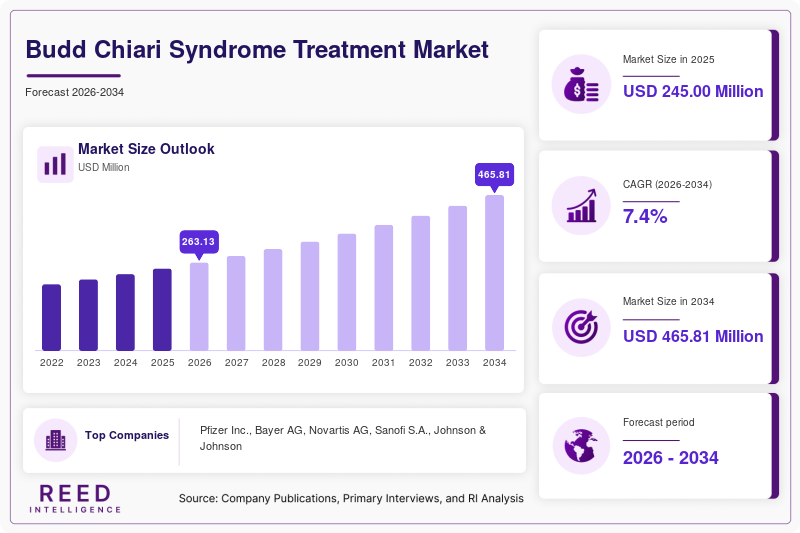
The global Budd Chiari Syndrome Treatment Market size was valued at USD 245 million in 2025 and is projected to reach USD 465 million by 2034, expanding at a CAGR of 7.4% during the forecast period (2025–2034). Budd-Chiari syndrome, a rare vascular disorder characterized by hepatic venous outflow obstruction, requires a multidisciplinary treatment approach involving pharmacological therapy, interventional radiology, and surgical procedures. The increasing prevalence of liver disorders and thrombotic conditions has contributed to a growing patient pool requiring timely diagnosis and intervention.
A key global factor supporting market growth is the advancement in minimally invasive treatment techniques, particularly transjugular intrahepatic portosystemic shunt (TIPS) procedures and image-guided thrombolysis. These innovations have improved survival rates and reduced hospitalization durations, making treatment more accessible and effective across healthcare systems.
Key Highlights
- North America dominated the market with 38.2% share in 2025, while Asia Pacific is projected to register the fastest CAGR of 8.6%
- By treatment type, anticoagulant therapy led with 34.5% share, while interventional procedures are expected to grow fastest at a CAGR of 8.9%
- By end-use, hospitals accounted for 61.3% share, whereas specialty clinics are projected to expand at a CAGR of 8.1%
- The U.S. market was valued at USD 78 million in 2025 and is estimated to reach USD 83 million in 2026
Market Trends
Increasing Adoption of Minimally Invasive Interventions
The Budd Chiari Syndrome Treatment Market is witnessing a shift toward minimally invasive procedures such as TIPS and catheter-directed thrombolysis. These techniques offer reduced procedural risks, shorter recovery times, and improved patient outcomes compared to traditional surgical approaches. As a result, healthcare providers are increasingly incorporating these interventions into standard treatment protocols.
Integration of Advanced Imaging Technologies
The use of high-resolution imaging modalities such as Doppler ultrasound, CT scans, and MRI is transforming the diagnostic landscape. Enhanced imaging allows for early and accurate identification of hepatic vein obstruction, enabling prompt treatment decisions. This trend is improving clinical outcomes and increasing the demand for targeted therapies, thereby supporting overall market growth.
Market Drivers
Rising Incidence of Thrombotic Disorders
The increasing prevalence of conditions such as polycythemia vera, antiphospholipid syndrome, and other hypercoagulable states is driving demand in the Budd Chiari Syndrome Treatment Market. These conditions are major risk factors for Budd-Chiari syndrome, leading to a higher number of diagnosed cases requiring treatment.
Expansion of Healthcare Infrastructure
The growth of healthcare facilities, especially in emerging economies, is enhancing access to specialized treatments. Governments and private entities are investing in advanced diagnostic and therapeutic equipment, enabling timely management of rare liver disorders. This expansion is contributing significantly to market growth.
Market Restraint
Limited Awareness and Delayed Diagnosis
One of the major challenges in the Budd Chiari Syndrome Treatment Market is the limited awareness of the condition among patients and primary care providers. Due to its rarity and nonspecific symptoms, the disease is often misdiagnosed or detected at advanced stages. This delay in diagnosis reduces treatment effectiveness and limits the adoption of early-stage therapies.
Additionally, the lack of standardized treatment guidelines across regions further complicates disease management. In low-resource settings, inadequate access to advanced imaging and interventional procedures restricts treatment options. These factors collectively hinder market growth and create disparities in patient outcomes.
Market Opportunities
Development of Targeted Pharmacological Therapies
The increasing focus on research and development of targeted anticoagulants and thrombolytic agents presents a significant growth opportunity. Novel drug formulations with improved efficacy and safety profiles are expected to enhance treatment outcomes and expand the therapeutic landscape.
Growth in Emerging Markets
Emerging economies in Asia Pacific, Latin America, and the Middle East & Africa offer untapped potential due to improving healthcare infrastructure and rising awareness. Increased government initiatives and investments in healthcare are expected to boost access to diagnosis and treatment, creating new revenue streams for market players.
Segmental Analysis
By Treatment Type
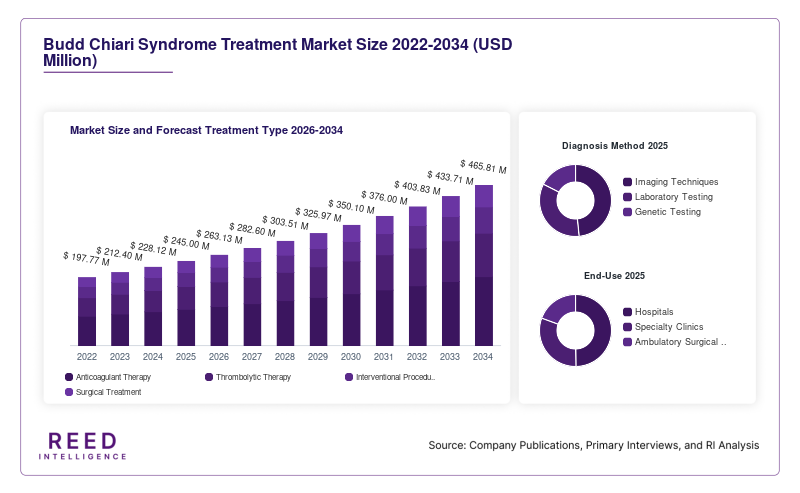
Anticoagulant therapy dominated the Budd Chiari Syndrome Treatment Market in 2025, accounting for 34.5% of the total share. This segment led due to its role as the first-line treatment in managing thrombotic complications. The widespread use of anticoagulants for long-term management and prevention of disease progression contributed to its dominance.
Interventional procedures are expected to be the fastest-growing subsegment, with a projected CAGR of 8.9% during the forecast period. The increasing adoption of TIPS and catheter-based therapies will drive growth, as these procedures offer effective symptom relief and improved survival rates.
By Diagnosis Method
Imaging techniques held the largest share of 41.2% in 2025, driven by the critical role of ultrasound, CT, and MRI in confirming diagnosis. These methods are widely used due to their accuracy and non-invasive nature.
Genetic and laboratory testing is anticipated to grow at the fastest CAGR of 8.3%, supported by advancements in molecular diagnostics. These tests will enable better identification of underlying causes, facilitating personalized treatment approaches.
By End-Use
Hospitals accounted for the largest share of 61.3% in 2025, as they provide comprehensive treatment facilities, including surgery and interventional procedures. The availability of multidisciplinary teams further supported their dominance.
Specialty clinics are projected to grow at a CAGR of 8.1%, driven by increasing patient preference for specialized care and shorter waiting times. These clinics will play a crucial role in early diagnosis and outpatient management.
By Route of Administration
Oral administration dominated with a 52.7% share in 2025, primarily due to the widespread use of oral anticoagulants for long-term therapy. Ease of administration and patient compliance contributed to its leading position.
Injectable administration is expected to grow at a CAGR of 7.9%, driven by the need for rapid action in acute cases. Injectable therapies will continue to be essential in hospital settings for emergency treatment.
Regional Analysis
North America
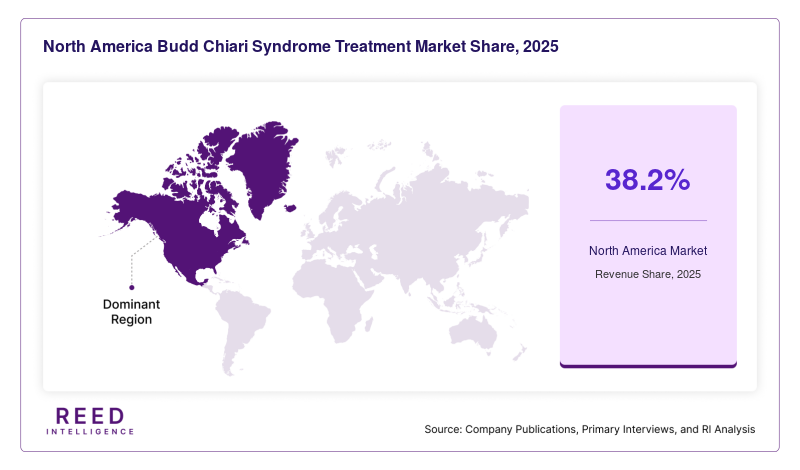
North America accounted for 38.2% of the Budd Chiari Syndrome Treatment Market share in 2025 and is expected to grow at a CAGR of 6.8% during the forecast period. The region benefited from well-established healthcare systems, advanced diagnostic technologies, and high awareness levels among healthcare professionals. The presence of specialized liver treatment centers also supported early diagnosis and intervention.
The United States dominated the regional market due to its strong focus on research and availability of advanced interventional procedures. The widespread adoption of minimally invasive techniques and favorable reimbursement policies contributed to sustained growth. Additionally, ongoing clinical trials and innovations in drug therapies are expected to further strengthen the market in the country.
Europe
Europe held 27.5% of the global market share in 2025 and will likely grow at a CAGR of 6.9% through 2034. The region demonstrated steady growth due to increasing healthcare expenditure and strong regulatory frameworks supporting rare disease treatment.
Germany emerged as the leading country in the region, driven by its advanced healthcare infrastructure and high adoption of imaging technologies. The country’s emphasis on early diagnosis and specialized care centers has improved patient outcomes and supported market expansion.
Asia Pacific
Asia Pacific captured 19.6% of the Budd Chiari Syndrome Treatment Market share in 2025 and is projected to grow at the fastest CAGR of 8.6%. The region experienced rapid growth due to increasing healthcare investments and rising awareness of rare diseases.
China dominated the regional market, supported by a large patient population and improving access to healthcare services. Government initiatives to expand healthcare coverage and investments in hospital infrastructure have enhanced the availability of diagnostic and treatment options.
Middle East & Africa
The Middle East & Africa region accounted for 8.1% of the market share in 2025 and is expected to grow at a CAGR of 7.2%. Growth in this region was driven by gradual improvements in healthcare infrastructure and increasing investments in medical facilities.
Saudi Arabia led the regional market due to its focus on healthcare modernization and adoption of advanced medical technologies. The country’s efforts to enhance specialized care services have contributed to improved diagnosis and treatment rates.
Latin America
Latin America held 6.6% of the global market share in 2025 and is anticipated to grow at a CAGR of 7.0%. The region showed moderate growth supported by expanding healthcare access and rising awareness of liver diseases.
Brazil dominated the regional market due to its relatively advanced healthcare system and increasing adoption of diagnostic imaging. Government initiatives aimed at improving healthcare infrastructure have further supported market growth in the country.
Competitive Landscape
The Budd Chiari Syndrome Treatment Market is moderately fragmented, with several global and regional players focusing on innovation and strategic collaborations. Leading companies are investing in research and development to introduce advanced therapies and improve treatment outcomes.
A key market leader is Pfizer Inc., which has strengthened its position through the development of advanced anticoagulant therapies. The company recently expanded its portfolio with a next-generation anticoagulant aimed at improving safety profiles and reducing bleeding risks.
Other prominent players include Bayer AG, Novartis AG, Sanofi S.A., and Johnson & Johnson. These companies are focusing on expanding their geographic presence and enhancing their product offerings to maintain competitiveness in the market.
Key Players
- Pfizer Inc.
- Bayer AG
- Novartis AG
- Sanofi S.A.
- Johnson & Johnson
- Bristol-Myers Squibb Company
- Abbott Laboratories
- AstraZeneca plc
- GlaxoSmithKline plc
- F. Hoffmann-La Roche Ltd
- Merck & Co., Inc.
- Eli Lilly and Company
- Takeda Pharmaceutical Company Limited
- Daiichi Sankyo Company, Limited
- Boehringer Ingelheim International GmbH
Recent Developments
- 2024: A major pharmaceutical company launched a novel anticoagulant with enhanced safety for liver disorder patients
- 2024: Expansion of interventional radiology centers in Asia Pacific improved access to advanced procedures
- 2023: Increased clinical trials focusing on targeted therapies for rare hepatic diseases
- 2023: Strategic collaborations between hospitals and biotech firms to develop innovative treatment protocols
- 2023: Regulatory approvals for new diagnostic imaging tools improved early detection rates
Budd Chiari Syndrome Treatment Market Segments
Treatment Type
- Anticoagulant Therapy
- Thrombolytic Therapy
- Interventional Procedures
- Surgical Treatment
Diagnosis Method
- Imaging Techniques
- Laboratory Testing
- Genetic Testing
End-Use
- Hospitals
- Specialty Clinics
- Ambulatory Surgical Centers
Route of Administration
- Oral
- Injectable
By Region
- North America
- Europe
- APAC
- Middle East and Africa
- LATAM