Bushing Anti-Vibration Mounts Market Size, Share & Demand Report By Type (Rubber-Based Mounts, Hydraulic Mounts, Polyurethane Mounts, Metal-Rubber Hybrid Mounts), By Application (Automotive Systems, Industrial Machinery, Aerospace Components, Marine Equipment), By End-Use Industry (Automotive, Industrial Manufacturing, Aerospace & Defense, Energy & Power), By Region & Segment Forecasts, 2026–2034
USD 3950
Market Overview
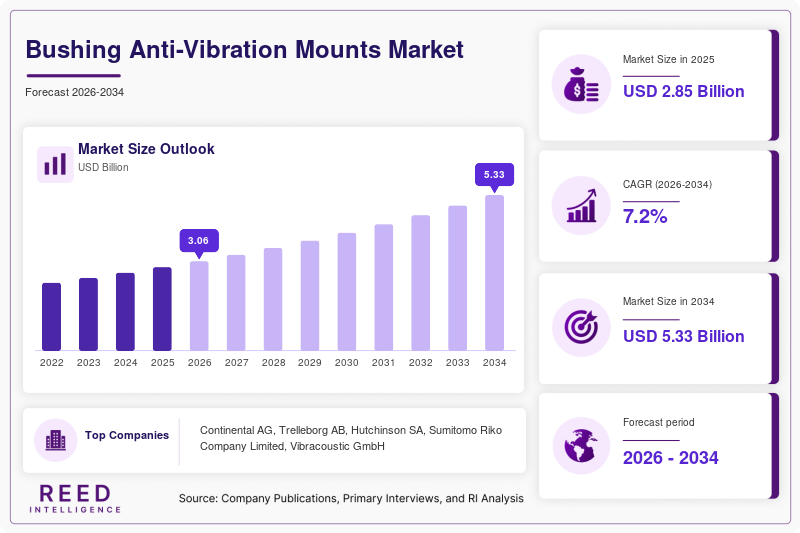
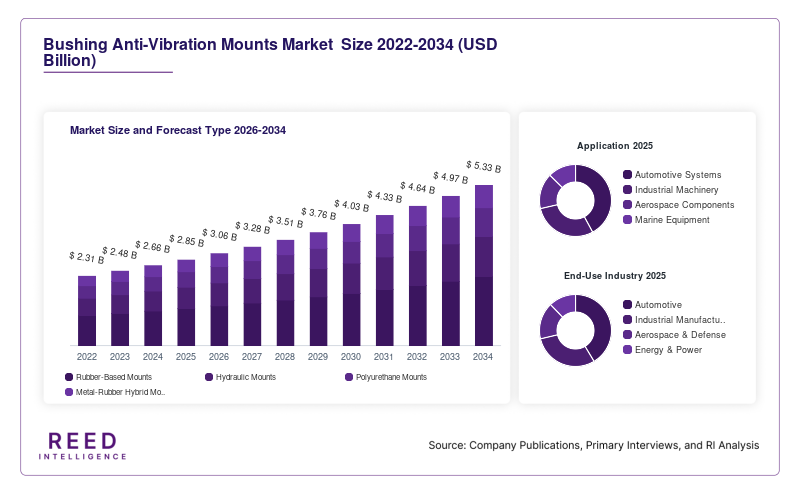
The global Bushing Anti-Vibration Mounts Market size was valued at approximately USD 2.85 billion in 2026 and is projected to reach USD 4.96 billion by 2034, expanding at a CAGR of 7.2% during the forecast period (2026–2034). The market growth is primarily supported by the increasing demand for vibration isolation solutions across automotive, industrial machinery, and aerospace sectors. As industries focus on improving equipment longevity, reducing noise pollution, and enhancing operational efficiency, the adoption of advanced anti-vibration technologies continues to rise steadily.
One of the key global factors driving the market is the rapid expansion of the automotive industry, particularly in emerging economies. Rising vehicle production, coupled with stricter regulations on noise, vibration, and harshness (NVH) levels, has accelerated the use of bushing anti-vibration mounts. Additionally, the growing trend of electrification in vehicles has created new requirements for vibration damping, further contributing to market expansion.
Key Highlights
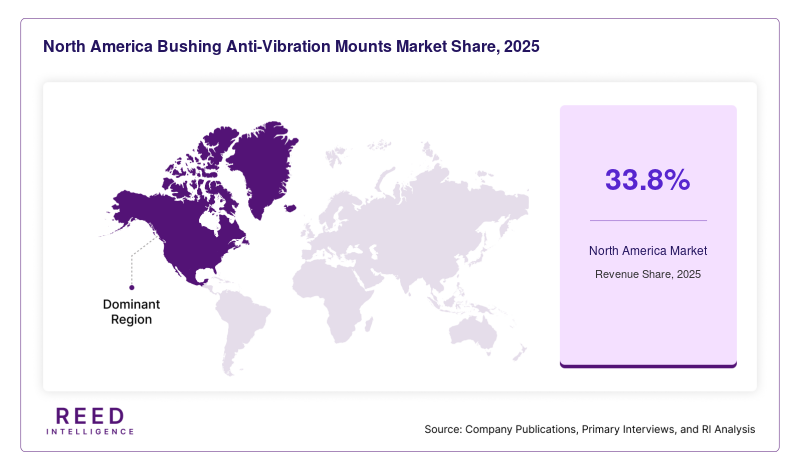
- North America dominated the market with a 33.8% share in 2025.
- Asia Pacific is expected to grow at the fastest CAGR of 8.6% during 2026–2034.
- By type, rubber-based mounts accounted for the largest share of 42.6%, while hydraulic mounts are projected to grow at a CAGR of 8.9%.
- By application, automotive systems led with a 45.3% share, whereas industrial machinery is expected to expand at a CAGR of 8.1%.
- The United States remained the dominant country, with market values of USD 620 million in 2024 and USD 670 million in 2025.
Market Trends
Growing integration of advanced materials in mount design
Manufacturers are increasingly focusing on the use of advanced materials such as polyurethane composites and high-performance elastomers to improve durability and vibration absorption efficiency. Traditional rubber mounts, while cost-effective, often face limitations in extreme environments involving high temperatures and heavy loads. As a result, material innovation has become a key trend, enabling mounts to deliver improved performance in demanding applications such as electric vehicles and heavy machinery. These advanced materials also contribute to extended product lifecycles and reduced maintenance requirements, which are critical factors for end users aiming to lower operational costs.
Additionally, the shift toward lightweight components in automotive and aerospace industries has encouraged the development of mounts that offer optimal strength-to-weight ratios. This trend is further supported by advancements in manufacturing processes such as injection molding and precision engineering, which allow for consistent product quality and customization. As industries continue to prioritize performance efficiency, the adoption of advanced material-based mounts is expected to accelerate significantly over the forecast period.
Rising demand from electric and hybrid vehicles
The transition toward electric and hybrid vehicles has introduced new vibration and noise challenges, leading to increased demand for specialized anti-vibration mounts. Unlike internal combustion engines, electric drivetrains produce different vibration patterns that require tailored damping solutions. This has prompted manufacturers to innovate and develop mounts that can effectively handle high-frequency vibrations while maintaining passenger comfort.
Furthermore, the absence of engine noise in electric vehicles makes even minor vibrations more noticeable, increasing the importance of efficient isolation systems. Automotive manufacturers are investing heavily in research and development to address these challenges, which is contributing to the expansion of the market. The growing adoption of electric mobility across regions such as Asia Pacific and Europe is expected to further drive demand for advanced bushing anti-vibration mounts, making this trend a critical factor shaping the industry’s future trajectory.
Market Drivers
Expansion of automotive production and stringent NVH standards
The steady growth in global automotive production is a major driver for the Bushing Anti-Vibration Mounts Market. Increasing vehicle ownership, particularly in developing regions, has led to higher demand for components that enhance ride quality and safety. Anti-vibration mounts play a crucial role in reducing noise, vibration, and harshness, which are key parameters in modern vehicle design.
At the same time, governments and regulatory bodies have implemented stringent standards to control noise pollution and improve passenger comfort. These regulations have compelled automotive manufacturers to integrate high-performance vibration isolation systems into their vehicles. As a result, the demand for advanced mounts has increased significantly. The continuous focus on improving vehicle performance and compliance with regulatory standards is expected to sustain market growth over the coming years.
Growth of industrial machinery and infrastructure development
The increasing use of heavy machinery in construction, manufacturing, and energy sectors has created a strong demand for vibration control solutions. Industrial equipment often operates under high stress and generates significant vibrations, which can lead to wear and tear if not properly managed. Bushing anti-vibration mounts help in minimizing these effects, thereby enhancing equipment reliability and lifespan.
Moreover, ongoing infrastructure development projects across emerging economies have further boosted the demand for construction machinery, indirectly supporting the market. Industries are also adopting predictive maintenance practices, which emphasize the importance of vibration control to prevent equipment failure. This growing awareness among end users regarding the benefits of anti-vibration mounts is expected to drive their adoption across various industrial applications, contributing to overall market expansion.
Market Restraint
Volatility in raw material prices and supply chain disruptions
The market faces challenges due to fluctuations in the prices of raw materials such as rubber, metals, and polymers used in manufacturing anti-vibration mounts. These materials are often subject to price volatility influenced by global supply-demand dynamics, geopolitical factors, and changes in trade policies. Such fluctuations can increase production costs, affecting profit margins for manufacturers and leading to higher product prices for end users.
Additionally, supply chain disruptions have become more prominent in recent years, impacting the availability of raw materials and finished products. Delays in procurement and logistics can hinder production schedules and create uncertainties in the market. For instance, industries relying on just-in-time manufacturing practices may face operational inefficiencies due to supply constraints. These challenges can limit market growth, particularly for small and medium-sized manufacturers who may lack the resources to absorb cost fluctuations or diversify their supply chains effectively.
Market Opportunities
Increasing adoption in renewable energy applications
The growing focus on renewable energy sources such as wind and solar power presents new opportunities for the Bushing Anti-Vibration Mounts Market. Wind turbines, in particular, require efficient vibration control systems to ensure stable operation and prevent structural damage. Anti-vibration mounts are used in various components of wind turbines, including gearboxes and generators, to minimize mechanical stress and enhance performance.
As governments and organizations continue to invest in renewable energy infrastructure, the demand for reliable vibration isolation solutions is expected to rise. This creates opportunities for manufacturers to develop specialized mounts tailored to the unique requirements of renewable energy systems. The increasing emphasis on sustainability and energy efficiency further supports the adoption of advanced anti-vibration technologies in this sector.
Technological advancements and smart mount solutions
Advancements in technology have opened up new possibilities for the development of smart anti-vibration mounts equipped with sensors and monitoring capabilities. These smart systems can provide real-time data on vibration levels, enabling predictive maintenance and improving operational efficiency. The integration of Internet of Things (IoT) technologies into vibration control solutions is gaining traction, particularly in industrial applications.
Such innovations allow end users to monitor equipment performance remotely and identify potential issues before they lead to failures. This not only reduces downtime but also enhances overall productivity. The increasing adoption of Industry 4.0 practices is expected to drive demand for smart mount solutions, creating significant growth opportunities for market players. As industries continue to embrace digital transformation, the role of advanced anti-vibration technologies is likely to expand further.
Segmental Analysis
By Type
Rubber-based mounts dominated the market in 2024, accounting for a share of 42.6%. These mounts are widely used due to their cost-effectiveness, flexibility, and ability to absorb vibrations effectively. They are commonly utilized in automotive and industrial applications where moderate vibration control is required. The widespread availability of raw materials and established manufacturing processes further support the dominance of this segment.
Hydraulic mounts are expected to be the fastest-growing subsegment, with a CAGR of 8.9%. These mounts offer superior vibration damping capabilities by using fluid-filled chambers to absorb and dissipate energy. Their ability to handle high-frequency vibrations makes them suitable for advanced applications such as electric vehicles and heavy machinery. The increasing demand for high-performance solutions is driving the growth of this segment.
By Application
Automotive systems held the largest share of 45.3% in 2024, driven by the extensive use of anti-vibration mounts in vehicles to enhance comfort and performance. These mounts are used in engines, transmissions, and suspension systems to reduce noise and vibration. The growing production of vehicles globally continues to support the dominance of this segment.
Industrial machinery is the fastest-growing application segment, with a CAGR of 8.1%. The increasing use of heavy equipment in manufacturing and construction industries has created a demand for efficient vibration control solutions. The adoption of predictive maintenance practices further drives the growth of this segment.
By End-Use
The automotive industry dominated the market in 2024, accounting for a significant share due to the high demand for vibration isolation components in vehicles. The focus on improving passenger comfort and meeting regulatory standards has driven the adoption of advanced mounts in this sector.
The aerospace sector is expected to witness the fastest growth, with a CAGR of 7.8%. The need for lightweight and high-performance components in aircraft has increased the demand for advanced anti-vibration solutions. Technological advancements in aerospace engineering further support the growth of this segment.
Regional Analysis
North America
North America held a dominant share of 33.8% in 2025 and is expected to maintain steady growth with a CAGR of 6.8% during the forecast period. The region’s well-established automotive and aerospace industries are major contributors to market demand. Additionally, the presence of leading manufacturers and strong research and development capabilities support innovation in anti-vibration technologies.
The United States remains the leading country in this region, driven by its advanced industrial base and high adoption of automation. A unique growth factor is the increasing investment in electric vehicle production, which has created a demand for specialized vibration control solutions tailored to new drivetrain systems.
Europe
Europe accounted for a significant share of 27.5% in 2025 and is projected to grow at a CAGR of 7.0%. The region’s focus on sustainability and stringent environmental regulations has encouraged the adoption of advanced anti-vibration solutions across industries. Automotive manufacturers in Europe are particularly focused on enhancing vehicle comfort and reducing emissions.
Germany leads the market in Europe due to its strong automotive manufacturing sector. A unique growth factor is the region’s emphasis on precision engineering and high-quality standards, which drives the demand for technologically advanced mounts with superior performance characteristics.
Asia Pacific
Asia Pacific is the fastest-growing region, with a CAGR of 8.6% during the forecast period. The region’s rapid industrialization, expanding automotive production, and increasing infrastructure development are key factors driving market growth. Countries such as China, India, and Japan are major contributors to the regional market.
China dominates the Asia Pacific market due to its large manufacturing base and growing automotive industry. A unique growth factor is the increasing adoption of electric vehicles, supported by government incentives and policies, which is driving demand for advanced anti-vibration solutions.
Middle East & Africa
The Middle East & Africa region held a smaller share of 6.2% in 2025 but is expected to grow at a CAGR of 6.5%. The region’s growth is supported by increasing investments in infrastructure and industrial projects, particularly in the construction and energy sectors.
Saudi Arabia is a key country in this region, driven by large-scale infrastructure development initiatives. A unique growth factor is the expansion of the oil and gas industry, which requires robust vibration control solutions for heavy machinery and equipment.
Latin America
Latin America accounted for 5.7% of the market share in 2025 and is projected to grow at a CAGR of 6.3%. The region’s growth is driven by the gradual recovery of its automotive and manufacturing sectors, along with increasing investments in infrastructure development.
Brazil leads the market in Latin America, supported by its growing industrial base. A unique growth factor is the increasing demand for construction equipment, which requires efficient vibration isolation systems to enhance performance and durability.
Competitive Landscape
The Bushing Anti-Vibration Mounts Market is characterized by the presence of several established players focusing on product innovation, strategic partnerships, and expansion into emerging markets. Companies are investing in research and development to enhance product performance and meet evolving industry requirements. The competitive environment is moderately fragmented, with key players striving to strengthen their market positions through technological advancements and efficient supply chain management.
One of the leading companies in the market is Vibracoustic, known for its comprehensive portfolio of vibration control solutions. The company has recently introduced advanced mounts designed for electric vehicles, addressing the unique challenges associated with new drivetrain systems. Other major players are also focusing on expanding their product offerings and improving manufacturing capabilities to gain a competitive edge.
Key Players
- Continental AG
- Trelleborg AB
- Hutchinson SA
- Sumitomo Riko Company Limited
- Vibracoustic GmbH
- Bridgestone Corporation
- Parker Hannifin Corporation
- Lord Corporation
- GMT Rubber-Metal-Technic Ltd
- FUKOKU Co., Ltd
- Toyoda Gosei Co., Ltd
- Freudenberg Group
- ACE Controls Inc.
- Enidine Inc.
- AV Industrial Products Ltd
Recent Developments
- Several companies have introduced advanced anti-vibration mounts designed specifically for electric vehicles, focusing on improved noise reduction and durability.
- A major manufacturer expanded its production facility in Asia Pacific to meet the growing demand from automotive and industrial sectors.
- Strategic collaborations between technology providers and automotive companies have led to the development of smart mounts with integrated sensor capabilities for real-time monitoring.
Bushing Anti-Vibration Mounts Market Segments
Type
- Rubber-Based Mounts
- Hydraulic Mounts
- Polyurethane Mounts
- Metal-Rubber Hybrid Mounts
Application
- Automotive Systems
- Industrial Machinery
- Aerospace Components
- Marine Equipment
End-Use Industry
- Automotive
- Industrial Manufacturing
- Aerospace & Defense
- Energy & Power
By Region
- North America
- Europe
- APAC
- Middle East and Africa
- LATAM