Business Broker Service Market Size, Share & Trends Analysis Report By Service Type (Sell-Side Business Brokerage, Buy-Side Business Brokerage, Business Valuation, Mergers & Acquisitions Advisory, Exit Planning), By Business Size (Main Street Businesses, Lower Middle Market Businesses), By Industry Vertical (Business Services, Retail & Restaurants, Manufacturing, Healthcare, Technology & Digital Businesses) Forecasts, 2026–2034
USD 3950
Business Broker Service Market Size
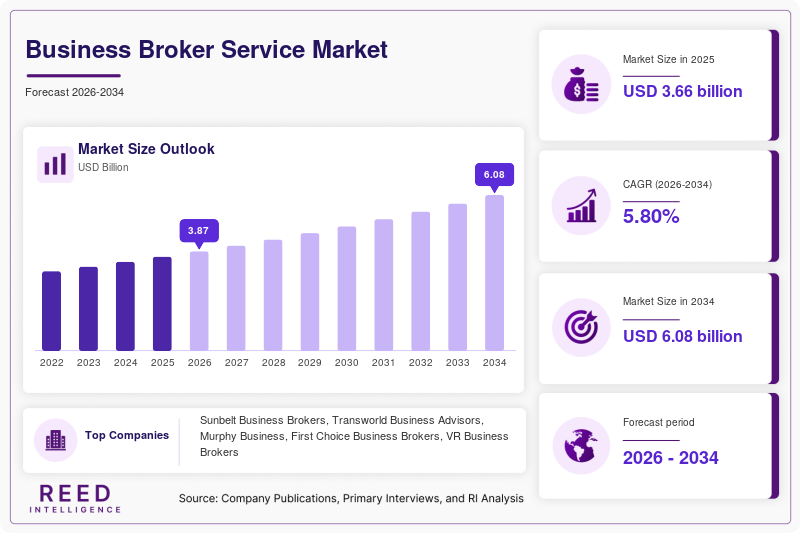
The global business broker service market size was valued at USD 3.66 billion in 2025 and is projected to grow from USD 3.87 billion in 2026 to USD 6.08 billion by 2034, registering a CAGR of 5.80% during the forecast period from 2026 to 2034.
The market is being shaped by business-owner succession, acquisition activity, demand for professional valuation and transaction preparation, and the increasing complexity of financing and due diligence. In the U.S., BizBuySell recorded 9,586 small-business transactions in 2025, with total enterprise value of USD 7.95 billion. Median sale price increased 2% to USD 350,000, while median cash flow increased 3% to USD 158,950.
Business broker services connect owners seeking an exit with individual buyers, strategic acquirers, private equity-backed buyers and other investors. The service increasingly extends beyond simply listing a business. Brokers are involved in valuation, confidential marketing, buyer qualification, financing coordination, negotiation, due diligence and closing.
Current transaction conditions are increasing the value of this intermediary role. In Q2 2026, 2,117 U.S. businesses changed hands through the BizBuySell marketplace, down 10% year over year, while total enterprise value reached USD 1.8 billion. BizBuySell described the market as increasingly selective, with stricter underwriting, deeper financial scrutiny and greater emphasis on earnings durability.
Financing remains an important part of the transaction mechanism. The U.S. Small Business Administration's 7(a) program permits financing for complete or partial changes of ownership, with a maximum loan amount of USD 5 million. SBA also has further changes to its lender procedures for changes of ownership scheduled to take effect October 1, 2026.
Business Broker Service Market Drivers
Business-owner succession and the need for structured exits
Business ownership transitions create a recurring requirement for intermediary services. Owners approaching retirement, entrepreneurs seeking liquidity and shareholders pursuing strategic exits often need an independent process for determining value, preparing financial information, identifying buyers and negotiating transaction terms.
The transaction data supports continued underlying activity. BizBuySell recorded nearly 9,600 small-business transactions in 2025, while median cash flow and revenue both increased 3%. Service businesses were the largest transaction category, and technology services, financial services and several professional-service categories showed stronger activity.
The commercial mechanism is straightforward: more businesses reaching a sale or ownership-transition stage creates demand for valuation, marketing, buyer screening and closing support. The opportunity is particularly relevant where owners lack internal M&A teams. Brokers also provide confidentiality by limiting sensitive business information to qualified buyers under non-disclosure agreements.
Increasing transaction complexity is expanding advisory requirements
Business acquisitions require financial analysis, valuation, negotiation, financing and due diligence. As buyers become more selective, these activities require greater preparation before a transaction reaches closing.
In Q2 2026, BizBuySell reported that financing had become a major deal hurdle and that buyers were applying deeper financial scrutiny. The Q1 2026 report similarly described longer diligence timelines and tighter lending conditions.
This changes the broker's role from a listing intermediary to a transaction-management provider. Brokers can help normalize financial statements, prepare confidential business reviews, organize buyer information, coordinate lenders and manage negotiations. Sunbelt, for example, describes a process covering preparation, value estimates, marketing, buyer screening, offer evaluation, due diligence and closing.
Financing availability supports acquisition activity
Acquisition financing directly affects the number of buyers capable of completing a transaction. SBA 7(a) loans can be used for complete or partial changes of ownership, alongside working capital, equipment and other qualifying business purposes. The maximum 7(a) loan amount is USD 5 million.
The financing mechanism creates work for brokers because lenders require financial records, valuation support, deal documentation and information about the acquiring business. In 2026, 67% of buyers surveyed by BizBuySell said they planned to use an SBA loan for an acquisition, while brokers reported that lenders were taking longer and applying greater scrutiny.
This supports demand for brokers capable of coordinating buyers and lenders early in the process. However, financing conditions can also delay or prevent transactions when a buyer's capital structure does not support the purchase price.
Business Broker Service Market Restraints
Tighter credit conditions can delay transaction closures
The same financing mechanism that supports business acquisitions can constrain brokerage activity when lenders become more selective. BizBuySell reported in Q2 2026 that acquisitions declined 10% year over year and that financing had become a major transaction hurdle.
For brokers, a delayed financing process can extend the time between listing and closing, increasing marketing and transaction-management costs. Deals can also fail after substantial work has already been completed if financing does not materialize.
The response from brokers is greater emphasis on buyer qualification and early lender engagement. This shifts the competitive requirement toward brokers with established lender relationships and experience structuring transactions that satisfy financing requirements.
Business valuations are becoming more sensitive to earnings quality
Buyers are increasingly distinguishing between businesses with durable cash flow and those dependent on volatile demand, a single owner, paid customer acquisition or uncertain future earnings. BizBuySell reported that the Q2 2026 market was characterized by deeper financial scrutiny and stronger emphasis on earnings durability.
This creates a restraint when sellers maintain valuation expectations that are disconnected from current cash flow or risk. Brokers may therefore need to spend more time preparing sellers before a listing reaches the market, including financial normalization, documentation and valuation analysis.
The effect is a more selective market in which the quality of the business and the quality of its financial records can influence buyer response, financing and final transaction terms.
Business Broker Service Market Opportunities
Technology-enabled valuation and transaction preparation
Digital tools can improve how brokers collect financial information, prepare confidential business reviews, organize buyer inquiries and track transaction milestones. The broader M&A ecosystem is also becoming more data-driven.
Flippa's H1 2026 digital-M&A data showed 123,022 active buyers on its platform, up 7% from the previous half and 18% from H1 2025. Its data also showed that buyers increasingly focused on recurring revenue, clean financials and resilience to AI-related disruption.
This creates room for brokers to differentiate through faster financial analysis, automated buyer matching, digital data rooms, transaction dashboards and AI-assisted due-diligence preparation.
Growing demand for specialized and technology businesses
Business buyers are increasingly examining technology-enabled businesses, recurring-revenue companies and specialized B2B services. BizBuySell reported that technology services transactions increased 12% in 2025, while financial-services transactions increased 38%.
Digital businesses also represent a specialized brokerage opportunity. Flippa reported that AI-aware buyers were increasingly evaluating whether digital businesses could maintain revenue, traffic and operations after a founder's departure.
Brokers with sector-specific valuation knowledge can therefore address transactions that require more than conventional revenue and cash-flow comparisons.
Segmental Analysis
By Service Type
Sell-Side Business Brokerage
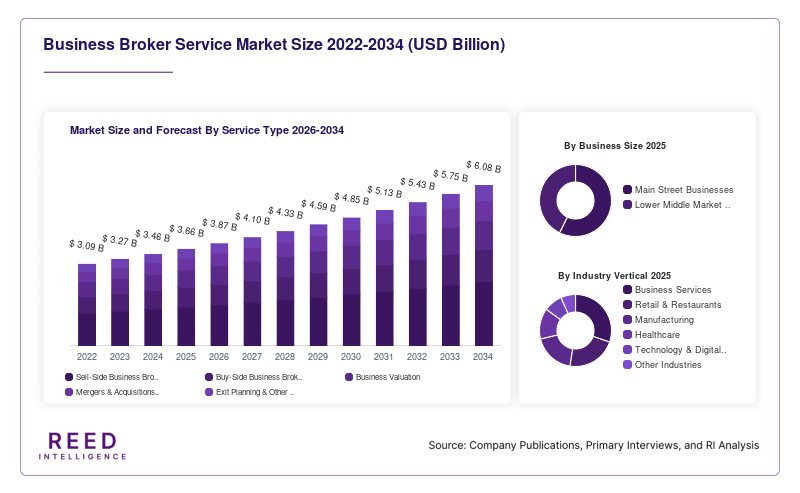
Sell-Side Business Brokerage represents approximately 34% of the global market in 2025, making it the largest service segment. The service covers valuation preparation, confidential marketing, buyer identification, qualification, offer evaluation, negotiation and closing.
The importance of this segment increases when owners lack internal transaction expertise. Murphy Business describes its sell-side process as moving from valuation and engagement through confidential marketing, buyer qualification, negotiation and closing.
Seller representation also creates a recurring commercial relationship because the broker generally manages several transaction stages rather than providing a single advisory service. Confidentiality is particularly important for small companies because premature disclosure of a planned sale can affect employees, customers, suppliers and competitors.
Buy-Side Business Brokerage
Buy-Side Business Brokerage accounts for approximately 22% of the market and is the fastest-growing service segment at approximately 6.8% CAGR. Buyers increasingly require assistance identifying appropriate targets, assessing financial performance, valuing businesses and arranging financing.
Murphy Business describes buyer services covering business searches, valuation, financing assistance, negotiations and closing.
The growth mechanism is linked to a larger and more sophisticated buyer pool. BizBuySell reported increasing participation from corporate refugees, private equity groups, search-fund buyers and other well-capitalized acquirers during 2026.
Business Valuation
Business Valuation represents approximately 18% of the market. Valuation is increasingly becoming a standalone service because owners use valuation information for sale preparation, retirement planning, financing and strategic decisions.
Murphy Business provides valuation services using professional appraisal methodologies and notes that valuation can be relevant to business sales, financing and retirement planning.
Mergers & Acquisitions Advisory
M&A Advisory accounts for approximately 16% of market demand. The segment becomes more relevant as businesses move above traditional Main Street transaction sizes and involve strategic acquirers, private equity groups or more complex deal structures.
IBBA separates Main Street and lower-middle-market transactions in its Market Pulse research, reflecting the different transaction characteristics across deal sizes.
Exit Planning & Other Services
Exit Planning & Other Services represents approximately 10% of the market. Services include succession preparation, financial cleanup, buyer-readiness assessment, transaction planning and post-sale support.
The segment is becoming more important because preparing a business several years before a sale can address documentation, owner dependence, customer concentration and earnings-quality issues before buyers begin diligence.
By Business Size
Main Street Businesses
Main Street Businesses account for approximately 61% of the market. These transactions are generally smaller and frequently involve individual buyers, owner-operators and SBA-supported financing.
Sunbelt generally classifies businesses valued below USD 1 million as Main Street businesses and describes these transactions as more locally oriented than larger middle-market transactions.
The segment produces substantial broker activity because individual owners often lack dedicated M&A teams. Financing coordination and buyer screening therefore remain important parts of the brokerage process.
Lower Middle Market Businesses
Lower Middle Market Businesses represent approximately 39% and are the fastest-growing business-size segment at approximately 7.0% CAGR. Larger transactions involve more institutional buyers, private equity groups and strategic acquirers, increasing the need for financial analysis, deal structuring and due diligence.
IBBA's Market Pulse distinguishes lower-middle-market transactions from Main Street deals and tracks transaction multiples across the different value ranges.
By Industry Vertical
Business Services
Business Services represent approximately 31% of market activity, supported by recurring revenue models, relatively asset-light operations and demand from buyers seeking businesses that can be integrated into broader service platforms.
BizBuySell reported that service businesses represented 42% of U.S. transactions in Q1 2026, while service-business sale prices increased 13% year over year during that quarter.
Retail & Restaurants
Retail & Restaurants account for approximately 25% of demand. These businesses generate a high volume of Main Street transactions, although valuation sensitivity can be greater when margins are exposed to labor, rent, food costs or consumer spending.
BizBuySell reported that retail and restaurants were among the largest transaction categories in 2025, with retail and service businesses also showing increased acquisition activity during parts of 2025.
Manufacturing
Manufacturing represents approximately 15% of the market. Manufacturing transactions tend to require deeper diligence because buyers must examine equipment, inventory, customers, suppliers, working capital and production capacity.
The sector also showed significant volatility. Manufacturing transactions increased 16% year over year in Q1 2026 after weakness during 2025, demonstrating how trade policy, supply chains and industrial demand can influence transaction activity.
Healthcare
Healthcare represents approximately 11% of market demand and is one of the more specialized areas because transactions can involve licensing, professional ownership structures, reimbursement exposure and regulatory requirements.
This increases demand for brokers who understand the operating and regulatory characteristics of individual healthcare subsectors.
Technology & Digital Businesses
Technology & Digital Businesses account for approximately 10% and are the fastest-growing industry vertical at approximately 8.1% CAGR. BizBuySell reported a 12% increase in technology-services transactions during 2025, while digital M&A activity on Flippa showed increasing buyer attention to recurring revenue, clean financials and AI resilience.
Regional Analysis
North America Business Broker Service Market
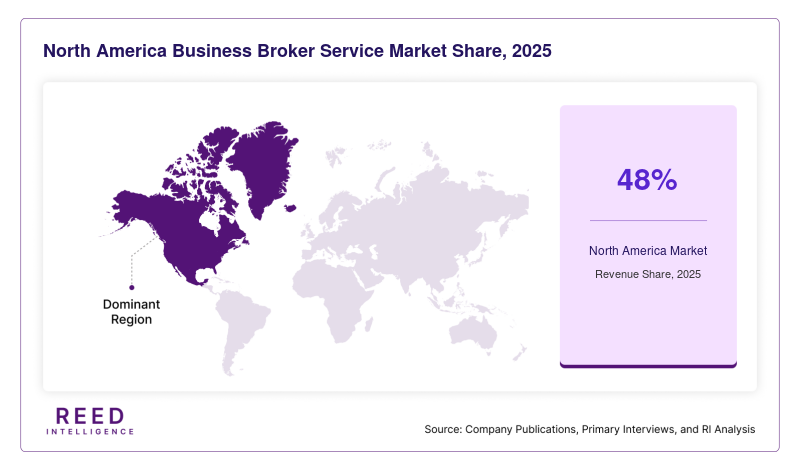
North America represents approximately 48% of the global business broker service market in 2025, making it the largest region, with approximately 5.2% CAGR. The region has a mature business brokerage infrastructure, extensive small-business ownership base, established financing channels and a large market for private business acquisitions.
The U.S. provides the strongest publicly visible transaction evidence. BizBuySell recorded 9,586 transactions during 2025, while total enterprise value reached USD 7.95 billion. The median business sold for USD 350,000, and businesses sold for approximately 94% of asking price on average.
Financing is an important regional mechanism. SBA 7(a) loans explicitly support complete and partial changes of ownership, with loans up to USD 5 million. The SBA also has updated change-of-ownership procedures scheduled for October 2026, making lender and documentation knowledge increasingly relevant to brokers.
The competitive environment includes large brokerage networks such as Sunbelt, Transworld and Murphy Business. Murphy operates across 38 U.S. states and Canada and reports more than USD 4.3 billion in completed transactions. Transworld reports more than 1,000 active brokers, 250-plus offices worldwide and more than 15,000 businesses sold.
The main constraint is selective financing and increased buyer scrutiny. Brokers increasingly need to demonstrate value through preparation, valuation, financing coordination and transaction execution rather than simply producing buyer leads.
Europe Business Broker Service Market
Europe accounts for approximately 23% of the global market in 2025, with approximately 5.5% CAGR. The regional market is supported by family-business succession, SME ownership, cross-border acquisitions and professionalization of small-company exits.
European business transfers frequently involve family ownership, management succession and strategic buyers. These conditions create demand for valuation, succession preparation and confidential buyer identification.
The market also benefits from established financial and professional-services infrastructure. Larger transactions can involve corporate finance advisers, accountants, lawyers and private-equity investors, while smaller transactions are served by specialist brokers and local intermediaries.
Cross-border transactions increase the value of brokers with international networks because buyers may originate outside the seller's home country. Transworld, for example, operates a global network covering multiple countries, while Sunbelt maintains international locations and cross-border buyer capabilities.
The key constraint is fragmentation across national tax systems, legal structures, languages and business-transfer regulations. This makes local expertise important and can increase transaction timelines.
APAC Business Broker Service Market
APAC represents approximately 18% of the global market in 2025 and is the fastest-growing region, registering approximately 7.4% CAGR. The regional opportunity is supported by expanding SME populations, entrepreneurship, family-business succession, digital-business transactions and increasing professionalization of business transfers.
Australia, Japan, Singapore and India provide different but complementary sources of demand. Mature markets generate professional brokerage and succession requirements, while developing markets provide increasing demand as entrepreneurs and SMEs become more accustomed to formal valuation and acquisition processes.
Technology-enabled businesses are particularly relevant in APAC because digital companies can attract buyers across borders. Flippa's H1 2026 data shows strong buyer engagement in digital M&A, with active buyers increasing 18% year over year.
The regional market also benefits from growing access to online business-for-sale platforms and digital valuation tools. These systems allow brokers to broaden buyer reach beyond local markets.
However, the region remains highly fragmented. Differences in ownership structures, taxation, regulatory systems, financing availability and business-transfer practices can complicate transactions. Brokers with localized industry expertise and cross-border networks therefore have a larger role in complex acquisitions.
Middle East and Africa Business Broker Service Market
Middle East and Africa accounts for approximately 5% of the global market in 2025, with approximately 6.0% CAGR. Business brokerage demand is linked to private-company succession, entrepreneurship, family businesses, SME development and increasing interest in professional transaction advisory.
The region has a particularly diverse business structure, ranging from family-owned enterprises to technology companies and larger privately held groups. This diversity creates demand for valuation, succession planning and buyer identification.
International brokerage networks are expanding the pool of potential buyers. Sunbelt lists international locations including Saudi Arabia and the United Arab Emirates, illustrating how international brokerage networks are connecting regional sellers with broader buyer pools.
Digital businesses also create a cross-border opportunity because they can be sold without the buyer and seller being located in the same country. The main constraint is uneven financial-market development, differences in corporate structures and varying transaction regulations across individual countries.
LATAM Business Broker Service Market
LATAM represents approximately 6% of the global market in 2025, with approximately 6.3% CAGR. Demand is supported by family-owned businesses, SME transactions, succession requirements and increasing entrepreneurial activity.
Business brokers in the region can create value through local buyer networks, financial preparation, valuation and cross-border buyer access. Businesses in consumer services, distribution, hospitality, manufacturing and technology provide potential transaction pipelines.
The regional opportunity is also linked to international investors seeking operating businesses in markets with established local demand. Cross-border transactions increase the importance of bilingual advisory capabilities and knowledge of local tax and corporate structures.
Currency volatility, financing availability and macroeconomic variation remain constraints. These factors can affect valuation expectations and make transaction timing less predictable than in mature markets.
Competitive Landscape
The business broker service market remains fragmented, with large franchise and brokerage networks competing alongside independent brokers, boutique M&A advisers, online marketplaces and accounting or advisory firms.
Competition is increasingly based on buyer reach, valuation expertise, industry specialization, confidentiality, financing relationships and transaction execution. Sunbelt offers business valuation, exit planning, financing assistance and separate pathways for businesses above and below USD 1 million.
Murphy Business combines brokerage with valuation and lower-middle-market M&A services and reports more than USD 4.3 billion in completed transactions. Its network covers the U.S. and Canada.
Transworld operates across business sales, M&A and franchises and reports more than 250 offices worldwide. Its scale gives the network access to buyers and sellers across multiple geographies.
Key Market Players
- Sunbelt Business Brokers
- Transworld Business Advisors
- Murphy Business
- First Choice Business Brokers
- VR Business Brokers
- BizBuySell
- Flippa
- Calder Capital
- Calhoun Companies
- Benchmark International
Recent Market Developments
September 2026 – SBA prepares new change-of-ownership procedures
The SBA's lender resources identify SOP 50 10 8.1 Appendix 15 for Changes of Ownership Transactions, effective October 1, 2026. The broader SOP 50 10 8.1 updates affect 7(a) and 504 lending procedures. Brokers handling SBA-financed acquisitions need to remain aligned with lender documentation and underwriting procedures, making financing expertise more commercially important.
February 2026 – IBBA publishes Q4 2025 transaction data
IBBA's Q4 2025 Market Pulse showed average offers per deal rising from 2.19 to 2.38 for Main Street transactions from 2024 to 2025, while average cash at close reached 84.5%. The survey also reported higher multiples for larger lower-middle-market transactions.
Business Broker Service Market Segments
By Service Type
- Sell-Side Business Brokerage
- Buy-Side Business Brokerage
- Business Valuation
- Mergers & Acquisitions Advisory
- Exit Planning & Other Services
By Business Size
- Main Street Businesses
- Lower Middle Market Businesses
By Industry Vertical
- Business Services
- Retail & Restaurants
- Manufacturing
- Healthcare
- Technology & Digital Businesses
- Other Industries
By Region
- North America
- Europe
- APAC
- Middle East and Africa
- LATAM