Business Broker Services Market Size, Share, Demand Report By Service Type (Sell-Side Services, Buy-Side Services, Valuation Services), By Business Size (Small Businesses, Medium-Sized Businesses, Large Businesses), By Region & Segment Forecasts, 2026–2034
USD 3950
Business Broker Services Market Size
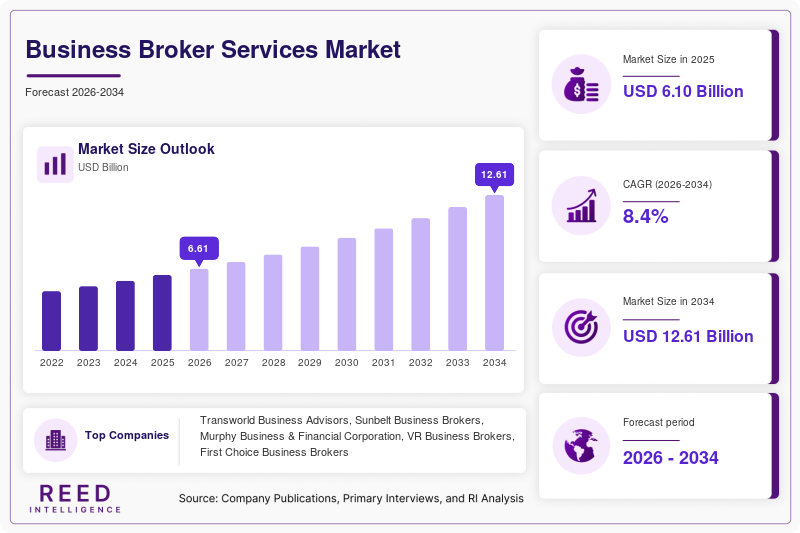
The global Business Broker Services Market size is projected at USD 6.61 billion in 2026 and is expected to hit USD 12.61 billion by 2034 with a CAGR of 8.4%. The market is expanding as business owners increasingly seek professional assistance for ownership transitions, valuations, buyer identification, negotiations, due diligence, and transaction execution. Detailed segmentation and competitive-landscape data are increasingly important as traditional brokerage networks compete with digital marketplaces, technology-enabled valuation platforms, and specialized M&A advisory firms.
Key takeaways
- Regional leadership: North America is estimated to dominate with approximately 43% market share in 2026, while Asia Pacific is projected to be the fastest-growing region at approximately 10.1% CAGR through 2034.
- Service dominance: Sell-side services account for approximately 47% of global revenue in 2026 because business owners continue to require assistance with valuation, marketing, buyer screening, negotiations, and closing.
- Fastest-growing segment: Buy-side services are projected to expand at approximately 9.2% CAGR through 2034 as entrepreneurs, private-equity-backed platforms, and strategic acquirers seek proprietary acquisition opportunities.
- Business-size leadership: Small businesses represent approximately 58% of the market in 2026, supported by high ownership-transition requirements and limited internal M&A capabilities.
- Emerging-country opportunity: India is projected to reach approximately USD 0.68 billion by 2034, expanding at an estimated 11.0% CAGR as SME consolidation, entrepreneurship, succession planning, and M&A activity increase.
Global business broker services comprise professional intermediary activities that connect buyers and sellers of privately held businesses and support transactions from initial valuation through negotiation and closing. Services typically include business valuation, confidential marketing, buyer qualification, financial analysis, transaction structuring, due diligence coordination, and post-agreement support. In 2025, the global market was estimated at approximately USD 6.10 billion, with the equivalent of roughly 9,500–10,500 professionally brokered small-business transactions represented through major organized marketplaces and brokerage networks. Adoption is highest among small and medium-sized enterprises because owners frequently lack dedicated transaction teams. Sell-side services contributed about 47% of revenue in 2026, followed by buy-side services at 31% and valuation services at 22%.
Business Broker Services Market Trends
Technology-enabled brokerage and data-driven valuations
Artificial intelligence, automated valuation models, digital listing platforms, customer relationship management systems, electronic document workflows, and data analytics are reshaping business brokerage. Brokers increasingly use comparable transaction databases, financial normalization tools, automated buyer matching, digital marketing, and virtual data rooms to shorten transaction cycles. Technology is also improving the ability of smaller brokerages to serve geographically dispersed buyers and sellers without maintaining large physical networks. Demand is particularly strong in professional services, healthcare, technology, e-commerce, home services, financial services, and franchise businesses. Businesses with recurring revenue, strong cash generation, specialized intellectual property, and defensible customer relationships are receiving increased buyer attention. At the same time, buyers are becoming more selective, increasing demand for rigorous financial normalization, quality-of-earnings reviews, operational analysis, and valuation support.
Business Broker Services Market Drivers
Rising business ownership transitions and SME exits
An aging ownership base, succession concerns, retirement decisions, and increasing interest in monetizing privately held businesses are creating a sustained pipeline of sellers. Many owners require third-party support to establish realistic asking prices, maintain confidentiality, identify qualified buyers, and manage negotiations while continuing to operate their businesses. Increasing interest in entrepreneurship and acquisition entrepreneurship is simultaneously expanding the pool of prospective buyers.
Business Broker Services Market Restraints
Transaction uncertainty and financing constraints
Interest-rate movements, tighter acquisition financing, economic uncertainty, changing tax policies, and fluctuating business valuations can delay transactions. Smaller businesses are particularly sensitive to financing availability because buyers often depend on bank or government-backed acquisition loans. Failed transactions can also increase brokerage costs because brokers may spend substantial time on due diligence and negotiation before a deal closes.
Business Broker Services Market Opportunities
Digital brokerage and emerging-market expansion
Digital marketplaces provide brokers with opportunities to expand beyond traditional geographic territories and reach international buyers. Emerging markets offer additional potential as SME ecosystems mature, family-owned businesses approach succession points, and cross-border investment increases. AI-assisted valuation, buyer screening, deal sourcing, and predictive analytics can further improve broker productivity and create scalable fee-based service models.
Challenges in Business Broker Services Market
Maintaining valuation accuracy and transaction confidentiality
Business valuations remain challenging because privately held companies have limited public transaction data and may have complex owner compensation, related-party transactions, customer concentration, or uneven financial records. Brokers must balance speed with rigorous diligence while protecting sensitive information. Competition from direct buyer-seller platforms also requires professional brokers to demonstrate clear value through expertise, access to qualified buyers, and transaction execution capabilities.
Business Broker Services Market Segmentation Analysis
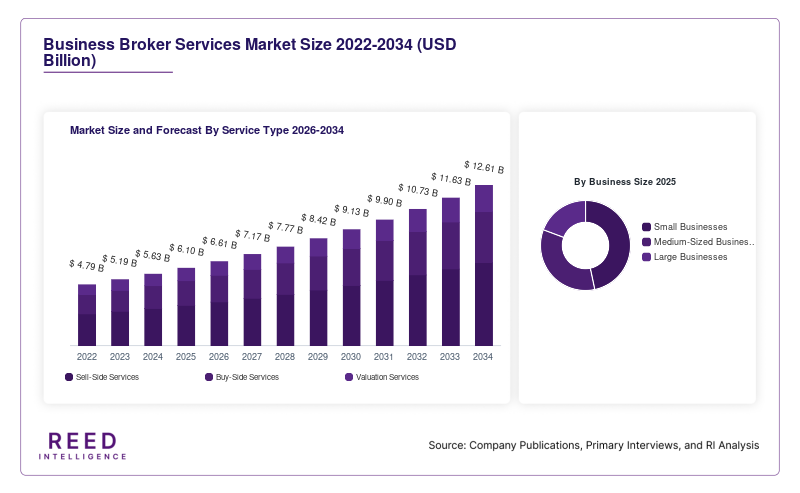
The market is primarily segmented by service type and business size. Sell-side services dominate with approximately 47% share in 2026, while small businesses account for nearly 58% of total demand. The strongest growth is expected from buy-side services and digitally enabled brokerage solutions as acquisition entrepreneurs and corporate buyers seek faster access to qualified opportunities.
By Type
Sell-Side Services: Sell-side brokerage represented approximately 47% of the market in 2026, equivalent to around USD 3.11 billion in service revenue. The segment includes business valuation, confidential listing preparation, marketing, buyer screening, negotiation, and closing coordination. In transaction-equivalent terms, organized brokerage networks supported approximately 5,000–5,500 business-sale engagements globally during the year. Typical technical requirements include normalized EBITDA analysis, comparable-company valuation, cash-flow assessment, confidential information memoranda, secure buyer qualification, and digital data-room workflows.
Buy-Side Services: Buy-side services held approximately 31% share, or about USD 2.05 billion, in 2026. Demand is increasing among individual entrepreneurs, strategic acquirers, private-equity-backed platforms, and search-fund investors. The segment represents an estimated 3,000–3,500 acquisition mandates and sourcing engagements globally. Services typically include acquisition criteria development, target identification, preliminary screening, financial analysis, negotiation support, and due-diligence coordination. AI-based matching and searchable transaction databases are increasingly important technical capabilities.
Valuation Services: Valuation services accounted for approximately 22% of the market, representing nearly USD 1.45 billion in 2026. Brokers and specialist advisors provide independent or transaction-oriented valuations using income, market, and asset-based approaches. Approximately 2,000–2,500 valuation engagements can be associated with the organized market annually, although many overlap with buy-side and sell-side mandates. Digital valuation models increasingly incorporate revenue growth, recurring revenue, EBITDA margins, customer concentration, industry multiples, and transaction comparables.
By Application
Small Businesses: Small businesses represented approximately 58% of demand in 2026 and generated an estimated USD 3.83 billion in brokerage-service revenue. This segment includes owner-operated companies, local service businesses, small retailers, restaurants, professional practices, and online businesses. Approximately 5,500–6,000 transaction and advisory engagements are estimated to originate from this category annually. Brokers typically emphasize normalized cash flow, seller financing, customer concentration, lease terms, working capital, and buyer financing eligibility.
Medium-Sized Businesses: Medium-sized businesses accounted for approximately 29% of the market, generating around USD 1.92 billion in 2026. This segment includes established companies with larger employee bases, stronger management teams, and more complex financial structures. Approximately 2,500–3,000 transaction engagements are estimated to involve this category. Technical requirements commonly include quality-of-earnings analysis, management assessment, working-capital normalization, enterprise-value calculations, competitive positioning, and structured buyer outreach.
Large Businesses: Large businesses contributed approximately 13% of market revenue, or about USD 0.86 billion in 2026. These assignments generally overlap with lower-middle-market M&A advisory and involve sophisticated corporate or institutional buyers. Approximately 1,000–1,500 specialized mandates and related advisory engagements are estimated annually. Requirements include detailed financial modeling, strategic buyer identification, acquisition structures, regulatory review, comprehensive due diligence, and complex negotiation support.
Business Broker Services Market Regional Analysis
North America Business Broker Services Market
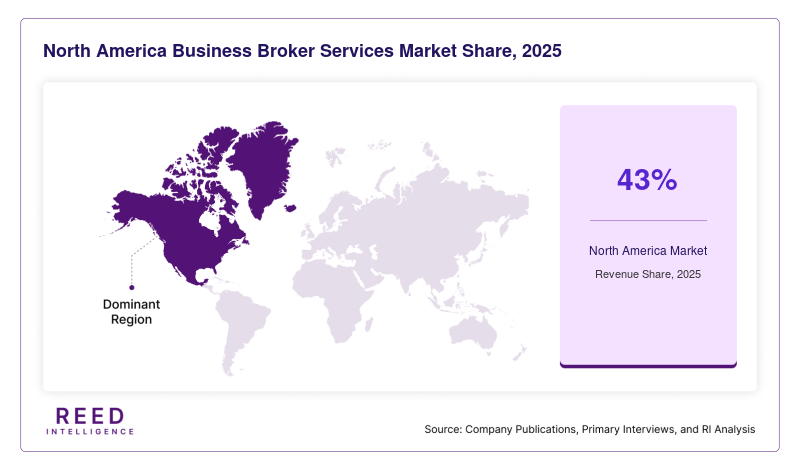
North America held approximately 43% of the global market in 2026, supported by a mature business-for-sale ecosystem, extensive brokerage networks, established financing channels, and high SME ownership-transition activity. The United States represents the largest contribution, followed by Canada. Professional services, healthcare, home services, restaurants, manufacturing, technology, and franchise businesses generate substantial brokerage demand. Digital marketplaces and nationwide franchise networks are increasing market reach.
Europe Business Broker Services Market
Europe represented approximately 27% of global revenue in 2026. The United Kingdom, Germany, France, Italy, and Spain are key contributors, with demand supported by family-business succession, SME consolidation, and cross-border acquisitions. Professional services, manufacturing, retail, hospitality, and technology account for important portions of broker activity. Europe is expected to grow at approximately 8.0% CAGR through 2034 as succession planning becomes more important.
Asia Pacific Business Broker Services Market
Asia Pacific accounted for roughly 18% of the global market in 2026 and is expected to record the fastest regional growth at approximately 10.1% CAGR. China, India, Japan, Australia, Singapore, and Southeast Asian economies are the primary contributors. India is benefiting from increasing M&A activity, entrepreneurial expansion, SME formalization, and professionalization of business succession. Technology-enabled marketplaces are particularly important in markets where traditional brokerage infrastructure remains fragmented.
Latin America Business Broker Services Market
Latin America held approximately 7% market share in 2026. Brazil and Mexico are the largest contributors, supported by growing SME ecosystems, private investment, franchising, and consolidation in consumer and service industries. Broker demand is increasingly concentrated around valuation, succession planning, and acquisition sourcing, while digital platforms are improving access to regional and international buyers.
Middle East & Africa Business Broker Services Market
The Middle East & Africa region represented approximately 5% of global revenue. The United Arab Emirates, Saudi Arabia, South Africa, and other developing commercial centers contribute the majority of demand. Business brokerage is gaining relevance as private enterprises diversify, foreign investment expands, and owners seek professional support for succession and strategic transactions. Digital advisory models are expected to improve accessibility across fragmented markets.
Top players in the Business Broker Services Market
- Transworld Business Advisors
- Sunbelt Business Brokers
- Murphy Business & Financial Corporation
- VR Business Brokers
- First Choice Business Brokers
- BizBuySell
- Empire Flippers
- LINK Business Brokers
- Business Broker Network
- Vested Business Brokers
- Generational Equity
- Business Team
- Benchmark Business Group
- Gateway Business Advisors
- DealStream
Recent Developments in Business Broker Services Market
- January 2026: BizBuySell reported that U.S. small-business transactions reached 9,586 in 2025, with total enterprise value increasing to approximately USD 7.95 billion and median sale prices rising to USD 350,000.
- March 2026: United Franchise Group announced the acquisition of full ownership of Transworld Business Advisors, reinforcing its position as a major global business brokerage network.
- June 2025: Murphy Business highlighted continued expansion and transaction activity across its U.S. and Canadian brokerage network, reflecting sustained demand for professional business-sale advisory services.
- February 2025: Technology-enabled valuation and analytics capabilities became increasingly prominent across business brokerage platforms as firms sought to accelerate seller assessments, buyer matching, and transaction forecasting.
- 2025: Small-business transaction activity increasingly favored service businesses and technology-oriented companies, while manufacturing faced greater buyer caution because of cost pressures, trade uncertainty, and margin concerns.
Business Broker Services Market Segments
By Service Type
- Sell-Side Services
- Buy-Side Services
- Valuation Services
By Business Size
- Small Businesses
- Medium-Sized Businesses
- Large Businesses
By Region
- North America
- Europe
- APAC
- Middle East and Africa
- LATAM