Butachlor Market Size, Share & Demand Report By Formulation Type (Emulsifiable Concentrate, Granules, Wettable Powder, Microencapsulated Formulations), By Crop Type (Rice, Wheat, Corn, Soybean, Others), By Application Method (Spray Application, Seed Treatment, Soil Treatment, Drone-Assisted Application), By Region & Segment Forecasts, 2026–2034
USD 3950
Market Overview
The global Butachlor Market size was valued at approximately USD 1.48 billion in 2026 and is projected to reach nearly USD 2.41 billion by 2034, expanding at a CAGR of 6.3% during the forecast period from 2026 to 2034. Butachlor is a widely used chloroacetanilide herbicide primarily applied in rice cultivation for controlling annual grasses and broadleaf weeds. The market continues to gain traction due to the increasing need for effective crop protection chemicals that can improve agricultural productivity and reduce weed-related crop losses. Growing pressure on global food systems, combined with the shrinking availability of arable land, has encouraged farmers to adopt herbicides that support higher crop yields and reduce labor-intensive weed management practices.
A major global factor supporting market expansion is the steady growth in rice cultivation across Asia Pacific and emerging agricultural economies. Governments in countries such as India, China, Vietnam, and Indonesia are investing in agricultural modernization programs to improve food security and farmer productivity. Mechanized farming practices and the increasing use of pre-emergence herbicides have strengthened demand for butachlor formulations in commercial farming. In addition, improvements in agrochemical distribution networks and the availability of cost-effective herbicide blends have contributed to wider product penetration in rural agricultural regions.
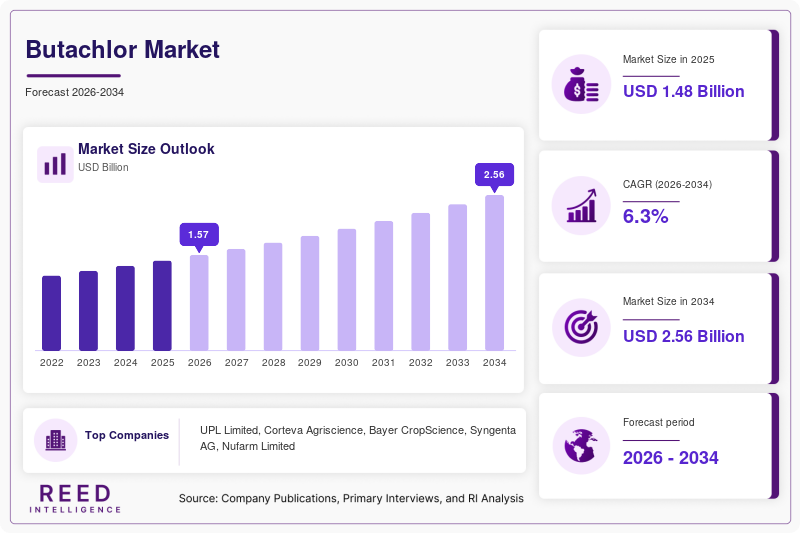
Key Highlights
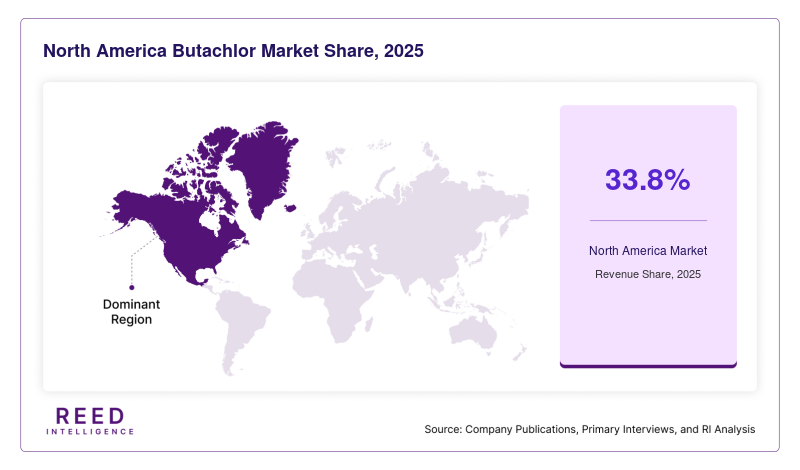
- North America dominated the market with a 33.8% share in 2025.
- Asia Pacific is expected to grow at the fastest CAGR of 7.6% during 2026–2034.
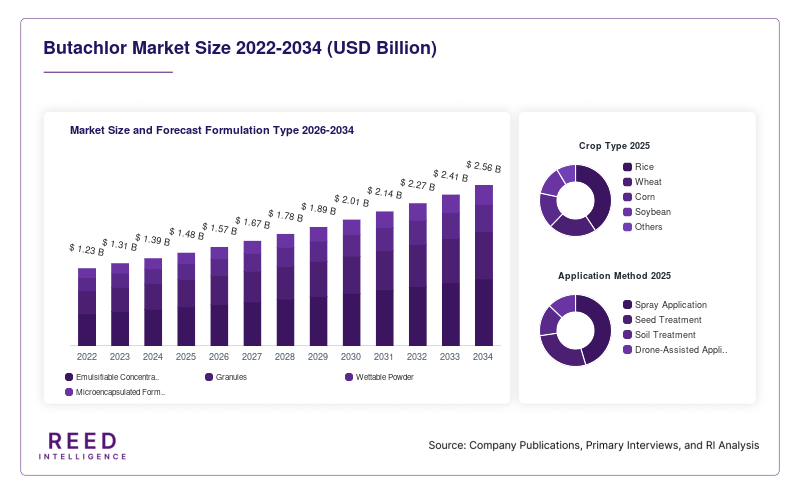
- By formulation type, emulsifiable concentrate accounted for the largest share of 44.1%.
- while microencapsulated formulations are projected to grow at a CAGR of 8.1%.
- By crop type, rice cultivation led with a 58.7% share, whereas wheat applications are expected to expand at a CAGR of 7.2%.
- By application method, spray application held the dominant share of 49.5%, while drone-assisted application is forecast to grow at a CAGR of 8.4%.
- China remained the dominant country, with market values of USD 282 million in 2024 and USD 301 million in 2025.
Market Trends
Increasing Adoption of Precision Agriculture Practices
The Butachlor Market is witnessing growing integration with precision agriculture technologies that improve herbicide application efficiency and reduce wastage. Farmers are increasingly adopting GPS-guided spraying systems, automated field monitoring tools, and sensor-based crop management solutions to optimize herbicide use. Precision agriculture allows better dosage control and targeted weed management, which improves butachlor effectiveness while minimizing environmental exposure. The trend is particularly visible in large-scale farming regions where growers seek cost savings and better productivity through advanced farm management systems.
The expansion of agricultural drones and automated spraying equipment is also contributing to this trend. Drone-assisted herbicide application is becoming popular in rice-producing countries due to its ability to cover large agricultural fields quickly and uniformly. Agrochemical manufacturers are responding by developing formulations compatible with precision spraying systems and variable-rate application technologies. This transition toward technology-supported farming is expected to increase herbicide efficiency and improve the long-term adoption potential of butachlor-based crop protection products.
Rising Demand for Sustainable Herbicide Formulations
Sustainability concerns and stricter environmental regulations are encouraging agrochemical producers to introduce safer and more efficient herbicide formulations. The market is observing rising demand for low-residue and controlled-release butachlor products that reduce chemical runoff and improve soil compatibility. Agricultural authorities in several countries are promoting responsible herbicide usage through awareness campaigns and regulatory monitoring programs. As a result, manufacturers are focusing on research activities aimed at improving environmental performance without reducing weed control effectiveness.
The trend toward sustainable farming practices is also influencing purchasing behavior among commercial growers and agricultural cooperatives. Farmers are seeking herbicides that provide strong weed suppression with lower application frequency and reduced ecological impact. Microencapsulated and water-based formulations are gaining attention because they offer controlled dispersion and lower toxicity levels. Companies operating in the Butachlor Market are expected to continue investing in sustainable product development to align with evolving regulatory standards and changing consumer expectations related to agricultural sustainability.
Market Drivers
Expanding Global Rice Production and Food Security Concerns
The increasing global demand for rice and staple food crops remains a major growth driver for the Butachlor Market. Rice cultivation requires effective weed management to maintain yield quality and crop productivity, making butachlor one of the preferred herbicides in paddy farming systems. Population growth, urbanization, and changing food consumption patterns are creating pressure on agricultural producers to increase crop output. Governments across Asia Pacific and Africa are introducing subsidies, irrigation projects, and modern farming initiatives to support domestic rice production and improve food security.
Weed infestations can significantly reduce crop yields and farm profitability, especially in regions with high humidity and favorable weed growth conditions. Butachlor helps farmers control annual grasses and broadleaf weeds during early crop development stages, reducing competition for nutrients and water. The herbicide’s cost-effectiveness and compatibility with large-scale farming operations have strengthened its adoption in emerging agricultural economies. Continued expansion of rice acreage and the growing need for reliable herbicide solutions are expected to sustain market demand throughout the forecast period.
Increasing Mechanization in Agricultural Operations
The growing adoption of mechanized farming practices is supporting the expansion of the Butachlor Market across commercial agricultural regions. Farmers are increasingly using tractors, boom sprayers, and automated application systems to improve operational efficiency and reduce labor dependency. Rising rural labor shortages and increasing labor costs are encouraging growers to adopt herbicides that can be applied rapidly across large farming areas. Butachlor formulations are widely compatible with mechanized spraying systems, making them suitable for modern agricultural practices.
Agricultural mechanization has also improved awareness regarding pre-emergence weed control methods and optimized herbicide application timing. Commercial farms are prioritizing productivity improvement and input cost reduction, which has accelerated demand for efficient crop protection chemicals. Emerging economies are investing in rural infrastructure, irrigation facilities, and farm equipment financing programs that support mechanized cultivation. This transition toward large-scale commercial farming is expected to increase herbicide consumption and strengthen the long-term growth prospects of the global butachlor industry.
Market Restraint
Environmental and Regulatory Concerns Regarding Herbicide Usage
Environmental concerns associated with herbicide residue accumulation and water contamination continue to restrain the growth of the Butachlor Market. Regulatory authorities in several countries are imposing stricter guidelines on agrochemical usage due to rising concerns regarding soil degradation, aquatic toxicity, and long-term ecosystem impact. Improper herbicide application and excessive chemical usage can affect surrounding biodiversity and contribute to environmental pollution. These concerns have encouraged governments to strengthen monitoring procedures and implement restrictions on certain herbicide formulations.
The market is also facing pressure from the growing adoption of organic farming and biological weed management practices. Farmers and agricultural cooperatives in developed economies are increasingly exploring sustainable crop protection alternatives that reduce chemical dependency. In some regions, changing regulatory frameworks have delayed product approvals and increased compliance costs for agrochemical manufacturers. Smaller producers may face operational challenges related to research investments and regulatory documentation requirements. These factors could limit market penetration in environmentally sensitive agricultural regions and create barriers for new product launches.
Market Opportunities
Expansion of Agricultural Activities in Emerging Economies
Emerging economies across Asia Pacific, Latin America, and Africa are creating substantial growth opportunities for the Butachlor Market due to expanding agricultural production and rising investments in modern farming practices. Governments in developing countries are prioritizing agricultural productivity to strengthen food security and rural income generation. Increased irrigation infrastructure, improved seed availability, and greater access to agrochemicals are contributing to higher herbicide consumption. Butachlor products are widely used in rice cultivation, which remains a major agricultural activity across several developing regions.
The expansion of organized agrochemical retail networks is also improving product availability in rural farming communities. International agrochemical companies are forming partnerships with local distributors to expand their market presence and improve supply chain efficiency. Training programs focused on herbicide application techniques and weed management strategies are increasing awareness among farmers regarding the benefits of pre-emergence herbicides. These developments are expected to create favorable conditions for sustained market growth in emerging agricultural economies during the forecast period.
Development of Advanced and Controlled-Release Formulations
The increasing focus on product innovation presents significant opportunities for companies operating in the Butachlor Market. Manufacturers are investing in advanced formulations that improve herbicide stability, reduce environmental impact, and enhance weed control efficiency. Controlled-release and microencapsulated technologies are attracting attention because they allow gradual chemical release and lower application frequency. Such innovations can help address environmental concerns while maintaining crop protection performance.
Advanced formulations are also expected to support compatibility with precision agriculture systems and automated spraying technologies. Agrochemical producers are exploring combination products that integrate butachlor with complementary herbicides to improve resistance management and broaden weed control capabilities. Research and development activities focused on formulation enhancement can strengthen product differentiation and create new revenue opportunities. As farmers increasingly seek efficient and sustainable crop protection solutions, technologically advanced butachlor products are likely to gain wider commercial acceptance.
Segmental Analysis
By Formulation Type
Emulsifiable concentrate formulations accounted for the largest share of the Butachlor Market in 2024, representing nearly 44.1% of global revenue. These formulations remain widely preferred because they provide effective weed control, easy mixing characteristics, and compatibility with traditional spraying equipment. Farmers in rice-producing regions continue to rely on emulsifiable concentrates due to their cost efficiency and broad commercial availability. Agrochemical distributors also favor these products because they can be transported and stored conveniently across large agricultural supply chains. The segment benefits from strong demand in developing agricultural economies where cost-sensitive growers prioritize reliable and affordable herbicide solutions. Continued expansion of commercial farming activities and increasing herbicide awareness among farmers are expected to maintain the dominance of emulsifiable concentrate products during the forecast period.
Microencapsulated formulations are projected to grow at the fastest CAGR of 8.1% between 2026 and 2034 due to increasing demand for controlled-release herbicide technologies. These formulations offer improved environmental safety, reduced chemical drift, and enhanced weed control efficiency compared to conventional products. Farmers are increasingly seeking solutions that minimize herbicide wastage and improve soil compatibility. Regulatory agencies are also encouraging the adoption of environmentally safer agrochemical products, which is accelerating demand for advanced formulations. Manufacturers are investing in research and development activities to improve formulation stability and compatibility with precision agriculture systems. Growing awareness regarding sustainable farming practices and integrated weed management strategies is expected to support rapid expansion of the microencapsulated formulation segment.
By Crop Type
Rice cultivation dominated the Butachlor Market in 2024 and accounted for approximately 58.7% of the overall market share. Butachlor is extensively used in paddy fields because it effectively controls annual grasses and broadleaf weeds during early crop development stages. The dominance of this segment is strongly linked to the high concentration of rice farming activities across Asia Pacific countries such as China, India, Vietnam, and Thailand. Farmers prefer butachlor in rice cultivation because it helps improve crop yields, reduce weed competition, and lower labor-intensive field maintenance requirements. Government support programs aimed at increasing rice productivity and strengthening food security have also encouraged herbicide usage. The growing commercialization of rice farming and rising adoption of mechanized agricultural practices are expected to sustain the segment’s leadership position.
Wheat applications are anticipated to expand at the fastest CAGR of 7.2% during the forecast period due to rising demand for effective weed management solutions in cereal cultivation. Wheat growers are increasingly adopting herbicides to improve productivity and reduce crop losses caused by aggressive weed growth. Expansion of commercial grain farming operations across North America, Europe, and parts of Latin America is contributing to higher herbicide consumption. Agricultural producers are also seeking crop protection products compatible with mechanized spraying systems and precision farming technologies. Improvements in irrigation infrastructure and increasing awareness regarding pre-emergence weed control methods are further supporting segment growth. Agrochemical manufacturers are introducing formulation variants specifically designed for cereal crop applications, which is expected to enhance market opportunities within the wheat segment.
By Application Method
Spray application held the dominant share of the Butachlor Market in 2024, accounting for nearly 49.5% of total revenue. The segment remains highly preferred because spray-based methods provide uniform herbicide distribution and effective weed suppression across large agricultural fields. Traditional boom sprayers and tractor-mounted systems continue to be widely used in commercial farming operations due to their operational efficiency and ease of application. Spray application methods are also compatible with various butachlor formulations, making them suitable for different crop types and farming conditions. The segment benefits from increasing mechanization in agricultural operations and improved access to farm equipment financing programs in emerging economies. Large-scale agricultural producers continue to invest in advanced spraying systems to improve productivity and optimize herbicide usage.
Drone-assisted application is expected to register the fastest CAGR of 8.4% during the forecast period due to the rapid adoption of smart farming technologies. Agricultural drones enable efficient herbicide spraying across large and difficult-to-access farming areas while reducing labor requirements and application time. Farmers are increasingly using drone systems to improve precision, minimize chemical wastage, and lower operational costs. Government support for digital agriculture initiatives and increasing investments in agricultural automation are further supporting segment growth. Agrochemical manufacturers are also developing butachlor formulations optimized for drone-based spraying systems. Rising awareness regarding precision agriculture and the need for efficient resource management are expected to accelerate the adoption of drone-assisted herbicide application methods across commercial farming regions.
Regional Analysis
North America
North America accounted for approximately 33.8% of the global Butachlor Market in 2025 and is expected to expand at a CAGR of 5.4% during the forecast period. The regional market benefits from advanced agricultural infrastructure, large-scale commercial farming operations, and the strong presence of agrochemical manufacturers. Farmers in the region continue to adopt herbicides to improve crop yields and manage labor shortages. Increased awareness regarding integrated weed management practices and precision agriculture technologies has also contributed to consistent demand for butachlor products across agricultural applications.
The United States remained the dominant country within North America due to its extensive commercial farming sector and high adoption of mechanized agricultural equipment. Growing investments in precision spraying technologies and drone-based herbicide application systems are supporting market development. Agricultural producers are increasingly focusing on efficient weed management solutions to improve productivity and reduce operational costs. Research partnerships between agrochemical companies and agricultural institutions are also encouraging the development of improved herbicide formulations suitable for large-scale farming conditions.
Europe
Europe represented nearly 24.1% of the global Butachlor Market in 2025 and is projected to grow at a CAGR of 4.9% from 2026 to 2034. The market is influenced by stable agricultural activities and rising demand for effective weed management solutions in cereal and grain cultivation. Farmers across the region are increasingly using herbicides to improve crop quality and reduce manual labor requirements. The presence of advanced agricultural cooperatives and strong distribution channels has further supported product accessibility and market expansion.
France emerged as the dominant country in the European market due to its strong agricultural output and extensive cereal cultivation activities. The country has witnessed increased adoption of modern farming technologies and precision herbicide application systems. Regulatory emphasis on responsible agrochemical usage has encouraged manufacturers to develop safer and more efficient butachlor formulations. Sustainable farming initiatives and investments in environmentally compatible crop protection products are expected to support steady market growth across the European agricultural sector.
Asia Pacific
Asia Pacific held approximately 28.7% of the global Butachlor Market in 2025 and is expected to register the fastest CAGR of 7.6% during the forecast period. The region remains a major consumer of butachlor products due to extensive rice cultivation and rising agricultural modernization efforts. Countries across Asia Pacific are investing in irrigation systems, mechanized farming equipment, and improved agrochemical distribution networks. Growing food demand and expanding rural agricultural activities continue to strengthen herbicide consumption across the region.
China dominated the Asia Pacific market owing to its large agricultural land area and high rice production volumes. Government initiatives supporting food security and modern farming practices have increased herbicide adoption among commercial growers. Rising labor costs and the shift toward mechanized farming are encouraging farmers to rely on efficient weed control solutions such as butachlor. In addition, domestic agrochemical manufacturers are expanding production capacities and investing in research activities aimed at improving product efficiency and environmental compatibility.
Middle East & Africa
The Middle East & Africa region accounted for nearly 7.3% of the global Butachlor Market in 2025 and is projected to grow at a CAGR of 5.8% during the forecast period. Agricultural development initiatives and increasing investments in food production infrastructure are contributing to regional market growth. Several countries are focusing on improving crop productivity to reduce food import dependency and strengthen domestic agricultural output. The adoption of herbicides is gradually increasing among commercial farms and government-supported agricultural projects.
South Africa remained the dominant country in the regional market due to its comparatively advanced agricultural sector and growing use of modern farming equipment. Farmers are increasingly adopting herbicides to manage weed infestations and improve crop quality in cereal cultivation. Expansion of irrigation projects and government support for agricultural modernization are creating favorable conditions for agrochemical demand. International agrochemical companies are also strengthening regional distribution networks to improve market penetration across emerging farming communities.
Latin America
Latin America captured approximately 6.1% of the global Butachlor Market in 2025 and is expected to expand at a CAGR of 6.2% between 2026 and 2034. The market is benefiting from increasing cultivation of rice, corn, and grain crops across major agricultural economies. Farmers are adopting herbicides to improve productivity and reduce labor-intensive weed management practices. Expansion of export-oriented agriculture and rising awareness regarding crop protection solutions are further supporting market growth across the region.
Brazil dominated the Latin American market due to its large-scale agricultural production and growing investment in commercial farming technologies. The country continues to expand irrigation infrastructure and mechanized cultivation practices, which support herbicide usage. Rising export demand for agricultural commodities has encouraged farmers to improve crop quality and yield consistency. Agrochemical suppliers are increasingly focusing on regional partnerships and localized distribution strategies to strengthen their presence in Brazil and neighboring agricultural markets.
Competitive Landscape
The Butachlor Market remains moderately consolidated, with leading agrochemical companies focusing on product innovation, regional expansion, and strategic distribution partnerships to strengthen market presence. Major participants are investing in research and development activities to improve formulation efficiency, environmental compatibility, and weed resistance management capabilities. Companies are also expanding manufacturing capacities to meet rising herbicide demand from emerging agricultural economies.
UPL Limited continues to hold a leading position in the global market due to its broad agrochemical portfolio, extensive distribution network, and strong presence across Asia Pacific and Latin America. The company recently introduced upgraded herbicide formulations designed for improved compatibility with precision agriculture technologies. Other major companies operating in the market include Corteva Agriscience, Bayer CropScience, Syngenta, and Nufarm Limited. These players are emphasizing strategic collaborations, localized production facilities, and farmer education initiatives to strengthen customer engagement and market penetration.
Key Players
- UPL Limited
- Corteva Agriscience
- Bayer CropScience
- Syngenta AG
- Nufarm Limited
- BASF SE
- FMC Corporation
- Adama Agricultural Solutions
- Sumitomo Chemical Co., Ltd.
- Nissan Chemical Corporation
- PI Industries
- Jiangsu Yangnong Chemical Group
- Bharat Rasayan Limited
- Rallis India Limited
Recent Developments
- In February 2026, UPL Limited expanded its herbicide manufacturing capacity in India to meet increasing demand for rice crop protection products across Asia Pacific.
- In September 2025, Syngenta introduced an upgraded controlled-release butachlor formulation designed to improve application efficiency and reduce environmental residue.
- In June 2025, Corteva Agriscience partnered with regional agricultural distributors in Southeast Asia to strengthen herbicide accessibility in rural farming markets.
Butachlor Market Segments
Formulation Type
- Emulsifiable Concentrate
- Granules
- Wettable Powder
- Microencapsulated Formulations
Crop Type
- Rice
- Wheat
- Corn
- Soybean
- Others
Application Method
- Spray Application
- Seed Treatment
- Soil Treatment
- Drone-Assisted Application
By Region
- North America
- Europe
- APAC
- Middle East and Africa
- LATAM