Butterfly Needle Set Market Size, Share & Demand Report By Type (Safety Butterfly Needle Sets, Conventional Butterfly Needle Sets), By Application (Blood Collection, IV Infusion, Others), By End-Use (Hospitals, Diagnostic Laboratories, Home Healthcare, Clinics), By Distribution Channel (Online, Offline) By Region & Segment Forecasts, 2026–2034
USD 3950
Market Overview
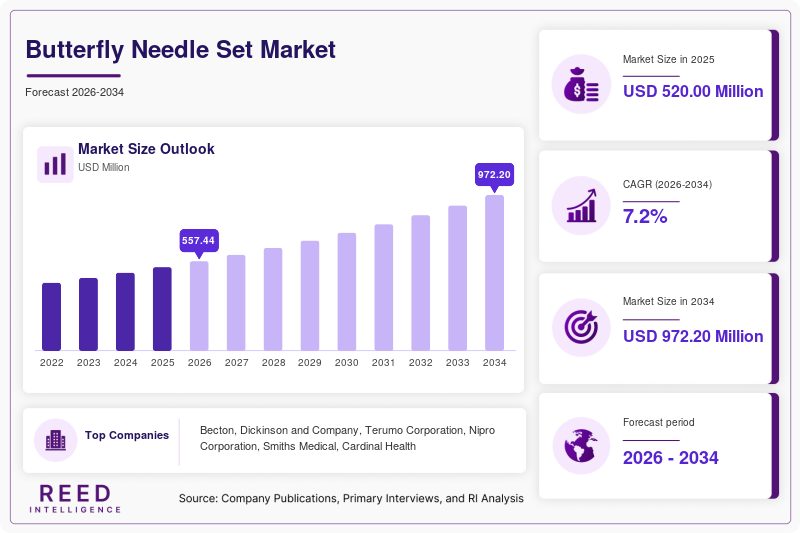
The Butterfly Needle Set Market was valued at approximately USD 520 million in 2026 and is projected to reach USD 910 million by 2034, expanding at a CAGR of 7.2% from 2026 to 2034. The market growth is primarily supported by the increasing demand for minimally invasive blood collection and intravenous (IV) access procedures across hospitals, diagnostic laboratories, and home healthcare settings. The rising global burden of chronic diseases such as diabetes, cancer, and cardiovascular disorders has significantly increased the frequency of blood sampling, thereby driving demand for butterfly needle sets.
Additionally, improvements in healthcare infrastructure and the expansion of diagnostic services in emerging economies have contributed to consistent market expansion. The growing preference for safer and more comfortable venipuncture devices, especially among pediatric and geriatric patients, has further enhanced the adoption of butterfly needle sets.
Key Highlights:
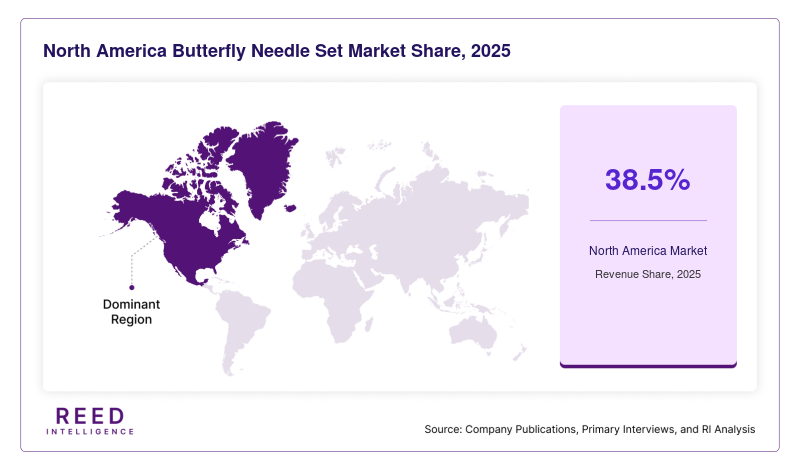
- North America dominated the market with a share of 38.5% in 2025, while Asia Pacific is projected to be the fastest-growing region with a CAGR of 8.6%.
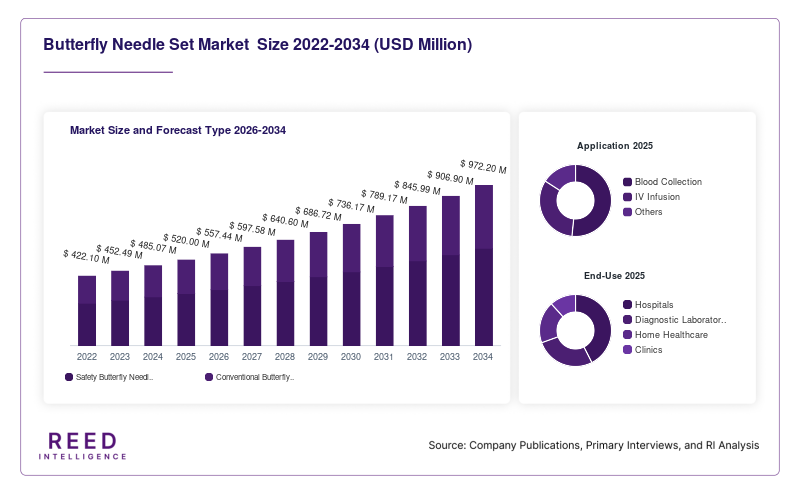
- By type, safety butterfly needle sets held the largest share of 61.2% in 2025, while advanced safety-engineered devices are expected to grow at a CAGR of 8.9%.
- By application, blood collection was the dominant segment with a 54.7% share, whereas IV infusion applications are forecast to grow at a CAGR of 7.8%.
- The United States remained the dominant country, with market values of USD 168 million in 2024 and USD 179 million in 2025.
Market Trends
Increasing Adoption of Safety-Engineered Devices
A major trend shaping the Butterfly Needle Set Market is the growing adoption of safety-engineered devices designed to reduce needlestick injuries. Healthcare providers are increasingly prioritizing occupational safety, leading to the widespread integration of retractable needles and shielding mechanisms. Regulatory frameworks in developed markets are also mandating the use of safety devices, which has accelerated their penetration across hospitals and clinics. This trend is particularly strong in North America and Europe, where compliance requirements and awareness levels are higher.
Expansion of Home Healthcare and Point-of-Care Testing
The rise of home healthcare services and decentralized diagnostic testing is another key trend influencing the market. Patients are increasingly opting for at-home blood collection and IV therapies, supported by portable medical devices and telehealth integration. Butterfly needle sets, known for ease of use and patient comfort, are becoming essential tools in these settings. This trend is further supported by aging populations and the need for frequent monitoring of chronic conditions, which is driving demand for user-friendly and minimally invasive solutions.
Market Drivers
Rising Prevalence of Chronic Diseases
The increasing global incidence of chronic diseases has significantly boosted demand for diagnostic and therapeutic procedures requiring venipuncture. Patients with conditions such as diabetes, renal disorders, and cancer require frequent blood testing and IV treatments. Butterfly needle sets offer precision and reduced discomfort, making them a preferred choice for repeated use. This growing patient pool continues to drive sustained demand across healthcare facilities.
Growing Emphasis on Patient Comfort and Clinical Efficiency
Healthcare providers are focusing on improving patient experience and operational efficiency. Butterfly needle sets provide better control during insertion and reduce complications such as vein collapse or bruising. Their ergonomic design and flexible tubing enhance usability for clinicians, particularly in difficult venous access cases. This combination of patient comfort and clinical effectiveness is driving widespread adoption across hospitals and diagnostic centers.
Market Restraint
Risk of Needlestick Injuries and Infection Transmission
Despite advancements in safety features, the risk of needlestick injuries remains a concern in the Butterfly Needle Set Market. Improper handling, inadequate training, and non-compliance with safety protocols can lead to accidental injuries, exposing healthcare workers to infections such as hepatitis and HIV. In developing regions, the limited availability of advanced safety-engineered devices further exacerbates this issue.
Additionally, cost constraints often lead smaller healthcare facilities to opt for conventional needle sets instead of more expensive safety variants. This price sensitivity can hinder the widespread adoption of advanced products, particularly in low- and middle-income countries. Addressing these challenges requires continued investment in training, awareness programs, and cost-effective product innovations.
Market Opportunities
Technological Advancements in Needle Design
Innovations in needle design, including ultra-thin needles, improved coatings, and enhanced safety mechanisms, present significant growth opportunities. Manufacturers are investing in research and development to create products that minimize pain, reduce complications, and improve usability. The integration of smart features such as blood flow indicators and automated safety locks is expected to drive product differentiation and adoption.
Growth in Emerging Healthcare Markets
Emerging economies in Asia Pacific, Latin America, and the Middle East are witnessing rapid improvements in healthcare infrastructure. Government initiatives to expand access to diagnostic services and increase healthcare spending are creating favorable conditions for market growth. The rising number of hospitals, clinics, and diagnostic laboratories in these regions is expected to drive demand for butterfly needle sets over the forecast period.
Segmental Analysis
By Type
Safety butterfly needle sets dominated the market, accounting for 61.2% of the total share in 2025. Their widespread adoption was driven by the increasing emphasis on reducing needlestick injuries and improving healthcare worker safety. Hospitals and diagnostic centers preferred these devices due to their integrated safety features and compliance with regulatory standards.
Advanced safety-engineered butterfly needle sets are expected to be the fastest-growing subsegment, with a projected CAGR of 8.9%. The growth will be driven by continuous innovation in safety mechanisms and increasing regulatory mandates. These devices will gain traction due to their ability to enhance user safety and reduce infection risks.
By Application
Blood collection emerged as the dominant application segment, holding a 54.7% share in 2025. The high frequency of diagnostic testing and routine blood sampling procedures contributed to its leading position. Butterfly needle sets are widely used in laboratories and hospitals for efficient and comfortable blood collection.
IV infusion is anticipated to be the fastest-growing application segment, with a CAGR of 7.8%. The increasing use of intravenous therapies and the need for precise fluid administration will drive growth. The flexibility and ease of use of butterfly needle sets make them suitable for infusion procedures.
By End-Use
Hospitals dominated the market with a 49.3% share in 2025, owing to the high volume of patient admissions and procedures. The availability of skilled healthcare professionals and advanced infrastructure supported the adoption of butterfly needle sets in hospital settings.
Home healthcare is projected to be the fastest-growing end-use segment, expanding at a CAGR of 8.4%. The shift towards decentralized care and the increasing preference for at-home treatments will drive demand. Butterfly needle sets are well-suited for home use due to their simplicity and patient comfort.
By Distribution Channel
Offline distribution channels held the largest share of 68.1% in 2025, as hospitals and clinics primarily procure medical devices through direct suppliers and distributors. Established supply chains and bulk purchasing agreements contributed to the dominance of this segment.
Online distribution is expected to grow at the fastest CAGR of 9.1%. The increasing adoption of e-commerce platforms and digital procurement systems will drive growth. Online channels offer convenience, competitive pricing, and a wide range of product options, attracting healthcare providers and individual users.
Regional Analysis
North America
North America accounted for 38.5% of the Butterfly Needle Set Market share in 2025 and is expected to maintain steady growth at a CAGR of 6.5% through 2034. The region’s dominance was driven by advanced healthcare infrastructure, high adoption of safety devices, and strong regulatory frameworks. The presence of established market players and continuous technological advancements further supported market expansion.
The United States emerged as the dominant country due to its high volume of diagnostic procedures and strong focus on patient safety. The widespread implementation of safety regulations and reimbursement policies has encouraged healthcare facilities to adopt advanced butterfly needle sets, contributing to sustained market growth.
Europe
Europe held a market share of 27.3% in 2025 and is projected to grow at a CAGR of 6.8% during the forecast period. The region benefited from increasing healthcare expenditure and rising awareness regarding infection control practices. The adoption of safety-engineered devices has been steadily increasing, supported by stringent regulatory requirements.
Germany led the European market due to its well-established healthcare system and strong emphasis on quality standards. The country’s focus on innovation and adoption of advanced medical devices has driven the demand for butterfly needle sets across hospitals and diagnostic laboratories.
Asia Pacific
Asia Pacific accounted for 21.6% of the market share in 2025 and is anticipated to grow at the fastest CAGR of 8.6% from 2026 to 2034. Rapid urbanization, increasing healthcare investments, and expanding diagnostic services have been key factors driving growth in the region.
China dominated the regional market due to its large population base and growing demand for healthcare services. The expansion of hospitals and diagnostic centers, coupled with government initiatives to improve healthcare access, has significantly boosted the adoption of butterfly needle sets.
Middle East & Africa
The Middle East & Africa region held a 7.2% market share in 2025 and is expected to grow at a CAGR of 7.1% over the forecast period. The market growth was supported by increasing investments in healthcare infrastructure and rising awareness of advanced medical devices.
Saudi Arabia emerged as the dominant country, driven by government initiatives to modernize healthcare systems and improve service quality. The growing number of hospitals and clinics has increased the demand for reliable and safe venipuncture devices.
Latin America
Latin America accounted for 5.4% of the Butterfly Needle Set Market share in 2025 and is projected to grow at a CAGR of 7.0% through 2034. The region experienced steady growth due to improving healthcare access and increasing demand for diagnostic services.
Brazil led the market owing to its expanding healthcare sector and rising focus on preventive care. The growing number of diagnostic laboratories and hospitals has contributed to the increasing adoption of butterfly needle sets.
Competitive Landscape
The Butterfly Needle Set Market is characterized by the presence of several established players focusing on product innovation and strategic collaborations. Leading companies are investing in research and development to introduce advanced safety features and improve product performance.
Becton, Dickinson and Company emerged as the market leader, leveraging its extensive product portfolio and global distribution network. The company recently introduced an enhanced safety butterfly needle set with improved shielding technology, strengthening its market position.
Other key players are focusing on expanding their presence in emerging markets and enhancing their product offerings. Strategic partnerships, mergers, and acquisitions are common strategies adopted to gain a competitive edge and increase market share.
Key Players List
- Becton, Dickinson and Company
- Terumo Corporation
- Nipro Corporation
- Smiths Medical
- Cardinal Health
- Medline Industries
- Fresenius Kabi
- Kawasumi Laboratories
- Greiner Bio-One International
- Sarstedt AG & Co. KG
- Boston Scientific Corporation
- ICU Medical, Inc.
- Vygon SA
- Poly Medicure Limited
- Hindustan Syringes & Medical Devices Ltd.
Recent Developments
- In 2025, leading manufacturers introduced advanced safety butterfly needle sets with enhanced retractable mechanisms to reduce injury risks.
- Several companies expanded their manufacturing capacities in Asia Pacific to meet rising regional demand.
- Strategic collaborations between healthcare providers and device manufacturers increased the adoption of innovative products.
- Digital procurement platforms gained traction, enabling faster and more efficient distribution of butterfly needle sets globally.
Butterfly Needle Set Market Segments
Type
- Safety Butterfly Needle Sets
- Conventional Butterfly Needle Sets
Application
- Blood Collection
- IV Infusion
- Others
End-Use
- Hospitals
- Diagnostic Laboratories
- Home Healthcare
- Clinics
Distribution Channel
- Online Retail
- Offline Distribution
By Region
- North America
- Europe
- APAC
- Middle East and Africa
- LATAM