Butylated Triphenyl Phosphate Market Size, Share Demand Report By Type (Liquid, Solid), By Function (Flame Retardant, Plasticizer), By Application (Plastics, Coatings, Adhesives, Lubricants), By End-Use Industry (Electronics, Automotive, Construction, Industrial), By Region & Segment Forecasts, 2025–2034
USD 3950
Market Overview
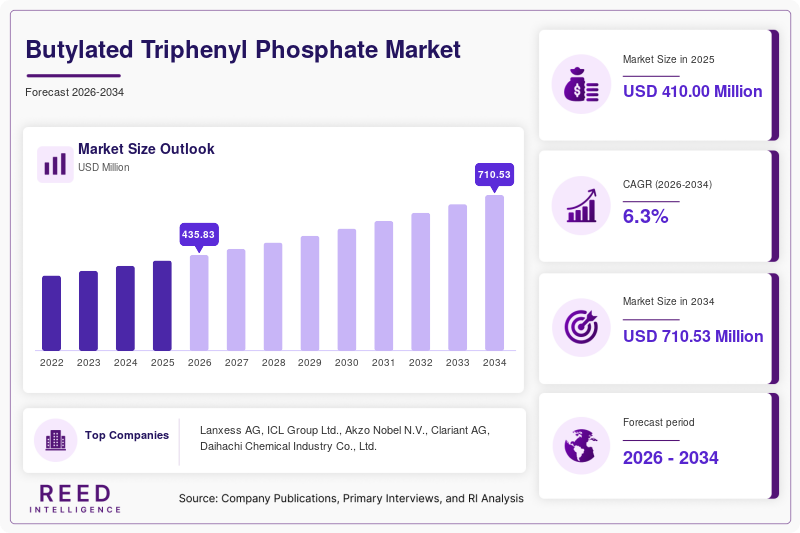
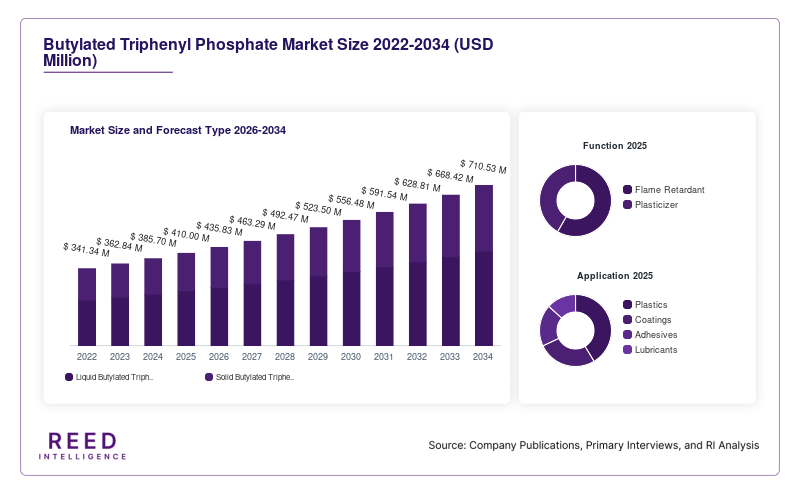
The global Butylated Triphenyl Phosphate Market size was valued at approximately USD 410 million in 2025 and is projected to reach USD 710 million by 2034, expanding at a CAGR of 6.3% during the forecast period (2025–2034). The market growth is being supported by the increasing demand for flame-retardant additives and plasticizers across industrial applications, particularly in electronics, automotive, and construction materials.
A key global factor driving the Butylated Triphenyl Phosphate Market is the steady expansion of advanced manufacturing sectors that require enhanced material safety and performance characteristics. The compound’s dual functionality as a flame retardant and plasticizer has made it an important additive in engineered polymers and coatings, especially where regulatory compliance and performance reliability are essential.
Key Highlights
- Asia Pacific dominated the market with a 42% share in 2025, while it is expected to register the fastest CAGR of 7.2%.
- By application, plastics accounted for the largest share at 38%, while coatings are projected to grow at the fastest CAGR of 6.9%.
- By end-use, electronics remained the leading segment, whereas automotive is expected to expand at a CAGR of 6.7%.
- China led the market with a value of USD 96 million in 2025 and is projected to reach USD 102 million in 2026.
Market Trends
Rising Adoption in High-Performance Polymers
The Butylated Triphenyl Phosphate Market is witnessing growing integration into high-performance polymer formulations. Manufacturers are increasingly incorporating the compound into engineering plastics used in electronics and industrial equipment to improve fire resistance and flexibility. This trend is driven by evolving safety regulations and the need for materials that maintain performance under extreme conditions. As advanced polymer technologies evolve, the demand for multifunctional additives such as butylated triphenyl phosphate is expected to strengthen further.
Shift Toward Environmentally Safer Additives
Another notable trend shaping the Butylated Triphenyl Phosphate Market is the gradual shift toward environmentally compliant chemical additives. Industries are focusing on reducing hazardous components while maintaining efficiency. Butylated triphenyl phosphate is being preferred due to its relatively balanced environmental and performance profile compared to traditional alternatives. This trend is particularly evident in regions with strict chemical safety frameworks, where manufacturers are reformulating products to align with regulatory expectations and sustainability goals.
Market Drivers
Increasing Demand for Flame Retardants in Electronics
The rapid expansion of the electronics industry is a key driver for the Butylated Triphenyl Phosphate Market. Electronic components require materials that can withstand heat and prevent fire hazards. The compound’s effectiveness as a flame retardant makes it suitable for circuit boards, connectors, and casings. With the growing production of consumer electronics and industrial devices, the demand for reliable flame-retardant additives is increasing steadily.
Growth in Construction and Infrastructure Development
The construction sector is also contributing to the growth of the Butylated Triphenyl Phosphate Market. The use of flame-retardant coatings, sealants, and plastic materials in buildings has increased due to stricter fire safety norms. The compound is widely used in coatings and insulation materials, supporting safer building designs. As urbanization continues and infrastructure investments rise globally, the demand for such chemical additives is expected to remain consistent.
Market Restraint
Regulatory Challenges and Environmental Concerns
One of the primary restraints affecting the Butylated Triphenyl Phosphate Market is the tightening regulatory landscape surrounding chemical additives. Governments and environmental agencies are imposing stricter guidelines on the use of phosphorus-based compounds due to concerns related to toxicity and environmental persistence.
Manufacturers are required to comply with evolving standards, which often increases production costs and delays product approvals. Additionally, there is growing scrutiny over the long-term environmental impact of such chemicals, leading to the development of alternative solutions. This shift can limit the adoption rate of butylated triphenyl phosphate in certain applications.
Furthermore, regulatory uncertainty in emerging markets can create challenges for market expansion. Companies operating in the Butylated Triphenyl Phosphate Market must invest in research and development to ensure compliance and maintain competitiveness, which may impact profit margins in the short term.
Market Opportunities
Expansion in Electric Vehicle Components
The rise of electric vehicles presents a significant opportunity for the Butylated Triphenyl Phosphate Market. EV components require advanced materials with high thermal stability and flame resistance. The compound is increasingly being used in battery casings, wiring systems, and interior components. As the EV industry expands globally, the demand for specialized additives is expected to grow.
Growth in Emerging Economies
Emerging economies offer strong growth potential for the Butylated Triphenyl Phosphate Market. Rapid industrialization, urban development, and increasing manufacturing activities are driving demand for plastics, coatings, and adhesives. Countries in Asia, Latin America, and Africa are investing in infrastructure and industrial sectors, creating opportunities for market players to expand their presence and capture new revenue streams.
Segmental Analysis
By Application
The plastics segment dominated the Butylated Triphenyl Phosphate Market in 2025, accounting for approximately 38% of the total share. The widespread use of plastics in electronics, automotive, and consumer goods contributed to its leading position. The compound’s ability to enhance flexibility and fire resistance made it a preferred additive in polymer formulations.
The coatings segment is expected to be the fastest-growing, registering a CAGR of 6.9% during the forecast period. The increasing use of protective coatings in construction and industrial applications will drive growth. The demand for materials that offer durability and safety will further support the expansion of this segment.
By End-Use Industry
The electronics segment held the largest share of the Butylated Triphenyl Phosphate Market in 2025, accounting for around 34%. The need for flame-retardant materials in electronic components has driven demand. The compound’s compatibility with various materials has supported its widespread use.
The automotive segment is projected to grow at the fastest CAGR of 6.7%. The increasing adoption of advanced materials in vehicle manufacturing will drive growth. The focus on safety and performance will encourage the use of specialized additives in automotive components.
By Type
Liquid butylated triphenyl phosphate dominated the market in 2025 with a share of approximately 56%. Its ease of application and compatibility with different formulations made it a preferred choice. The segment’s versatility has contributed to its strong market presence.
Solid forms are expected to grow at a CAGR of 6.5% during the forecast period. The demand for stable and easy-to-handle materials will support growth. Innovations in product formulation will further enhance the segment’s adoption.
By Function
The flame retardant segment accounted for the largest share of 47% in 2025. The compound’s effectiveness in reducing fire risks has driven its use across industries. Regulatory requirements have also supported the demand for flame-retardant additives.
The plasticizer segment is expected to grow at a CAGR of 6.6%. The increasing use of flexible materials in various applications will drive growth. The demand for improved material properties will further support this segment.
Regional Analysis
North America
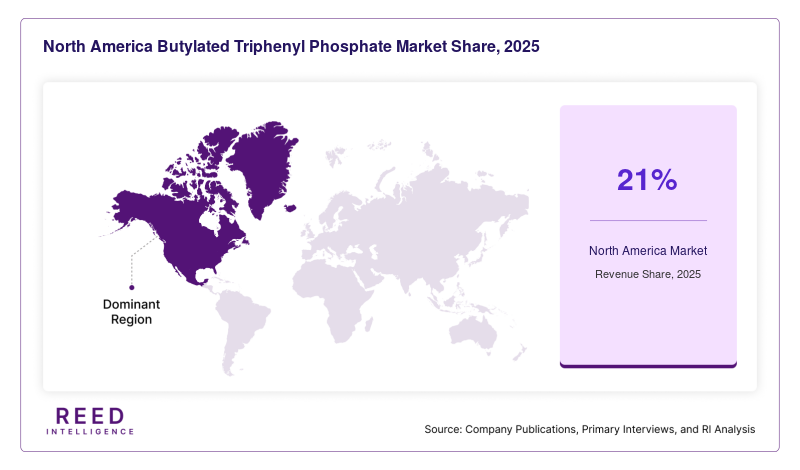
North America accounted for approximately 21% of the Butylated Triphenyl Phosphate Market share in 2025 and is expected to grow at a CAGR of 5.8% during the forecast period. The region’s mature industrial base and consistent demand for high-performance materials supported its market position. The presence of advanced manufacturing sectors has contributed to stable consumption patterns.
The United States dominated the regional market due to its strong electronics and aerospace industries. The demand for flame-retardant materials in critical applications supported market growth. Additionally, the country’s focus on product innovation and material performance has encouraged the adoption of specialized additives.
Europe
Europe held around 18% of the Butylated Triphenyl Phosphate Market share in 2025 and is projected to grow at a CAGR of 5.6%. The region’s emphasis on regulatory compliance and sustainable materials has influenced market dynamics. Industries have been adopting safer chemical formulations to meet environmental standards.
Germany emerged as the leading country due to its robust automotive and industrial sectors. The demand for high-quality coatings and engineering plastics has driven the use of butylated triphenyl phosphate. The country’s focus on precision manufacturing has further supported market growth.
Asia Pacific
Asia Pacific dominated the Butylated Triphenyl Phosphate Market with a 42% share in 2025 and is anticipated to grow at the fastest CAGR of 7.2%. Rapid industrialization, expanding manufacturing capabilities, and increasing demand for electronics have contributed to the region’s leading position.
China led the regional market due to its large-scale production of plastics and electronic components. The country’s strong manufacturing ecosystem and export-oriented industries have driven the demand for flame-retardant additives. Continuous investments in industrial infrastructure have further supported market expansion.
Middle East & Africa
The Middle East & Africa accounted for approximately 10% of the Butylated Triphenyl Phosphate Market share in 2025 and is expected to grow at a CAGR of 5.4%. The region’s growing construction and industrial activities have contributed to market development.
Saudi Arabia dominated the regional market due to its expanding construction sector and investments in industrial diversification. The demand for flame-retardant materials in infrastructure projects has supported the adoption of butylated triphenyl phosphate.
Latin America
Latin America held about 9% of the Butylated Triphenyl Phosphate Market share in 2025 and is projected to grow at a CAGR of 5.7%. The region’s developing industrial base and increasing demand for consumer goods have influenced market growth.
Brazil emerged as the leading country due to its growing automotive and construction sectors. The demand for durable and safe materials has driven the use of flame-retardant additives. Economic development initiatives have further supported market expansion.
Competitive Landscape
The Butylated Triphenyl Phosphate Market is moderately competitive, with several global and regional players focusing on product innovation and expansion strategies. Key companies are investing in research and development to enhance product performance and meet regulatory requirements.
Lanxess AG is a leading player in the market, known for its extensive portfolio of specialty chemicals. The company recently introduced an advanced formulation aimed at improving flame retardancy in high-performance plastics, strengthening its market position.
Other players are focusing on expanding their production capacities and entering emerging markets to capture growth opportunities. Strategic collaborations and product diversification remain key approaches among market participants.
Key Players List
- Lanxess AG
- ICL Group Ltd.
- Akzo Nobel N.V.
- Clariant AG
- Daihachi Chemical Industry Co., Ltd.
- Jiangsu Yoke Technology Co., Ltd.
- Zhejiang Wansheng Co., Ltd.
- Solvay S.A.
- BASF SE
- Albemarle Corporation
- ADEKA Corporation
- RTP Company
- Thor Group Limited
- Chemtura Corporation
- ExxonMobil Chemical
Recent Developments
- In 2024, Lanxess AG expanded its flame-retardant additives portfolio with a new formulation targeting electronics applications.
- In 2023, Clariant AG introduced improved phosphate-based additives to enhance sustainability compliance.
- In 2024, ICL Group invested in expanding production capacity in Asia Pacific.
- In 2023, BASF SE focused on developing environmentally compatible plasticizers.
- In 2024, Solvay S.A. strengthened its distribution network in emerging markets.
Butylated Triphenyl Phosphate Market Segments
Type
- Liquid Butylated Triphenyl Phosphate
- Solid Butylated Triphenyl Phosphate
Function
- Flame Retardant
- Plasticizer
Application
- Plastics
- Coatings
- Adhesives
- Lubricants
End-Use Industry
- Electronics
- Automotive
- Construction
- Industrial
By Region
- North America
- Europe
- APAC
- Middle East and Africa
- LATAM