Butyric Acid for Animal Feed Market Size, Share Demand Report By Form (Coated Butyric Acid, Sodium Butyrate, Calcium Butyrate, Glycerides), By Livestock (Poultry, Swine, Ruminants, Aquaculture, Others), By Function (Gut Health Improvement, Feed Efficiency Enhancement, Disease Resistance Enhancement, Growth Promotion), By Region & Segment Forecasts, 2026–2034
USD 3950
Market Overview
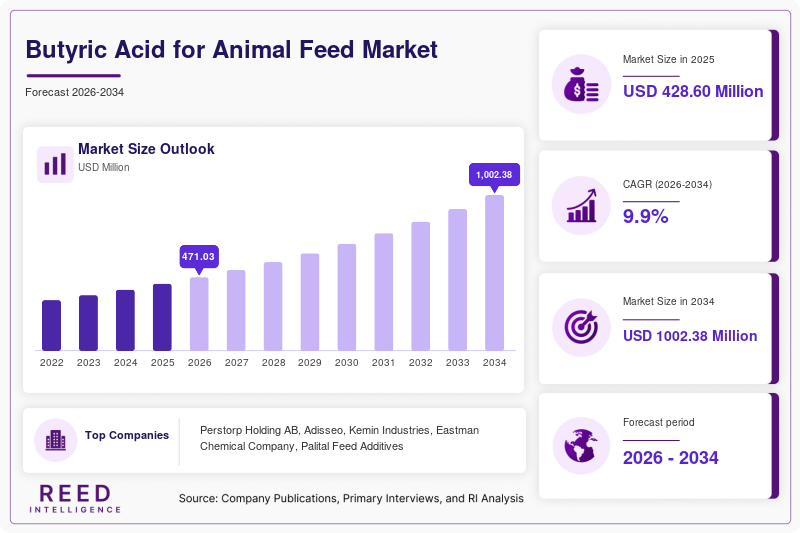
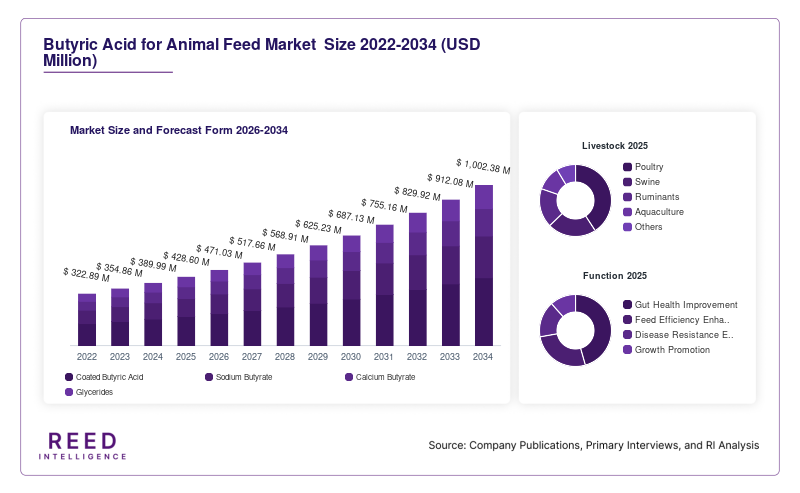
The global Butyric Acid for Animal Feed Market size was valued at USD 428.6 million in 2026 and is projected to reach USD 912.4 million by 2034, expanding at a CAGR of 9.9% during the forecast period. Market expansion is being shaped by the growing demand for efficient livestock nutrition solutions that improve gut health, enhance feed conversion ratios, and reduce antibiotic dependency in poultry, swine, aquaculture, and ruminant farming. Butyric acid, commonly used in protected salts such as sodium butyrate and coated butyrate forms, supports intestinal integrity and nutrient absorption, making it increasingly valuable as feed producers align with stricter regulations on antibiotic growth promoters. Rising global meat consumption, especially in emerging economies, has encouraged producers to adopt advanced feed additives that improve productivity while maintaining animal welfare standards. The market is also supported by broader industrial shifts toward sustainable animal farming, where feed efficiency and disease prevention are central priorities. Technological improvements in encapsulation and slow-release formulations have further increased the adoption of butyric acid by improving stability and targeted intestinal delivery. Growing awareness among commercial farms regarding gastrointestinal disease prevention and better performance outcomes has created favorable industry conditions. Regulatory support for non-antibiotic feed additives in major agricultural economies has also reinforced product demand.
Key Highlights
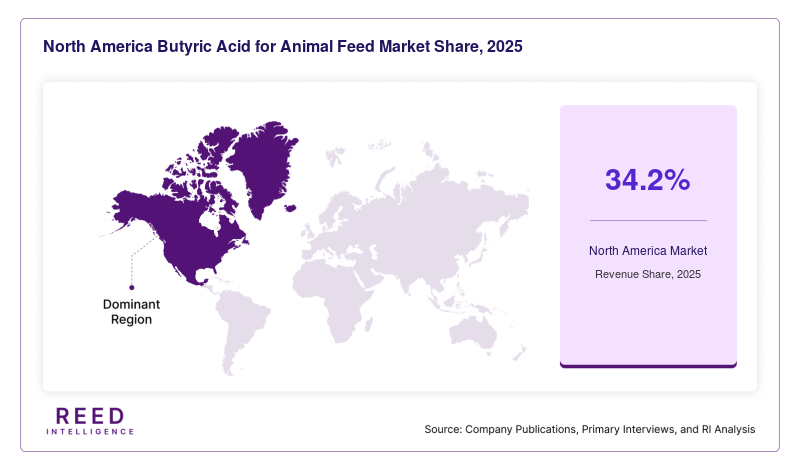
- North America dominated the market with a 34.2% share in 2025.
- Asia Pacific is expected to grow at the fastest CAGR of 11.4% during 2026–2034.
- By form, coated butyric acid accounted for the largest share of 39.1%, while glycerides are projected to grow at a CAGR of 12.1%.
- By livestock, poultry led with a 43.8% share, whereas aquaculture is expected to expand at a CAGR of 12.7%.
- By function, gut health improvement held the leading share of 46.3%, while disease resistance enhancement is forecast to grow at a CAGR of 11.8%.
- The United States remained the dominant country, with market values of USD 118.5 million in 2024 and USD 129.8 million in 2025.
Market Trends
Expansion of Encapsulated and Protected Butyric Acid Solutions
The market is witnessing rising adoption of encapsulated and coated butyric acid products due to their improved delivery efficiency within the gastrointestinal tract. Traditional free butyric acid often faces limitations related to odor, volatility, and premature absorption, which can reduce its effectiveness. Feed manufacturers are increasingly shifting toward coated formulations that ensure gradual release in the lower intestine, where butyrate provides optimal digestive support. This trend is particularly visible in poultry and swine production, where producers seek better nutrient utilization and pathogen control. Advanced encapsulation technologies are also improving product shelf life and handling convenience, making these solutions more commercially viable for large-scale feed producers.
Rising Shift Toward Antibiotic-Free Animal Production
Global regulatory pressure and consumer preference for antibiotic-free meat products are reshaping feed additive priorities. Butyric acid is increasingly positioned as an alternative performance enhancer because of its role in promoting gut integrity, reducing harmful bacteria, and improving immunity. Livestock producers are integrating butyric acid into preventive health strategies to maintain growth rates without relying on traditional antibiotics. This shift is especially pronounced in Europe and North America, where antibiotic growth promoter bans have accelerated functional feed additive adoption. Emerging markets are also following this path as export-oriented producers align with international food safety standards.
Market Drivers
Increasing Demand for High-Performance Livestock Nutrition
Global meat and dairy consumption continue to rise due to population growth, urbanization, and dietary changes, creating pressure on producers to maximize feed efficiency. Butyric acid supports intestinal villi development and digestive health, allowing animals to absorb nutrients more effectively while lowering feed waste. This benefit is especially important as feed costs remain a major operational expense. Producers are prioritizing additives that offer measurable productivity gains, including better weight gain and lower mortality rates. The economic advantages of improved feed conversion ratios are making butyric acid a practical investment across industrial farming systems.
Regulatory Support for Antibiotic Alternatives
Many countries have strengthened restrictions on antibiotic growth promoters due to concerns about antimicrobial resistance. This has encouraged feed formulators to identify safer alternatives that maintain production outcomes. Butyric acid has gained regulatory favor because of its digestive and antimicrobial properties without contributing to resistance concerns. Governments and industry organizations are supporting feed innovation focused on sustainable animal health. This regulatory environment has expanded market opportunities for butyrate-based products, particularly in poultry and swine sectors where antibiotic replacement remains a major strategic priority.
Market Restraint
High Production Costs and Formulation Complexity
Despite favorable demand conditions, the Butyric Acid for Animal Feed Market faces challenges from relatively high product costs, especially for advanced coated and glyceride formulations. Manufacturing butyric acid in stable, odor-controlled, and targeted-release formats requires sophisticated processing technologies, increasing production expenses. Smaller feed mills in cost-sensitive regions often hesitate to adopt premium additives when conventional alternatives appear cheaper in the short term. Price volatility in raw materials can also influence product affordability. For example, livestock producers in developing agricultural economies may prioritize lower-cost organic acids or probiotics over butyric acid, limiting penetration. This pricing barrier may slow broader market expansion unless manufacturers improve cost efficiency or provide stronger economic performance data.
Market Opportunities
Rapid Growth in Aquaculture Feed Applications
Aquaculture is emerging as a strong opportunity area due to increasing seafood demand and intensive fish farming practices. Fish and shrimp producers are under pressure to improve feed conversion while reducing disease outbreaks in dense farming environments. Butyric acid offers digestive and antimicrobial advantages that can support intestinal health and reduce pathogenic stress in aquatic species. As aquaculture feed formulations become more advanced, butyrate additives are gaining traction as functional ingredients. This opportunity is especially strong in Asia Pacific, where aquaculture output is expanding rapidly.
Expansion in Emerging Livestock Economies
Developing nations across Asia, Latin America, and parts of Africa are modernizing livestock systems to meet growing domestic protein demand. Industrial-scale poultry and swine farms are increasingly adopting performance-enhancing feed technologies previously concentrated in developed markets. As awareness of gut health and feed efficiency rises, butyric acid suppliers have opportunities to expand through localized distribution, education, and cost-optimized products. The growing professionalization of feed manufacturing in these regions creates a broader customer base for butyrate solutions.
Segmental Analysis
By Form
Coated butyric acid dominated the market with a 39.1% share in 2024 due to its superior delivery performance, odor control, and targeted intestinal release. This format is widely preferred in industrial poultry and swine systems because it protects active compounds from premature digestion. Feed manufacturers value coated solutions for their consistency, ease of blending, and improved efficacy under commercial farming conditions. The segment also benefits from technological innovations in microencapsulation.
Glycerides are projected to grow at the fastest CAGR of 12.1% through 2034 due to enhanced stability and energy contribution benefits. Tributyrin and related glyceride forms are gaining popularity in premium livestock formulations because they combine digestive health advantages with improved metabolic functionality. Growth is supported by increasing investment in multifunctional feed additives.
By Livestock
Poultry represented the leading livestock segment with 43.8% market share in 2024. Broiler and layer industries are major consumers because feed efficiency, gut integrity, and disease resistance directly impact profitability. Butyric acid is widely used to improve intestinal morphology and support better growth rates, making it highly relevant in high-density poultry operations globally.
Aquaculture is anticipated to record the highest CAGR of 12.7% over the forecast period. Fish and shrimp producers are increasingly incorporating butyric acid to improve nutrient uptake and reduce intestinal stress in intensive farming systems. Rising seafood demand and disease management concerns are key growth accelerators.
By Function
Gut health improvement held the largest functional segment share at 46.3% in 2024 because digestive optimization remains the primary application for butyric acid. By supporting epithelial health and beneficial microbiota, butyrate additives help improve nutrient absorption and lower gastrointestinal disorders. This makes the segment central to feed productivity strategies.
Disease resistance enhancement is expected to expand at the fastest CAGR of 11.8% through 2034. Producers increasingly use butyric acid as part of preventive animal health strategies to reduce pathogen loads and improve resilience. Rising focus on non-antibiotic immunity support is driving this segment.
Regional Analysis
North America
North America accounted for 34.2% of the global Butyric Acid for Animal Feed Market in 2025 and is projected to grow at a CAGR of 8.8% through 2034. The region benefits from advanced commercial livestock systems, high feed additive awareness, and strong regulatory support for antibiotic alternatives. Poultry and swine sectors remain major consumers due to productivity-focused farming practices and consistent demand for optimized feed performance.
The United States dominates the regional market due to its industrialized poultry production and large feed manufacturing sector. A unique growth factor is the rapid adoption of precision nutrition strategies that integrate functional additives for measurable feed efficiency gains. Commercial producers are increasingly focused on gut health optimization to reduce veterinary costs and improve large-scale operational outcomes.
Europe
Europe held 27.6% of the market share in 2025 and is expected to expand at a CAGR of 9.1% during the forecast period. Strict restrictions on antibiotic growth promoters and strong consumer demand for sustainable animal products are driving adoption. The region has a mature feed additive industry, with coated butyrate solutions seeing broad uptake across poultry and pig farming systems.
Germany leads the European market due to advanced feed science capabilities and strong livestock productivity standards. A unique regional factor is the regulatory emphasis on antimicrobial resistance reduction, which has encouraged feed manufacturers to aggressively expand butyric acid-based formulations as preventive health tools.
Asia Pacific
Asia Pacific represented 23.4% of the market in 2025 and is forecast to record the fastest CAGR of 11.4% through 2034. Expanding poultry, swine, and aquaculture sectors are creating strong demand for feed additives that improve efficiency and reduce disease risk. Rising protein consumption and modernization of animal agriculture are key contributors.
China dominates the regional landscape due to its massive feed production infrastructure and large livestock population. A distinctive growth factor is the country's increasing investment in antibiotic-free production systems to strengthen food security and export competitiveness, which is accelerating butyric acid adoption.
Middle East & Africa
Middle East & Africa captured 7.4% of the global market in 2025 and is projected to grow at a CAGR of 8.5%. Demand is supported by expanding poultry production, food security initiatives, and increasing investment in modern farming systems. Feed quality improvement remains a strategic priority across commercial agricultural projects.
Saudi Arabia leads regional growth due to heavy investments in domestic poultry self-sufficiency. A unique factor is government-backed agricultural modernization programs designed to reduce food import dependence, encouraging adoption of advanced feed additives including butyric acid.
Latin America
Latin America held 7.4% market share in 2025 and is expected to grow at a CAGR of 9.3% over the forecast period. Strong poultry and beef industries, combined with export-oriented livestock production, are supporting demand for feed optimization technologies. Regional producers increasingly focus on feed efficiency to remain globally competitive.
Brazil dominates the market due to its major poultry and meat export industries. A unique growth driver is the pressure to meet international animal welfare and antibiotic-free export standards, which supports wider integration of butyrate solutions.
Competitive Landscape
The Butyric Acid for Animal Feed Market is moderately consolidated, with major players competing through product innovation, regional expansion, and advanced encapsulation technologies. Perstorp Holding AB remains a leading participant due to its broad portfolio of protected butyrate solutions and strong presence in global feed markets. The company recently expanded its specialty feed additive production capacity to support rising demand in Asia. Other major players include Adisseo, Kemin Industries, Eastman Chemical Company, and Palital Feed Additives. Competitive strategies increasingly focus on slow-release technologies, species-specific formulations, and strategic partnerships with feed mills. Companies are also investing in research to validate performance outcomes, particularly in antibiotic-free livestock systems.
Key Players
- Perstorp Holding AB
- Adisseo
- Kemin Industries
- Eastman Chemical Company
- Palital Feed Additives
- Nutreco
- Novus International
- Berg + Schmidt
- Impextraco
- Biomin
- Norel Animal Nutrition
- Global Nutrition International
- Hangzhou King Techina
- Avitech Nutrition
- Vetagro
Recent Developments
- Perstorp expanded protected butyrate manufacturing capabilities in Asia to strengthen regional supply.
- Adisseo launched an upgraded encapsulated sodium butyrate product for poultry gut health applications.
- Kemin Industries increased R&D investment in species-specific butyrate formulations for aquaculture and swine sectors.
Butyric Acid for Animal Feed Market Segments
Form
- Coated Butyric Acid
- Sodium Butyrate
- Calcium Butyrate
- Glycerides
Livestock
- Poultry
- Swine
- Ruminants
- Aquaculture
- Others
Function
- Gut Health Improvement
- Feed Efficiency Enhancement
- Disease Resistance Enhancement
- Growth Promotion
By Region
- North America
- Europe
- APAC
- Middle East and Africa
- LATAM