Byssinosis Treatment Market Size, Share & Demand Report By Drug Class (Bronchodilators, Corticosteroids, Combination Therapies, Others), By Route of Administration (Inhalation, Oral, Injectable), By Distribution Channel (Hospital Pharmacies, Retail Pharmacies, Online Pharmacies), By End-User (Hospitals, Clinics, Homecare Settings), By Region & Segment Forecasts, 2025–2034
USD 3950
Market Overview
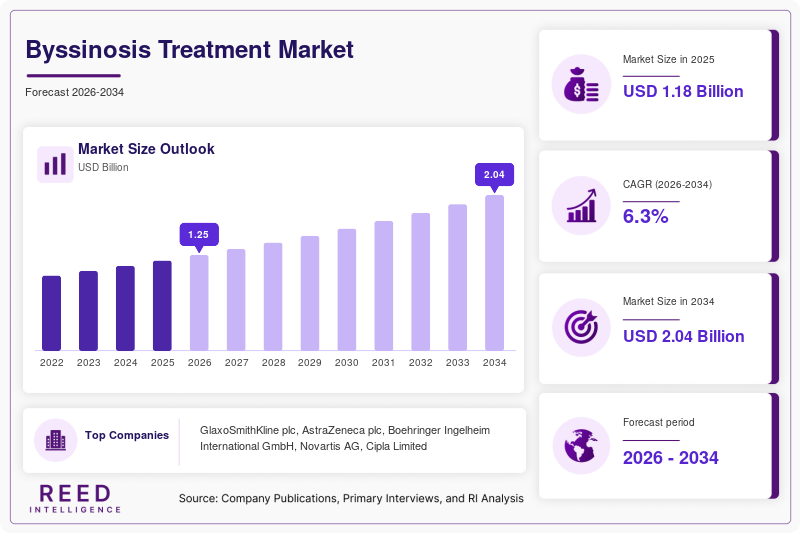
The global Byssinosis Treatment Market size was valued at approximately USD 1.18 billion in 2025 and is projected to reach USD 2.05 billion by 2034, expanding at a CAGR of 6.3% from 2025 to 2034. The market reflects steady growth driven by rising occupational health awareness and increasing diagnosis rates of respiratory diseases linked to industrial environments, particularly in textile manufacturing sectors.
One major global factor supporting market expansion is the strengthening of occupational safety regulations across emerging and developed economies. Governments and regulatory bodies are mandating improved workplace air quality monitoring and worker health screening, which has led to early diagnosis and higher treatment adoption rates for byssinosis. This regulatory push has increased demand for bronchodilators, corticosteroids, and supportive therapies, strengthening the treatment ecosystem.
The Byssinosis Treatment Market analysis also indicates that healthcare providers are increasingly integrating respiratory management protocols into occupational health programs, contributing to consistent treatment demand.
Key Highlights
- North America dominated the market with a 34.2% share in 2025, while Asia Pacific is expected to register the fastest CAGR of 7.4% through 2034.
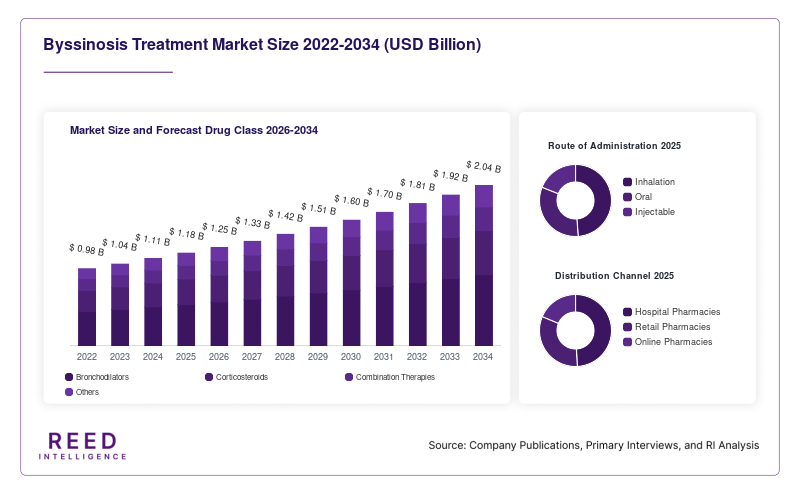
- Among drug classes, bronchodilators led with a 41.5% share, while combination therapies are projected to grow fastest at a 7.8% CAGR.
- By distribution channel, hospital pharmacies dominated with 46.8% share, while online pharmacies are expected to grow at 8.1% CAGR.
- The United States remained the dominant country, with market values of USD 382 million in 2025 and USD 405 million in 2026.
Market Trends
Shift Toward Preventive Respiratory Care
A significant trend shaping the Byssinosis Treatment Market is the growing emphasis on preventive healthcare in occupational settings. Employers in industries such as textiles and cotton processing are increasingly investing in early screening programs and protective interventions. This shift has led to earlier detection of byssinosis symptoms, reducing disease severity and increasing the demand for maintenance therapies rather than emergency treatments. Preventive care integration is also driving demand for long-term inhalation therapies and patient monitoring solutions.
Adoption of Combination Drug Therapies
Another notable trend is the rising use of combination therapies, including bronchodilators paired with corticosteroids. These therapies offer improved symptom control and reduce disease progression in chronic cases. Pharmaceutical companies are focusing on developing fixed-dose combinations that enhance patient compliance and simplify treatment regimens. This trend is particularly evident in developed markets where healthcare systems emphasize efficient and outcome-based treatment strategies. As clinical evidence supporting combination therapy efficacy continues to grow, its adoption is expected to expand across emerging markets as well.
Market Drivers
Increasing Occupational Lung Disease Incidence
The growing prevalence of occupational lung diseases, particularly among workers in textile and cotton industries, is a major driver of the Byssinosis Treatment Market growth. Continuous exposure to cotton dust and poor ventilation conditions have resulted in rising cases of respiratory complications. As awareness increases, more individuals are seeking medical attention, leading to higher diagnosis and treatment rates. This expanding patient pool is directly contributing to sustained market demand.
Advancements in Respiratory Drug Formulations
Technological progress in drug delivery systems and respiratory therapies is another key driver. Innovations such as improved inhaler devices and long-acting bronchodilators are enhancing treatment outcomes and patient adherence. Pharmaceutical companies are investing in research to develop targeted therapies with fewer side effects. These advancements are improving overall treatment efficiency, encouraging adoption among both patients and healthcare providers, and supporting the market’s long-term expansion.
Market Restraint
Limited Awareness in Low-Income Regions
A major restraint affecting the Byssinosis Treatment Market is the limited awareness and underdiagnosis of the disease in low-income and rural regions. Many workers exposed to cotton dust do not recognize early symptoms or lack access to healthcare facilities for proper diagnosis. This results in delayed treatment and reduced market penetration. Additionally, inadequate occupational health policies in certain regions further limit screening initiatives and treatment adoption. The absence of structured healthcare infrastructure and low affordability of advanced therapies continue to hinder market growth. Addressing these challenges requires coordinated efforts from governments, healthcare providers, and industry stakeholders to improve education, accessibility, and affordability.
Market Opportunities
Expansion in Emerging Markets
Emerging economies present a strong growth opportunity for the Byssinosis Treatment Market. Countries in Asia Pacific, Latin America, and Africa have large textile manufacturing sectors with a high risk of occupational exposure. As these regions strengthen healthcare infrastructure and implement workplace safety regulations, the demand for byssinosis treatments is expected to rise. Market players can capitalize on this opportunity by introducing cost-effective therapies and expanding distribution networks.
Development of Digital Health Monitoring Solutions
The integration of digital health technologies into respiratory care is creating new opportunities. Wearable devices and mobile health applications can monitor lung function and track symptoms in real time. These tools enable early intervention and improve treatment adherence. Pharmaceutical and technology companies are increasingly collaborating to develop integrated solutions, which can enhance patient outcomes and create additional revenue streams within the market.
Segmental Analysis
By Drug Class
Bronchodilators dominated the Byssinosis Treatment Market with a 41.5% share in 2025, as they are the first-line treatment for symptom relief. Their widespread use in managing airflow obstruction made them the preferred choice among healthcare providers.
Combination therapies are expected to grow at the fastest CAGR of 7.8%, driven by their ability to provide comprehensive symptom management. These therapies will gain traction due to improved patient compliance and enhanced therapeutic outcomes.
By Route of Administration
Inhalation therapies accounted for the largest share of 52.3% in 2025, as they deliver medication directly to the lungs, ensuring rapid relief. This route remained the standard for respiratory disease management.
Oral medications are projected to grow at a CAGR of 6.9%, supported by their convenience and increasing use in long-term management plans, particularly in regions with limited access to inhalation devices.
By Distribution Channel
Hospital pharmacies held a 46.8% share in 2025, as most treatments were initiated in clinical settings. Their role in providing specialized medications contributed to their dominance.
Online pharmacies are expected to grow at a CAGR of 8.1%, driven by increasing digital adoption and the convenience of home delivery services. This channel will expand rapidly in urban areas.
By End-User
Hospitals dominated with a 49.7% share in 2025, due to their role in diagnosis and initial treatment. Specialized respiratory care units contributed to their strong position.
Homecare settings are projected to grow at a CAGR of 7.2%, as patients increasingly prefer managing chronic conditions at home. The availability of portable inhalers and monitoring devices will support this growth.
Regional Analysis
North America
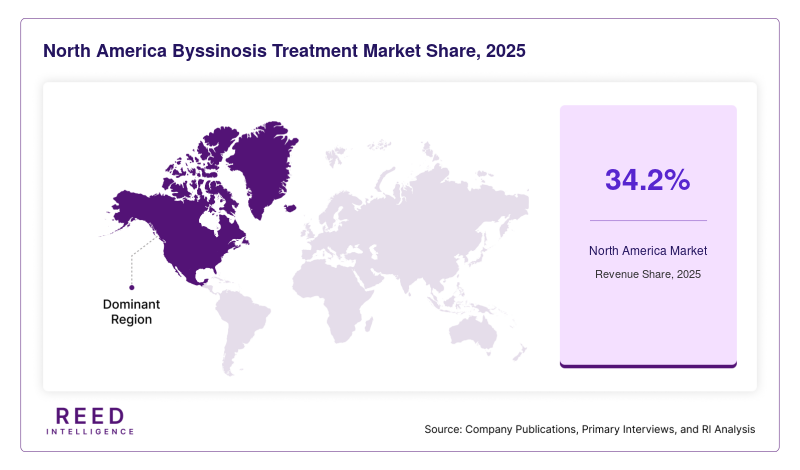
North America accounted for 34.2% of the Byssinosis Treatment Market share in 2025 and is expected to grow at a CAGR of 5.8% through 2034. The region’s established healthcare infrastructure and strong regulatory framework supported early diagnosis and treatment adoption. Government initiatives focused on occupational safety contributed to consistent demand for respiratory therapies.
The United States dominated the regional market due to widespread awareness and advanced healthcare systems. A key growth factor was the integration of occupational health programs within corporate sectors, ensuring regular screening and treatment access for workers.
Europe
Europe held 27.6% market share in 2025 and is projected to grow at a CAGR of 5.9% during the forecast period. The region benefited from strict workplace safety regulations and high healthcare spending. Countries emphasized preventive healthcare measures, leading to increased diagnosis rates.
Germany emerged as the dominant country, driven by its strong industrial base and focus on employee health standards. The implementation of advanced workplace monitoring systems supported early detection and consistent treatment demand.
Asia Pacific
Asia Pacific captured 22.8% of the market share in 2025 and is expected to grow at the fastest CAGR of 7.4% through 2034. Rapid industrialization and expanding textile manufacturing activities contributed to a higher prevalence of byssinosis cases. Increasing healthcare investments supported market growth.
China led the regional market due to its large workforce in textile industries. A key growth factor was the government’s increasing focus on improving occupational health standards, which boosted diagnosis and treatment rates.
Middle East & Africa
The Middle East & Africa region accounted for 8.1% of the market share in 2025 and is projected to grow at a CAGR of 6.1%. Growth was supported by gradual improvements in healthcare infrastructure and rising awareness of occupational diseases.
South Africa dominated the region, driven by expanding industrial sectors and increasing government initiatives aimed at improving worker health conditions.
Latin America
Latin America held 7.3% market share in 2025 and is expected to grow at a CAGR of 6.0% through 2034. The region’s growth was influenced by increasing investments in healthcare and industrial safety measures.
Brazil emerged as the leading country, supported by the expansion of its textile industry and growing emphasis on occupational health programs, which improved diagnosis and treatment adoption.
Competitive Landscape
The Byssinosis Treatment Market is moderately fragmented, with several pharmaceutical companies focusing on respiratory therapies. Leading players are investing in research and development to introduce advanced drug formulations and improve treatment efficacy.
A key market leader is GlaxoSmithKline plc, which continues to strengthen its respiratory portfolio through innovation in inhalation therapies. The company recently introduced an improved combination inhaler designed to enhance patient adherence and treatment outcomes.
Other players are focusing on strategic collaborations, product launches, and geographic expansion to increase their market presence. Companies are also exploring digital health integration to differentiate their offerings and improve patient engagement.
Key Players List
- GlaxoSmithKline plc
- AstraZeneca plc
- Boehringer Ingelheim International GmbH
- Novartis AG
- Cipla Limited
- Teva Pharmaceutical Industries Ltd.
- Sun Pharmaceutical Industries Ltd.
- Lupin Limited
- Dr. Reddy’s Laboratories Ltd.
- Merck & Co., Inc.
- Pfizer Inc.
- Sanofi S.A.
- Mylan N.V.
- Hikma Pharmaceuticals PLC
- Glenmark Pharmaceuticals Ltd.
Recent Developments
- 2024: GlaxoSmithKline plc launched an advanced inhaler for chronic respiratory conditions.
- 2024: AstraZeneca expanded its respiratory drug portfolio with a new combination therapy.
- 2023: Cipla Limited introduced cost-effective inhalation therapies targeting emerging markets.
- 2023: Boehringer Ingelheim enhanced its digital respiratory care platform.
- 2023: Teva Pharmaceutical Industries Ltd. strengthened distribution networks in Asia Pacific.
Byssinosis Treatment Market Segments
Drug Class
- Bronchodilators
- Corticosteroids
- Combination Therapies
- Others
Route of Administration
- Inhalation
- Oral
- Injectable
Distribution Channel
- Hospital Pharmacies
- Retail Pharmacies
- Online Pharmacies
End-User
- Hospitals
- Clinics
- Homecare Settings
By Region
- North America
- Europe
- APAC
- Middle East and Africa
- LATAM