Cabinet Lock Market Size, Share & Demand Report By Product Type (Mechanical Cabinet Locks, Electronic Cabinet Locks, Biometric Cabinet Locks, RFID Cabinet Locks), By Application (Residential, Commercial, Industrial), By End Use (Furniture Manufacturers, Healthcare Facilities, Retail Stores, Educational Institutions, Hospitality Sector, Government Offices), By Region & Segment Forecasts, 2026–2034
USD 3950
Market Overview
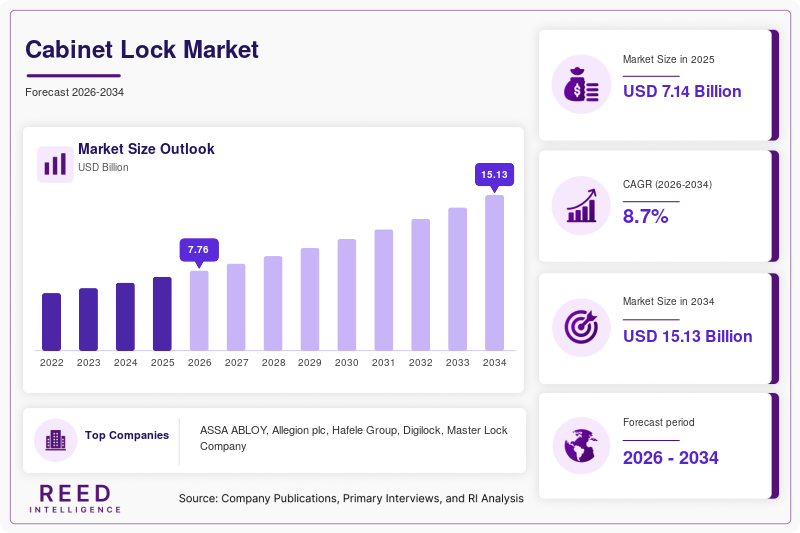
The global Cabinet Lock Market size was valued at USD 7.14 billion in 2026 and is projected to reach USD 13.92 billion by 2034, expanding at a CAGR of 8.7% during the forecast period from 2026 to 2034. The market continues to gain momentum due to increasing investments in residential renovation projects, expanding commercial infrastructure, and rising awareness regarding asset protection across households and enterprises. Cabinet locks are widely used in offices, retail facilities, educational institutions, hospitals, industrial facilities, and residential properties to secure documents, tools, medicines, valuables, and confidential assets. Growing urbanization and the expansion of modular furniture installations are also supporting product demand across developed and developing economies.
The rapid adoption of smart home technologies has emerged as a major global factor driving market expansion. Consumers are increasingly integrating digital locking systems with connected home ecosystems to improve convenience and security. Manufacturers are responding by introducing biometric cabinet locks, RFID-enabled solutions, and mobile-controlled locking systems designed for modern furniture applications. In commercial environments, businesses are adopting advanced cabinet locking systems to improve access control and maintain regulatory compliance. The increasing replacement rate of traditional mechanical locks with electronic alternatives is expected to create stable long-term revenue opportunities for manufacturers.
Key Highlights
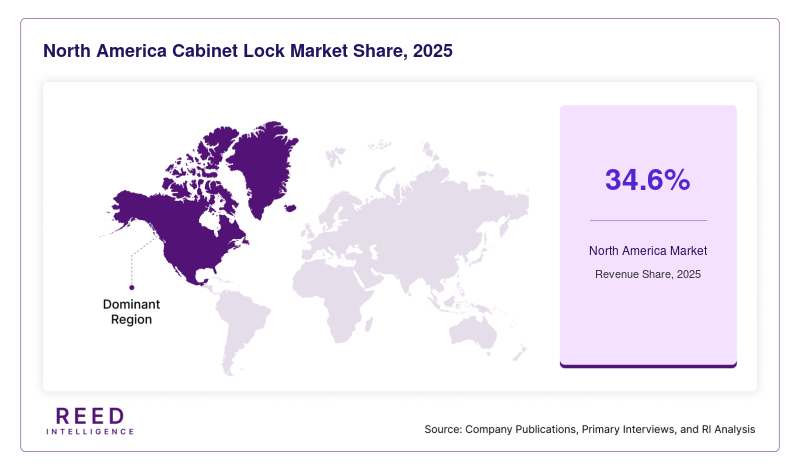
- North America dominated the market with a 34.6% share in 2025, while Asia Pacific is expected to grow at the fastest CAGR of 10.9% during 2026–2034.
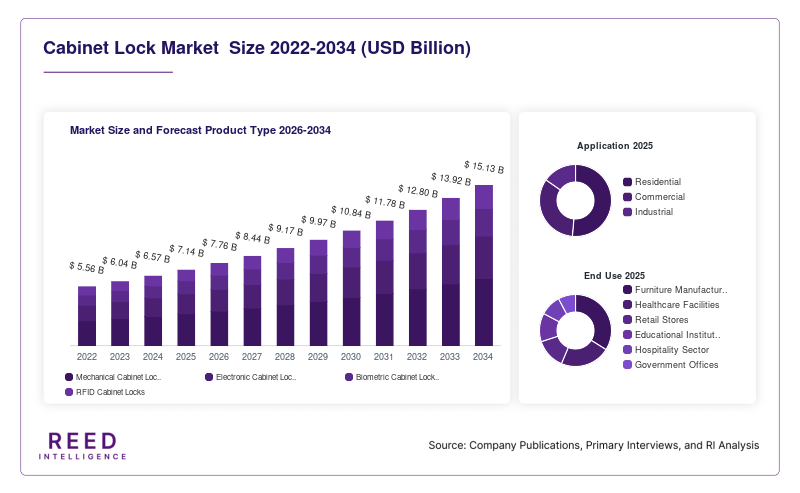
- By product type, mechanical cabinet locks accounted for the largest share of 56.8%, while electronic cabinet locks are projected to grow at a CAGR of 11.6%.
- By application, residential applications led with a 44.3% share, whereas commercial applications are expected to expand at a CAGR of 10.8%.
- By end use, furniture manufacturers held the largest share of 39.5%, while healthcare facilities are anticipated to grow at a CAGR of 11.1%.
- The United States remained the dominant country, with market values of USD 1.42 billion in 2024 and USD 1.56 billion in 2025.
Market Trends
Rising Integration of Smart and Biometric Cabinet Locks
The increasing adoption of connected security systems is reshaping the Cabinet Lock Market across residential and commercial sectors. Consumers are showing growing preference for cabinet locks integrated with Bluetooth, Wi-Fi, fingerprint recognition, and mobile application support. Smart cabinet locks provide enhanced convenience by enabling remote access monitoring and digital authentication, making them suitable for offices, retail counters, pharmacies, and premium households. Businesses are also integrating electronic cabinet locks with centralized access management systems to improve operational control and reduce unauthorized access risks. The growing penetration of smart homes in North America, Europe, and Asia Pacific is accelerating the demand for digitally enabled cabinet security products. Manufacturers are introducing compact biometric cabinet locks designed for wooden and metal cabinets, creating additional opportunities within the premium furniture segment.
Growth in Modular Furniture and Interior Renovation Activities
The rising popularity of modular furniture systems is contributing significantly to demand growth in the Cabinet Lock Market. Consumers increasingly prefer customized storage cabinets for kitchens, offices, and bedrooms, which require secure and aesthetically compatible locking systems. Rapid urbanization and higher disposable incomes are encouraging homeowners to invest in premium furniture products with integrated security features. Commercial spaces such as coworking facilities, retail stores, educational institutions, and hospitality properties are also expanding investments in modular storage infrastructure. Manufacturers are focusing on compact lock mechanisms, concealed designs, and corrosion-resistant materials to align with evolving interior preferences. The expansion of online furniture retailing platforms has additionally increased the visibility of cabinet lock accessories, allowing suppliers to reach broader consumer groups and strengthen aftermarket sales.
Market Drivers
Expansion of Commercial Infrastructure and Workplace Security Requirements
The expansion of commercial buildings, healthcare facilities, educational institutions, and retail outlets is creating strong demand for advanced cabinet security systems. Businesses increasingly require secure storage solutions for confidential documents, medical supplies, electronic devices, and cash management systems. As workplace security standards continue to evolve, organizations are investing in cabinet locks with improved durability and access management features. Electronic cabinet locks are gaining popularity in commercial environments due to their ability to support audit trails, restricted access permissions, and centralized management. The rapid growth of coworking spaces and flexible office environments has further increased the need for secure personal storage systems. In addition, industrial facilities are adopting heavy-duty cabinet locks to secure hazardous materials, specialized tools, and operational equipment.
Increasing Consumer Awareness Regarding Home Safety and Asset Protection
Growing awareness regarding household security is supporting long-term expansion in the Cabinet Lock Market. Consumers are becoming more conscious about protecting valuables, medicines, confidential files, firearms, and electronic accessories stored inside cabinets and drawers. Rising urban crime rates in several metropolitan regions have encouraged households to adopt reliable locking systems for improved safety. Parents are increasingly installing childproof cabinet locks to prevent accidental access to harmful substances and sharp objects. The growth of home offices and remote working arrangements has also increased the need for secure document and device storage. Manufacturers are capitalizing on this trend by introducing aesthetically appealing locks with improved ease of installation and enhanced tamper resistance. Product availability across e-commerce platforms has further strengthened consumer accessibility and product awareness.
Market Restraint
Price Sensitivity and Compatibility Challenges Across Low-Cost Furniture Segments
Price sensitivity among consumers remains a significant restraint for the Cabinet Lock Market, particularly across developing economies and low-cost furniture categories. Many residential consumers prioritize affordability over advanced security features, limiting the adoption of premium electronic and biometric cabinet locks. Budget furniture manufacturers often prefer inexpensive locking mechanisms to maintain competitive pricing, which reduces opportunities for technologically advanced products. Compatibility issues between cabinet lock designs and different furniture materials can also create installation challenges for end users and contractors.
Electronic cabinet locks generally require batteries, software integration, or periodic maintenance, increasing long-term ownership costs for consumers. Small businesses and institutions with limited budgets may delay upgrades from traditional mechanical locks despite the operational advantages of smart systems. Counterfeit products and low-quality imports further intensify pricing pressure in regional markets, affecting profit margins for established manufacturers. In some cases, inconsistent product standards and lack of technical expertise during installation may lead to reduced product efficiency, limiting customer confidence in advanced cabinet security technologies.
Market Opportunities
Rising Demand for Child Safety and Healthcare Storage Solutions
The growing focus on child safety and secure medicine storage is creating substantial opportunities in the Cabinet Lock Market. Parents are increasingly adopting cabinet locks designed to prevent children from accessing harmful chemicals, sharp tools, and pharmaceutical products stored inside kitchens and bathrooms. Regulatory emphasis on child safety products in residential environments is encouraging manufacturers to introduce improved locking systems with simple installation features. Healthcare facilities are also increasing investments in secure medicine cabinets and pharmaceutical storage units to maintain compliance with safety standards and inventory management protocols. Hospitals, clinics, diagnostic laboratories, and elderly care centers require reliable cabinet locks to protect sensitive medical supplies and confidential records. This trend is expected to generate stable product demand across both residential and institutional applications.
Expansion of E-Commerce and Direct-to-Consumer Distribution Channels
The rapid growth of online retail platforms is opening new growth avenues for cabinet lock manufacturers worldwide. E-commerce channels allow consumers to compare product specifications, materials, locking technologies, and customer reviews before making purchasing decisions. Small and medium-sized manufacturers are increasingly leveraging digital platforms to expand geographic reach and improve brand visibility without depending entirely on physical retail networks. Online marketplaces are also supporting aftermarket sales of replacement locks, smart locking accessories, and installation kits. Manufacturers are investing in digital marketing strategies and product customization tools to attract consumers seeking furniture-compatible security solutions. Subscription-based smart lock monitoring services and bundled installation support are emerging as additional revenue opportunities, particularly in developed markets with strong smart home adoption.
Segmental Analysis
By Product Type
Mechanical cabinet locks accounted for the largest share of 56.8% in 2024 due to their affordability, ease of installation, and widespread use across residential and commercial applications. These locks are commonly installed in office drawers, filing cabinets, kitchen storage units, and industrial tool cabinets because they offer reliable security without requiring electronic integration. Mechanical locks are particularly popular in developing economies where consumers prioritize cost-effective solutions. Manufacturers continue to introduce improved designs with enhanced durability, corrosion resistance, and tamper protection to strengthen product competitiveness. The segment also benefits from strong aftermarket demand because replacement cycles for traditional cabinet locks remain consistent across institutional and residential applications. Commercial facilities and educational institutions continue to rely heavily on mechanical locking systems for standardized storage requirements.
Electronic cabinet locks are projected to expand at the fastest CAGR of 11.6% during the forecast period due to rising smart home adoption and increasing demand for advanced access control systems. These locks provide features such as biometric authentication, mobile connectivity, RFID access, and digital monitoring capabilities. Businesses are increasingly deploying electronic locks to improve audit tracking and operational efficiency across offices, healthcare facilities, and retail environments. Residential consumers are also showing growing interest in premium cabinet security systems compatible with smart home ecosystems. Technological advancements in battery efficiency and wireless communication are improving product reliability and user convenience. Manufacturers are investing in compact designs and simplified installation features to accelerate adoption across modular furniture and premium residential applications.
By Application
Residential applications held the dominant share of 44.3% in 2024 due to increasing consumer focus on home security and child safety solutions. Cabinet locks are widely used in kitchens, bathrooms, wardrobes, and home offices to protect valuables, medicines, and hazardous materials. Rising urbanization and growth in apartment living are encouraging households to invest in organized storage systems with integrated locking features. The popularity of modular kitchens and premium interior furniture has also strengthened product demand across middle-income and high-income households. Manufacturers are responding by offering decorative finishes, concealed lock mechanisms, and user-friendly installation kits tailored for residential consumers. The growing availability of cabinet locks through e-commerce channels has additionally improved consumer awareness and accessibility.
Commercial applications are anticipated to register the fastest CAGR of 10.8% during the forecast period as businesses continue to strengthen workplace security and storage management systems. Offices, coworking spaces, hospitals, hotels, educational institutions, and retail facilities increasingly require secure cabinet storage for documents, electronics, medicines, and operational supplies. Commercial organizations are adopting advanced electronic cabinet locks to improve access monitoring and reduce unauthorized entry risks. The expansion of healthcare infrastructure and data-sensitive workplaces is further supporting demand for high-security storage solutions. Growing investments in commercial renovation projects are also increasing replacement demand for outdated cabinet locking systems. Suppliers are focusing on scalable locking technologies that integrate with centralized facility management systems to improve operational efficiency.
By End Use
Furniture manufacturers represented the largest end-use segment with a 39.5% share in 2024 due to increasing integration of cabinet locks within ready-to-assemble and modular furniture products. Manufacturers of office furniture, kitchen cabinets, wardrobes, and retail display units increasingly incorporate locking systems during the production stage to improve product functionality and customer value. The segment benefits from rising global demand for customized storage furniture in residential and commercial environments. Furniture companies are partnering with lock manufacturers to develop lightweight, aesthetically compatible, and durable locking mechanisms tailored for modern interior designs. Growing exports of modular furniture products from Asia Pacific and Europe continue to support large-scale procurement of cabinet locking systems across the manufacturing sector.
Healthcare facilities are expected to witness the fastest CAGR of 11.1% during the forecast period due to increasing requirements for secure pharmaceutical storage and confidential record management. Hospitals, diagnostic centers, laboratories, and pharmacies require cabinet locks to maintain compliance with healthcare safety regulations and inventory control protocols. The expansion of healthcare infrastructure in emerging economies is creating strong demand for reliable cabinet security systems capable of supporting high-frequency usage. Electronic cabinet locks are becoming increasingly popular in healthcare environments because they allow restricted access management and audit monitoring. Rising investments in medical storage modernization and growing awareness regarding medication security are expected to strengthen segment growth across both developed and developing markets.
Regional Analysis
North America
North America accounted for 34.6% of the global Cabinet Lock Market share in 2025 and is expected to maintain stable growth during the forecast period with a CAGR of 8.1%. The region benefits from strong adoption of advanced security technologies across residential and commercial sectors. Demand for electronic and biometric cabinet locks continues to rise as consumers prioritize integrated smart home ecosystems. Commercial offices, hospitals, and educational institutions are also increasing investments in secure storage systems to strengthen workplace safety and operational efficiency. Product innovation and high replacement demand for aging locking systems continue to support regional revenue growth.
The United States remains the dominant country within North America due to extensive investments in residential renovation activities and commercial security infrastructure. The country recorded significant demand for childproof cabinet locks and digital cabinet security systems across urban households. A major growth factor in the United States is the increasing adoption of smart furniture solutions integrated with mobile-controlled locking systems. Canada is also experiencing rising demand for durable cabinet locks in healthcare facilities, government offices, and industrial storage applications. Regional manufacturers are focusing on advanced materials and energy-efficient electronic locks to strengthen product competitiveness.
Europe
Europe represented 27.4% of the global Cabinet Lock Market in 2025 and is projected to expand at a CAGR of 7.9% between 2026 and 2034. The region demonstrates stable demand due to strong consumer awareness regarding household safety and stringent workplace security regulations. Commercial establishments and hospitality properties across Europe increasingly deploy premium cabinet locking systems to improve asset protection and operational reliability. Demand for aesthetically designed locks compatible with modern interior concepts is particularly strong in Western European countries. Manufacturers are also emphasizing sustainable production materials and recyclable metal components to align with regional environmental priorities.
Germany continues to dominate the European market due to its established furniture manufacturing industry and strong industrial infrastructure. The country benefits from growing adoption of high-security cabinet locks across manufacturing plants, research laboratories, and healthcare institutions. A key growth factor in Germany is the expansion of premium modular furniture exports, which require durable and advanced locking systems. France and the United Kingdom are also witnessing increased investments in smart residential infrastructure, supporting demand for electronic cabinet locks. Regional suppliers are strengthening partnerships with furniture brands to improve market penetration.
Asia Pacific
Asia Pacific is expected to register the fastest CAGR of 10.9% during the forecast period, supported by rapid urbanization and expanding middle-class populations. The region accounted for 24.8% of the global Cabinet Lock Market share in 2025. Rising construction activities, residential apartment development, and commercial infrastructure expansion are contributing significantly to market growth. Demand for affordable cabinet security products remains high across emerging economies, while developed countries within the region increasingly adopt smart locking systems. Growing online retail penetration and increasing furniture manufacturing activities are also strengthening regional product demand.
China dominates the Asia Pacific market due to its large-scale furniture manufacturing sector and substantial residential construction activities. The country has become a major production hub for both mechanical and electronic cabinet locks, supporting domestic and export demand. One unique growth factor in China is the rapid expansion of smart apartment projects integrated with connected security technologies. India is also witnessing strong growth driven by rising urban housing projects and increasing awareness regarding child safety locks. Japan and South Korea continue to support premium product demand through advanced smart home adoption and technologically sophisticated consumer preferences.
Middle East & Africa
The Middle East & Africa region held 7.1% of the global Cabinet Lock Market share in 2025 and is forecast to grow at a CAGR of 7.4% through 2034. Increasing investments in commercial infrastructure, hospitality projects, and healthcare facilities are supporting regional demand for secure cabinet storage systems. Governments across Gulf countries are expanding smart city initiatives, encouraging adoption of advanced electronic locking technologies. Demand for corrosion-resistant cabinet locks is particularly high in areas with challenging environmental conditions. Growing retail expansion and office development projects are also contributing to steady product consumption across the region.
Saudi Arabia remains the leading market within the Middle East & Africa region due to ongoing commercial development initiatives and rising investments in smart infrastructure projects. The country is witnessing increasing adoption of electronic cabinet locks across hotels, healthcare facilities, and government buildings. A unique growth factor supporting Saudi Arabia is the rapid expansion of tourism-related infrastructure projects that require secure storage systems for hospitality operations. South Africa is also experiencing moderate demand growth due to commercial office development and increasing consumer awareness regarding residential safety products.
Latin America
Latin America accounted for 6.1% of the global Cabinet Lock Market share in 2025 and is anticipated to grow at a CAGR of 7.2% during the forecast period. Rising urbanization and improving residential construction activities are contributing to regional market expansion. Demand for cost-effective mechanical cabinet locks remains high among middle-income consumers, while commercial facilities are gradually adopting electronic locking systems for improved operational security. Educational institutions, retail outlets, and healthcare facilities are also investing in durable cabinet locks to strengthen storage management and asset protection capabilities.
Brazil dominates the Latin American market due to its expanding furniture manufacturing industry and increasing investments in residential infrastructure. The country continues to experience rising demand for cabinet locks in urban housing developments and retail applications. A major growth factor in Brazil is the increasing popularity of modular kitchen and office furniture requiring integrated locking systems. Mexico is also witnessing growing demand supported by commercial office expansion and industrial facility modernization projects. Regional manufacturers are focusing on affordable product designs and localized distribution networks to improve market accessibility.
Competitive Landscape
The Cabinet Lock Market remains moderately fragmented, with global and regional manufacturers competing through product innovation, pricing strategies, distribution expansion, and smart technology integration. Companies are increasingly focusing on electronic and biometric cabinet lock development to align with evolving security requirements across residential and commercial applications. Partnerships with furniture manufacturers and smart home solution providers have become important strategies for improving market presence and expanding customer reach.
ASSA ABLOY remains one of the leading participants in the market due to its broad portfolio of mechanical and electronic locking solutions. The company continues to strengthen its position through investments in connected security technologies and digital access management systems. In 2025, the company introduced a new line of RFID-enabled cabinet locks designed for healthcare and office storage applications. Other major players including Allegion plc, Hafele Group, Digilock, and Master Lock Company are also expanding their smart lock offerings and regional distribution capabilities.
Key Players
- ASSA ABLOY
- Allegion plc
- Hafele Group
- Digilock
- Master Lock Company
- CompX Security Products
- Lowe & Fletcher Group
- Zephyr Lock
- Salto Systems
- Godrej Locks
- Hettich Holding GmbH
- Ojmar SA
- Camlock Systems Ltd
- SISO Denmark A/S
- Sugatsune Kogyo Co., Ltd.
Recent Developments
- In February 2025, ASSA ABLOY launched a cloud-connected cabinet locking platform designed for commercial office storage and healthcare applications.
- In July 2025, Digilock expanded its smart cabinet lock manufacturing capacity in Asia Pacific to support rising regional demand for electronic locking systems.
- In November 2024, Hafele Group introduced a new range of concealed cabinet locks featuring fingerprint authentication and mobile application connectivity for residential furniture applications.
- In March 2025, Allegion plc partnered with a modular office furniture manufacturer to integrate RFID-enabled cabinet locks into premium workplace storage systems.
- In August 2024, Godrej Locks launched child-safety cabinet locking solutions targeting urban residential consumers across India and Southeast Asia.
Cabinet Lock Market Segments
Product Type
- Mechanical Cabinet Locks
- Electronic Cabinet Locks
- Biometric Cabinet Locks
- RFID Cabinet Locks
Application
- Residential
- Commercial
- Industrial
End Use
- Furniture Manufacturers
- Healthcare Facilities
- Retail Stores
- Educational Institutions
- Hospitality Sector
- Government Offices
By Region
- North America
- Europe
- APAC
- Middle East and Africa
- LATAM