Cable Tag Market Size, Share & Demand Report By Product Type (Printable Cable Tags, RFID-Enabled Cable Tags, Wrap-Around Cable Tags), By Material (Nylon Cable Tags, Polyester Cable Tags), By Application (Electrical and Power Systems, Telecommunications Infrastructure, Industrial Automation Systems), By End Use (Industrial Manufacturing, Energy and Utilities), By Region & Segment Forecasts, 2026–2034
USD 3950
Market Overview
The Cable Tag Market size was valued at USD 1.42 billion in 2026 and is projected to reach USD 2.61 billion by 2034, expanding at a CAGR of 7.9% during the forecast period (2026–2034). The global Cable Tag Market growth has been supported by increasing investments in industrial automation and smart infrastructure projects across developed and emerging economies. Rising deployment of power transmission networks, telecommunications infrastructure, and industrial control systems has increased the need for organized cable management and identification solutions, thereby accelerating the adoption of cable tags across multiple sectors.
The Cable Tag Market has gained traction as industries focus on operational safety, maintenance efficiency, and asset traceability. Cable tags are increasingly used in manufacturing facilities, data centers, utilities, transportation systems, and construction projects to ensure quick identification of electrical and communication cables. Growing digitization and expansion of network infrastructure have also strengthened the demand outlook for durable and weather-resistant cable identification systems.
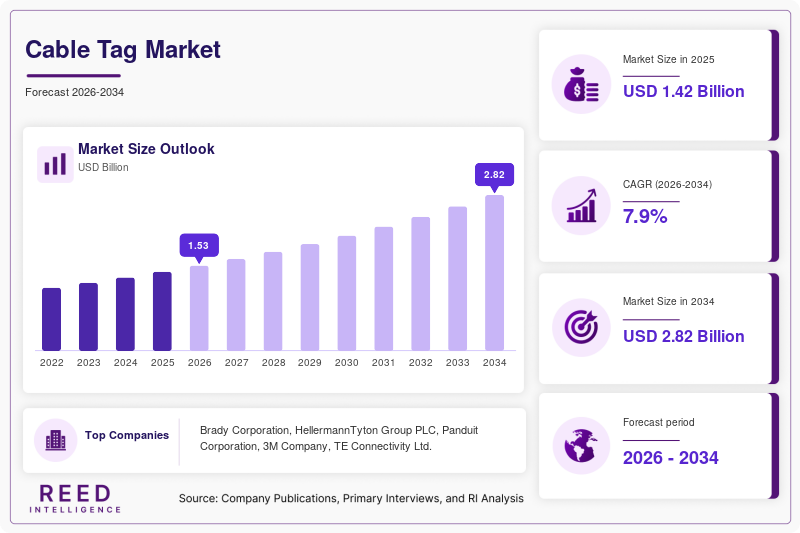
Key Highlights
- North America accounted for 34.8% of the global Cable Tag Market share in 2025, while Asia Pacific is projected to register the fastest CAGR of 9.4% during 2026–2034.
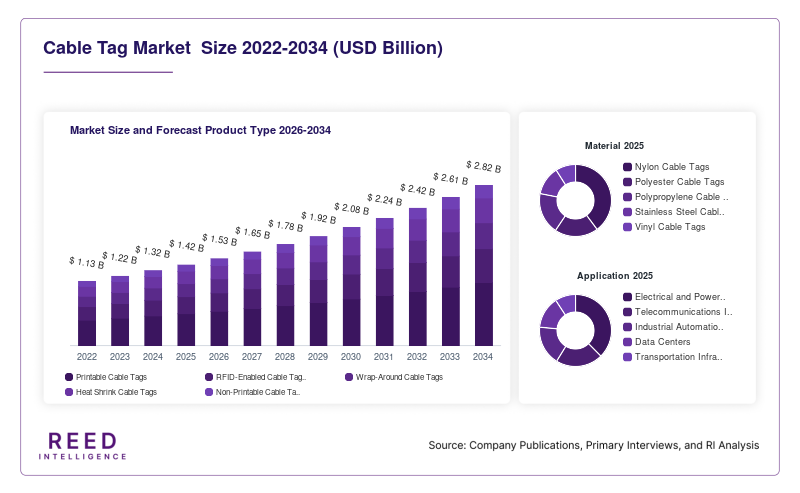
- By product type, printable cable tags held the dominant share of 39.2% in 2025, whereas RFID-enabled cable tags are expected to grow at the fastest CAGR of 10.1%.
- By material, nylon cable tags dominated the market with a 36.7% share in 2025, while stainless steel cable tags are anticipated to expand at a CAGR of 9.7%.
- By application, electrical and power systems represented the leading segment with 41.6% market share in 2025, while telecommunications infrastructure is forecast to grow at 9.8% CAGR.
- By end use, industrial manufacturing accounted for 33.9% of the Cable Tag Market share in 2025, while data centers are expected to witness the fastest growth rate of 10.3%.
- The U.S. Cable Tag Market was valued at USD 338 million in 2024 and reached USD 362 million in 2025.
Market Trends
Increasing Adoption of RFID-Enabled Cable Identification
The adoption of RFID-enabled cable tags is emerging as a notable trend in the Cable Tag Market. Industries are integrating RFID technology into cable management systems to improve tracking accuracy, reduce maintenance time, and enhance operational visibility. RFID-enabled cable tags support automated asset identification and real-time monitoring, making them suitable for large industrial facilities, power plants, and telecommunication networks. Companies are increasingly investing in smart cable labeling solutions to improve maintenance workflows and minimize operational disruptions.
Rising Demand for Heat-Resistant and Weatherproof Cable Tags
Another major trend shaping the Cable Tag Market is the growing preference for heat-resistant and weatherproof cable tags. Industrial sectors such as oil & gas, mining, marine, and utilities require cable identification products capable of withstanding harsh environmental conditions. Manufacturers are introducing cable tags made from stainless steel, polyester, and high-performance polymers to improve durability and operational lifespan. This trend is expected to support product innovation and premium product demand during the forecast period.
Market Drivers
Expansion of Industrial Automation Infrastructure
The increasing deployment of industrial automation systems is a significant driver for the Cable Tag Market. Automated manufacturing facilities require organized cable management systems to support operational efficiency and safety. Cable tags help maintenance teams quickly identify electrical and communication lines, reducing downtime and improving troubleshooting efficiency. Industries including automotive manufacturing, electronics production, and pharmaceuticals are increasingly adopting cable labeling systems to streamline operations.
Growth in Power Transmission and Telecommunication Networks
The expansion of power distribution networks and telecommunication infrastructure is another major growth driver. Governments and private operators are investing heavily in grid modernization projects, fiber optic installations, and renewable energy infrastructure. These projects require durable cable identification systems to support maintenance and safety compliance. The growing deployment of 5G infrastructure and data communication networks is expected to further accelerate the Cable Tag Market growth.
Market Restraint
Volatility in Raw Material Prices
Fluctuations in the prices of plastics, metals, and specialty polymers remain a major restraint for the Cable Tag Market. Variations in raw material costs can impact manufacturing expenses and profit margins for cable tag producers. Rising prices of stainless steel and engineering plastics may limit adoption among cost-sensitive end users, particularly in small-scale industrial applications.
Market Opportunities
Growing Investments in Renewable Energy Infrastructure
The rapid expansion of renewable energy installations presents a significant opportunity for the Cable Tag Market. Solar farms, wind energy projects, and battery storage systems require extensive cable management and identification solutions. Cable tags are increasingly being used to improve operational reliability and maintenance efficiency in renewable energy networks.
Increasing Development of Smart Data Centers
The growth of hyperscale and edge data centers is creating new opportunities for cable tag manufacturers. Data centers require organized cable management systems to handle complex networking and power infrastructure. Advanced cable tags with barcode and QR-code capabilities are gaining popularity for improving maintenance efficiency and infrastructure scalability.
Segmental Analysis
By Product Type
Printable Cable Tags Dominated the Market
Printable cable tags accounted for 39.2% of the Cable Tag Market share in 2025 due to their flexibility, ease of customization, and widespread adoption across industrial applications. These tags are extensively used in electrical installations, manufacturing facilities, and telecommunications infrastructure for quick identification and maintenance.
RFID-Enabled Cable Tags to Register the Fastest Growth
RFID-enabled cable tags are projected to grow at a CAGR of 10.1% during the forecast period. The segment growth will be supported by increasing adoption of smart asset management systems and automated maintenance operations. Industries are expected to adopt RFID cable tags to improve operational visibility and inventory management efficiency.
By Material
Nylon Cable Tags Held the Largest Share
Nylon cable tags held 36.7% of the market share in 2025 owing to their durability, flexibility, and cost-effectiveness. These tags are commonly used in electrical and industrial environments where lightweight and chemical-resistant materials are required.
Stainless Steel Cable Tags to Expand Rapidly
Stainless steel cable tags are forecast to expand at a CAGR of 9.7% during 2026–2034. Growth will be driven by increasing demand from harsh industrial environments such as oil & gas, marine, and mining industries. Their resistance to corrosion and extreme temperatures is expected to support long-term adoption.
By Application
Electrical and Power Systems Dominated the Market
Electrical and power systems represented 41.6% share of the Cable Tag Market in 2025. Rising investments in grid modernization and renewable energy installations contributed to segment dominance. Cable tags are widely used in substations, transmission systems, and industrial power distribution networks.
Telecommunications Infrastructure to Witness Fastest Growth
Telecommunications infrastructure is anticipated to grow at a CAGR of 9.8% during the forecast period. Expansion of fiber optic networks and 5G deployment projects will increase the need for organized cable management systems. Telecom operators are expected to adopt advanced cable identification products to improve network maintenance efficiency.
By End Use
Industrial Manufacturing Accounted for the Largest Share
Industrial manufacturing held 33.9% share of the Cable Tag Market in 2025 due to extensive use of cable labeling systems in automated production facilities. Manufacturers increasingly rely on cable tags to improve maintenance operations and ensure workplace safety.
Data Centers to Record the Highest CAGR
Data centers are projected to expand at a CAGR of 10.3% through 2034. The segment growth will be supported by increasing investments in cloud computing infrastructure and edge data center expansion. Organized cable management systems are expected to remain essential for efficient network operations and maintenance.
Regional Analysis
North America
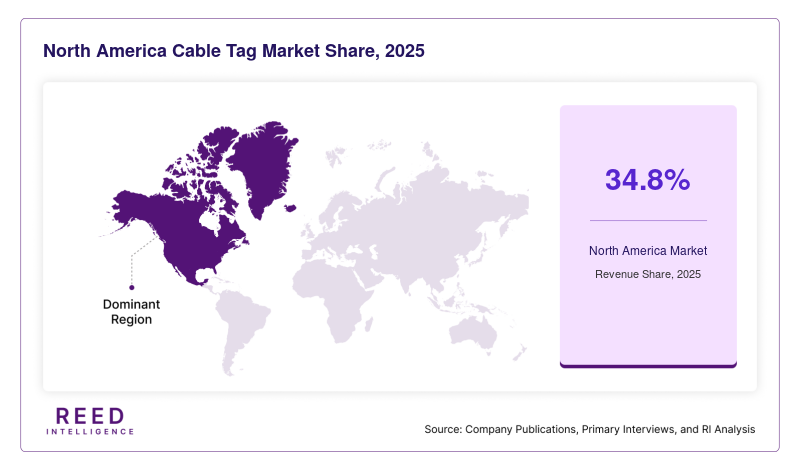
North America accounted for 34.8% of the Cable Tag Market share in 2025 and is expected to grow at a CAGR of 7.5% during 2026–2034. The regional market growth is associated with rising investments in industrial automation and data center infrastructure. The United States dominated the regional market due to increasing modernization of power transmission systems and expanding telecommunications projects. The growing adoption of smart factories has further strengthened demand for advanced cable identification products across industrial facilities.
Europe
Europe held 27.1% share of the Cable Tag Market in 2025 and will expand at a CAGR of 7.3% during the forecast period. The regional market has been driven by industrial safety standards and modernization of transportation infrastructure. Germany emerged as the dominant country due to the strong presence of automotive manufacturing facilities and industrial automation companies. Increased adoption of sustainable industrial operations has also supported the use of recyclable and durable cable tagging solutions.
Asia Pacific
Asia Pacific represented 24.5% of the Cable Tag Market share in 2025 and is projected to witness the fastest CAGR of 9.4% through 2034. Rapid urbanization, industrial development, and telecommunication expansion have contributed to regional market growth. China dominated the Asia Pacific market owing to extensive investments in electrical infrastructure and manufacturing expansion. Rising deployment of 5G networks and renewable energy projects is expected to strengthen market demand in the region.
Middle East & Africa
The Middle East & Africa accounted for 7.2% of the global Cable Tag Market share in 2025 and is anticipated to grow at a CAGR of 8.1% during 2026–2034. Infrastructure modernization and expansion of energy projects have contributed to market demand. Saudi Arabia led the regional market due to investments in smart city developments and utility infrastructure. Growing industrial diversification initiatives are expected to increase the adoption of cable management systems across the region.
Latin America
Latin America captured 6.4% of the Cable Tag Market share in 2025 and is forecast to expand at a CAGR of 7.6% over the forecast period. Increasing industrial investments and expansion of telecommunication networks have supported regional growth. Brazil dominated the regional market due to rising construction activities and utility modernization projects. Demand for organized cable identification systems is expected to increase across industrial and commercial sectors.
Competitive Landscape
The Cable Tag Market remains moderately fragmented with the presence of global and regional manufacturers competing on product durability, material innovation, and smart identification technologies. Leading companies are focusing on product customization, RFID integration, and expansion of industrial distribution networks to strengthen market presence.
Brady Corporation remains a leading player in the Cable Tag Market due to its broad product portfolio and strong industrial customer base. The company recently expanded its industrial labeling solutions with advanced RFID-compatible cable identification systems designed for high-performance industrial applications.
HellermannTyton has strengthened its market position through durable cable management products for telecommunication and industrial sectors. Panduit Corporation continues to invest in smart cable identification technologies for data center applications. TE Connectivity has expanded its industrial cable labeling portfolio for harsh environments. 3M Company remains active in the market through high-performance cable identification products designed for power and utility applications.
Key Players List
- Brady Corporation
- HellermannTyton Group PLC
- Panduit Corporation
- 3M Company
- TE Connectivity Ltd.
- ABB Ltd.
- Legrand SA
- Phoenix Contact GmbH & Co. KG
- Partex Marking Systems AB
- Cablecraft Ltd.
- Novoflex Marketing Pvt. Ltd.
- Silver Fox Limited
- Seton Identification Products
- K-Sun Corporation
- Brother Industries Ltd.
- Dymo Corporation
- Avery Dennison Corporation
Recent Developments
- January 2025 – Brady Corporation introduced RFID-integrated industrial cable tags for automated maintenance systems.
- March 2025 – HellermannTyton launched weather-resistant cable identification products for renewable energy installations.
- June 2024 – Panduit Corporation expanded its smart cable management portfolio for hyperscale data centers.
- September 2024 – TE Connectivity introduced heat-resistant cable tags for high-temperature industrial applications.
- February 2025 – 3M Company launched durable cable labeling solutions for utility infrastructure projects.
- November 2024 – Phoenix Contact expanded production capacity for industrial cable marking systems in Europe.
- April 2025 – ABB Ltd. introduced digital cable identification technologies for smart grid projects.
- August 2025 – Legrand SA developed advanced cable labeling products for intelligent building infrastructure.
Cable Tag Market Segments
Product Type
- Printable Cable Tags
- RFID-Enabled Cable Tags
- Wrap-Around Cable Tags
- Heat Shrink Cable Tags
- Non-Printable Cable Tags
Material
- Nylon Cable Tags
- Polyester Cable Tags
- Polypropylene Cable Tags
- Stainless Steel Cable Tags
- Vinyl Cable Tags
Application
- Electrical and Power Systems
- Telecommunications Infrastructure
- Industrial Automation Systems
- Data Centers
- Transportation Infrastructure
End Use
- Industrial Manufacturing
- Energy and Utilities
- Telecommunications
- Commercial Buildings
- Healthcare Facilities
By Region
- North America
- Europe
- APAC
- Middle East and Africa
- LATAM