Cadmium Pigment Market Size, Share & Demand Report By Type (Cadmium Sulfide, Cadmium Sulfoselenide, Cadmium Zinc Sulfide), By Application (Plastics, Coatings, Ceramics, Glass, Printing Inks), By End-Use Industry (Construction Materials, Automotive, Electronics, Industrial Manufacturing), By Region & Segment Forecasts, 2022–2034.
USD 3950
Market Overview
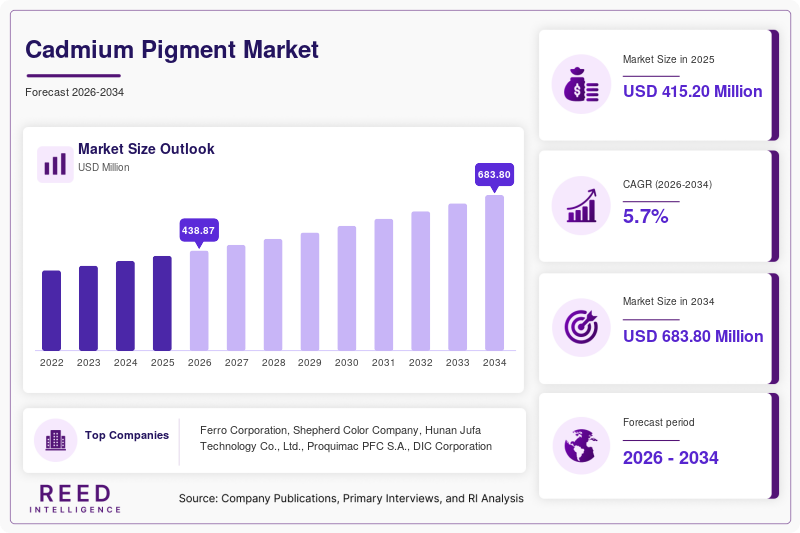
The global Cadmium Pigment Market size was valued at USD 415.2 million in 2024 and is projected to reach USD 678.5 million by 2033, expanding at a compound annual growth rate (CAGR) of 5.7% during 2025–2033. Cadmium pigments are inorganic compounds primarily used for their superior color strength, thermal stability, and chemical resistance. These pigments are widely utilized in high-performance coatings, plastics, ceramics, and specialty glass manufacturing where long-term durability and color consistency are essential.
Growth in the Cadmium Pigment Market has been supported by the rising demand for high-performance pigments in industrial applications that require resistance to extreme heat and UV exposure. Cadmium-based pigments maintain color stability even under harsh environmental conditions, making them suitable for aerospace coatings, automotive components, engineering plastics, and industrial ceramics. Their ability to deliver bright yellow, orange, and red hues has also sustained demand in specialized artistic paints and high-temperature plastic processing.
Key Highlights
- Dominant region: Asia Pacific held 39.4% market share in 2025, while Latin America is projected to record the fastest CAGR of 6.8% through 2033.
- Leading subsegment: Cadmium Sulfide accounted for 41.2% share in 2024, while Cadmium Sulfoselenide is expected to grow at 6.4% CAGR.
- Application leader: Plastics dominated with 33.6% share in 2024, while coatings will grow fastest at 6.2% CAGR.
- Dominant country: China recorded USD 96.5 million in 2024, rising to USD 101.3 million in 2025.
Market Trends
Expansion of High-Temperature Engineering Plastics Applications
A notable trend shaping the Cadmium Pigment Market is the increasing use of cadmium pigments in high-temperature engineering plastics. Industries such as automotive, electronics, and industrial machinery require pigments capable of withstanding processing temperatures above 300°C without degrading. Cadmium pigments provide exceptional thermal stability and color retention in polymers such as polyamide, polyethylene, and polypropylene. This has made them suitable for molded plastic components used in electrical housings, automotive interiors, and industrial equipment. The need for long-lasting pigmentation in engineering-grade plastics has therefore reinforced their niche industrial relevance.
Technological Advancements in Pigment Processing
Another emerging trend in the Cadmium Pigment Market is the adoption of improved pigment manufacturing technologies to enhance dispersion properties and particle uniformity. Manufacturers are implementing advanced milling, calcination, and surface treatment processes to produce pigments with better opacity and stability. These technological improvements allow pigment producers to deliver materials with consistent color performance in coatings, plastics, and ceramics. Additionally, improved production methods help reduce impurities and enhance compliance with industrial safety guidelines. This trend is expected to support long-term product adoption in specialized applications where precision color performance is required.
Market Drivers
Growing Demand for Durable Industrial Coatings
One of the primary drivers of the Cadmium Pigment Market is the increasing demand for durable industrial coatings in sectors such as aerospace, marine, and heavy machinery. Cadmium pigments offer exceptional resistance to heat, light, and chemical degradation, making them suitable for protective coatings exposed to harsh operating conditions. These pigments help maintain color integrity and coating performance over extended service periods. Industries requiring protective coatings with long service life therefore continue to incorporate cadmium pigments in specialized formulations.
Rising Consumption in Ceramic and Glass Manufacturing
Another important driver supporting the Cadmium Pigment Market is the expanding use of cadmium pigments in ceramic and glass manufacturing. Cadmium-based pigments provide vibrant colors and excellent stability during high-temperature firing processes. Ceramic tiles, decorative glass products, and porcelain materials benefit from these pigments due to their ability to maintain color intensity during kiln processing. The increasing global production of ceramic products for residential and commercial construction has consequently contributed to stable demand for cadmium pigments.
Market Restraint
Regulatory Restrictions on Cadmium Usage
A significant restraint affecting the Cadmium Pigment Market is the presence of strict regulatory frameworks governing cadmium use. Cadmium compounds are classified as hazardous materials in several jurisdictions due to their potential environmental and health impacts. Regulatory agencies in regions such as Europe and North America have established restrictions on cadmium-based materials in consumer products.
These regulatory controls require manufacturers to implement strict handling procedures, waste management protocols, and compliance documentation. Compliance costs can increase production expenses for pigment manufacturers and downstream industries. Additionally, certain consumer product sectors have gradually adopted alternative pigments to reduce regulatory risk.
Despite these restrictions, cadmium pigments continue to be utilized in specialized industrial applications where alternative pigments cannot easily replicate their thermal stability or color performance. However, regulatory pressure remains a critical factor influencing the growth trajectory and competitive dynamics of the Cadmium Pigment Market.
Segmental Analysis
By Type
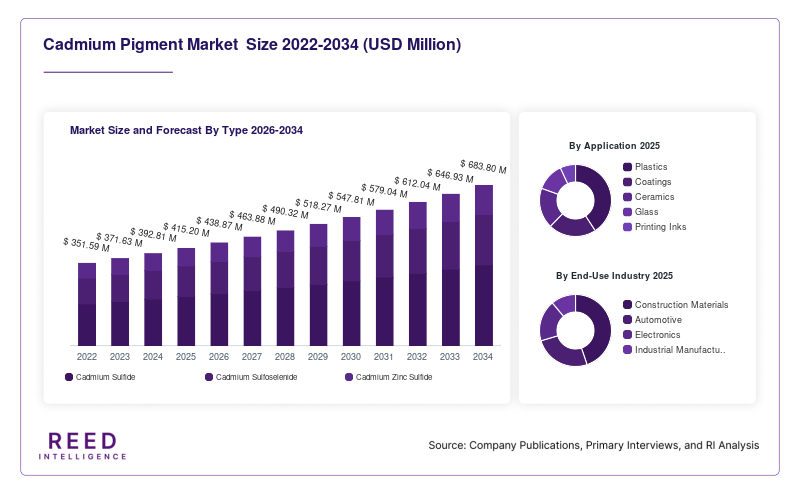
The Cadmium Sulfide segment held the largest share of the Cadmium Pigment Market, accounting for 41.2% in 2024. Cadmium sulfide pigments are widely recognized for producing bright yellow shades with excellent lightfastness and chemical stability. These pigments have been extensively used in plastics, ceramics, and industrial coatings due to their durability under high-temperature processing conditions. Their strong tinting strength and opacity have made them suitable for demanding industrial color applications.
The Cadmium Sulfoselenide segment will grow at the fastest CAGR of 6.4% during the forecast period. This pigment type produces orange and red color shades that remain stable at elevated temperatures. Growth will be driven by the need for high-performance pigments in ceramic glazes and engineering plastics where color stability during thermal processing is essential. The ability of sulfoselenide pigments to maintain brightness and durability will support their increased adoption.
By Application
The Plastics segment accounted for the largest Cadmium Pigment Market share of 33.6% in 2024. Cadmium pigments have been widely utilized in plastic formulations because they maintain color integrity during high-temperature molding processes. Their compatibility with polymers such as polypropylene and polyethylene has supported their application in molded plastic products, electrical housings, and industrial components.
The Coatings segment will record the fastest CAGR of 6.2% through 2033. Growth will be supported by the increasing demand for pigments capable of maintaining stability in protective coatings applied to industrial equipment and infrastructure. Cadmium pigments provide resistance to ultraviolet radiation and chemical degradation, which will support their use in high-performance coating formulations.
By End-Use Industry
The Construction Materials segment dominated the Cadmium Pigment Market with 34.8% share in 2024. The construction sector uses cadmium pigments in ceramic tiles, colored glass, and architectural materials. These pigments offer stable coloration during high-temperature firing processes used in ceramic manufacturing. Their durability and color strength have supported widespread use in decorative building materials.
The Automotive Industry segment will grow at the fastest CAGR of 6.5% during the forecast period. Automotive manufacturers will increasingly use cadmium pigments in specialized coatings and polymer components where long-term color stability is required. High-performance pigments are particularly useful for components exposed to heat, sunlight, and chemical exposure. As automotive manufacturing evolves, demand for durable pigments in specialty applications will continue to increase.
Regional Analysis
North America
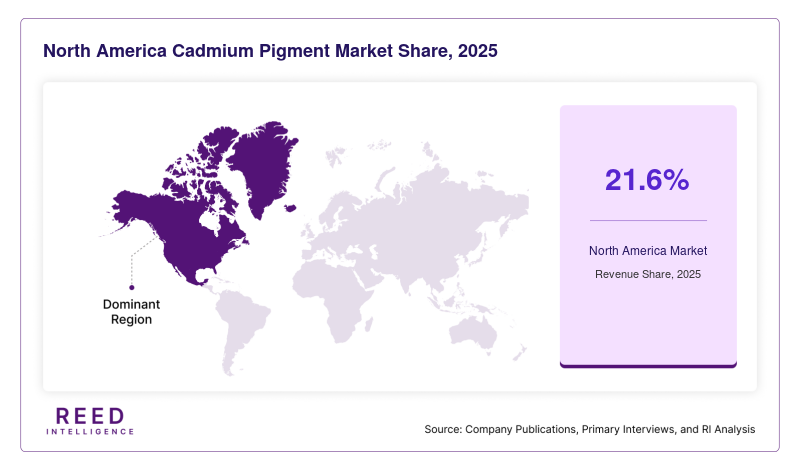
North America accounted for 21.6% of the Cadmium Pigment Market share in 2025, reflecting steady industrial consumption in specialized applications. The region’s market growth will expand at a CAGR of 4.9% between 2025 and 2033. Demand in North America has largely been associated with industrial coatings, high-performance plastics, and niche artistic pigment applications. The presence of established pigment manufacturers and specialty chemical companies has also contributed to stable supply chains within the region.
The United States represented the dominant country in the regional market. Growth has been associated with the country’s well-established industrial coatings sector and demand for durable pigments in aerospace and defense applications. Several specialized coatings used in aircraft components and industrial equipment require pigments capable of maintaining stability under high temperatures and exposure to chemicals. The United States therefore continues to represent a key market for high-performance cadmium pigments.
Europe
Europe held 24.3% share of the Cadmium Pigment Market in 2025. The regional market will grow at a CAGR of 4.5% through 2033. Europe’s pigment industry has historically maintained strong expertise in inorganic pigment production and advanced material processing. Demand in the region has primarily originated from industrial ceramics, specialty coatings, and artistic pigment applications.
Germany dominated the European market due to its advanced chemical manufacturing industry and strong presence of pigment producers. German manufacturers have maintained leadership in pigment processing technologies, including calcination and particle engineering techniques used to improve pigment stability and color performance. The country’s expertise in advanced materials manufacturing has supported demand for high-quality cadmium pigments in industrial applications.
Asia Pacific
Asia Pacific represented the largest regional market with 39.4% share in 2025. The region will expand at a CAGR of 6.1% during the forecast period. Rapid industrialization and expansion of manufacturing sectors across Asia Pacific have contributed to increasing demand for pigments used in plastics, ceramics, and coatings. The region has also become a major global hub for pigment production due to the availability of raw materials and large-scale chemical manufacturing infrastructure.
China dominated the regional market and remained the largest national market globally. The country’s extensive chemical manufacturing industry and large plastics processing sector have supported the consumption of cadmium pigments. Additionally, China’s ceramic tile and glass manufacturing industries have generated significant demand for pigments capable of withstanding high firing temperatures. These industrial capabilities have positioned China as a key contributor to regional market expansion.
Middle East & Africa
The Middle East & Africa accounted for 7.5% share of the Cadmium Pigment Market in 2025. The regional market will grow at a CAGR of 5.2% through 2033. Growth in the region has been associated with industrial infrastructure development and expansion of construction-related industries that utilize ceramic and glass materials.
Saudi Arabia represented the leading market within the region. Industrial diversification initiatives and investment in manufacturing infrastructure have supported demand for pigments used in ceramic tiles and construction materials. Local industries increasingly require pigments capable of maintaining performance in high-temperature processing environments, contributing to stable cadmium pigment consumption.
Latin America
Latin America accounted for 7.2% of the Cadmium Pigment Market share in 2025. The regional market will expand at the fastest CAGR of 6.8% during 2025–2033. Growth has been supported by increasing industrial production and rising demand for colored plastics and coatings in infrastructure and consumer goods manufacturing.
Brazil remained the dominant country within the Latin American market. The country’s large plastics processing industry and expanding construction materials sector have generated demand for durable pigments used in polymer and coating applications. Brazil’s industrial base therefore continues to support increasing regional consumption of cadmium pigments.
Competitive Landscape
The Cadmium Pigment Market remains moderately consolidated with the presence of established inorganic pigment manufacturers and specialty chemical companies. Market participants focus on improving pigment processing technologies, product purity, and application performance to strengthen their competitive positions.
Ferro Corporation has maintained a leading position in the market due to its strong portfolio of inorganic pigments and extensive global distribution network. The company has focused on expanding its pigment product lines for high-temperature applications in ceramics and industrial coatings.
Other major companies have concentrated on improving production efficiency and developing pigments with enhanced dispersion properties for plastics and coatings. Continuous investment in pigment processing technologies and product development has helped manufacturers maintain competitiveness in specialized industrial segments.
Key Players
- Shepherd Color Company
- Hunan Jufa Technology Co., Ltd.
- Proquimac PFC S.A.
- DIC Corporation
- Huntsman Corporation
- BASF SE
- Lanxess AG
- Sudarshan Chemical Industries Limited
- Kronos Worldwide Inc.
- Clariant AG
Recent Developments
- Ferro Corporation expanded its inorganic pigment product line for high-temperature ceramic applications.
- Shepherd Color Company introduced improved dispersion-grade pigments for polymer processing industries.
- Hunan Jufa Technology increased pigment production capacity to meet growing demand from the Asian ceramics sector.
- Lanxess AG strengthened specialty pigment distribution partnerships in European industrial coatings markets.
- Sudarshan Chemical Industries enhanced pigment processing technology to improve color stability in plastics.
Cadmium Pigment Market Segments
By Type
- Cadmium Sulfide
- Cadmium Sulfoselenide
- Cadmium Zinc Sulfide
By Application
- Plastics
- Coatings
- Ceramics
- Glass
- Printing Inks
By End-Use Industry
- Construction Materials
- Automotive
- Electronics
- Industrial Manufacturing
By Region
- North America
- Europe
- APAC
- Middle East and Africa
- LATAM