Calcium Ascorbate for Feed Market Size, Share & Demand Report By Type (Coated Calcium Ascorbate, Uncoated Calcium Ascorbate), By Application (Poultry Feed, Aquaculture Feed, Swine Feed, Ruminant Feed), By End-Use (Commercial Feed Manufacturers, On-Farm Feed Production), By Region & Segment Forecasts, 2025–2034
USD 3950
Market Overview
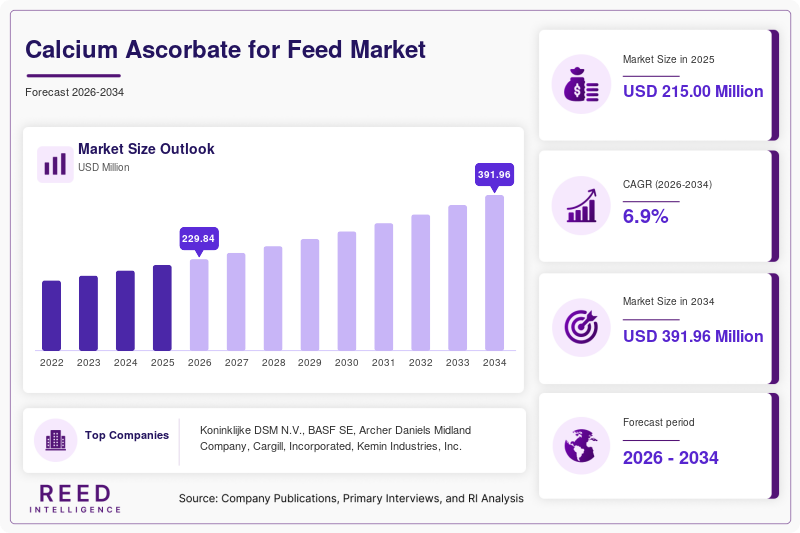
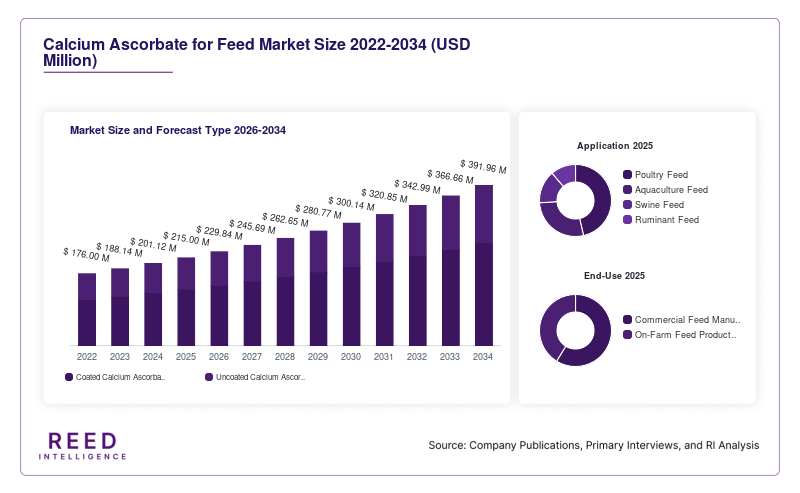
The Calcium Ascorbate for Feed Market size is estimated at USD 215 million in 2025 and is projected to reach USD 232 million in 2026, reflecting stable year-on-year growth. Over the forecast period, the market is expected to reach approximately USD 395 million by 2034, expanding at a compound annual growth rate (CAGR) of 6.9% from 2025 to 2034.
Calcium ascorbate, a buffered form of vitamin C, is widely used in feed formulations due to its superior stability, bioavailability, and reduced acidity compared to ascorbic acid. It plays a critical role in improving immunity, growth performance, and stress resistance in livestock, poultry, and aquaculture species. The increasing industrialization of animal farming and the growing focus on feed quality are key contributors to market growth.
Key Highlights
- North America held the dominant regional share of 28.0% in 2025.
Asia Pacific is projected to register the fastest growth at a CAGR of 7.8% during 2025–2034. - Within Type, Coated Calcium Ascorbate led the market with a 58.0% share in 2024.
Uncoated Calcium Ascorbate is expected to grow at the fastest CAGR of 7.4% over the forecast period. - Within Application, Poultry Feed accounted for the largest share of 42.0% in 2024.
Aquaculture Feed is anticipated to expand at the fastest CAGR of 8.1% during the forecast timeline. - The United States remained the dominant country with a market value of USD 60 million in 2024.
The country’s market size is expected to increase to USD 65 million in 2025, reflecting steady growth.
Market Trends
Shift Toward Functional and Nutrient-Enriched Feed Formulations
The market is experiencing a noticeable shift toward functional feed formulations that provide added health benefits beyond basic nutrition. Calcium ascorbate is increasingly incorporated into feed to enhance immunity, reduce oxidative stress, and improve animal productivity. This trend is particularly evident in poultry and aquaculture sectors, where disease outbreaks can significantly impact profitability. Feed manufacturers are developing advanced formulations that combine calcium ascorbate with other micronutrients and antioxidants to deliver targeted health benefits. The growing demand for premium-quality meat and dairy products is also influencing producers to adopt nutrient-enriched feed solutions, supporting consistent growth in this segment.
Increasing Adoption in Aquaculture and Intensive Farming Systems
Aquaculture and intensive livestock farming systems are driving the demand for stable vitamin supplements like calcium ascorbate. In high-density farming environments, animals are more susceptible to stress and infections, making vitamin supplementation essential. Calcium ascorbate is preferred due to its stability in water and feed, ensuring consistent nutrient delivery. The expansion of fish and shrimp farming in emerging economies is further accelerating this trend. Additionally, producers are focusing on optimizing feed conversion ratios and minimizing mortality rates, which is increasing the use of functional additives. This trend is expected to remain strong as global seafood consumption continues to rise.
Market Drivers
Increasing Demand for Antibiotic-Free Feed Solutions
The global shift toward antibiotic-free animal production is a major driver for the Calcium Ascorbate for Feed Market. Regulatory authorities across several regions are imposing strict limits on the use of antibiotic growth promoters in animal feed due to concerns about antimicrobial resistance. As a result, feed manufacturers are turning to nutritional alternatives such as calcium ascorbate to maintain animal health and productivity. This compound supports immune function and reduces the risk of infections, making it a suitable substitute. Livestock producers are increasingly adopting these alternatives to comply with regulations while maintaining performance standards, which is driving consistent demand.
Growth in Livestock and Aquaculture Production
The expansion of global livestock and aquaculture industries is significantly contributing to market growth. Rising population levels and increasing disposable incomes are boosting the consumption of meat, dairy, and seafood products. This, in turn, is increasing the demand for high-quality feed additives that improve growth rates and overall productivity. Calcium ascorbate plays a vital role in enhancing nutrient absorption and reducing stress in animals, particularly in intensive farming systems. The rapid development of commercial farming operations in emerging markets is further supporting the adoption of advanced feed additives, including calcium ascorbate.
Market Restraint
High Production Costs and Price Sensitivity in Feed Industry
One of the key restraints in the Calcium Ascorbate for Feed Market is the relatively high production cost compared to conventional vitamin C sources. Calcium ascorbate requires specialized manufacturing processes to ensure stability and bioavailability, which increases overall production expenses. This cost factor becomes critical in price-sensitive markets, where feed producers often operate on thin margins. Small and medium-scale farmers may prefer lower-cost alternatives, limiting widespread adoption. Additionally, fluctuations in raw material prices can further impact product pricing, creating uncertainty in the market. This restraint is particularly evident in developing regions, where affordability remains a key concern.
Market Opportunities
Expansion in Emerging Markets and Commercial Farming
Emerging economies present significant growth opportunities for the Calcium Ascorbate for Feed Market. Countries in Asia Pacific, Latin America, and Africa are witnessing rapid expansion in commercial farming and aquaculture activities. Governments in these regions are supporting livestock development through subsidies and modernization initiatives. This is encouraging the adoption of advanced feed additives to improve productivity and disease resistance. Calcium ascorbate is gaining traction due to its effectiveness and safety profile. As awareness about animal nutrition continues to increase, market players can tap into these regions by offering cost-effective and tailored solutions.
Development of Advanced Feed Additive Formulations
The development of innovative feed formulations offers another promising opportunity for market growth. Manufacturers are investing in research and development to create advanced products that combine calcium ascorbate with other functional ingredients. These formulations aim to enhance stability, improve absorption, and deliver targeted health benefits. Microencapsulation and controlled-release technologies are being explored to increase product efficiency. Such innovations are expected to expand the application scope of calcium ascorbate in feed, particularly in high-performance livestock systems. This trend is likely to create new revenue streams for market participants.
Segmental Analysis
By Type
The coated calcium ascorbate segment dominated the market in 2024, accounting for approximately 58% of the total share. This dominance is attributed to its enhanced stability during feed processing and storage. Coated variants are less susceptible to degradation under high temperature and humidity conditions, making them suitable for pelleted and extruded feed. Feed manufacturers prefer coated calcium ascorbate due to its longer shelf life and consistent nutrient delivery. The growing demand for high-performance feed additives is further supporting the adoption of this segment.
The uncoated calcium ascorbate segment is expected to grow at the fastest CAGR of 7.4% during the forecast period. This growth is driven by its cost-effectiveness and ease of incorporation in certain feed formulations. Small-scale producers and cost-sensitive markets are increasingly adopting uncoated variants. Additionally, advancements in formulation techniques are improving the stability of uncoated calcium ascorbate, making it more competitive in the market.
By Application
The poultry feed segment held the largest share of approximately 42% in 2024. This is due to the high consumption of poultry products and the need for efficient feed solutions. Calcium ascorbate is widely used in poultry feed to improve immunity, growth rates, and egg production. The increasing demand for high-quality poultry products is encouraging producers to adopt advanced feed additives.
Aquaculture feed is the fastest-growing segment, with a projected CAGR of 8.1%. The rapid expansion of fish and shrimp farming is driving demand for vitamin-enriched feed. Calcium ascorbate plays a critical role in enhancing stress resistance and reducing mortality rates in aquatic species. This segment is expected to witness strong growth due to increasing seafood consumption.
By End-Use
Commercial feed manufacturers accounted for the largest share of around 65% in 2024. These companies produce large volumes of feed and require consistent quality and performance. Calcium ascorbate is widely used in commercial feed production to ensure optimal nutrient content and animal health.
The on-farm feed production segment is expected to grow at a CAGR of 7.2%. Farmers are increasingly producing their own feed to reduce costs and improve control over feed quality. The rising awareness about the benefits of vitamin supplementation is driving the adoption of calcium ascorbate in on-farm feed production.
Regional Analysis
North America
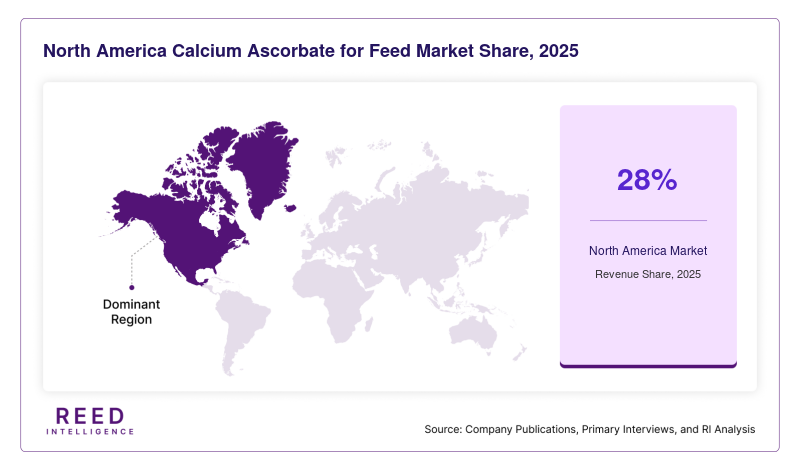
North America accounted for approximately 28% of the market share in 2025 and is expected to grow at a CAGR of 6.2% during the forecast period. The region’s well-established livestock industry and strong focus on feed quality are key contributors to market growth. Increasing consumer demand for high-quality animal products is encouraging producers to adopt advanced feed additives. Regulatory restrictions on antibiotics are further driving the use of nutritional alternatives like calcium ascorbate.
The United States dominates the regional market due to its large-scale poultry and cattle farming operations. A unique growth factor in this region is the increasing adoption of precision livestock farming technologies. These technologies enable optimized feed utilization and nutrient management, which supports the demand for high-performance additives such as calcium ascorbate.
Europe
Europe held around 24% market share in 2025 and is projected to grow at a CAGR of 5.8% through 2034. The region is characterized by strict regulations regarding animal welfare and feed safety, which are driving the adoption of high-quality feed additives. The ban on antibiotic growth promoters has significantly increased the use of alternative nutritional solutions.
Germany leads the European market, supported by its advanced livestock farming practices. A unique growth factor in this region is the strong emphasis on sustainable and organic farming. This is encouraging the use of natural and safe feed additives, including calcium ascorbate, to meet regulatory and consumer requirements.
Asia Pacific
Asia Pacific dominated the market with a 34% share in 2025 and is expected to register the fastest growth at a CAGR of 7.8%. Rapid urbanization, population growth, and increasing protein consumption are key drivers in this region. The expansion of aquaculture and poultry industries is significantly boosting demand for feed additives.
China is the dominant country, driven by its large livestock and aquaculture production base. A unique growth factor is the government’s focus on improving feed efficiency and reducing disease outbreaks. This is leading to increased adoption of vitamin-enriched feed solutions such as calcium ascorbate.
Middle East & Africa
The Middle East & Africa region accounted for approximately 7% of the market share in 2025 and is projected to grow at a CAGR of 6.5%. The market is supported by increasing investments in livestock farming and food security initiatives. Rising awareness about animal nutrition is also contributing to growth.
Saudi Arabia is a key market in this region. A unique growth factor is the government’s focus on reducing dependency on food imports by boosting domestic livestock production. This is encouraging the adoption of high-quality feed additives to improve productivity.
Latin America
Latin America held around 7% market share in 2025 and is expected to grow at a CAGR of 6.7%. The region’s strong agricultural base and growing meat export industry are key growth drivers. Increasing adoption of advanced farming practices is supporting market expansion.
Brazil dominates the regional market due to its large-scale poultry and cattle production. A unique growth factor is the rising demand for export-quality meat products, which requires high standards of feed quality and nutrition, boosting the use of calcium ascorbate.
Competitive Landscape
The Calcium Ascorbate for Feed Market is moderately competitive, with several global and regional players focusing on product innovation and expansion strategies. Key companies are investing in research and development to improve product stability and effectiveness. Strategic partnerships and acquisitions are also common as companies aim to strengthen their market position.
Koninklijke DSM N.V. is recognized as a leading player due to its strong product portfolio and global presence. The company recently introduced an advanced stabilized vitamin C formulation designed specifically for aquaculture applications. Other players are focusing on expanding their distribution networks in emerging markets to capture growth opportunities.
Key Players List
- Koninklijke DSM N.V.
- BASF SE
- Archer Daniels Midland Company
- Cargill, Incorporated
- Kemin Industries, Inc.
- Nutreco N.V.
- Lonza Group Ltd.
- Adisseo France SAS
- Novus International, Inc.
- Zhejiang NHU Company Ltd.
- Shandong Luwei Pharmaceutical Co., Ltd.
- Foodchem International Corporation
- Hebei Welcome Pharmaceutical Co., Ltd.
- Jiangsu Jiangshan Pharmaceutical Co., Ltd.
- Anhui Tiger Biotech Co., Ltd.
Recent Developments
- In 2024, DSM launched a new stabilized calcium ascorbate product for aquaculture feed applications.
- In 2023, BASF expanded its feed additive production capacity in Asia Pacific to meet rising demand.
- In 2024, Cargill introduced a new vitamin-enriched feed formulation incorporating calcium ascorbate for poultry nutrition.
Calcium Ascorbate for Feed Market Segments
Type
- Coated Calcium Ascorbate
- Uncoated Calcium Ascorbate
Application
- Poultry Feed
- Aquaculture Feed
- Swine Feed
- Ruminant Feed
End-Use
- Commercial Feed Manufacturers
- On-Farm Feed Production
By Region
- North America
- Europe
- APAC
- Middle East and Africa
- LATAM