Calcium Silicate Insulation Market Size, Share Demand Report By Type (High-Temperature Insulation, Low-Temperature Insulation), By Application (Industrial, Commercial Construction, Residential), By End-Use Industry (Power Generation, Petrochemical, Cement, Metal Processing, Others), By Form (Boards, Pipes, Blocks), By Region & Segment Forecasts, 2026–2034
USD 3950
Market Overview
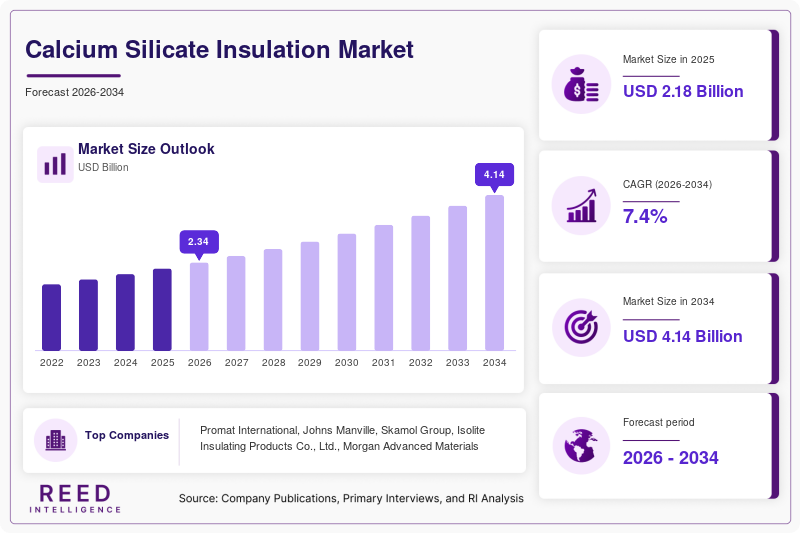
The Calcium Silicate Insulation Market size was valued at USD 2.18 billion in 2026 and is projected to reach USD 3.86 billion by 2034, expanding at a CAGR of 7.4% during the forecast period (2026–2034). The market growth is being supported by the rising global emphasis on energy efficiency and thermal management across industrial and commercial sectors. Increasing investments in infrastructure modernization and industrial process optimization have strengthened demand for high-performance insulation materials such as calcium silicate.
Calcium silicate insulation is widely used due to its superior compressive strength, high-temperature resistance, and moisture tolerance, making it suitable for applications in power generation, petrochemicals, and construction. The transition toward sustainable building practices and industrial decarbonization has further reinforced its adoption globally.
Key Highlights
- Dominant region: Asia Pacific held approximately 41.6% market share in 2025, while North America is expected to grow at the fastest CAGR of 7.9% (2026–2034)
- Leading subsegments: High-temperature insulation dominated the type segment with 58.2% share in 2025, while industrial application led with 46.5% share; the commercial construction segment is projected to grow fastest at a CAGR of 8.1%
- Dominant country: The United States recorded market values of USD 420 million in 2024 and USD 447 million in 2025
Market Trends
Rising adoption of sustainable insulation materials
Growing environmental awareness has led to increased preference for non-toxic, recyclable insulation solutions. Calcium silicate products, being asbestos-free and durable, align with green building certifications and sustainable construction initiatives.
Integration in high-performance industrial systems
Industries are increasingly integrating advanced insulation solutions into equipment such as boilers, turbines, and pipelines to enhance efficiency and reduce heat loss. This trend is driving innovation in product formulations with improved thermal conductivity and mechanical strength.
Market Drivers
Expansion of Industrial Infrastructure
Rapid industrialization across emerging economies is driving the demand for insulation materials capable of withstanding high temperatures and harsh conditions. Calcium silicate insulation is extensively used in petrochemical plants, refineries, and power stations, where thermal efficiency and safety are critical.
Growth in Energy Efficiency Regulations
Stringent energy efficiency norms across developed and developing regions are encouraging the adoption of advanced insulation materials. Regulatory frameworks promoting reduced energy consumption in buildings and industrial operations are significantly boosting the demand for calcium silicate insulation products.
Market Restraint
High Initial Installation Costs
The relatively higher upfront cost of calcium silicate insulation compared to conventional materials can limit adoption, particularly in cost-sensitive markets. Budget constraints in small-scale projects may hinder widespread implementation despite long-term performance benefits.
Market Opportunities
Increasing Demand in Renewable Energy Projects
The expansion of renewable energy infrastructure, including solar thermal and biomass plants, presents new growth avenues for calcium silicate insulation. Its ability to handle high temperatures makes it suitable for thermal energy storage and transfer systems.
Advancements in Lightweight Insulation Materials
Ongoing research and development are enabling the production of lightweight calcium silicate insulation with enhanced durability and easier installation. These innovations are expected to broaden application scope across commercial and residential sectors.
Segmental Analysis
By Type
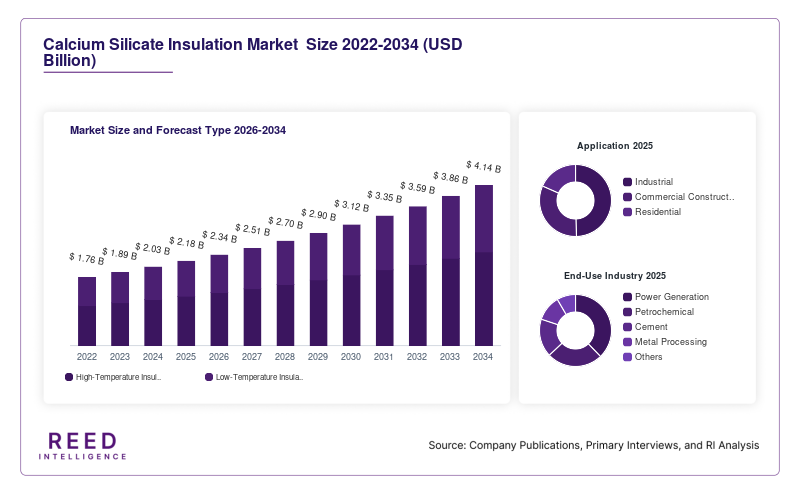
High-temperature insulation dominated the segment with a 58.2% share in 2025, driven by its extensive use in industrial applications requiring thermal resistance above 650°C.
The low-temperature insulation segment is expected to grow at the fastest CAGR of 7.8%, supported by increasing demand in commercial building applications where energy conservation and indoor climate control are critical.
By Application
Industrial applications accounted for the largest share of 46.5% in 2025, as calcium silicate insulation is widely used in power plants, refineries, and manufacturing facilities for thermal protection.
The commercial construction segment is projected to grow at a CAGR of 8.1%, driven by rising demand for energy-efficient buildings and compliance with building energy codes.
By End-Use Industry
The power generation sector held a dominant share of 34.8% in 2025, owing to the need for insulation in boilers, turbines, and heat exchangers.
The petrochemical sector is expected to grow at a CAGR of 7.7%, fueled by increasing investments in refining and chemical processing facilities.
By Form
Board form dominated the market with a 52.4% share in 2025, due to its ease of installation and structural strength.
Pipe insulation is projected to grow at a CAGR of 7.9%, driven by its application in pipeline systems across industrial and commercial settings.
Regional Analysis
North America
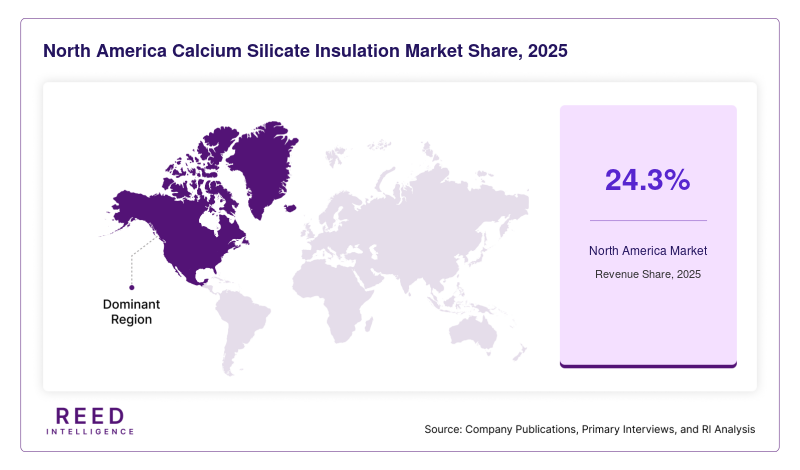
North America accounted for 24.3% of the market share in 2025 and is expected to grow at a CAGR of 7.9% during the forecast period. The United States dominated the region due to strong investments in industrial retrofitting and modernization. The increasing focus on reducing carbon emissions in manufacturing processes has supported the adoption of advanced insulation solutions.
Europe
Europe held approximately 21.7% share in 2025 and is projected to grow at a CAGR of 6.8%. Germany emerged as the dominant country, driven by its well-established industrial base and stringent environmental regulations. The region’s focus on sustainable construction practices has further contributed to market expansion.
Asia Pacific
Asia Pacific led the global market with a 41.6% share in 2025 and is expected to grow at a CAGR of 7.6%. China dominated the region due to rapid industrialization and infrastructure development. The expansion of power generation and petrochemical industries has significantly increased the demand for thermal insulation materials.
Middle East & Africa
The Middle East & Africa accounted for 7.2% share in 2025 and is anticipated to grow at a CAGR of 6.5%. Saudi Arabia led the region, supported by ongoing investments in oil & gas infrastructure and industrial diversification initiatives.
Latin America
Latin America captured 5.2% share in 2025 and is projected to expand at a CAGR of 6.3%. Brazil dominated the region due to growth in construction and energy sectors. Increasing infrastructure development projects have driven the adoption of insulation materials.
Competitive Landscape
The Calcium Silicate Insulation Market is moderately consolidated, with key players focusing on product innovation and geographic expansion. Prominent companies include Promat International, Johns Manville, Skamol Group, Isolite Insulating Products, and Morgan Advanced Materials. Among these, Promat International is recognized as a market leader due to its extensive product portfolio and global distribution network. The company recently introduced advanced calcium silicate insulation boards designed for enhanced thermal performance and reduced environmental impact.
Other players are investing in research and development to improve product durability and efficiency while meeting evolving regulatory standards. Strategic collaborations and acquisitions are also shaping the competitive landscape, enabling companies to strengthen their market presence and expand into emerging regions. The focus remains on delivering cost-effective and high-performance insulation solutions to meet the growing demand across industrial and construction sectors.
Key Players List
- Promat International
- Johns Manville
- Skamol Group
- Isolite Insulating Products Co., Ltd.
- Morgan Advanced Materials
- American Elements
- HIL Limited
- Luyang Energy-Saving Materials Co., Ltd.
- Etex Group
- Beijing North Refractories Co., Ltd.
- Industrial Insulation Group LLC
- Ramco Industries Limited
- Thermoacoustic Solutions
- IIG-CCA Company
- Shandong Yinguang Chemical Industry Group
Recent Developments
- In 2025, Promat International launched a new range of eco-friendly calcium silicate insulation boards with improved thermal resistance.
- Johns Manville expanded its production capacity in North America to meet growing demand from industrial sectors.
- Skamol Group introduced lightweight insulation solutions aimed at enhancing installation efficiency.
- Morgan Advanced Materials focused on developing high-performance insulation products for extreme temperature applications.
- HIL Limited strengthened its distribution network in Asia Pacific to expand its market presence.
Calcium Silicate Insulation Market Segments
Type
- High-Temperature Insulation
- Low-Temperature Insulation
Application
- Industrial
- Commercial Construction
- Residential
End-Use Industry
- Power Generation
- Petrochemical
- Cement
- Metal Processing
- Others
Form
- Boards
- Pipes
- Blocks
By Region
- North America
- Europe
- APAC
- Middle East and Africa
- LATAM