Calcium Sulphate Board Raised Access Floor Market Size, Share & Demand Report By Product Type (Encapsulated Calcium Sulphate Panels, Bare Finished Calcium Sulphate Panels), By Application (Data Centers, Commercial Office Spaces, Educational Institutions, Healthcare Facilities), By End User (Commercial Buildings, IT & Telecom Facilities, Healthcare Facilities, Government Institutions), By Installation Type (Stringer Systems, Stringerless Systems), By Region & Segment Forecasts, 2026–2034
USD 3950
Key Highlights
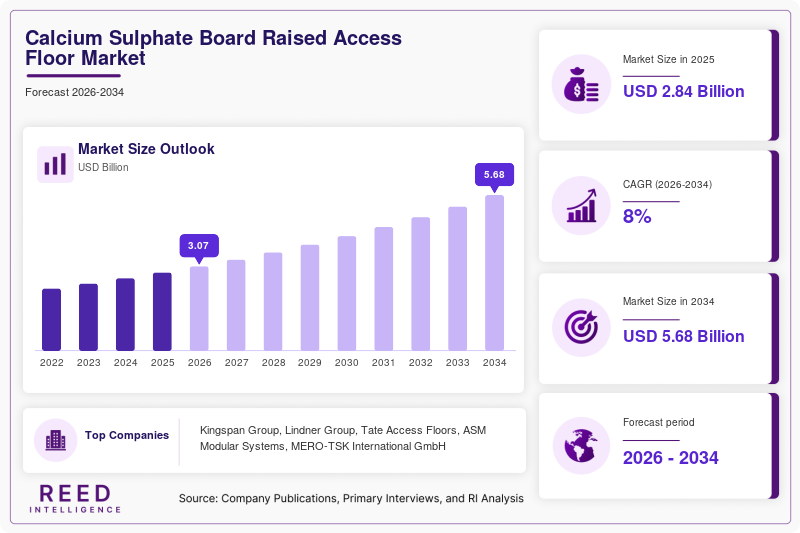
- Europe accounted for nearly 35.7% of the global Calcium Sulphate Board Raised Access Floor Market share in 2025, while Asia Pacific is projected to register the fastest CAGR of 9.4% during the forecast period.
- By product type, encapsulated calcium sulphate panels held the leading share of 42.6% in 2025, whereas bare finished calcium sulphate panels are anticipated to expand at a CAGR of 9.8% through 2034.
- By application, data centers remained the dominant segment with 38.9% market share in 2025, while commercial office spaces are expected to witness the fastest growth rate of 9.5%.
- By end user, commercial buildings accounted for 47.4% of the global market share in 2025, whereas healthcare facilities are forecast to grow at a CAGR of 9.2%.
- Germany represented the dominant country market with values of USD 286 million in 2024 and USD 309 million in 2025 due to increasing smart building investments and rising demand for sustainable flooring systems.
Market Trends
Increasing Adoption of Sustainable Building Materials
The growing focus on environmentally sustainable construction practices has emerged as a significant trend shaping the Calcium Sulphate Board Raised Access Floor Market. Construction companies and infrastructure developers are increasingly selecting eco-friendly materials that contribute to green building certification programs and carbon emission reduction goals. Calcium sulphate board flooring systems are gaining strong demand because they are manufactured using recyclable gypsum materials and provide lower environmental impact compared to conventional flooring alternatives.
Architects and developers are increasingly prioritizing sustainable flooring systems in commercial and institutional projects to comply with environmental regulations and corporate sustainability objectives. This trend has encouraged manufacturers to introduce flooring products with improved recyclability, lower volatile organic compound emissions, and enhanced resource efficiency.
Growing Integration of Smart Building Infrastructure
Another important trend influencing the Calcium Sulphate Board Raised Access Floor Market is the increasing integration of smart building technologies. Modern commercial buildings and data centers require efficient underfloor cable management systems capable of supporting advanced networking infrastructure, intelligent lighting systems, and HVAC technologies.
Raised access floors based on calcium sulphate boards provide flexibility for future infrastructure modifications and maintenance activities. Businesses are increasingly investing in adaptable flooring systems that support digital building management solutions. The expansion of smart office environments and connected infrastructure projects is expected to continue supporting market growth during the forecast period.
Market Drivers
Expansion of Global Data Center Construction
The rapid expansion of global data center infrastructure has remained a major driver supporting the Calcium Sulphate Board Raised Access Floor Market. Increasing cloud computing demand, digital transformation initiatives, and rising internet traffic have accelerated investments in hyperscale and colocation data centers worldwide.
Data center operators require raised flooring systems that provide efficient airflow management, cable routing flexibility, and high load-bearing capacity for heavy server equipment. Calcium sulphate board raised access floors offer strong structural performance and fire-resistant properties, making them suitable for modern data center environments. The continued growth of digital infrastructure projects is expected to strengthen market demand.
Rising Demand for Flexible Commercial Interior Solutions
The increasing preference for modular and flexible interior infrastructure has also contributed significantly to the growth of the Calcium Sulphate Board Raised Access Floor Market. Commercial offices, educational facilities, and institutional buildings increasingly require flooring systems that allow rapid layout changes and efficient maintenance access.
Raised access floors provide convenient underfloor space for electrical wiring, communication systems, and ventilation distribution. Businesses are adopting adaptable infrastructure designs to support hybrid workspaces and evolving operational requirements. The growing demand for flexible building solutions is expected to support future market expansion.
Market Restraint
High Initial Installation Costs
One of the major restraints affecting the Calcium Sulphate Board Raised Access Floor Market is the relatively high initial installation cost associated with advanced raised flooring systems. Calcium sulphate board panels require specialized support structures, precise installation methods, and professional labor, which can increase project expenses.
Cost-sensitive construction projects may prefer conventional flooring systems due to lower upfront investment requirements. Additionally, fluctuations in raw material and transportation costs may impact pricing stability within the industry.
Market Opportunities
Increasing Development of Smart Cities
The development of smart city infrastructure presents significant opportunities for the Calcium Sulphate Board Raised Access Floor Market. Governments and private developers are increasingly investing in digitally connected commercial buildings, public institutions, and transportation hubs that require advanced flooring infrastructure.
Raised access floor systems support intelligent building management technologies and future-ready utility integration. Increasing urban infrastructure modernization programs are expected to create strong long-term opportunities for market participants.
Rising Demand from Healthcare Infrastructure Projects
Healthcare infrastructure modernization and hospital expansion programs are creating new growth opportunities for the Calcium Sulphate Board Raised Access Floor Market. Hospitals and healthcare facilities increasingly require hygienic, durable, and fire-resistant flooring systems capable of supporting complex medical equipment installations.
Calcium sulphate board raised access floors are gaining popularity in healthcare environments because they provide acoustic insulation, moisture resistance, and ease of maintenance. Expanding investments in healthcare infrastructure across emerging economies are expected to support future market demand.
Segmental Analysis
By Product Type
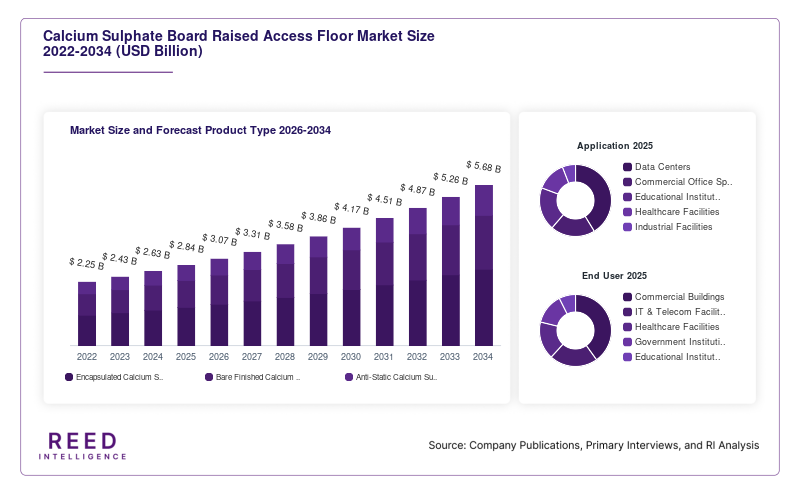
Based on product type, the Calcium Sulphate Board Raised Access Floor Market is segmented into encapsulated calcium sulphate panels, bare finished calcium sulphate panels, and anti-static calcium sulphate panels.
Encapsulated calcium sulphate panels dominated the market with a share of 42.6% in 2025. Their extensive use in commercial offices and data center facilities contributed significantly to segment growth. These panels provide enhanced durability, moisture protection, and structural stability, making them suitable for high-traffic environments.
Bare finished calcium sulphate panels are expected to witness the fastest CAGR of 9.8% during the forecast period. Increasing demand for customized floor finishing solutions and improved design flexibility will support future segment growth. Architects and commercial developers are increasingly selecting these panels for modern interior applications.
By Application
Based on application, the market is categorized into data centers, commercial office spaces, educational institutions, healthcare facilities, and industrial facilities.
Data centers accounted for the largest market share of 38.9% in 2025 due to increasing investments in cloud infrastructure and digital storage facilities. Raised access floor systems are widely used in data centers to support efficient cooling management and cable organization.
Commercial office spaces are projected to grow at the fastest CAGR of 9.5% through 2034. Increasing adoption of flexible workspace concepts and smart office technologies is expected to support future segment expansion. Businesses are increasingly investing in modular interior infrastructure capable of supporting future technological upgrades.
By End User
Based on end user, the Calcium Sulphate Board Raised Access Floor Market is segmented into commercial buildings, IT & telecom facilities, healthcare facilities, government institutions, and educational institutions.
Commercial buildings remained the dominant end-user segment with 47.4% market share in 2025. Increasing office modernization projects and rising demand for flexible infrastructure systems contributed significantly to segment dominance.
Healthcare facilities are expected to register the fastest CAGR of 9.2% during the forecast period. Rising investments in hospital construction and growing demand for hygienic interior infrastructure solutions will support future segment growth. Healthcare operators increasingly prefer durable and fire-resistant flooring systems for critical care environments.
By Installation Type
Based on installation type, the market is segmented into stringer systems and stringerless systems.
Stringer systems held the largest share of 63.1% in 2025 because of their enhanced structural support and superior load distribution capabilities. These systems remained widely preferred in high-load commercial and data center applications.
Stringerless systems are anticipated to grow at the fastest CAGR of 8.9% during the forecast period due to easier installation processes and lower material requirements. Increasing adoption in lightweight commercial projects is expected to support segment growth.
Regional Analysis
Europe
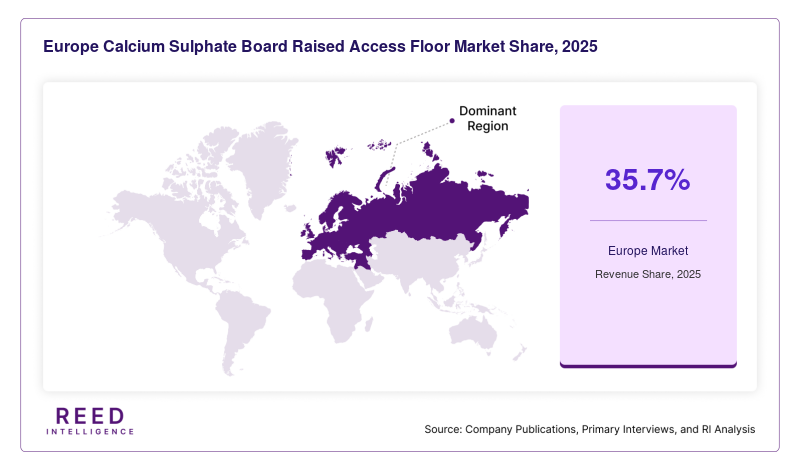
Europe held approximately 35.7% of the global Calcium Sulphate Board Raised Access Floor Market share in 2025. The region benefited from increasing green building initiatives, advanced commercial infrastructure development, and growing adoption of sustainable construction materials. Germany remained the dominant country due to strong investments in smart commercial buildings and environmentally efficient construction systems.
The regional market is expected to grow at a CAGR of 7.6% during the forecast period. Increasing renovation activities and expansion of energy-efficient office infrastructure are expected to support future market growth across Europe.
North America
North America accounted for nearly 29.8% of the global Calcium Sulphate Board Raised Access Floor Market share in 2025. The region benefited from increasing data center construction activities and widespread adoption of modular commercial infrastructure systems.
The market is projected to expand at a CAGR of 7.9% through 2034. The United States emerged as the dominant country due to rising cloud infrastructure investments and growing demand for advanced raised flooring systems in technology-driven commercial facilities. Expansion of hyperscale data center projects is expected to strengthen regional demand.
Asia Pacific
Asia Pacific represented around 24.4% of the global Calcium Sulphate Board Raised Access Floor Market share in 2025. Rapid urbanization, rising commercial real estate development, and increasing digital infrastructure investments contributed significantly to regional market growth.
The region is forecast to witness the fastest CAGR of 9.4% during the forecast period. China remained the leading country market because of expanding smart city projects and increasing data center construction activities. Government investments in digital infrastructure and commercial modernization are expected to support future demand.
Middle East & Africa
The Middle East & Africa accounted for approximately 5.4% of the global market share in 2025. The region benefited from growing investments in commercial complexes, hospitality infrastructure, and modern office developments.
The market is anticipated to grow at a CAGR of 8.1% through 2034. Saudi Arabia emerged as the dominant country due to increasing smart infrastructure projects and rising investments in commercial real estate development. Expansion of digital business hubs is expected to contribute to future regional growth.
Latin America
Latin America captured nearly 4.7% of the global Calcium Sulphate Board Raised Access Floor Market share in 2025. Expanding commercial construction activities and modernization of office infrastructure supported regional market development.
The market is projected to register a CAGR of 7.8% during the forecast period. Brazil remained the leading country market because of increasing corporate office development and rising demand for sustainable interior infrastructure solutions. Commercial real estate investments are expected to support future regional demand.
Competitive Landscape
The competitive landscape of the Calcium Sulphate Board Raised Access Floor Market remains moderately competitive, with manufacturers focusing on sustainable product development, modular design innovation, and expansion into high-growth infrastructure sectors. Companies are investing in advanced flooring technologies capable of improving load performance, acoustic insulation, and installation efficiency.
Kingspan Group remained one of the leading market participants due to its broad portfolio of sustainable building solutions and strong presence in commercial infrastructure projects. The company recently expanded its raised access flooring product range designed for modern data center applications.
Other major manufacturers are increasingly focusing on strategic partnerships with commercial developers and infrastructure contractors. Product differentiation through fire resistance, eco-friendly materials, and smart infrastructure compatibility has become an important competitive strategy across the industry.
Key Players List
- Kingspan Group
- Lindner Group
- Tate Access Floors
- ASM Modular Systems
- MERO-TSK International GmbH
- Huatong Xinli Flooring
- Jansen Group
- Polygroup
- UNITILE
- NICHIAS Corporation
- Bathgate Flooring
- Gerflor Group
- CBI Europe
- Global IFS
- Veitchi Flooring
Recent Developments
- In 2025, Kingspan Group expanded its sustainable raised flooring product portfolio for hyperscale data center applications.
- In 2024, Lindner Group introduced advanced fire-resistant calcium sulphate floor systems for commercial infrastructure projects.
- In 2025, Tate Access Floors launched modular flooring systems designed for smart office environments.
- In 2024, ASM Modular Systems expanded manufacturing capacity to support rising demand across Asia Pacific commercial construction projects.
- In 2025, MERO-TSK International GmbH partnered with infrastructure developers to provide customized raised flooring solutions for healthcare facilities.
Calcium Sulphate Board Raised Access Floor Market Segments
Product Type
- Encapsulated Calcium Sulphate Panels
- Bare Finished Calcium Sulphate Panels
- Anti-Static Calcium Sulphate Panels
Application
- Data Centers
- Commercial Office Spaces
- Educational Institutions
- Healthcare Facilities
- Industrial Facilities
End User
- Commercial Buildings
- IT & Telecom Facilities
- Healthcare Facilities
- Government Institutions
- Educational Institutions
Installation Type
- Stringer Systems
- Stringerless Systems
By Region
- North America
- Europe
- APAC
- Middle East and Africa
- LATAM