Callus Treatment Market Size, Share & Demand Report By Product Type (Topical Treatments, Pads & Cushions, Electronic Devices), By Treatment Type (Medicated, Non-Medicated), By End-User (Homecare, Clinical Settings), By Distribution Channel (Pharmacies, Supermarkets/Hypermarkets, E-commerce) By Region & Segment Forecasts, 2026–2034
USD 3950
Market Overview
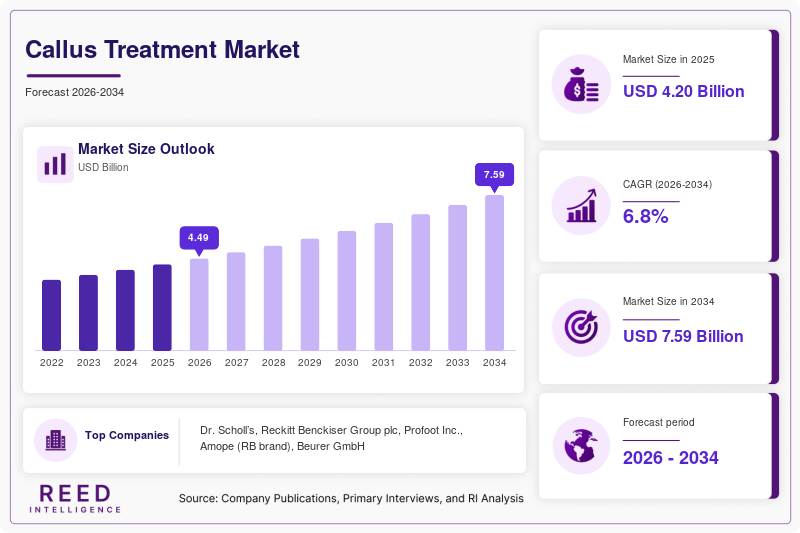
The Callus Treatment Market size was valued at approximately USD 4.2 billion in 2026 and is projected to reach USD 7.1 billion by 2034, expanding at a CAGR of 6.8% during the forecast period (2026–2034). The market growth is supported by increasing awareness of foot health, rising incidence of diabetes-related foot complications, and growing consumer demand for over-the-counter (OTC) skincare solutions. The expanding aging population worldwide has also contributed to sustained demand, as older individuals are more prone to callus formation due to reduced skin elasticity and mobility issues.
A major global factor supporting the Callus Treatment Market is the increasing prevalence of lifestyle-related conditions such as obesity and diabetes, which often lead to foot-related complications requiring consistent care. In addition, advancements in dermatological formulations and the availability of user-friendly treatment options such as medicated pads, creams, and electronic callus removers are improving accessibility and adoption.
Key Highlights:
- North America dominated the market with a 36% share in 2025, while Asia Pacific is expected to register the fastest CAGR of 8.1% during the forecast period.
- By product type, topical treatments held the largest share (42%), while electronic devices are projected to grow fastest at a CAGR of 9.3%.
- By distribution channel, pharmacies led with 48% share, whereas e-commerce is anticipated to grow at a CAGR of 10.2%.
- The U.S. remained the dominant country, with market values of USD 1.3 billion in 2024 and USD 1.4 billion in 2025.
Market Trends
Rising Adoption of At-Home Treatment Solutions
A notable trend in the Callus Treatment Market is the increasing preference for at-home treatment products. Consumers are opting for convenient, cost-effective solutions such as medicated creams, gels, and electric callus removers that eliminate the need for frequent clinical visits. This trend is driven by growing digital awareness, easy product availability online, and the expansion of personal care routines. Additionally, improved product formulations offering faster results and minimal side effects are encouraging repeat purchases. As consumers become more proactive about foot care, the demand for easy-to-use home-based treatments is expected to rise steadily.
Integration of Dermatological and Cosmetic Benefits
Another significant trend shaping the Callus Treatment Market is the convergence of medical and cosmetic benefits in treatment products. Manufacturers are increasingly incorporating moisturizing agents, essential oils, and skin-repair compounds into callus removal solutions. This approach enhances both therapeutic effectiveness and aesthetic appeal, catering to consumers seeking smoother and healthier-looking skin. Products that combine exfoliation with hydration are gaining traction, especially among urban populations. This trend reflects a shift toward holistic skincare, where functional treatment aligns with cosmetic outcomes, influencing product innovation and brand positioning.
Market Drivers
Increasing Prevalence of Foot Disorders
The growing incidence of foot-related disorders is a major driver of the Callus Treatment Market. Conditions such as corns, calluses, and cracked heels are becoming more common due to sedentary lifestyles, improper footwear, and chronic diseases. Individuals suffering from diabetes are particularly prone to callus formation, necessitating regular foot care. As awareness about preventive healthcare increases, more consumers are investing in treatment products to manage these conditions effectively. Healthcare providers are also recommending routine foot care, further boosting demand across both clinical and retail channels.
Expansion of Retail and Online Distribution Channels
The rapid expansion of retail networks and e-commerce platforms has significantly contributed to market growth. Pharmacies, supermarkets, and online marketplaces are making callus treatment products widely accessible to consumers across urban and rural areas. Online platforms offer convenience, product comparisons, and customer reviews, influencing purchasing decisions. Subscription-based models and targeted digital marketing campaigns are further driving sales. This widespread availability ensures that consumers can easily access a variety of treatment options, supporting sustained growth in the Callus Treatment Market.
Market Restraint
Limited Awareness in Developing Regions
Despite steady growth, the Callus Treatment Market faces challenges due to limited awareness in certain developing regions. In many low- and middle-income countries, foot care is often overlooked, and callus formation is not perceived as a condition requiring medical attention. Consumers in these regions may rely on traditional remedies or neglect treatment altogether, limiting market penetration. Additionally, lack of access to advanced products and limited distribution networks further restrict growth. Price sensitivity also plays a role, as premium treatment solutions may not be affordable for a large segment of the population. Addressing these awareness gaps through education campaigns and affordable product offerings will be crucial for market expansion.
Market Opportunities
Growth in Emerging Markets
Emerging economies present significant growth opportunities for the Callus Treatment Market. Rising disposable incomes, improving healthcare infrastructure, and increasing awareness of personal hygiene are driving demand for foot care products. Manufacturers are focusing on expanding their presence in these regions through localized marketing strategies and affordable product lines. Partnerships with local distributors and retailers are also helping companies penetrate untapped markets. As consumer awareness continues to grow, these regions are expected to contribute substantially to future market expansion.
Innovation in Smart and Electric Devices
Technological advancements in personal care devices are creating new opportunities in the Callus Treatment Market. The development of smart and rechargeable electronic callus removers with adjustable settings and ergonomic designs is enhancing user experience. These devices offer efficient and painless treatment, making them appealing to a wide consumer base. Integration with mobile applications and personalized skincare recommendations is further expanding their appeal. As technology continues to evolve, innovative devices are expected to gain traction and drive higher adoption rates.
Segmental Analysis
By Product Type
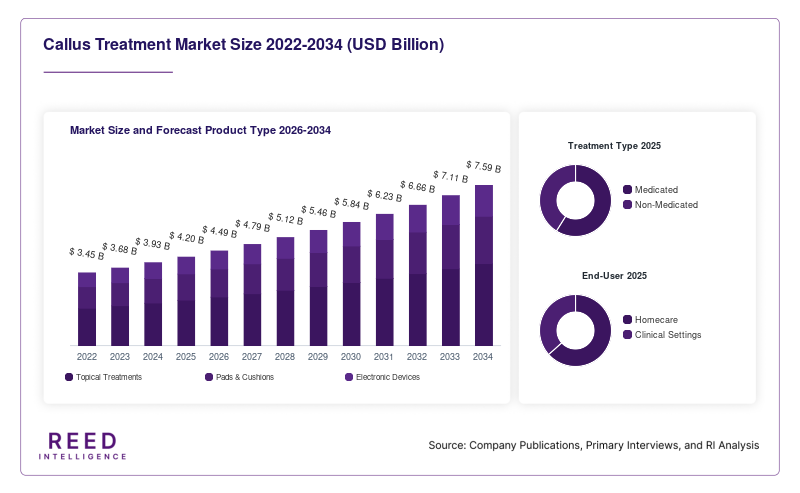
Topical treatments dominated the Callus Treatment Market in 2025, accounting for 42% of the share due to their ease of use and widespread availability.
Electronic devices are expected to be the fastest-growing subsegment, with a projected CAGR of 9.3%, driven by increasing demand for efficient and reusable solutions.
By Treatment Type
Medicated treatments held the largest share of 55% in 2025, supported by their effectiveness in treating severe calluses.
Non-medicated treatments are anticipated to grow at a CAGR of 7.5%, fueled by rising demand for natural and chemical-free products.
By End-User
Homecare settings accounted for 60% of the market share in 2025, reflecting the growing preference for self-treatment.
Clinical settings are expected to grow at a CAGR of 6.9%, driven by increasing cases of chronic foot conditions requiring professional care.
By Distribution Channel
Pharmacies dominated the segment with a 48% share in 2025 due to consumer trust and accessibility.
E-commerce platforms are projected to grow at a CAGR of 10.2%, supported by convenience and expanding digital infrastructure.
Regional Analysis
North America
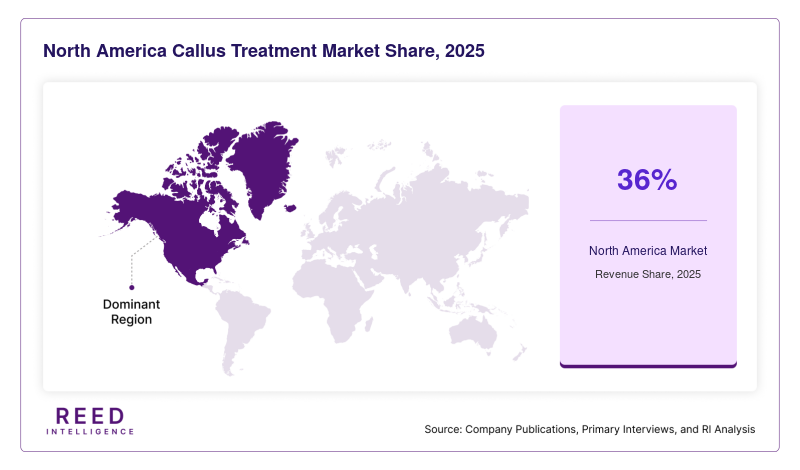
North America accounted for 36% of the Callus Treatment Market share in 2025 and is expected to grow at a CAGR of 6.2% during the forecast period.
The United States dominated the region due to strong consumer awareness and widespread availability of advanced treatment products. A key growth factor in the country is the high prevalence of diabetes and related foot complications, which necessitate regular foot care and drive demand for specialized treatments.
Europe
Europe held a 28% share of the Callus Treatment Market in 2025 and is projected to expand at a CAGR of 6.0% from 2026 to 2034.
Germany emerged as the leading country, supported by a well-established healthcare system and a strong emphasis on personal hygiene. The growing preference for dermatologically tested products is contributing to sustained demand across the region.
Asia Pacific
Asia Pacific represented 22% of the market share in 2025 and is anticipated to register the fastest CAGR of 8.1% over the forecast period.
China led the region, driven by rapid urbanization and increasing consumer spending on personal care products. The expansion of e-commerce platforms has further accelerated product accessibility and adoption.
Middle East & Africa
The Middle East & Africa accounted for 8% of the Callus Treatment Market share in 2025 and is expected to grow at a CAGR of 5.5% during the forecast period.
The United Arab Emirates dominated the region, with growth supported by rising awareness of skincare and increasing availability of premium products in urban centers.
Latin America
Latin America held a 6% share of the market in 2025 and is projected to grow at a CAGR of 5.8% from 2026 to 2034.
Brazil led the region, driven by a growing focus on personal grooming and expanding retail distribution networks. Increasing consumer interest in affordable skincare solutions is further supporting market growth.
Competitive Landscape
The Callus Treatment Market is moderately fragmented, with several global and regional players competing through product innovation and distribution expansion. Leading companies are focusing on enhancing product efficacy and expanding their presence in emerging markets.
One prominent market leader is Dr. Scholl’s, which continues to strengthen its position through continuous product innovation and strategic partnerships. The company recently introduced advanced electronic callus removers with improved safety features, enhancing user convenience. Other players are also investing in research and development to introduce multifunctional products that combine treatment and skincare benefits.
Key Players List
- Dr. Scholl’s
- Reckitt Benckiser Group plc
- Profoot Inc.
- Amope (RB brand)
- Beurer GmbH
- Emjoi Inc.
- HoMedics USA LLC
- Scholl Concepts GmbH
- PediFix Inc.
- Footlogix Inc.
- Revlon Inc.
- Conair Corporation
- CVS Health Corporation
- Walgreens Boots Alliance
- Himalaya Wellness Company
Recent Developments
- 2025: Launch of advanced electric callus removers with enhanced safety features.
- 2024: Expansion of e-commerce distribution channels by key players.
- 2025: Introduction of herbal and natural-based callus treatment creams.
- 2024: Strategic partnerships between manufacturers and retail chains to improve product accessibility.
Callus Treatment Market Segments
Product Type
- Topical Treatments
- Pads & Cushions
- Electronic Devices
Treatment Type
- Medicated
- Non-Medicated
End-User
- Homecare
- Clinical Settings
Distribution Channel
- Pharmacies
- Supermarkets/Hypermarkets
- E-commerce
By Region
- North America
- Europe
- APAC
- Middle East and Africa
- LATAM