Camera Gimbal Market Size, Share & Demand Report By Type (2-Axis Gimbals, 3-Axis Gimbals), By Device Compatibility (Camera, Smartphone, Action Camera), By Application (Handheld, Wearable, Mounted), By End-Use (Media & Entertainment, Individual Creators, Commercial Use), By Distribution Channel (Online, Offline), By Region & Segment Forecasts, 2025–2034
USD 3950
Market Overview
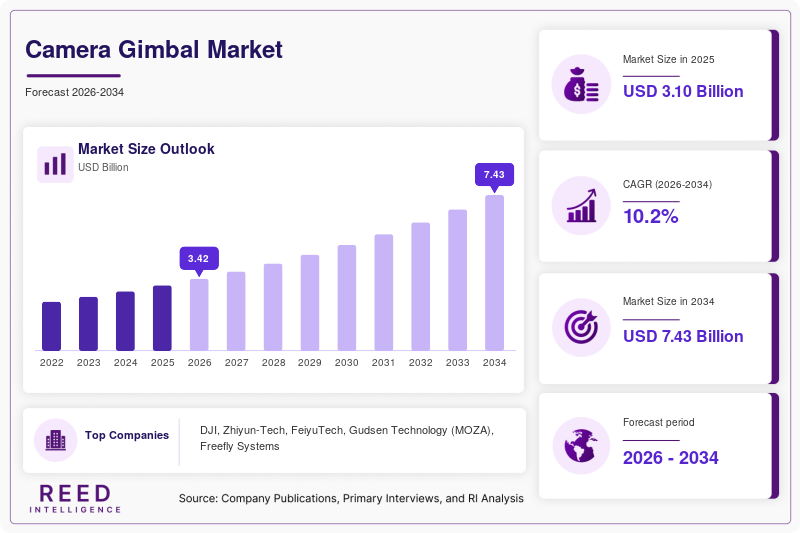
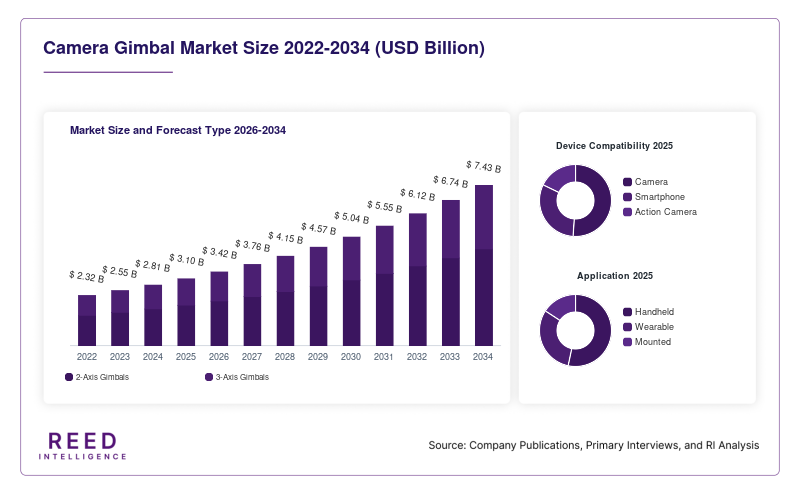
The Camera Gimbal Market size was valued at USD 3.1 billion in 2025 and is projected to reach USD 7.4 billion by 2034, expanding at a CAGR of 10.2% from 2025 to 2034. The market growth is primarily driven by the increasing demand for stabilized video content across professional filmmaking, content creation, and social media platforms. The rapid expansion of digital media ecosystems has encouraged both amateurs and professionals to invest in high-quality stabilization equipment, accelerating market penetration globally.
One of the major global factors supporting market growth is the widespread adoption of video-centric communication and entertainment formats. With the rise of live streaming, short-form videos, and virtual events, users increasingly prioritize smooth and cinematic visuals, boosting demand for advanced camera gimbals across consumer and professional segments.
Key Highlights
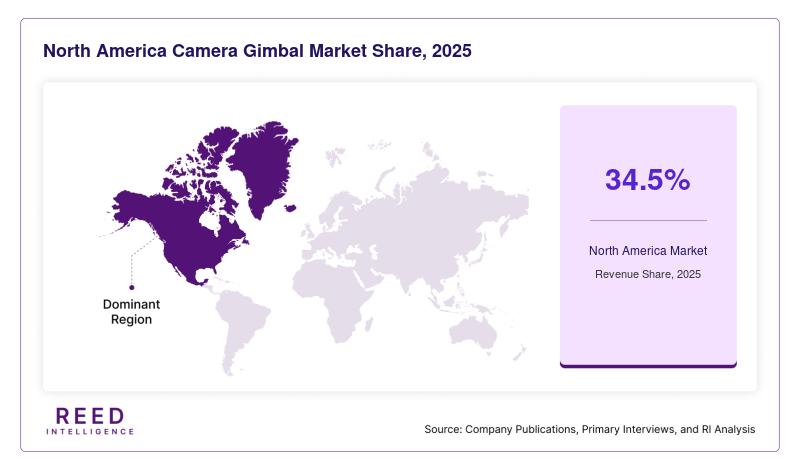
- Dominant Region: North America held 34.5% market share in 2025, while Asia Pacific is expected to grow at the fastest CAGR of 12.8%.
- Leading Segments: 3-axis gimbals dominated the type segment with 62% share, while handheld gimbals led applications with 58% share. Smartphone-compatible gimbals are projected to grow fastest at a CAGR of 13.5%.
- Dominant Country: The United States market was valued at USD 0.98 billion in 2025 and is expected to reach USD 1.05 billion in 2026.
Market Trends
Integration of AI and Smart Stabilization Technologies
The Camera Gimbal Market is witnessing a shift toward intelligent stabilization systems powered by artificial intelligence. Manufacturers are incorporating features such as object tracking, gesture control, and automated horizon leveling. These capabilities enhance usability for content creators, enabling smooth footage without manual adjustments. AI-driven gimbals are gaining traction in both consumer and professional segments, especially among vloggers and filmmakers seeking efficiency.
Rising Popularity of Compact and Foldable Designs
Portability has become a significant trend in the market. Consumers increasingly prefer lightweight and foldable gimbals that are easy to carry during travel and outdoor shoots. This trend is particularly strong among smartphone users and social media influencers. Compact designs also align with the growing demand for on-the-go content creation, contributing to higher adoption rates in emerging markets.
Market Drivers
Growth in Digital Content Creation
The surge in digital content creation across platforms such as video-sharing apps and streaming services has significantly fueled the Camera Gimbal Market. Independent creators, vloggers, and influencers require stable footage to maintain viewer engagement. This has led to increased demand for affordable yet advanced gimbals, particularly in developing economies.
Expansion of Film and Media Production Industry
The global film and media production industry continues to expand, driving demand for professional-grade camera stabilization systems. Production houses are investing in high-performance gimbals to achieve cinematic quality shots. This demand extends to advertising agencies and event production companies, further strengthening market growth.
Market Restraint
High Cost of Advanced Gimbal Systems
Despite growing demand, the Camera Gimbal Market faces a notable restraint in the form of high costs associated with advanced stabilization systems. Professional-grade gimbals equipped with multi-axis stabilization, AI integration, and extended battery life often come at premium prices. This limits adoption among budget-conscious consumers and small-scale creators.
Additionally, maintenance costs and the need for technical expertise can further deter users. While entry-level products are available, they often lack advanced features, creating a gap between affordability and performance. This pricing challenge may slow market expansion in price-sensitive regions.
Market Opportunities
Growth in Emerging Markets
Emerging economies present significant opportunities for the Camera Gimbal Market. Increasing smartphone penetration and internet accessibility are enabling more users to engage in content creation. Affordable gimbal solutions tailored for these markets can unlock new revenue streams for manufacturers.
Expansion into Virtual Reality and Augmented Reality Applications
The integration of camera gimbals into virtual reality (VR) and augmented reality (AR) applications is an emerging opportunity. As immersive content gains traction, the need for stabilized video capture becomes crucial. Gimbals designed for VR/AR production can open new avenues in gaming, education, and training sectors.
Segmental Analysis
By Type
The 3-axis gimbals segment dominated the Camera Gimbal Market with a 62% share in 2025. These gimbals provide superior stabilization across three axes, making them ideal for professional and high-quality video production.
The 2-axis gimbals segment is expected to grow at a CAGR of 8.9%. Their lower cost and simpler design will attract entry-level users and hobbyists seeking basic stabilization solutions.
By Device Compatibility
Camera-specific gimbals held the largest share of 54% in 2025, driven by demand from professional videographers and filmmakers requiring precise stabilization.
Smartphone gimbals will grow at the fastest CAGR of 13.5%. The increasing use of smartphones for content creation and improvements in mobile camera technology will drive this segment.
By Application
The handheld segment dominated with a 58% share in 2025, as it offers flexibility and ease of use for various shooting scenarios.
The wearable gimbals segment is projected to grow at a CAGR of 12.2%, supported by rising demand for action and adventure videography.
By End-Use
The media & entertainment sector accounted for 46% share in 2025, driven by professional production requirements.
The individual content creators segment will grow at a CAGR of 13.1%, fueled by the increasing popularity of social media platforms and independent video production.
By Distribution Channel
The offline segment dominated with 55% share in 2025, supported by specialty electronics stores offering hands-on product experience.
The online segment is expected to grow at a CAGR of 12.6%, driven by e-commerce expansion and competitive pricing strategies.
Regional Analysis
North America
North America accounted for 34.5% of the Camera Gimbal Market share in 2025 and will grow at a CAGR of 9.6% through 2034. The region’s mature media industry and strong adoption of advanced filming technologies will continue to support steady growth.
The United States dominated the regional market due to its well-established entertainment and content creation ecosystem. A key growth factor is the high concentration of professional filmmakers and digital creators who require advanced stabilization solutions for high-quality production.
Europe
Europe held approximately 26.2% share in 2025 and is projected to grow at a CAGR of 9.1% during the forecast period. The region’s growth is driven by increasing demand for high-quality video production across commercial and independent sectors.
Germany emerged as the dominant country due to its strong manufacturing base and growing adoption of advanced filming equipment. The country’s focus on precision engineering has contributed to the development of high-performance gimbal systems.
Asia Pacific
Asia Pacific captured 22.8% market share in 2025 and is expected to grow at the fastest CAGR of 12.8%. Rapid urbanization and rising disposable incomes are fueling demand for consumer electronics, including camera accessories.
China led the region due to its large consumer base and expanding electronics manufacturing sector. The growth factor includes the presence of local manufacturers offering cost-effective gimbals, making the technology accessible to a broader audience.
Middle East & Africa
The Middle East & Africa region held 8.1% share in 2025 and is anticipated to grow at a CAGR of 8.7%. Increasing investments in media and entertainment infrastructure are supporting market growth.
The United Arab Emirates dominated the region due to its growing tourism and event management sectors. The demand for high-quality video production in promotional campaigns is driving adoption of camera gimbals.
Latin America
Latin America accounted for 8.4% of the market in 2025 and will grow at a CAGR of 9.3%. The region is witnessing increased adoption of digital content platforms, boosting demand for stabilization equipment.
Brazil led the market due to its expanding social media user base. The growth factor includes rising participation in online content creation, which is encouraging investment in affordable camera accessories.
Competitive Landscape
The Camera Gimbal Market is moderately fragmented, with key players focusing on product innovation and strategic partnerships. The market leader, DJI, maintains a strong position due to its advanced stabilization technology and wide product portfolio. The company recently introduced a new AI-enabled gimbal series designed for professional filmmakers.
Other prominent players include Zhiyun, FeiyuTech, Moza, and Gudsen Technology. These companies are investing in lightweight designs, improved battery performance, and smart features to enhance user experience. Competitive strategies include new product launches, collaborations with camera manufacturers, and expansion into emerging markets.
Key Players List
- DJI
- Zhiyun-Tech
- FeiyuTech
- Gudsen Technology (MOZA)
- Freefly Systems
- Ikan Corporation
- Glidecam Industries
- EVO Gimbals
- Hohem Technology
- Removu
- LanParte
- Pilotfly
- Benro
- Varavon
- Tilta Technology
Recent Developments
- DJI launched a next-generation AI-powered camera gimbal with enhanced tracking features in 2024.
- Zhiyun introduced a foldable smartphone gimbal targeting travel vloggers.
- FeiyuTech expanded its product line with lightweight gimbals for action cameras.
- Moza partnered with camera manufacturers to improve device compatibility.
- Hohem Technology focused on budget-friendly gimbals for emerging markets.
Camera Gimbal Market Segments
Type
- 2-Axis Gimbals
- 3-Axis Gimbals
Device Compatibility
- Camera
- Smartphone
- Action Camera
Application
- Handheld
- Wearable
- Mounted
End-Use
- Media & Entertainment
- Individual Creators
- Commercial Use
Distribution Channel
- Online Retail
- Electronics & Specialty Stores
By Region
- North America
- Europe
- APAC
- Middle East and Africa
- LATAM