Camouflage Coating Market Size, Share & Demand Report By Product Type (Infrared Camouflage Coatings, Radar Absorbing Coatings, Multispectral Camouflage Coatings, Visual Camouflage Coatings), By Application (Military Vehicles, Aerospace Systems, Naval Systems, Tactical Equipment, Military Infrastructure), By End Use (Defense and Military, Commercial and Industrial, Aerospace Maintenance Providers, Security and Law Enforcement Agencies) By Region & Segment Forecasts, 2026–2034
USD 3950
Market Overview
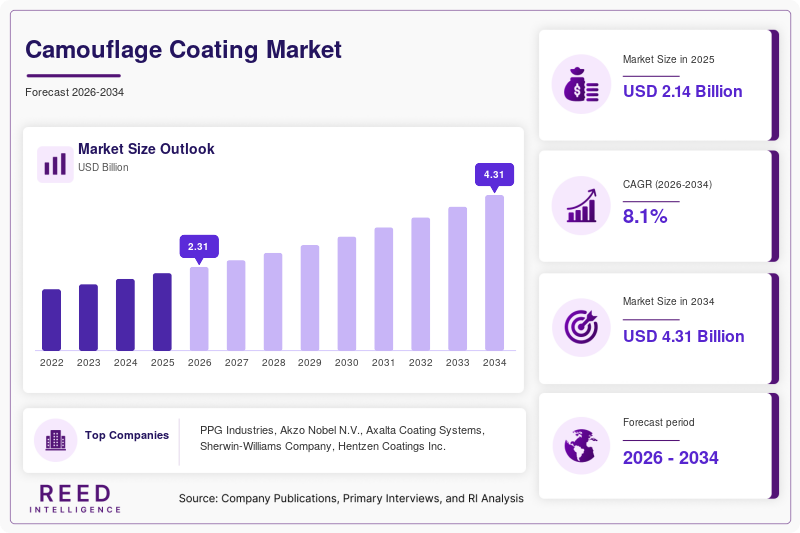
The global Camouflage Coating Market size was valued at USD 2.14 billion in 2026 and is projected to reach USD 3.98 billion by 2034, expanding at a CAGR of 8.1% during the forecast period. Camouflage coatings are widely used in military vehicles, defense infrastructure, tactical equipment, aerospace systems, naval vessels, and specialized commercial applications where concealment, durability, and environmental adaptability are essential. These coatings are designed to reduce visibility under infrared, thermal, radar, and visual detection systems while maintaining surface protection against harsh operating conditions. The growing focus on modern warfare technologies and border security investments has continued to increase the adoption of advanced coating solutions across multiple defense platforms.
A major factor supporting market growth is the rising investment in defense modernization programs across developed and emerging economies. Governments are allocating larger budgets toward military mobility systems, lightweight armored vehicles, stealth aircraft, and naval modernization projects that require advanced camouflage technologies. In addition, increasing geopolitical tensions and the expansion of cross-border surveillance activities have encouraged procurement agencies to adopt coatings with improved thermal management, weather resistance, and multispectral concealment capabilities. Manufacturers are also developing eco-friendly and low-VOC camouflage coatings to comply with environmental regulations while maintaining coating performance.
Key Highlights
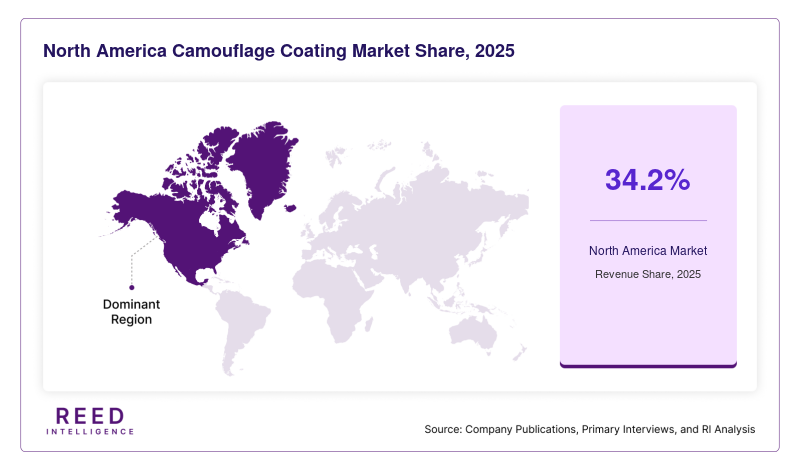
- North America dominated the market with a 34.2% share in 2025.
- Asia Pacific is expected to grow at the fastest CAGR of 10.9% during 2026–2034.
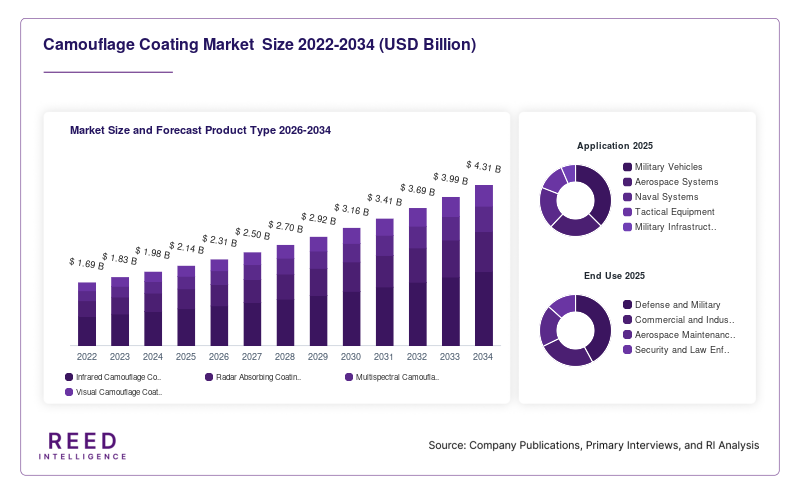
- By product type, infrared camouflage coatings accounted for the largest share of 39.4%, while multispectral camouflage coatings are projected to grow at a CAGR of 11.6%.
- By application, military vehicles led with a 36.8% share, whereas aerospace systems are expected to expand at a CAGR of 10.8%.
- The United States remained the dominant country, with market values of USD 620 million in 2024 and USD 685 million in 2025.
Market Trends
Integration of Multispectral and Adaptive Coating Technologies
Defense agencies and coating manufacturers are increasingly focusing on multispectral camouflage technologies capable of reducing detection across infrared, thermal, ultraviolet, and radar frequencies. Conventional camouflage coatings primarily focused on visual concealment, but modern combat systems require advanced materials that can adapt to changing operational environments. Manufacturers are introducing adaptive coatings that adjust surface characteristics based on temperature, humidity, and terrain conditions. These coatings are being incorporated into armored vehicles, combat helmets, drones, and naval systems to improve survivability and operational flexibility. The integration of nanotechnology and smart pigments has also enhanced coating durability and resistance against corrosion, abrasion, and chemical exposure. As military operations become more technology driven, the demand for advanced multispectral coatings is expected to increase steadily across major defense economies.
Growing Adoption of Environmentally Sustainable Coatings
The market is witnessing a strong shift toward environmentally sustainable camouflage coating solutions due to stricter environmental standards and defense procurement policies. Traditional solvent-based coatings often contain volatile organic compounds that create environmental and occupational concerns during manufacturing and application processes. As a result, coating manufacturers are investing in water-based, low-VOC, and bio-based formulations that reduce environmental impact without compromising concealment efficiency or protective performance. Sustainable coatings are gaining attention in military maintenance facilities, aerospace manufacturing plants, and naval applications where long-term environmental compliance is becoming important. Companies are also focusing on recyclable coating materials and energy-efficient production methods to support sustainable manufacturing targets. This trend is expected to strengthen as governments increasingly prioritize green defense technologies within procurement and modernization programs.
Market Drivers
Expansion of Global Defense Modernization Programs
Rising defense modernization initiatives across North America, Europe, and Asia Pacific are supporting demand for advanced camouflage coatings. Governments are increasing investments in combat vehicles, stealth aircraft, tactical equipment, and naval platforms to strengthen operational readiness and surveillance capabilities. Modern defense systems require coatings that provide concealment against thermal imaging, radar systems, and infrared detection technologies. The increasing deployment of unmanned systems and lightweight military platforms has also created demand for specialized coatings with enhanced durability and reduced weight. Several defense agencies are replacing outdated camouflage technologies with advanced formulations that improve survivability in complex operational environments. In addition, ongoing procurement programs for armored vehicles and fighter aircraft are encouraging long-term contracts for camouflage coating manufacturers, supporting stable market growth during the forecast period.
Increasing Demand for Durable Protective Coatings in Harsh Environments
The need for durable coatings capable of operating under extreme environmental conditions is another major growth driver for the market. Military and aerospace equipment are frequently exposed to moisture, heat, ultraviolet radiation, chemical contaminants, and abrasive conditions that can reduce operational efficiency and structural integrity. Camouflage coatings not only provide concealment but also enhance corrosion resistance, weather protection, and thermal insulation. Advanced formulations are increasingly used on naval vessels, desert combat vehicles, and aerospace systems where equipment performance must remain stable for extended operational cycles. Manufacturers are introducing coatings with improved adhesion, scratch resistance, and maintenance efficiency to reduce lifecycle costs for defense organizations. The growing requirement for long-lasting and low-maintenance protective systems is expected to sustain demand across both developed and emerging defense markets.
Market Restraint
High Development Costs and Complex Regulatory Standards
The development and commercialization of advanced camouflage coatings involve high research costs, complex testing procedures, and strict compliance requirements, which continue to restrain market expansion. Multispectral and radar-absorbing coatings require extensive material engineering, laboratory validation, and environmental testing to ensure reliable performance across diverse operational conditions. Defense procurement agencies also impose strict certification standards related to durability, toxicity, thermal resistance, and stealth performance. These regulatory requirements increase product development timelines and manufacturing expenses, especially for small and medium-sized coating companies. In addition, fluctuations in raw material prices for specialty pigments, polymers, and nano-additives can impact production profitability. Delays in defense procurement cycles and budget approvals may further slow commercial adoption. For example, certain military modernization projects in emerging economies have experienced postponements due to budget constraints and compliance challenges, affecting coating supply agreements and delaying deployment schedules.
Market Opportunities
Rising Demand for Camouflage Coatings in Unmanned Defense Systems
The growing deployment of unmanned aerial vehicles, autonomous combat systems, and robotic surveillance platforms is creating new opportunities for camouflage coating manufacturers. Modern unmanned systems require lightweight and thermally efficient coatings that minimize detection while maintaining operational performance. Governments are increasingly using drones for intelligence gathering, border monitoring, and tactical operations, which has accelerated demand for advanced concealment materials. Manufacturers are developing specialized coatings with low reflectivity and infrared suppression capabilities to improve mission effectiveness. The rapid integration of autonomous systems into defense strategies across Asia Pacific and Europe is expected to create long-term growth opportunities for companies offering high-performance camouflage technologies. In addition, increasing investments in compact and portable defense equipment are encouraging innovation in flexible and lightweight coating materials.
Expansion of Commercial and Industrial Applications
Although defense remains the primary end-use sector, commercial and industrial applications are emerging as an attractive opportunity area for camouflage coating suppliers. Industries such as outdoor equipment manufacturing, automotive customization, aerospace maintenance, and industrial infrastructure protection are increasingly adopting specialized coatings for durability and environmental resistance. Certain law enforcement agencies and security organizations are also utilizing camouflage coatings for tactical vehicles and protective equipment. In addition, demand for heat-resistant and weather-resistant coatings in industrial facilities has expanded the commercial relevance of advanced coating technologies originally designed for defense use. Manufacturers are leveraging these opportunities by introducing customized coating solutions for industrial machinery, recreational vehicles, and aviation maintenance applications. The diversification of application areas is expected to reduce dependency on defense procurement cycles and support broader revenue generation across the market.
Segmental Analysis
By Product Type
Infrared camouflage coatings accounted for the largest share of the global market in 2024 due to their widespread adoption across armored vehicles, military shelters, naval vessels, and tactical equipment. These coatings are designed to reduce infrared visibility and thermal signatures, helping military systems avoid detection by surveillance and targeting technologies. The increasing use of thermal imaging devices in modern warfare has strengthened demand for coatings with enhanced infrared suppression capabilities. Defense organizations are prioritizing infrared camouflage systems because they improve operational concealment in both day and night conditions. Manufacturers are also developing formulations with improved corrosion resistance, weather durability, and thermal stability to support long-term military deployment. The segment continues to benefit from steady procurement of armored mobility platforms and surveillance systems across major defense economies.
By Application
Military vehicles held the dominant share of the Camouflage Coating Market in 2024 because of rising investments in armored combat vehicles, tactical transport systems, and border security equipment. Camouflage coatings play a critical role in reducing visual and thermal detectability while protecting vehicle surfaces from harsh operational conditions. Modern military vehicles frequently operate in desert, forest, arctic, and urban environments where advanced concealment technologies improve operational effectiveness. Governments across North America, Europe, and Asia Pacific continue to invest in vehicle modernization programs, increasing demand for coatings with enhanced durability, scratch resistance, and corrosion protection. In addition, growing deployment of lightweight armored vehicles has encouraged the use of specialized coatings that reduce maintenance requirements while supporting mobility and fuel efficiency.
By End Use
Defense and military organizations accounted for the largest market share in 2024 due to continuous procurement of advanced concealment technologies for tactical operations and strategic defense systems. Camouflage coatings are widely used in military infrastructure, armored vehicles, naval fleets, aircraft, weapons systems, and surveillance equipment. Governments are increasingly prioritizing operational survivability and stealth enhancement as part of defense modernization programs. The demand for durable and weather-resistant coatings has also increased because military equipment frequently operates in harsh environmental conditions. Procurement agencies prefer coatings that combine concealment efficiency with corrosion protection and maintenance reduction. Long-term defense contracts and modernization initiatives across developed economies continue to support stable demand for camouflage coating suppliers serving military end users.
Regional Analysis
North America
North America accounted for 34.2% of the global Camouflage Coating Market in 2025 and is expected to maintain a stable growth trajectory with a CAGR of 7.8% during the forecast period. The region benefits from substantial defense expenditure, advanced military manufacturing capabilities, and continuous investment in stealth technologies. Demand for camouflage coatings remains strong across armored vehicles, naval systems, aerospace platforms, and tactical equipment. The presence of established defense contractors and coating manufacturers also supports innovation in infrared and multispectral coating technologies. Increasing procurement of unmanned defense systems is further contributing to market expansion across the region.
Europe
Europe represented a significant share of the global market in 2025 and is anticipated to expand at a CAGR of 7.5% through 2034. Rising geopolitical tensions and increasing regional defense cooperation have encouraged higher investments in military infrastructure and modernization projects. Countries across the region are focusing on upgrading armored vehicles, naval systems, and surveillance platforms with advanced concealment technologies. In addition, the adoption of environmentally sustainable coating solutions is gaining momentum due to strict environmental regulations and sustainability goals. Several coating manufacturers in Europe are investing in water-based and low-emission formulations to support compliance requirements while maintaining operational performance.
Asia Pacific
Asia Pacific is projected to register the fastest CAGR of 10.9% during the forecast period due to rising military spending, expanding defense manufacturing activities, and increasing border security concerns. Governments across China, India, South Korea, and Japan are accelerating investments in advanced defense equipment and tactical systems. Demand for camouflage coatings is increasing for military vehicles, aircraft, naval vessels, and surveillance infrastructure. The region is also witnessing strong growth in domestic defense production capabilities, encouraging local manufacturers to invest in coating innovation and specialized material development. Increasing procurement of lightweight armored systems is another factor supporting market growth.
Middle East & Africa
The Middle East & Africa region is expected to witness steady growth during the forecast period with increasing defense procurement activities and infrastructure protection initiatives. Countries across the Gulf region are investing in armored vehicles, surveillance systems, and border security technologies due to rising geopolitical uncertainties. Camouflage coatings are gaining demand for desert combat equipment and military transport systems that require protection against extreme temperatures and sand exposure. In addition, growing investments in naval defense capabilities are encouraging the adoption of corrosion-resistant and heat-resistant coatings suitable for harsh operating environments.
Latin America
Latin America accounted for a smaller but steadily expanding share of the global Camouflage Coating Market in 2025 and is expected to grow at a CAGR of 6.7% during the forecast period. The region is witnessing moderate increases in defense spending, particularly for border surveillance, tactical mobility systems, and naval modernization projects. Countries are investing in maintenance and upgrade programs for existing military equipment, which supports demand for durable camouflage coatings. Industrial coating applications are also expanding gradually, especially in infrastructure and transportation sectors where protective surface technologies are increasingly required.
Competitive Landscape
The Camouflage Coating Market is moderately consolidated, with leading companies focusing on advanced material innovation, strategic partnerships, and defense supply contracts to strengthen market presence. Major manufacturers are investing in research related to multispectral coatings, infrared suppression technologies, and environmentally sustainable formulations. Competitive differentiation is primarily based on coating durability, stealth performance, regulatory compliance, and customization capabilities for defense applications.
PPG Industries remains one of the leading participants in the market due to its broad industrial coating portfolio and strong relationships with aerospace and defense manufacturers. The company has recently expanded research activities focused on low-emission camouflage coating systems designed for military vehicles and aerospace platforms. Akzo Nobel, Axalta Coating Systems, Hentzen Coatings, and Sherwin-Williams are also strengthening their market positions through product development and regional expansion strategies. Several companies are collaborating with defense agencies to develop adaptive coatings capable of improving concealment efficiency across multiple operational environments. The market is also witnessing increasing investment in smart coating technologies and nanomaterial-based solutions to meet evolving military performance requirements.
Key Players
- PPG Industries
- Akzo Nobel N.V.
- Axalta Coating Systems
- Sherwin-Williams Company
- Hentzen Coatings Inc.
- Kansai Paint Co., Ltd.
- Nippon Paint Holdings Co., Ltd.
- Jotun A/S
- RPM International Inc.
- BASF SE
- Berger Paints India Limited
- Mankiewicz Gebr. & Co.
- NOROO Paint & Coatings Co., Ltd.
- Cloverdale Paint Inc.
- General Dynamics Ordnance and Tactical Systems
Recent Developments
- In February 2025, PPG Industries introduced a new low-VOC infrared camouflage coating designed for tactical military vehicles operating in desert and high-temperature environments.
- In September 2024, Akzo Nobel expanded its defense coating research facility in Europe to accelerate development of multispectral camouflage technologies for aerospace and naval systems.
- In June 2025, Axalta Coating Systems partnered with a defense equipment manufacturer to develop lightweight camouflage coatings for unmanned aerial vehicles and autonomous surveillance platforms.
- In November 2024, Hentzen Coatings launched an upgraded radar-absorbing coating formulation aimed at improving durability and corrosion resistance for naval defense applications.
Camouflage Coating Market Segments
Product Type
- Infrared Camouflage Coatings
- Radar Absorbing Coatings
- Multispectral Camouflage Coatings
- Visual Camouflage Coatings
Application
- Military Vehicles
- Aerospace Systems
- Naval Systems
- Tactical Equipment
- Military Infrastructure
End Use
- Defense and Military
- Commercial and Industrial
- Aerospace Maintenance Providers
- Security and Law Enforcement Agencies
By Region
- North America
- Europe
- APAC
- Middle East and Africa
- LATAM