Cap Applicators Market Size, Share, Demand Report By Type (Rotary Cap Applicators, Inline Cap Applicators, Servo-driven Cap Applicators, Manual & Semi-automatic Applicators), By Application (Beverage Packaging, Pharmaceutical Packaging, Food Packaging, Personal Care Packaging), By End-Use Industry (Food & Beverage, Pharmaceuticals, Personal Care & Cosmetics, Chemicals, Household Products), By Region & Segment Forecasts, 2025–2034
USD 3950
Market Overview
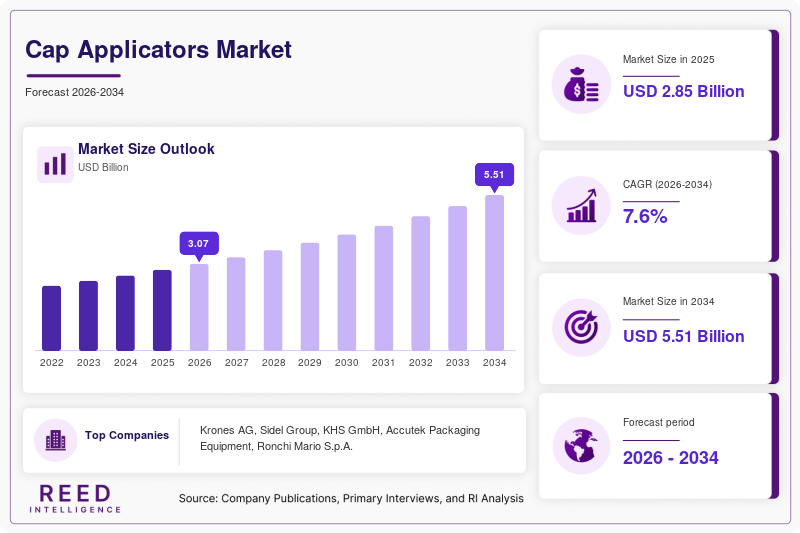
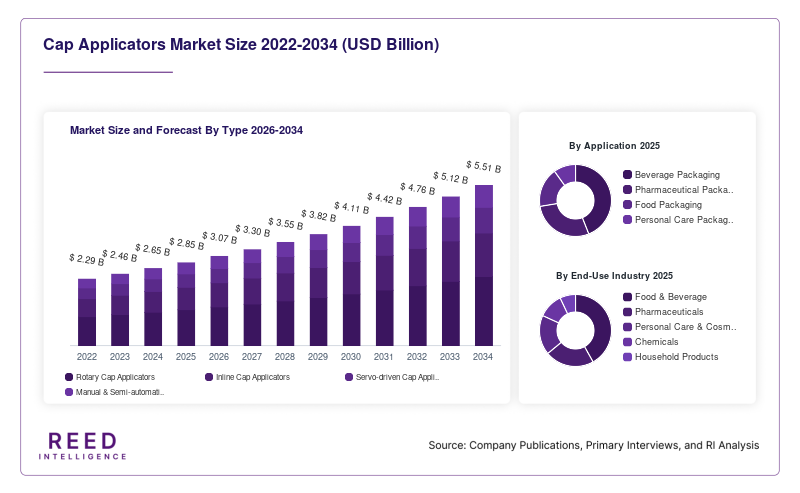
The Cap Applicators Market size is estimated at USD 2.85 billion, and it is projected to reach USD 3.10 billion in 2026. By 2034, the market is forecasted to attain approximately USD 5.65 billion, expanding at a CAGR of 7.6% during 2025–2034.
The growth of the market is primarily supported by the rapid shift toward automated production facilities, where cap applicators play a critical role in improving packaging efficiency, reducing manual labor dependency, and ensuring uniform sealing quality. The pharmaceutical sector is increasingly adopting high-speed applicators to comply with stringent packaging standards, while beverage manufacturers are deploying rotary and inline systems for high-volume production lines. Additionally, the rising consumption of bottled products in emerging economies is accelerating equipment deployment.
Key Highlights
- Asia Pacific held the dominant regional share of 25% in 2025, while Asia Pacific will record the fastest CAGR of 8.4% through 2034.
- Rotary cap applicators led the type segment with 41% share in 2024, while servo-driven cap applicators will expand fastest at a CAGR of 8.2%.
- Beverage packaging accounted for 38% of market share in 2024, while pharmaceutical packaging will grow fastest at 8.6% CAGR.
- The United States remained a key country market within North America with strong adoption in automated packaging systems and continued expansion in food and pharmaceutical manufacturing.
Market Trends
Increasing adoption of fully automated high-speed cap applicators
The market is experiencing a notable shift toward fully automated high-speed cap applicators, particularly in large-scale manufacturing environments. These systems are designed to handle continuous production lines with minimal downtime, improving operational throughput and reducing labor dependency. Industries such as bottled water, carbonated beverages, and liquid pharmaceuticals are increasingly adopting rotary and inline automated systems capable of processing thousands of containers per hour. Integration of sensors and servo motors allows for real-time torque adjustment, ensuring precise sealing across different container types. This trend is further strengthened by the need for consistent packaging quality, especially in regulated industries such as pharmaceuticals, where sealing integrity is directly linked to product safety and compliance. Manufacturers are also investing in modular designs that allow quick changeovers between packaging formats, improving production flexibility.
Integration of smart monitoring and IoT-enabled packaging systems
Another major trend shaping the Cap Applicators Market is the integration of smart technologies, including IoT-enabled monitoring systems and predictive maintenance capabilities. Modern cap applicators are increasingly equipped with connected sensors that track torque force, alignment accuracy, and machine health in real time. This enables manufacturers to reduce downtime and prevent mechanical failures through predictive alerts. Data-driven packaging systems are also being used to optimize production efficiency and reduce operational costs. The use of cloud-based dashboards allows plant managers to monitor multiple production lines remotely, improving decision-making efficiency. This trend is particularly strong in developed manufacturing hubs where Industry 4.0 adoption is accelerating. Additionally, artificial intelligence is being integrated to detect inconsistencies in cap placement, further improving quality control and reducing rejection rates in high-volume production environments.
Market Drivers
Expansion of food, beverage, and pharmaceutical packaging industries
One of the primary drivers of the Cap Applicators Market is the rapid expansion of end-use packaging industries, particularly food, beverage, and pharmaceuticals. The increasing global demand for bottled beverages, processed foods, and over-the-counter drugs has significantly raised the need for efficient and reliable packaging solutions. Cap applicators are essential in ensuring airtight sealing, preventing contamination, and maintaining product shelf life. In the pharmaceutical sector, strict regulatory standards require precise torque control and tamper-evident sealing, driving adoption of advanced applicator systems. Similarly, the beverage industry relies heavily on high-speed production lines, where cap applicators enhance productivity and reduce operational delays. The rise in urbanization and changing consumer lifestyles has further increased packaged product consumption, thereby supporting sustained market growth.
Increasing automation and industrial modernization initiatives
Another major driver is the global shift toward automation and modernization of manufacturing facilities. Companies are investing heavily in automated packaging lines to improve efficiency, reduce labor costs, and maintain consistent product quality. Cap applicators are a core component of these systems, enabling seamless integration with filling, labeling, and sealing machines. The adoption of Industry 4.0 technologies is further accelerating this trend, as manufacturers seek real-time monitoring, predictive maintenance, and data-driven optimization. In addition, labor shortages in manufacturing sectors are pushing companies toward automated solutions. Emerging economies are also modernizing their production infrastructure, increasing demand for semi-automatic and fully automatic cap applicators across diverse industries.
Market Restraint
High initial investment and maintenance complexity
A key restraint impacting the Cap Applicators Market is the high initial investment cost associated with advanced automated systems. Fully automated and servo-driven cap applicators require significant capital expenditure, making them less accessible for small and medium-sized enterprises. In addition to purchase costs, installation and integration with existing production lines often require technical expertise and system customization, further increasing overall expenses. Maintenance complexity also poses challenges, as modern systems incorporate electronic controls, sensors, and software-based monitoring systems that require skilled technicians for servicing. In developing regions, the lack of trained personnel can lead to operational inefficiencies and increased downtime. Furthermore, periodic calibration and component replacement add to long-term operational costs. For smaller manufacturers operating with limited budgets, these financial and technical barriers can delay adoption of advanced cap applicator systems, thereby restraining market penetration despite strong demand potential.
Market Opportunities
Growth in emerging economies and industrial expansion
Emerging economies present a significant growth opportunity for the Cap Applicators Market due to rapid industrialization and expansion of packaged goods manufacturing. Countries in Asia Pacific, Latin America, and parts of Africa are witnessing increasing investments in food processing, beverage production, and pharmaceutical manufacturing facilities. These industries require efficient packaging automation, creating strong demand for cost-effective cap applicators. Government initiatives promoting manufacturing infrastructure and foreign direct investment are further supporting market expansion. Additionally, rising consumer spending on packaged goods in urban areas is accelerating production capacity expansion. Manufacturers are increasingly introducing affordable semi-automatic and entry-level automated systems tailored to small and mid-sized enterprises, enabling wider market penetration in price-sensitive regions.
Technological innovation in sustainable and energy-efficient systems
Another major opportunity lies in the development of sustainable and energy-efficient cap applicator technologies. Manufacturers are focusing on reducing energy consumption and minimizing material waste during packaging operations. Eco-friendly machinery designs, including low-power servo motors and recyclable material compatibility, are gaining traction. There is also growing demand for machines capable of handling lightweight and biodegradable packaging materials without compromising sealing integrity. Integration of AI-based optimization tools offers additional efficiency improvements by reducing errors and enhancing production accuracy. As sustainability regulations become more stringent globally, companies investing in green packaging technologies are expected to gain competitive advantage, creating long-term growth opportunities in the Cap Applicators Market.
Segmental Analysis
By Type
The rotary cap applicators segment accounted for approximately 41% market share in 2024, driven by its ability to handle high-speed production environments efficiently. Rotary systems are widely used in beverage and pharmaceutical industries where continuous production and high throughput are essential. Their ability to apply caps uniformly across large batches makes them a preferred choice in large-scale manufacturing facilities.
The fastest-growing subsegment is servo-driven cap applicators, projected to expand at a CAGR of 8.2%, driven by increasing demand for precision control and energy efficiency. These systems provide better torque accuracy, reduced energy consumption, and improved adaptability across different container formats, making them suitable for modern automated production lines.
By Application
The beverage packaging segment held approximately 38% share in 2024, supported by large-scale bottled water and carbonated drink production. High-speed production requirements and hygiene standards make cap applicators essential in this application segment.
Pharmaceutical applications are the fastest-growing subsegment, expanding at a CAGR of 8.6%, driven by stringent regulatory requirements and increasing demand for tamper-evident and contamination-free packaging systems.
By End-Use Industry
The food and beverage industry dominated with 45% market share in 2024, due to widespread adoption of automated packaging lines. High-volume production requirements and cost optimization needs continue to support this dominance.
The personal care industry is the fastest-growing segment, projected at a CAGR of 7.9%, driven by increasing consumption of cosmetic and hygiene products requiring precise and aesthetic packaging solutions.
Regional Analysis
North America
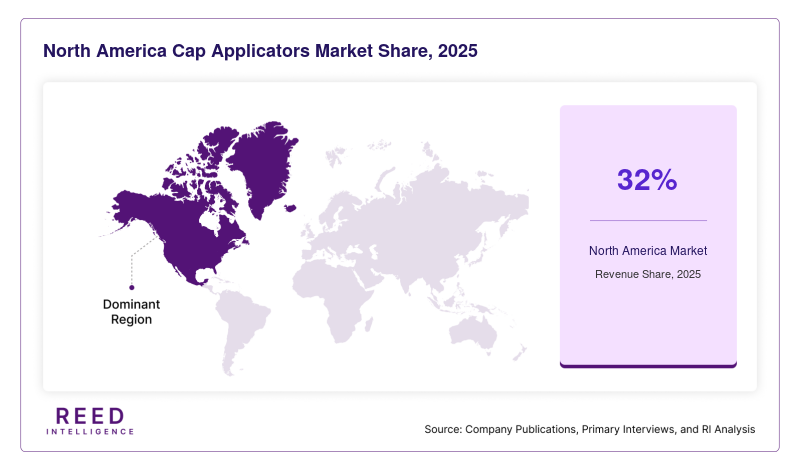
North America accounted for approximately 32% market share in 2025, with a projected CAGR of 6.8% from 2025 to 2034. The region benefits from advanced manufacturing infrastructure and early adoption of automated packaging technologies. Strong demand from pharmaceutical and beverage industries continues to drive equipment installations across production facilities.
The United States dominates the regional market due to its large-scale food processing and pharmaceutical manufacturing base. A key growth factor is the increasing investment in smart factories and Industry 4.0 integration, where cap applicators are linked with digital monitoring systems for improved efficiency and compliance tracking.
Europe
Europe held nearly 27% market share in 2025, growing at a CAGR of 6.5% through 2034. The region emphasizes regulatory compliance and packaging precision, particularly in pharmaceuticals and food safety applications.
Germany leads the European market due to its strong engineering manufacturing ecosystem. A key growth factor is the rising demand for energy-efficient packaging machinery aligned with strict environmental regulations and sustainability goals.
Asia Pacific
Asia Pacific captured around 25% market share in 2025, with a higher CAGR of 8.4%, driven by rapid industrial expansion and growing packaged goods consumption.
China dominates the region, supported by large-scale beverage and consumer goods production. A key growth factor is increasing foreign direct investment in manufacturing infrastructure and automation adoption.
Additionally, rising demand from India, Vietnam, and Southeast Asian countries is accelerating the installation of automated packaging lines across mid-sized manufacturing facilities. The growing shift toward smart factories and Industry 4.0 integration is further enhancing the adoption of advanced cap applicator systems in the region.
Middle East & Africa
Middle East & Africa region accounted for 8% market share in 2025, expanding at a CAGR of 7.2% during the forecast period.
Saudi Arabia leads the regional market due to expanding food processing industries. A key growth factor is diversification efforts away from oil-based economies toward manufacturing and industrial production.
Additionally, increasing government investments in industrial zones and food security initiatives are supporting the development of modern packaging infrastructure across the region. Rising demand for packaged beverages and processed foods in urban centers is further driving the adoption of automated cap applicator systems.
Latin America
Latin America held approximately 8% market share in 2025, with a CAGR of 7.0% through 2034.
Brazil is the dominant country due to its strong beverage production industry. A key growth factor is the increasing demand for packaged consumer goods driven by urban population growth and retail expansion.
Additionally, rising investments in automated bottling and packaging facilities are accelerating the adoption of advanced cap applicator systems across mid-sized manufacturers. The growing presence of multinational food and beverage companies is further strengthening regional production capabilities and boosting demand for high-speed, efficient packaging equipment.
Competitive Landscape
The Cap Applicators Market is moderately consolidated, with several global and regional manufacturers competing based on automation capabilities, pricing strategies, and technological innovation. Companies are focusing on expanding product portfolios and integrating smart technologies to enhance operational efficiency. Strategic partnerships with packaging line integrators are also common to strengthen market presence.
A key market leader is Krones AG, which continues to strengthen its position through advancements in high-speed rotary packaging systems. Recent developments include the introduction of modular cap applicators designed for flexible production lines with reduced changeover time. Other major players include Sidel Group, KHS GmbH, Accutek Packaging Equipment, and Ronchi Mario S.p.A. These companies are investing in automation, IoT integration, and energy-efficient machinery to meet evolving industrial demands.
Key Players List
- Krones AG
- Sidel Group
- KHS GmbH
- Accutek Packaging Equipment
- Ronchi Mario S.p.A.
- Zalkin
- Closure Systems International
- Arol Group
- E-PAK Machinery
- Shemesh Automation
- Liquid Packaging Solutions
- ACG Worldwide
- Tetra Pak International
- Bosch Packaging Technology
- NJM Packaging
Recent Developments
- Several manufacturers introduced servo-controlled cap applicators integrated with AI-based torque monitoring systems to improve packaging precision and reduce defect rates.
- A leading European packaging equipment company expanded its production facility to increase output capacity for automated bottling and capping systems targeting emerging markets.
- Partnerships between packaging machinery providers and beverage companies increased, focusing on developing high-speed modular production lines with reduced energy consumption and faster changeover capabilities.
Cap Applicators Market Segments
By Type
- Rotary Cap Applicators
- Inline Cap Applicators
- Servo-driven Cap Applicators
- Manual & Semi-automatic Applicators
By Application
- Beverage Packaging
- Pharmaceutical Packaging
- Food Packaging
- Personal Care Packaging
By End-Use Industry
- Food & Beverage
- Pharmaceuticals
- Personal Care & Cosmetics
- Chemicals
- Household Products
By Region
- North America
- Europe
- APAC
- Middle East and Africa
- LATAM