Car Vending Machine Market Size, Share & Demand Report By Vehicle Type (Used Cars, New Cars, Electric Vehicles), By Structure Type (Tower-Based Systems, Modular Systems), By Application (Dealerships, Online Automotive Platforms), By End-Use (Individual Consumers, Fleet Operators), By Region & Segment Forecasts, 2025–2034
USD 3950
Market Overview
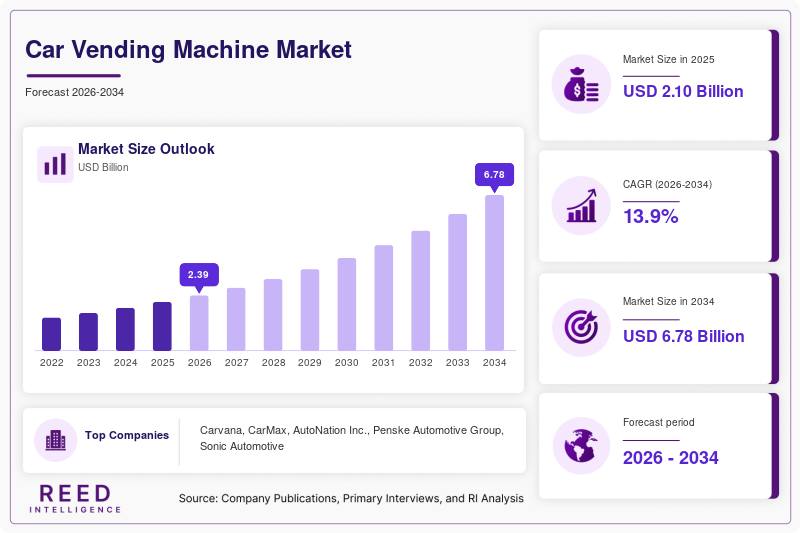
The global Car Vending Machine Market size was valued at USD 2.1 billion in 2025 and is projected to reach USD 6.8 billion by 2034, expanding at a CAGR of 13.9% during the forecast period (2025–2034). The market is witnessing strong growth due to the transformation of automotive retail through automation and digitalization. Car vending machines, which enable customers to purchase vehicles through automated multi-story structures, are gaining traction for their convenience, efficiency, and reduced operational costs.
A key global factor supporting the growth of the Car Vending Machine Market is the rapid shift toward contactless and digital purchasing experiences. Consumers increasingly prefer seamless, technology-driven buying journeys that minimize human interaction while offering transparency in pricing and selection. Automotive retailers are adopting automated vending solutions to align with evolving consumer expectations and optimize inventory display in urban locations with limited space.
Key Highlights
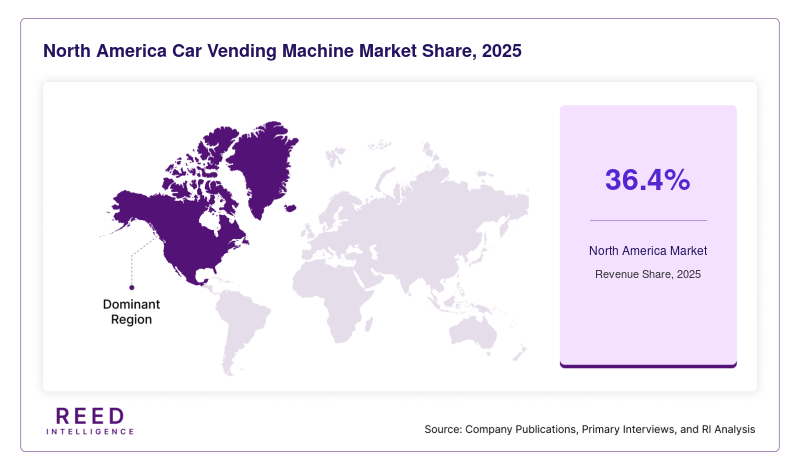
- North America dominated the market with a share of 36.4% in 2025, while Asia Pacific is projected to grow at the fastest CAGR of 15.8%.
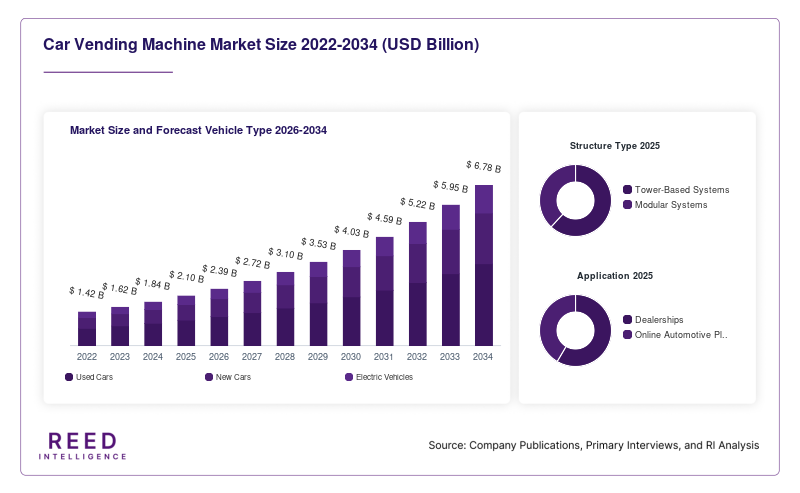
- By vehicle type, used cars held the largest share at 62.7%, while electric vehicles are expected to grow at the fastest CAGR of 17.6%.
- By structure type, tower-based vending systems accounted for 58.3% share, while modular systems are projected to grow at a CAGR of 16.9%.
- The U.S. Car Vending Machine Market was valued at USD 0.74 billion in 2025 and is estimated to reach USD 0.83 billion in 2026.
Market Trends
Integration of Digital Retail Ecosystems
The Car Vending Machine Market is experiencing a strong trend toward integration with digital retail platforms. Automotive companies are combining online vehicle selection, financing, and purchasing processes with automated vending systems. Customers can browse vehicles online, complete transactions, and collect their cars from vending towers, creating a unified omnichannel experience. This trend enhances customer convenience while streamlining dealership operations and reducing overhead costs.
Expansion of Electric Vehicle Offerings
Another key trend shaping the Car Vending Machine Market is the growing inclusion of electric vehicles (EVs) within vending systems. As governments promote clean mobility and consumers shift toward sustainable transportation, EV inventory in vending machines is increasing. Operators are adapting infrastructure to accommodate EV charging and maintenance requirements, making vending systems more aligned with future automotive demand.
Market Drivers
Rising Demand for Automated Retail Solutions
The increasing adoption of automated retail technologies is a major driver of the Car Vending Machine Market. Businesses are leveraging automation to improve operational efficiency, reduce labor costs, and provide 24/7 service availability. Car vending machines allow dealerships to display a large inventory in a compact space while offering a unique purchasing experience.
Urban Space Constraints and Efficient Land Utilization
Urbanization has led to limited availability of land for traditional car dealerships. Car vending machines address this challenge by utilizing vertical space, enabling operators to store multiple vehicles within a smaller footprint. This efficient use of space is particularly valuable in densely populated cities, driving the adoption of vending systems.
Market Restraint
High Initial Investment and Infrastructure Complexity
A significant restraint in the Car Vending Machine Market is the high capital investment required for installation and operation. Building multi-story automated structures involves substantial costs related to construction, robotics, and software integration. Additionally, ongoing maintenance and technical support further increase operational expenses.
The complexity of integrating these systems with existing dealership infrastructure can also pose challenges. Smaller dealerships may face financial and technical barriers, limiting widespread adoption. Furthermore, regulatory approvals and zoning requirements in urban areas can delay project implementation. These factors collectively restrain the growth of the Car Vending Machine Market, particularly in developing regions where capital resources may be limited.
Market Opportunities
Growth in Emerging Automotive Markets
Emerging economies present significant opportunities for the Car Vending Machine Market. Rapid urbanization, rising disposable income, and increasing vehicle ownership are driving demand for innovative retail solutions. Countries in Asia Pacific and Latin America are witnessing expansion in automotive sales, creating a favorable environment for vending machine adoption.
Technological Advancements in Automation and AI
Advancements in automation, artificial intelligence, and IoT technologies are creating new opportunities in the Car Vending Machine Market. Enhanced inventory management, predictive maintenance, and personalized customer experiences can be achieved through these technologies. Integration of AI-driven recommendation systems can further improve customer engagement and sales conversion rates.
Segmental Analysis
By Vehicle Type
Used cars dominated the Car Vending Machine Market with a share of 62.7% in 2025, as they offer affordability and a wide range of options for consumers. Vending machines are particularly effective in showcasing pre-owned inventory.
Electric vehicles are expected to grow at the fastest CAGR of 17.6% during the forecast period. The increasing focus on sustainability and government incentives for EV adoption will drive their integration into vending systems.
By Structure Type
Tower-based vending systems accounted for the largest share of 58.3% in 2025 due to their high storage capacity and visual appeal. These structures are commonly used in urban locations.
Modular systems are projected to grow at a CAGR of 16.9%, supported by their flexibility and lower installation costs. They allow operators to scale operations based on demand.
By Application
Dealerships held the dominant share of 54.1% in 2025, as they are the primary adopters of vending systems to enhance customer experience.
Online automotive platforms are expected to grow at the fastest CAGR of 15.2%, driven by the integration of e-commerce and automated retail solutions.
By End-Use
Individual consumers accounted for the largest share of 68.5% in 2025, reflecting the direct-to-consumer nature of vending machine transactions.
Fleet operators are anticipated to grow at a CAGR of 14.6%, as businesses seek efficient ways to procure vehicles in bulk.
Regional Analysis
North America
North America accounted for 36.4% of the Car Vending Machine Market share in 2025 and will grow at a CAGR of 12.8% during the forecast period. The region has a well-established automotive retail ecosystem and high adoption of advanced technologies.
The United States dominated the regional market due to the presence of major automotive retailers adopting innovative sales models. The growth factor includes strong consumer acceptance of automated purchasing systems and high internet penetration supporting digital transactions.
Europe
Europe held a market share of 24.7% in 2025 and is expected to grow at a CAGR of 12.5% through 2034. The region’s focus on sustainability and digital transformation is supporting market expansion.
Germany emerged as the dominant country, driven by its robust automotive industry and technological expertise. The adoption of automated retail solutions aligns with the region’s emphasis on innovation and efficiency.
Asia Pacific
Asia Pacific represented 21.9% of the Car Vending Machine Market in 2025 and is projected to grow at the fastest CAGR of 15.8%. Rapid urbanization and increasing demand for modern retail experiences are key growth factors.
China led the region due to its large automotive market and strong adoption of digital technologies. Government initiatives supporting smart cities and automation further contribute to market growth.
Middle East & Africa
The Middle East & Africa accounted for 9.6% of the market share in 2025 and is expected to grow at a CAGR of 13.2%. The region is witnessing increased investments in smart infrastructure and retail innovation.
The United Arab Emirates dominated the region, driven by the development of technologically advanced retail environments. The focus on luxury and premium automotive experiences is supporting the adoption of vending systems.
Latin America
Latin America held a market share of 7.4% in 2025 and is projected to grow at a CAGR of 13.0%. The region is gradually adopting innovative retail models in the automotive sector.
Brazil emerged as the leading country due to its expanding automotive market. Increasing consumer awareness and interest in digital purchasing solutions are contributing to the growth of the Car Vending Machine Market.
Competitive Landscape
The Car Vending Machine Market is characterized by a mix of automotive retailers, technology providers, and infrastructure developers. Companies compete on innovation, system efficiency, and customer experience.
Carvana is a leading player in the market, known for its large-scale car vending towers and integrated digital platform. The company recently expanded its vending machine network to new urban locations, enhancing its market presence.
Other players are focusing on partnerships and technological advancements to improve system capabilities. Investments in automation, robotics, and AI are enabling companies to offer more efficient and user-friendly solutions. Strategic collaborations with automotive manufacturers and online platforms are also supporting market expansion.
Key Players
- Carvana
- CarMax
- AutoNation Inc.https://www.autonation.com/
- Penske Automotive Group
- Sonic Automotive
- Alibaba Group (Tmall Auto)
- JD.com Inc.
- Ford Motor Company
- Toyota Motor Corporation
- Volkswagen AG
- Hyundai Motor Company
- Nissan Motor Co., Ltd.
- Daimler AG
- BMW Group
- Lithia Motors Inc.
Recent Developments
- 2024: Carvana expanded its car vending machine network across major U.S. cities.
- 2024: Alibaba Group enhanced its automated car retail platform with AI-based recommendations.
- 2023: JD.com introduced smart car vending solutions integrated with digital payment systems.
- 2023: AutoNation invested in automated retail infrastructure for urban markets.
- 2023: Penske Automotive Group explored partnerships to deploy modular vending systems.
Car Vending Machine Market Segments
Vehicle Type
- Used Cars
- New Cars
- Electric Vehicles
Structure Type
- Tower-Based Systems
- Modular Systems
Application
- Dealerships
- Online Automotive Platforms
End-Use
- Individual Consumers
- Fleet Operators
Distribution Channel
- Direct Sales
- Online Platforms
- Third-Party Integrators
By Region
- North America
- Europe
- APAC
- Middle East and Africa
- LATAM