Caramel Inclusion Market Size, Share Demand Report By Product Type (Sauces, Syrups, Pastes, Chunks/Chocolates), By Application (Ice Cream & Desserts, Bakery, Confectionery, Beverages, Others), By Flavor Type (Classic Caramel, Salted Caramel, Butter Caramel, Flavored) & Segment Forecasts, 2026–2034
USD 3950
Caramel Inclusion Market Size
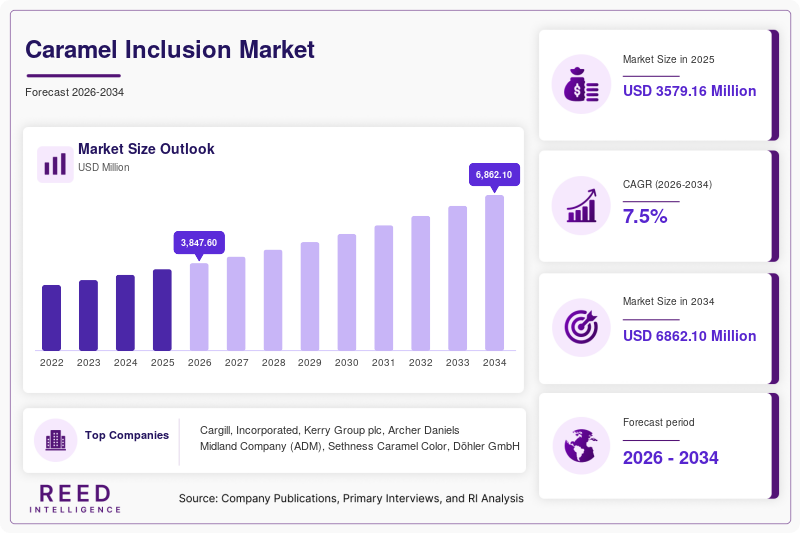
Caramel Inclusion market size is projected at USD 3,847.6 million in 2026 and is expected to hit USD 6,847.5 million by 2034 with a CAGR of 7.5% during the forecast period. The increasing consumer demand for indulgent and premium food experiences, coupled with the growing popularity of caramel flavor in ice cream, bakery, and confectionery products, underpins market expansion. This report delivers a comprehensive analysis of the Caramel Inclusion market, including segmentation by type and application, competitive dynamics, and regional growth patterns, equipping stakeholders with critical intelligence. The Caramel Inclusion market continues to demonstrate strong growth potential, fueled by the rising trend of premiumization in the food industry, the increasing use of caramel as a versatile flavor and texture ingredient, and continuous innovation in caramel product formulations.
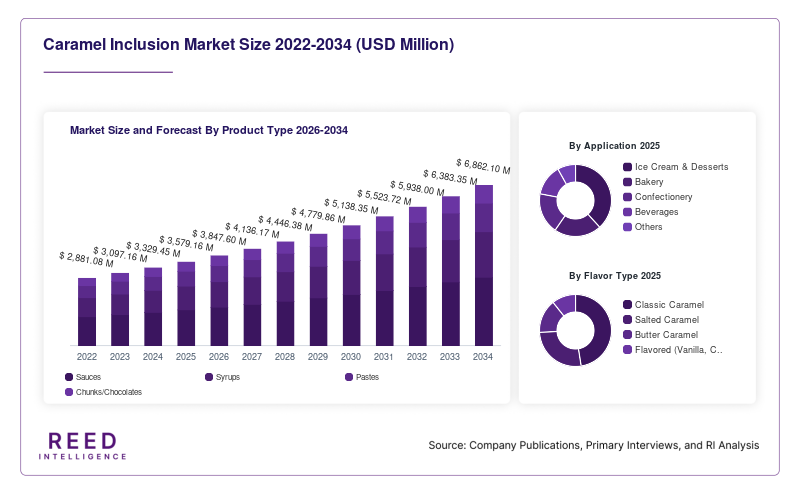
Caramel inclusions are sweet, brown, and flavorful ingredients derived from the controlled heating of sugars, used to add taste, texture, and visual appeal to a variety of food products. They are available in various forms, including sauces, syrups, pastes, and solid pieces, and are widely used in ice cream, bakery, and confectionery. The global production volume of caramel inclusions exceeded 1.2 million metric tons in 2025, reflecting a 7% increase from 2023, driven by the growing demand from the ice cream and dessert sectors. Adoption patterns reveal that the Sauces type dominates the market, accounting for 35% of total demand, followed by Syrups at 28%, Pastes at 22%, and Chunks/Chocolates at 15%. The Caramel Inclusion market's trajectory is closely linked to the growth of the global confectionery and dessert market, which is projected to reach USD 500 billion by 2028, and the increasing consumer preference for rich and complex flavor profiles.
Caramel Inclusion Market Trends
Development of Clean-Label and Natural Caramel Inclusions
The Caramel Inclusion market is witnessing a significant trend toward the development of clean-label and natural caramel inclusions, driven by increasing consumer demand for transparency and natural ingredients. The revenue from clean-label caramel products grew to USD 1.2 billion in 2025, a year-on-year increase of 12%, as 35% of new product launches in 2025 specified clean-label, non-GMO, or natural ingredients. Adoption rates of natural caramel inclusions in premium ice cream and bakery products reached 30%, with this figure projected to exceed 55% by 2030. The Caramel Inclusion market's trend toward clean-label is reinforced by the need for consumer trust, the increasing focus on health and wellness, and the continuous innovation in natural caramel manufacturing processes.
Growing Focus on Innovative Textures and Flavor Combinations
The increasing focus on innovative textures and flavor combinations is a major trend shaping the Caramel Inclusion market, with the development of products that offer unique sensory experiences, such as salted caramel, caramel with sea salt, and caramel blended with other flavors. The market has seen a 15% increase in the demand for flavored caramel inclusions since 2022, with 25% of new products in 2025 featuring unique flavor combinations and textural contrasts. The use of caramel inclusions in artisanal and craft products has also gained significant traction. The Caramel Inclusion market's trend toward innovation is reinforced by the need for differentiation, the increasing consumer desire for novel taste experiences, and the continuous innovation in flavor and texture technologies.
Caramel Inclusion Market Drivers
The Caramel Inclusion market's expansion is primarily driven by the increasing demand for premium and indulgent food products, with the global premium food market valued at USD 800 billion in 2025 and growing at a steady pace. The need for versatile flavor ingredients that can enhance taste, texture, and visual appeal has been a major driver, with caramel inclusions being a popular choice. The rising consumption of ice cream and frozen desserts has also fueled market growth. Additionally, the expansion of the bakery and confectionery industries has spurred demand. The Caramel Inclusion market's growth is further reinforced by the continuous innovation in caramel product development, leading to better quality and variety.
Caramel Inclusion Market Restraints
Despite favorable growth prospects, the Caramel Inclusion market faces significant constraints, primarily related to the high sugar content and caloric value of caramel products, which can be a concern for health-conscious consumers. The availability of alternative flavorings and the challenge of maintaining product stability and shelf life can also be a limitation. The Caramel Inclusion market's growth is also tempered by the fluctuating prices of raw ingredients, such as sugar and dairy, and the need for specific storage and handling conditions.
Caramel Inclusion Market Opportunities
The Caramel Inclusion market presents significant opportunities in the rapidly expanding market for plant-based and dairy-free products, where caramel inclusions can be formulated without animal-derived ingredients. The development of reduced-sugar and sugar-free caramel inclusions is expected to grow at a CAGR of 9% through 2034. Emerging opportunities also exist in the use of caramel inclusions in functional foods and beverages, and the expansion into emerging markets with growing dessert and confectionery sectors. The Caramel Inclusion market's opportunity profile is further enhanced by the growing trend of customization and personalization in food.
Challenges in Caramel Inclusion Market
The Caramel Inclusion market faces persistent challenges related to the need for continuous innovation to meet evolving consumer preferences for health, flavor, and texture. The complexity of developing caramel inclusions that maintain their integrity and flavor under various processing conditions can also be a challenge. The market is also contending with the challenge of managing the supply chain for high-quality raw materials. Additionally, the Caramel Inclusion market is challenged by the need to address the environmental impact of packaging and production.
Caramel Inclusion Market Segmentation
The Caramel Inclusion market is segmented by Type and Application to provide a comprehensive market perspective. By Type, Sauces dominate with a 35% market share, driven by their versatility in various applications. The Application segment is led by Ice Cream & Desserts, which accounts for 38% of the market, followed by Bakery at 25%, Confectionery at 18%, Beverages at 12%, and Others at 7%.
By Type
Sauces represent the largest segment in the Caramel Inclusion market, commanding a 35% share, with production exceeding 420,000 metric tons in 2025. These are characterized by their liquid to semi-liquid consistency, used as toppings and fillings. Technical specifications include viscosity, Brix level, and shelf life. The Caramel Inclusion market's Sauces segment is driven by its use in ice cream, desserts, and beverages.
Syrups capture a 28% share of the Caramel Inclusion market, with production of 336,000 metric tons in 2025. These are characterized by their thinner consistency, ideal for flavoring beverages and drizzling. Technical specifications include viscosity, sugar content, and flavor profile. The Caramel Inclusion market's Syrups segment is driven by its use in coffee, cocktails, and bakery glazes.
Pastes represent 22% of the Caramel Inclusion market, with production of 264,000 metric tons in 2025. These are characterized by their thick, spreadable consistency, used in fillings and as a flavor base. Technical specifications include spreadability, flavor intensity, and shelf life. The Caramel Inclusion market's Pastes segment is driven by its use in bakery and confectionery.
Chunks/Chocolates comprise the remainder of the Caramel Inclusion market, accounting for 15% of total production, with 180,000 metric tons in 2025. These are characterized by their solid pieces, adding texture and visual appeal. Technical specifications include size, shape, and coating. The Caramel Inclusion market's Chunks segment is driven by its use in ice cream, cookies, and chocolate bars.
By Application
Ice Cream & Desserts dominates the Caramel Inclusion market, accounting for 38% of sales, representing 456,000 metric tons in 2025. This segment includes use in ice cream, frozen yogurt, puddings, and other desserts. Usage penetration exceeds 40% in the sector. The Caramel Inclusion market's Ice Cream segment is characterized by its focus on flavor, texture, and indulgence.
Bakery accounts for 25% of the Caramel Inclusion market, with sales of 300,000 metric tons in 2025. This segment encompasses use in cakes, cookies, pastries, and breads. The segment is growing at a steady CAGR, driven by the demand for premium baked goods. The Caramel Inclusion market's Bakery segment is characterized by its focus on flavor enhancement and texture.
Confectionery represents 18% of the Caramel Inclusion market, with sales of 216,000 metric tons in 2025. This segment includes use in chocolates, candies, and caramel-filled products. The segment is growing at a moderate rate. The Caramel Inclusion market's Confectionery segment is characterized by its focus on quality and taste.
Beverages accounts for 12% of the Caramel Inclusion market, with sales of 144,000 metric tons in 2025. This segment includes use in coffee, milkshakes, and cocktails. The segment is growing at a robust CAGR, driven by the specialty coffee trend. The Caramel Inclusion market's Beverages segment is characterized by its focus on flavoring and sweetness.
Others comprises the remainder of the Caramel Inclusion market, accounting for 7% of total sales, with 84,000 metric tons in 2025. This includes use in cereals, yogurt, and other niche applications. The segment is projected to grow at a moderate CAGR through 2034. The Caramel Inclusion market's Others segment is characterized by its diverse and evolving applications.
Caramel Inclusion Market Regional Outlook
North America Caramel Inclusion Market
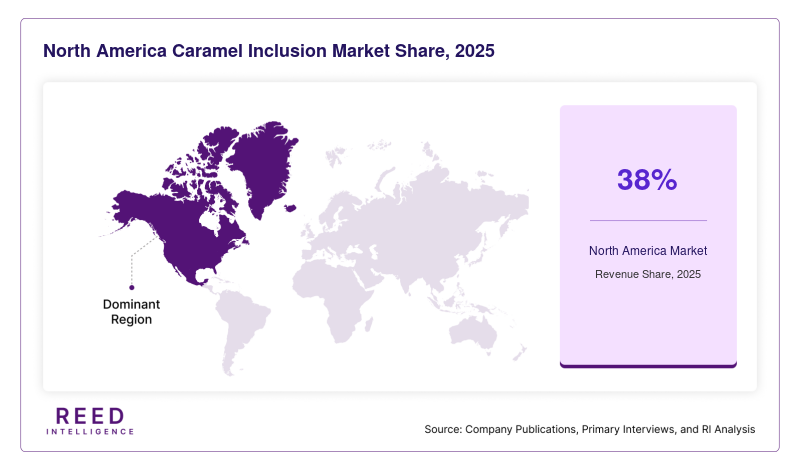
Leads the Caramel Inclusion market, commanding a 38% share, with a revenue of USD 1,462.1 million in 2025. The United States is the primary driver, accounting for 85% of regional demand, driven by the large ice cream and dessert market, high consumer spending on premium products, and a well-established food processing industry. The North American Caramel Inclusion market is characterized by its focus on innovation and premium products.
Europe Caramel Inclusion Market
Represents the second-largest market, capturing a 30% share with a revenue of USD 1,154.3 million in 2025. The UK, Germany, and France are the primary drivers, collectively accounting for 60% of regional demand, driven by a strong bakery and confectionery tradition, high-quality standards, and a growing demand for artisanal products. The Caramel Inclusion market in Europe is characterized by its focus on quality and tradition.
Asia-Pacific Caramel Inclusion Market
Accounts for 22% of the global Caramel Inclusion market, with a revenue of USD 846.5 million in 2025. China, Japan, and Australia are the primary drivers, together accounting for 70% of regional demand, driven by the growing middle class, increasing Western food influence, and expanding dessert and bakery sectors. The Asia-Pacific Caramel Inclusion market is projected to grow at the fastest CAGR of 9% through 2034.
Middle East & Africa and Latin America Caramel Inclusion Market
Together account for the remaining 10% of the Caramel Inclusion market, with the UAE leading the Middle East market and Brazil leading the Latin American market. Both regions are projected to grow at CAGRs exceeding 8%, driven by increasing food service and hospitality sectors.
Top players in Caramel Inclusion Market
- Cargill, Incorporated
- Kerry Group plc
- Archer Daniels Midland Company (ADM)
- Sethness Caramel Color
- Döhler GmbH
- Sensient Technologies Corporation
- Frutarom Industries Ltd.
- Givaudan S.A.
- International Flavors & Fragrances Inc. (IFF)
- Nestlé S.A.
- Mars, Incorporated
- Mondelez International, Inc.
- Unilever PLC
- Aryzta AG
- CSM Ingredients
Cargill, Incorporated
Cargill holds a dominant position in the Caramel Inclusion market, with an estimated 16% global market share, particularly strong in the North American and European industrial food segments. The company's portfolio of caramel inclusions is widely recognized for its quality, consistency, and innovation. Cargill's market leadership is reinforced by its significant R&D investment, its extensive global supply chain, and its strong relationships with major food manufacturers. Cargill commands over 18% of the North American market and 14% of the European market, positioning it as a key player in the Caramel Inclusion market.
Kerry Group plc
Kerry Group is a leading player in the Caramel Inclusion market, commanding approximately 12% of the global market share through its comprehensive portfolio of taste and nutrition solutions. The company's expertise in flavor development and its focus on clean-label and natural products have solidified its position. Kerry's caramel inclusions are known for their quality, flavor profile, and versatility. The company's commitment to innovation and its strong presence in the North American and European markets have enhanced its competitive advantage.
Archer Daniels Midland Company (ADM) holds a significant 10% market share, with particular strength in the sweetener and ingredient segments. Sethness Caramel Color is a major player in the caramel color and flavor market, holding an 8% share.
Recent Developments in Caramel Inclusion Market
- 2025: Cargill launched a new line of clean-label caramel sauces with natural colors and flavors, targeting the premium ice cream and dessert market.
- 2025: Kerry Group introduced a new plant-based caramel inclusion for dairy-free ice cream and desserts, addressing the growing vegan market.
Caramel Inclusion Market Segments
By Product Type
- Sauces
- Syrups
- Pastes
- Chunks/Chocolates
By Application
- Ice Cream & Desserts
- Bakery
- Confectionery
- Beverages
- Others
By Flavor Type
- Classic Caramel
- Salted Caramel
- Butter Caramel
- Flavored (Vanilla, Chocolate, etc.)
By Region
- North America
- Europe
- APAC
- Middle East and Africa
- LATAM