Carbolic Oil Market Size, Share Demand Report By Type (Light Carbolic Oil, Medium Carbolic Oil, Heavy Carbolic Oil, Refined Carbolic Oil), By Application (Wood Preservation, Disinfectants, Chemical Intermediates, Industrial Processing), By End-Use (Construction, Agriculture, Chemical Industry, Manufacturing), By Distribution Channel (Direct Sales, Distributors, Online Channels), By Region & Segment Forecasts, 2026–2034
USD 3950
Market Overview
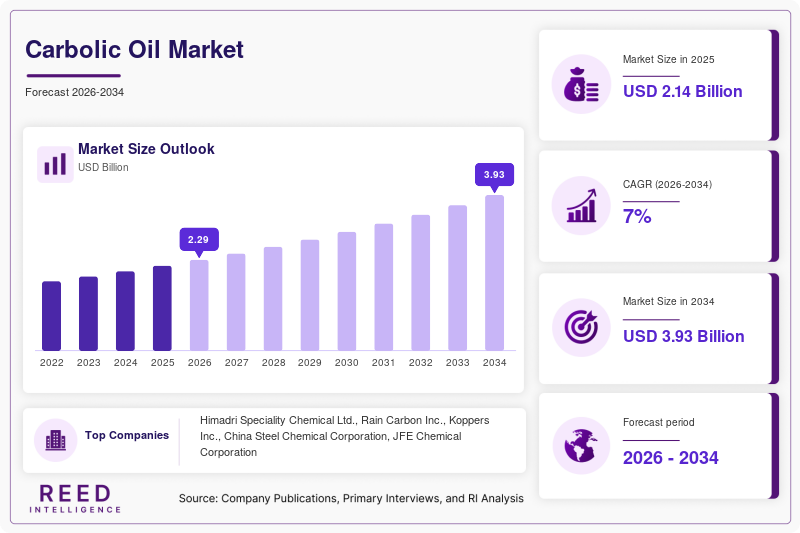
The global Carbolic Oil Market size was valued at USD 2.14 billion in 2026 and is projected to reach USD 3.68 billion by 2034, expanding at a CAGR of 7.0% from 2026 to 2034. Carbolic oil, derived from coal tar distillation, is widely used in wood preservation, disinfectants, chemical intermediates, and industrial processing. The market continues to gain traction due to its cost efficiency and effectiveness in industrial applications.
A key global factor supporting market growth is the steady expansion of infrastructure and construction activities worldwide, which has increased the demand for wood preservatives and protective coatings. Carbolic oil’s ability to enhance durability and resistance to environmental degradation has made it a preferred choice in industrial applications.
Key Highlights
- Dominant Region: Asia Pacific held approximately 41.3% share in 2025, while Latin America is projected to grow at the fastest CAGR of 7.8% through 2034.
- Leading Subsegments:
- By Type: Heavy carbolic oil dominated with 46.2% share in 2025, while refined carbolic oil is expected to grow at a CAGR of 7.5%.
- By Application: Wood preservation led with 38.7% share, while chemical intermediates is forecasted to grow at 7.6% CAGR.
- By End-Use: Construction sector accounted for 34.5% share, while agriculture is expected to grow at 7.4% CAGR.
- Dominant Country: China recorded market values of USD 0.54 billion in 2024 and USD 0.58 billion in 2025, driven by industrial output expansion.
Market Trends
Industrial Shift Toward Sustainable Chemical Derivatives
Manufacturers are increasingly focusing on refining carbolic oil into higher-purity derivatives for use in specialty chemicals. This trend aligns with environmental compliance requirements and enhances product value across industries such as pharmaceuticals and agrochemicals.
Integration of Advanced Distillation Technologies
The adoption of improved distillation and separation processes is enhancing yield efficiency and product quality. These advancements are enabling producers to diversify their product portfolio and cater to niche industrial applications.
Market Drivers
Rising Demand for Wood Preservation Solutions
The increasing use of timber in infrastructure, railways, and utility poles has fueled the demand for effective preservation solutions. Carbolic oil’s protective properties extend the lifespan of wood materials, making it an essential component in construction and industrial maintenance.
Expansion of Chemical Processing Industry
The growth of the global chemical sector has led to increased demand for intermediates derived from coal tar. Carbolic oil serves as a critical raw material in producing phenolic compounds, contributing to its sustained market growth.
Market Restraint
Environmental and Regulatory Constraints
Stringent environmental regulations related to coal tar derivatives and their potential health impacts are limiting market expansion. Compliance requirements and disposal challenges may increase operational costs for manufacturers.
Market Opportunities
Development of High-Purity Derivatives
The growing demand for specialty chemicals presents an opportunity for manufacturers to develop refined carbolic oil products with enhanced purity and performance characteristics.
Emerging Demand in Agricultural Applications
Carbolic oil is gaining traction in pest control and soil treatment applications. Increasing agricultural modernization in developing economies is expected to create new growth avenues.
Segmental Analysis
By Type
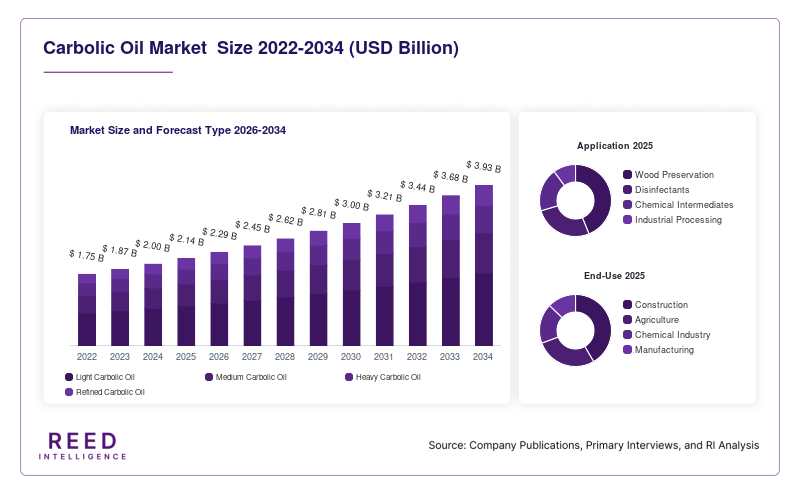
Heavy carbolic oil dominated the market with a 46.2% share in 2025, driven by its extensive use in industrial-grade applications. Refined carbolic oil is projected to grow at a CAGR of 7.5%, supported by increasing demand for high-purity chemical inputs.
By Application
Wood preservation accounted for 38.7% share in 2025, reflecting its widespread use in infrastructure projects. Chemical intermediates are expected to grow at a CAGR of 7.6%, fueled by expanding downstream industries.
By End-Use
The construction sector led with a 34.5% share in 2025, due to high demand for durable materials. The agriculture segment is projected to grow at a CAGR of 7.4%, driven by increasing use in pest control and soil treatment.
By Distribution Channel
Direct sales dominated with 62.1% share in 2025, as bulk industrial buyers prefer long-term contracts. Online distribution channels are expected to grow at a CAGR of 7.2%, supported by digital transformation in procurement processes.
Regional Analysis
North America
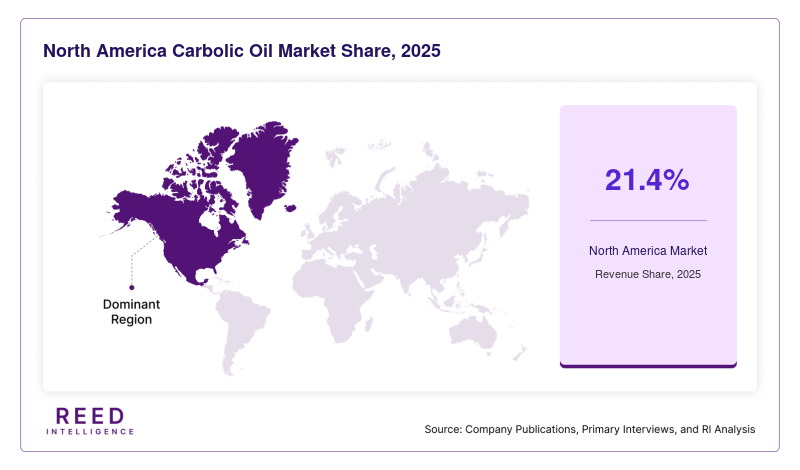
North America accounted for 21.4% of the Carbolic Oil Market share in 2025 and is projected to grow at a CAGR of 6.5% through 2034. The United States remains the dominant country, supported by advancements in industrial processing technologies.
Europe
Europe held 18.6% share in 2025 and is expected to expand at a CAGR of 6.3% during the forecast period. Germany leads the region, benefiting from its well-established chemical manufacturing base.
Asia Pacific
Asia Pacific dominated with 41.3% share in 2025 and is anticipated to grow at a CAGR of 7.4%. China leads the regional market due to large-scale industrial production and increasing demand for chemical intermediates.
Middle East & Africa
The Middle East & Africa region captured 9.2% share in 2025 and is forecasted to grow at a CAGR of 6.8%. Saudi Arabia stands out as a key contributor, driven by industrial diversification initiatives.
Latin America
Latin America held 9.5% share in 2025 and is projected to expand at the fastest CAGR of 7.8%. Brazil leads the region, supported by growing construction and agricultural sectors.
Competitive Landscape
The Carbolic Oil Market is moderately fragmented, with several regional and global players competing on product quality, pricing, and technological advancements. Leading companies focus on refining processes and expanding their product portfolios to cater to diverse industrial applications. One prominent market leader has strengthened its position by investing in advanced distillation technologies to improve product efficiency and sustainability. Recent developments include capacity expansions, strategic partnerships, and investments in research and development to meet evolving industry requirements.
Companies are also focusing on environmental compliance and sustainable production practices to align with regulatory frameworks. Competitive strategies include geographic expansion, mergers, and product innovation to gain market share. The increasing demand for high-purity derivatives has encouraged key players to enhance their refining capabilities and target specialty chemical markets, thereby intensifying competition across regions.
Key Players List
- Himadri Speciality Chemical Ltd.
- Rain Carbon Inc.
- Koppers Inc.
- China Steel Chemical Corporation
- JFE Chemical Corporation
- Mitsubishi Chemical Group
- ArcelorMittal S.A.
- NalonChem Group
- Shandong Gude Chemical Co., Ltd.
- Jiangsu Baoshun Chemical Co., Ltd.
- Baowu Carbon Materials
- Hengshui Zehao Chemical Co., Ltd.
- Epsilon Carbon Pvt. Ltd.
- PCC Rokita SA
- OCI Company Ltd.
Recent Developments
- In 2025, a major producer expanded its refining capacity to meet increasing demand for high-purity carbolic oil derivatives.
- In 2024, a leading chemical company launched a new line of refined carbolic oil products targeting specialty chemical applications.
- In 2025, a strategic partnership was formed between two manufacturers to enhance distribution networks across Asia Pacific.
- In 2024, advancements in distillation technology were introduced to improve yield efficiency and reduce environmental impact.
- In 2025, a key player invested in research and development to develop eco-friendly alternatives within the carbolic oil product range.
Carbolic Oil Market Segments
Type
- Light Carbolic Oil
- Medium Carbolic Oil
- Heavy Carbolic Oil
- Refined Carbolic Oil
Application
- Wood Preservation
- Disinfectants
- Chemical Intermediates
- Industrial Processing
End-Use
- Construction
- Agriculture
- Chemical Industry
- Manufacturing
Distribution Channel
- Direct Sales
- Distributors
- Online Channels
By Region
- North America
- Europe
- APAC
- Middle East and Africa
- LATAM