Carbon Fiber Reinforced Plastic Propeller Shaft Market Size, Share, Demand Report by Vehicle Type (Passenger Vehicles, Commercial Vehicles, Electric Vehicles), By Application (Automotive Drivetrain Systems, Aerospace Systems, Industrial Machinery), By End-Use (OEMs, Aftermarket) and Regional Forecasts, 2026–2034
USD 3950
Market Overview
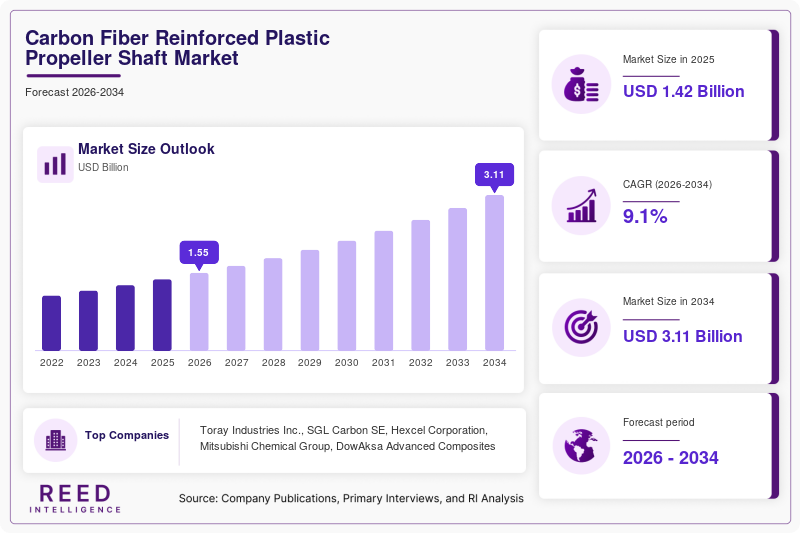
The Carbon Fiber Reinforced Plastic Propeller Shaft Market size is projected to witness steady expansion, with the global market valued at approximately USD 1.42 billion in 2026 and expected to reach USD 2.85 billion by 2034, registering a CAGR of 9.1% during 2026–2034. Growth in the market is primarily supported by the increasing demand for lightweight, high-strength drivetrain components across automotive, marine, and aerospace industries. The shift toward fuel efficiency and emission reduction has significantly accelerated the adoption of carbon fiber reinforced plastic (CFRP) propeller shafts, especially in next-generation electric and hybrid vehicles.
A major global factor supporting market growth is the rapid transition toward electric mobility and stringent environmental regulations across major economies. Automotive manufacturers are increasingly replacing traditional steel and aluminum propeller shafts with CFRP variants to reduce vehicle weight, enhance torque transmission efficiency, and improve overall performance. Additionally, advancements in composite manufacturing technologies, such as automated fiber placement and resin transfer molding, have improved production scalability and cost efficiency.
Key Highlights
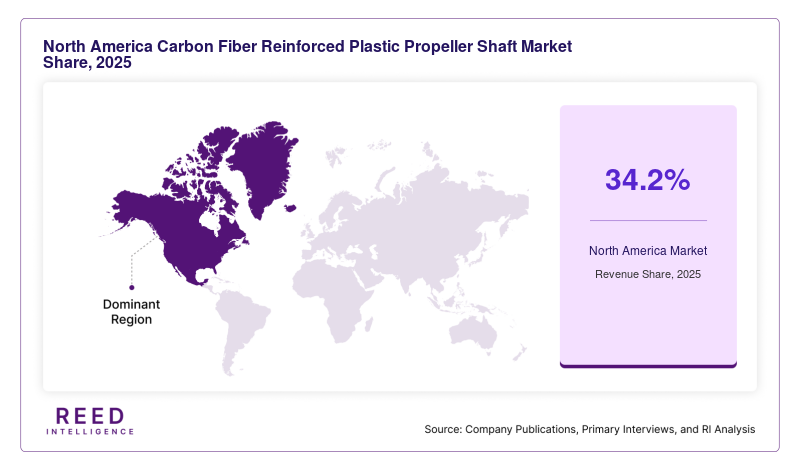
- North America dominated the market with a 34.2% share in 2025.
- Asia Pacific is expected to grow at the fastest CAGR of 11.2% during 2026–2034.
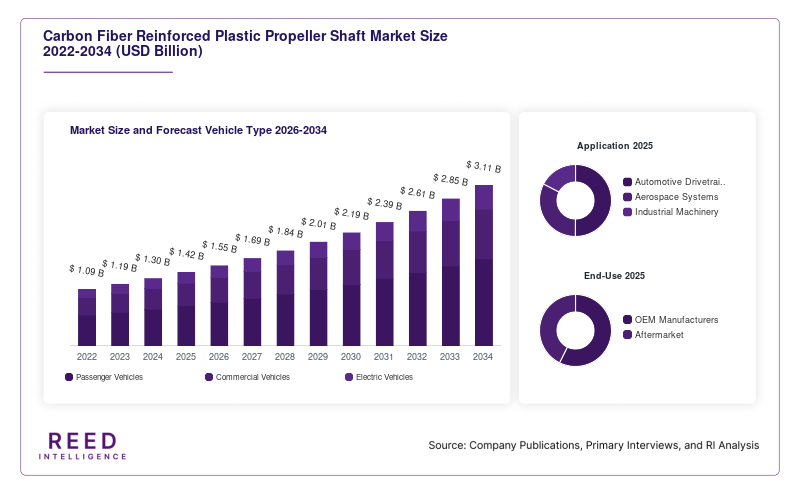
- By vehicle type, passenger vehicles accounted for the largest share of 52.6%, while electric vehicles are projected to grow at a CAGR of 12.7%.
- By application, automotive drivetrain systems led with a 46.3% share, whereas aerospace applications are expected to expand at a CAGR of 10.9%.
- The United States remained the dominant country, with market values of USD 610 million in 2024 and USD 665 million in 2025.
Market Trends
Increasing Adoption of Lightweight Composite Drivetrain Systems
One of the most prominent trends in the Carbon Fiber Reinforced Plastic Propeller Shaft Market is the increasing integration of lightweight composite materials into drivetrain systems. Automotive OEMs are prioritizing weight reduction to meet stringent emission norms and improve fuel efficiency. CFRP propeller shafts offer up to 60% weight reduction compared to steel alternatives while maintaining superior torsional rigidity. This has led to widespread adoption in performance vehicles and premium electric vehicles. Additionally, manufacturers are investing in hybrid composite structures that combine carbon fiber with thermoplastic resins to enhance durability and reduce vibration noise in high-speed applications.
Advancements in Automated Manufacturing and Cost Optimization
Another significant trend shaping the market is the advancement of automated manufacturing technologies. Traditional CFRP production has been cost-intensive; however, innovations such as automated fiber placement, high-pressure resin infusion, and AI-driven quality inspection systems are reducing production costs and improving scalability. These advancements are enabling mid-range vehicle manufacturers to integrate CFRP propeller shafts into mass-market models. Furthermore, the development of recyclable carbon fiber composites is gaining traction, aligning with sustainability goals and circular economy practices across the automotive and aerospace sectors.
Market Drivers
Rising Demand for Fuel Efficiency and Emission Reduction
The growing global focus on reducing carbon emissions is a key driver of the Carbon Fiber Reinforced Plastic Propeller Shaft Market. Governments across Europe, North America, and Asia are implementing strict fuel efficiency standards, compelling automakers to adopt lightweight components. CFRP propeller shafts significantly reduce rotational mass, improving drivetrain efficiency and reducing fuel consumption. In hybrid and electric vehicles, these components enhance acceleration performance and energy efficiency, making them highly desirable. This regulatory push, combined with consumer demand for eco-friendly mobility solutions, continues to accelerate market expansion.
Expansion of Electric and High-Performance Vehicle Production
The rapid expansion of electric and high-performance vehicle production is another major growth driver. Electric vehicles require components that offer high torque handling, low inertia, and minimal energy loss, making CFRP propeller shafts an ideal choice. Luxury automotive brands are increasingly incorporating carbon fiber drivetrains to enhance vehicle dynamics and performance. Additionally, motorsport applications have further validated the reliability and efficiency of CFRP shafts under extreme conditions. This adoption is gradually transitioning into mainstream automotive manufacturing, supporting long-term market growth.
Market Restraint
High Production Cost and Complex Manufacturing Processes
A significant restraint in the Carbon Fiber Reinforced Plastic Propeller Shaft Market is the high production cost associated with carbon fiber materials and complex manufacturing processes. CFRP components require specialized equipment, controlled environments, and skilled labor, which increases overall production expenses. Compared to conventional steel shafts, CFRP variants remain significantly more expensive, limiting their adoption in cost-sensitive automotive segments. Additionally, long production cycles and limited recycling infrastructure further challenge large-scale commercialization. These cost-related barriers continue to restrict market penetration, particularly in developing economies where affordability remains a key purchasing factor.
Market Opportunities
Expansion in Aerospace and Defense Applications
The aerospace and defense sector presents a strong growth opportunity for the Carbon Fiber Reinforced Plastic Propeller Shaft Market. Aircraft manufacturers are increasingly adopting lightweight composite components to improve fuel efficiency and payload capacity. CFRP propeller shafts are being explored in UAVs, helicopters, and next-generation aircraft propulsion systems due to their high strength-to-weight ratio and fatigue resistance. With rising global defense budgets and modernization programs, demand for advanced composite drivetrain systems is expected to increase significantly, creating new revenue streams for market participants.
Growth Potential in Emerging Automotive Markets
Emerging economies in Asia Pacific, Latin America, and parts of the Middle East are offering substantial growth opportunities. Rapid urbanization, increasing disposable income, and expanding automotive production facilities are driving demand for advanced vehicle components. Local manufacturers are gradually adopting CFRP technologies to compete with global automotive brands. Government incentives for electric vehicle production in countries such as India and China are further accelerating adoption. As manufacturing costs decline, CFRP propeller shafts are expected to penetrate mid-range vehicle segments in these regions.
Segmental Analysis
Vehicle Type Segment
Passenger vehicles dominated the market with a 52.6% share in 2024, driven by rising demand for fuel-efficient and lightweight drivetrain systems. Luxury and premium car manufacturers are the primary adopters of CFRP propeller shafts, integrating them into high-performance models to improve acceleration and handling efficiency.
Electric vehicles represent the fastest-growing subsegment, expected to expand at a CAGR of 12.7%. The increasing global shift toward electrification is driving demand for lightweight components that enhance battery efficiency and vehicle range. CFRP shafts play a critical role in reducing drivetrain losses and improving torque delivery in EV platforms.
Application Segment
Automotive drivetrain systems held the largest share of 46.3% in 2024, supported by widespread adoption across passenger and performance vehicles. The segment benefits from continuous innovation in lightweight material integration and vehicle efficiency optimization.
Aerospace applications are the fastest-growing segment, projected at a CAGR of 10.9%. Increasing demand for fuel-efficient aircraft and lightweight structural components is driving adoption of CFRP propeller shafts in UAVs, helicopters, and commercial aviation systems.
End-Use Segment
OEM manufacturers accounted for a dominant 61.4% share in 2024, as most CFRP propeller shafts are integrated during vehicle assembly. Strong partnerships between automotive OEMs and composite manufacturers continue to support this dominance.
Aftermarket applications are growing at a CAGR of 9.8%, driven by rising demand for performance upgrades and replacement of conventional shafts in high-end vehicles. Enthusiast and motorsport segments are key contributors to this growth.
Regional Analysis
North America
North America accounted for approximately 34.2% of the global market share in 2025, with a projected CAGR of 8.7% from 2026 to 2034. The region benefits from strong automotive R&D infrastructure and early adoption of advanced composite materials.
The United States dominates the regional market due to its strong presence of automotive OEMs and aerospace manufacturers. Increasing investment in electric vehicle production and lightweight material innovation continues to support growth, particularly in high-performance and luxury vehicle segments.
Europe
Europe held around 27.5% market share in 2025, with a forecast CAGR of 8.9% through 2034. The region is driven by strict emission regulations and strong demand for premium automotive technologies.
Germany leads the European market, supported by its advanced automotive engineering sector. The country’s focus on electric mobility and lightweight vehicle design has significantly increased CFRP adoption in drivetrain systems.
Asia Pacific
Asia Pacific captured nearly 24.8% share in 2025 and is expected to grow at the fastest CAGR of 11.2%. Rapid industrialization and expanding automotive production drive regional demand.
China dominates the region due to its massive EV manufacturing base and government support for clean energy vehicles. Increasing investments in domestic composite material production are further strengthening market growth.
Middle East & Africa
The Middle East & Africa region accounted for 7.1% market share in 2025, with a CAGR of 7.8% expected through 2034. Growth is supported by infrastructure development and defense modernization programs.
The United Arab Emirates leads the region, driven by investments in aerospace and luxury automotive imports. Demand for high-performance vehicles in urban centers is contributing to gradual CFRP adoption.
Latin America
Latin America held around 6.4% share in 2025, with a projected CAGR of 7.5%. The region is witnessing steady growth in automotive manufacturing and industrial applications.
Brazil dominates the market due to its expanding automotive production base and increasing foreign investments. Rising interest in fuel-efficient vehicles is gradually supporting the adoption of composite drivetrain components.
Competitive Landscape
The Carbon Fiber Reinforced Plastic Propeller Shaft Market is moderately consolidated, with leading players focusing on material innovation, cost reduction, and strategic partnerships. Key companies include Toray Industries, SGL Carbon, Hexcel Corporation, Mitsubishi Chemical Group, and DowAksa. Toray Industries remains a dominant player due to its advanced carbon fiber production capabilities and strong automotive supply chain integration. Recent developments include expansion of CFRP manufacturing facilities in North America to meet rising EV demand.
Key Players List
- Toray Industries Inc.
- SGL Carbon SE
- Hexcel Corporation
- Mitsubishi Chemical Group
- DowAksa Advanced Composites
- Teijin Limited
- Solvay S.A.
- Gurit Holding AG
- Mitsubishi Rayon Co. Ltd.
- Zoltek Companies Inc.
- Owens Corning
- Plasan Carbon Composites
- Strongwell Corporation
- Nippon Graphite Fiber Corporation
- Rock West Composites
Recent Developments
- A leading composites manufacturer expanded its CFRP production facility in the United States to support electric vehicle drivetrain demand.
- A joint venture between two major automotive suppliers introduced a next-generation thermoplastic carbon fiber shaft designed for mass-market EV platforms.
- An aerospace supplier successfully tested CFRP propeller shaft components in UAV propulsion systems, demonstrating improved fatigue resistance and weight reduction efficiency.
Carbon Fiber Reinforced Plastic Propeller Shaft Market Segments
Vehicle Type
- Passenger Vehicles
- Commercial Vehicles
- Electric Vehicles
Application
- Automotive Drivetrain Systems
- Aerospace Systems
- Industrial Machinery
End-Use
- OEM Manufacturers
- Aftermarket
By Region
- North America
- Europe
- APAC
- Middle East and Africa
- LATAM