Carbon Nanotube based Concrete Additives Market Size, Share & Demand Report By Type (Multi-Walled Carbon Nanotubes, Single-Walled Carbon Nanotubes), By Application (Infrastructure Construction, Residential Construction, Commercial Construction, Smart Concrete), By End-Use Industry (Construction, Energy & Utilities, Industrial), By Form (Powder, Liquid Dispersion), By Region & Segment Forecasts, 2025–2034
USD 3950
Market Overview
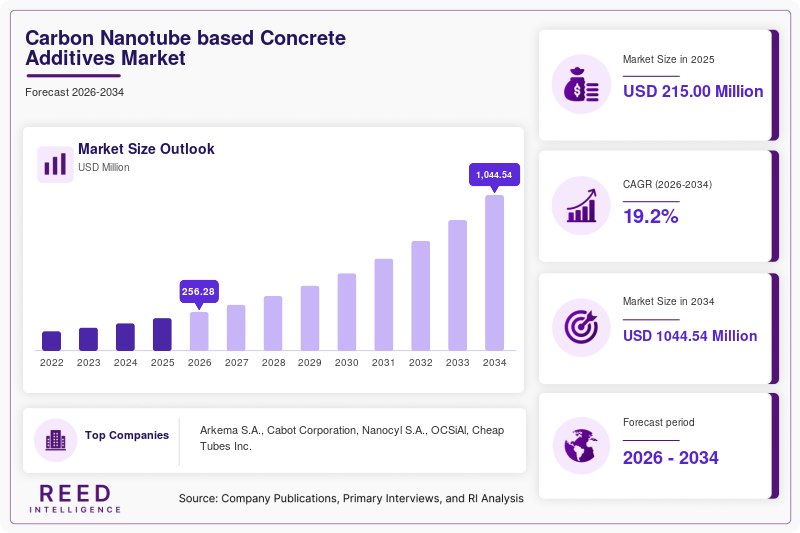
The global Carbon Nanotube based Concrete Additives Market size was valued at USD 215 million in 2025 and is projected to reach USD 1,045 million by 2034, expanding at a CAGR of 19.2% during 2025–2034. The market growth is primarily supported by increasing global demand for high-performance construction materials that enhance durability, tensile strength, and crack resistance in infrastructure projects. Carbon nanotube (CNT) additives are gaining traction due to their ability to significantly improve mechanical and electrical properties of concrete, making them suitable for advanced construction applications.
A key global factor driving the market is the rising investment in smart infrastructure and sustainable construction practices. Governments and private developers are increasingly adopting innovative materials that extend the lifecycle of structures while reducing maintenance costs. CNT-based additives contribute to improved structural integrity and reduced carbon footprint, aligning with green building standards.
Key Highlights
- Dominant region: Asia Pacific held approximately 38% market share in 2025, while it is expected to register the fastest growth with a CAGR of 21.1%.
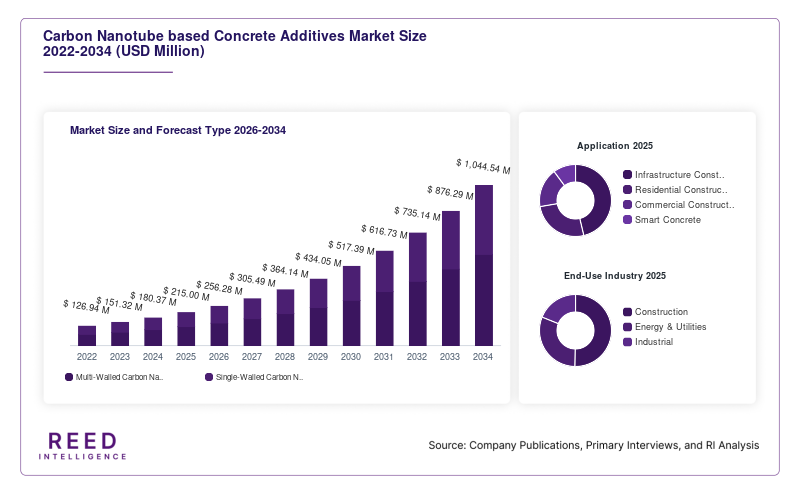
- Leading subsegments: Multi-walled carbon nanotubes dominated the type segment with 62% share, while single-walled nanotubes are projected to grow fastest at 20.5% CAGR. In applications, infrastructure construction led with 45% share, while smart concrete applications are expected to grow fastest at 22.3% CAGR.
- Dominant country: China accounted for USD 72 million in 2025, expected to reach USD 85 million in 2026, driven by rapid infrastructure expansion.
Market Trends
Integration of Smart and Self-Sensing Concrete
The Carbon Nanotube based Concrete Additives Market is witnessing a shift toward smart construction materials. CNT-based additives enable self-sensing capabilities in concrete by enhancing electrical conductivity. This allows real-time monitoring of structural health, stress, and damage. Such innovations are increasingly used in bridges, tunnels, and high-rise buildings to improve safety and predictive maintenance. The trend aligns with the broader adoption of intelligent infrastructure systems.
Adoption of Sustainable and Low-Carbon Construction Materials
Sustainability is becoming a central focus in the construction industry. CNT-based additives help reduce the volume of cement required while improving performance, thereby lowering overall carbon emissions. The growing emphasis on environmentally responsible construction is driving demand for advanced nanomaterials. Manufacturers are also investing in eco-friendly production methods for CNTs, further strengthening the market outlook.
Market Drivers
Increasing Demand for High-Strength Concrete
The need for durable and high-performance concrete is rising across infrastructure and commercial construction sectors. CNT-based additives significantly enhance compressive strength, tensile strength, and resistance to cracking. These properties make them suitable for demanding applications such as highways, bridges, and industrial structures, supporting consistent market expansion.
Growth in Urbanization and Infrastructure Development
Rapid urbanization, particularly in emerging economies, is driving large-scale construction activities. Governments are investing heavily in transportation networks, smart cities, and energy infrastructure. CNT-based additives offer improved longevity and reduced maintenance, making them an attractive solution for modern construction requirements.
Market Restraint
High Production and Material Costs
One of the primary challenges in the Carbon Nanotube based Concrete Additives Market is the high cost associated with the production and integration of carbon nanotubes. The synthesis of CNTs involves complex processes that require specialized equipment and expertise, leading to higher material costs compared to traditional additives.
Additionally, the lack of standardized guidelines for incorporating CNTs into concrete mixtures limits widespread adoption. Small and medium-sized construction firms often hesitate to adopt these advanced materials due to budget constraints and uncertainty regarding long-term performance. These factors collectively restrict market penetration, particularly in cost-sensitive regions.
Market Opportunities
Expansion in Smart Infrastructure Projects
The increasing adoption of smart infrastructure presents significant opportunities for CNT-based additives. The ability of CNT-enhanced concrete to provide real-time data on structural conditions is highly valuable for modern construction projects. This creates new avenues for integration in intelligent transportation systems and smart buildings.
Advancements in Nanotechnology Manufacturing
Ongoing research and development in nanotechnology are expected to reduce production costs and improve scalability. Innovations in CNT synthesis methods can make these additives more accessible to a broader range of applications. As production becomes more cost-efficient, market adoption is expected to accelerate across both developed and emerging economies.
Segmental Analysis
By Type
Multi-walled carbon nanotubes (MWCNTs) dominated the market with a 62% share in 2025, owing to their cost-effectiveness and superior mechanical reinforcement capabilities. Their widespread use in structural applications made them the preferred choice.
Single-walled carbon nanotubes (SWCNTs) are expected to grow at the fastest CAGR of 20.5%, driven by their exceptional electrical conductivity and potential in smart concrete applications. Their ability to enable self-sensing properties will support future adoption.
By Application
Infrastructure construction accounted for the largest share of 45% in 2025, supported by extensive use in bridges, roads, and tunnels. CNT additives enhanced durability and reduced maintenance requirements.
Smart concrete applications are projected to grow at a CAGR of 22.3%, driven by increasing demand for real-time monitoring systems in critical structures. This segment will benefit from advancements in sensor-enabled construction materials.
By End-Use Industry
The construction sector dominated with 68% share in 2025, as CNT additives were primarily used in residential, commercial, and industrial projects.
The energy and utilities segment is expected to grow at a CAGR of 19.8%, driven by demand for durable materials in power plants and renewable energy infrastructure.
By Form
Powder form held a dominant share of 57% in 2025, due to ease of mixing and compatibility with existing concrete formulations.
Liquid dispersions are projected to grow at a CAGR of 20.1%, as they offer improved dispersion of CNTs within the concrete matrix, enhancing performance.
Regional Analysis
North America
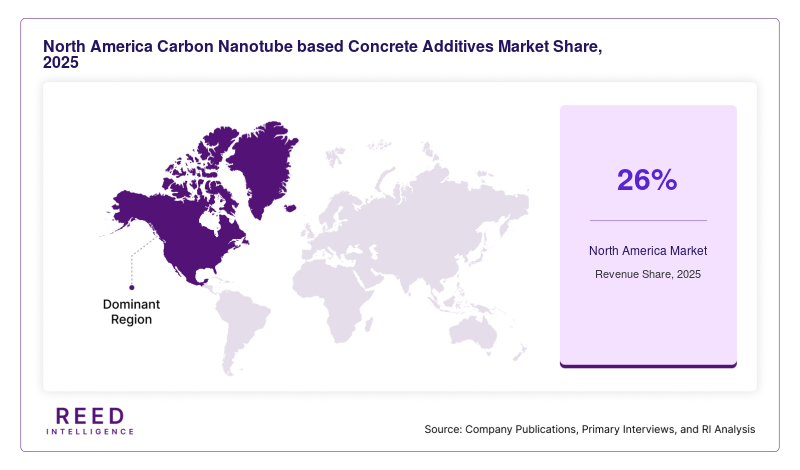
North America accounted for approximately 26% of the Carbon Nanotube based Concrete Additives Market share in 2025 and is expected to grow at a CAGR of 17.8% through 2034. The region’s growth is driven by the increasing adoption of advanced construction materials and strong focus on infrastructure modernization.
The United States dominated the regional market due to investments in highway rehabilitation and smart city initiatives. The demand for high-performance materials in seismic-resistant construction further supported market expansion.
Europe
Europe held around 22% market share in 2025 and is projected to grow at a CAGR of 18.3%. The region emphasized sustainable construction practices and strict environmental regulations, encouraging the use of innovative materials like CNT-based additives.
Germany emerged as the dominant country, driven by its advanced construction technologies and focus on energy-efficient buildings. The integration of CNT additives in green building projects contributed to regional growth.
Asia Pacific
Asia Pacific led the market with 38% share in 2025 and is expected to register the fastest CAGR of 21.1%. Rapid urbanization and large-scale infrastructure projects across developing economies supported growth.
China dominated the region due to extensive investments in transportation infrastructure and smart city developments. The country’s strong manufacturing base for nanomaterials further accelerated adoption.
Middle East & Africa
The Middle East & Africa accounted for 8% market share in 2025 and is projected to grow at a CAGR of 19.0%. Infrastructure development in urban centers and investments in mega construction projects supported demand.
The United Arab Emirates led the region, driven by high-end construction projects and adoption of advanced building materials for improved durability in extreme climatic conditions.
Latin America
Latin America held 6% market share in 2025 and is expected to grow at a CAGR of 18.7%. The region’s growth was supported by infrastructure development and increasing adoption of modern construction techniques.
Brazil dominated the regional market due to ongoing investments in transportation and residential infrastructure, creating demand for enhanced concrete performance.
Competitive Landscape
The Carbon Nanotube based Concrete Additives Market is moderately fragmented, with key players focusing on product innovation and strategic partnerships. Leading companies are investing in research and development to enhance CNT dispersion techniques and reduce production costs.
Arkema S.A. is recognized as a market leader, leveraging its expertise in advanced materials. The company recently expanded its nanomaterials portfolio to support high-performance construction applications.
Other prominent players are actively strengthening their global presence through collaborations with construction firms and infrastructure developers. The competitive environment is shaped by technological advancements and increasing demand for sustainable construction materials.
Key Players List
- Arkema S.A.
- Cabot Corporation
- Nanocyl S.A.
- OCSiAl
- Cheap Tubes Inc.
- Hanwha Corporation
- Showa Denko K.K.
- Hyperion Catalysis International
- CHASM Advanced Materials
- LG Chem Ltd.
- Toray Industries Inc.
- CNano Technology Limited
- Raymor Industries Inc.
- Kumho Petrochemical Co., Ltd.
- Arry International Group
Recent Developments
- Arkema S.A. expanded its CNT production capacity to support growing construction applications.
- OCSiAl introduced advanced CNT dispersions tailored for concrete reinforcement.
- Cabot Corporation invested in R&D for scalable CNT manufacturing technologies.
- Nanocyl S.A. partnered with construction firms to develop high-performance concrete solutions.
- CNano Technology launched new CNT grades optimized for infrastructure applications.
Carbon Nanotube based Concrete Additives Market Segments
Type
- Multi-Walled Carbon Nanotubes
- Single-Walled Carbon Nanotubes
Application
- Infrastructure Construction
- Residential Construction
- Commercial Construction
- Smart Concrete
End-Use Industry
- Construction
- Energy & Utilities
- Industrial
Form
- Powder
- Liquid Dispersion
By Region
- North America
- Europe
- APAC
- Middle East and Africa
- LATAM