Carbonyl Chloride Market Size, Share & Demand Report By Application (Isocyanates, Polycarbonates, Agrochemicals, Others), By End-Use Industry (Chemical, Automotive, Construction, Electronics), By Production Method (On-Site Production, Centralized Production), By End Product (Polyurethane Intermediates, Polycarbonate Resins, Specialty Chemical Intermediates), By Region & Segment Forecasts, 2026–2034
USD 3950
Market Overview
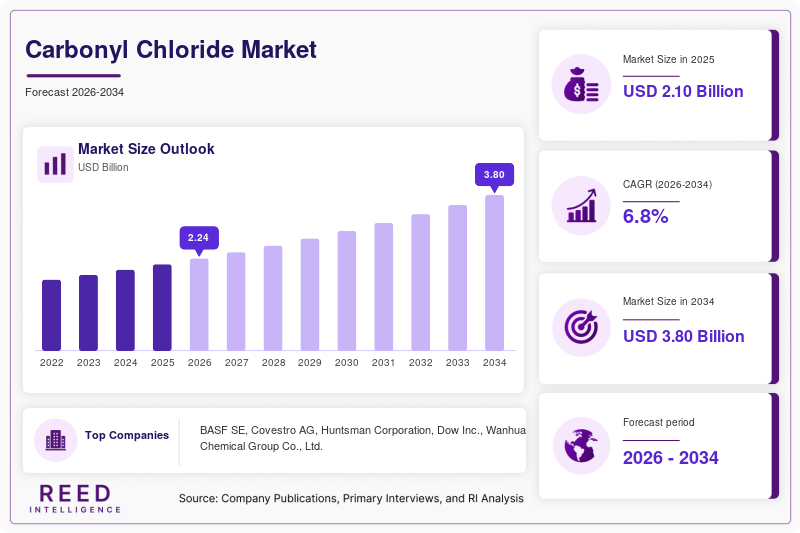
The global Carbonyl Chloride Market size was valued at approximately USD 2.1 billion in 2026 and is projected to reach USD 3.6 billion by 2034, expanding at a CAGR of 6.8% during the forecast period (2026–2034). Carbonyl chloride, commonly known as phosgene, plays a critical role as an intermediate in the production of polycarbonates, isocyanates, and agrochemicals, thereby sustaining steady demand across industrial sectors.
A key global factor supporting market growth has been the increasing demand for high-performance polymers and specialty chemicals in automotive, construction, and electronics industries. The shift toward lightweight and durable materials has elevated the consumption of polycarbonate resins and polyurethane foams, both of which rely heavily on carbonyl chloride in their manufacturing processes.
Key Highlights:
- Asia Pacific dominated the market with a 42% share in 2025, while it is expected to register the fastest growth at a CAGR of 7.5% during 2026–2034.
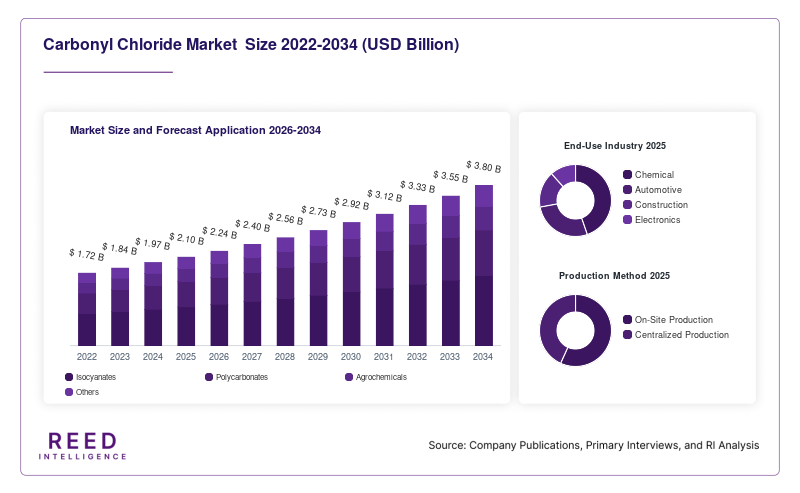
- By application, isocyanates accounted for the largest share at 48% in 2025, while polycarbonates are projected to grow at the fastest CAGR of 7.9%.
- By end-use, the chemical industry held the leading share of 51% in 2025, whereas the automotive sector is anticipated to grow at a CAGR of 7.2%.
- The United States remained the dominant country, with market values of USD 480 million in 2024 and USD 505 million in 2025.
Market Trends
Rising Adoption of Polycarbonate-Based Materials
One of the prominent trends shaping the Carbonyl Chloride Market is the increasing adoption of polycarbonate materials in advanced manufacturing applications. Polycarbonates offer high impact resistance, transparency, and thermal stability, making them suitable for automotive components, electronics housings, and construction panels. As industries focus on lightweight and energy-efficient solutions, the demand for polycarbonate resins has increased steadily. This trend is particularly evident in electric vehicle manufacturing, where lightweight materials contribute to enhanced battery performance and efficiency. Consequently, the upstream demand for carbonyl chloride as a key raw material in polycarbonate synthesis continues to expand.
Integration of Closed-Loop Production Systems
Another notable trend is the integration of closed-loop and on-site production systems for carbonyl chloride. Due to its toxic nature, manufacturers are increasingly adopting captive production models to minimize transportation risks and ensure operational safety. Companies are investing in advanced containment technologies and automated monitoring systems to handle carbonyl chloride more efficiently. This shift toward integrated production not only enhances safety but also reduces operational costs and improves supply chain reliability. Additionally, stringent environmental regulations have encouraged manufacturers to optimize production processes, resulting in improved efficiency and reduced emissions.
Market Drivers
Expansion of Polyurethane and Isocyanate Demand
The growing demand for polyurethane products has been a major driver for the Carbonyl Chloride Market. Polyurethanes are widely used in insulation materials, coatings, adhesives, and flexible foams. These applications are experiencing increased demand due to rising construction activities and the need for energy-efficient buildings. Carbonyl chloride serves as a critical intermediate in the production of isocyanates such as MDI and TDI, which are essential for polyurethane manufacturing. As construction and infrastructure development continue to expand globally, the demand for polyurethane-based materials is expected to remain strong, thereby driving the carbonyl chloride market.
Growth of Agrochemical Production
Another key driver is the rising demand for agrochemicals to support global food production. Carbonyl chloride is used in the synthesis of various pesticides and herbicides, which are essential for improving crop yields. With increasing population and shrinking arable land, the need for efficient agricultural practices has intensified. This has led to higher consumption of agrochemicals, indirectly boosting the demand for carbonyl chloride. Additionally, advancements in agrochemical formulations and the introduction of new crop protection products are expected to further support market growth.
Market Restraint
Toxicity and Stringent Regulatory Frameworks
A major restraint impacting the Carbonyl Chloride Market is the highly toxic nature of carbonyl chloride and the strict regulatory frameworks governing its production, storage, and transportation. Carbonyl chloride is classified as a hazardous chemical due to its potential health and environmental risks. Exposure can lead to severe respiratory issues, necessitating stringent safety measures during handling.
Regulatory authorities across regions have implemented strict guidelines to control emissions and ensure safe handling practices. Compliance with these regulations requires significant investment in safety infrastructure, monitoring systems, and employee training. For small and medium-scale manufacturers, these costs can be substantial, limiting their ability to compete effectively in the market.
Furthermore, the transportation of carbonyl chloride is heavily restricted, leading to logistical challenges and increased operational costs. Many companies prefer on-site production to mitigate these risks, but this approach requires additional capital investment. These factors collectively act as barriers to market entry and expansion, potentially restraining overall market growth during the forecast period.
Market Opportunities
Growth in Specialty Chemical Applications
The expanding specialty chemicals sector presents a significant opportunity for the Carbonyl Chloride Market. Carbonyl chloride is increasingly used in the synthesis of high-value specialty chemicals, including pharmaceuticals, dyes, and performance additives. The growing demand for customized chemical solutions across industries is driving the need for advanced intermediates, creating new growth avenues for carbonyl chloride manufacturers. As industries continue to innovate and develop new products, the demand for specialized chemical intermediates is expected to rise, offering long-term growth potential.
Emerging Markets Industrialization
Rapid industrialization in emerging economies offers another promising opportunity for market expansion. Countries in Asia Pacific, Latin America, and parts of Africa are witnessing increased investments in manufacturing and chemical production. This growth is supported by favorable government policies, improving infrastructure, and rising domestic demand. As these regions develop their industrial capabilities, the demand for carbonyl chloride as a key intermediate is expected to increase. Additionally, the establishment of new chemical plants and expansion of existing facilities in these regions will further support market growth.
Segmental Analysis
By Application
The isocyanates segment dominated the Carbonyl Chloride Market, accounting for approximately 48% of the market share in 2025. This dominance has been driven by the widespread use of isocyanates in polyurethane production. Polyurethane materials are extensively used in insulation, coatings, and adhesives, making isocyanates a key application area for carbonyl chloride.
The polycarbonates segment is expected to grow at the fastest CAGR of 7.9% during the forecast period. The increasing use of polycarbonate materials in automotive and electronics applications will drive this growth. Polycarbonates offer superior mechanical properties and durability, making them suitable for high-performance applications. As industries continue to adopt lightweight and durable materials, the demand for polycarbonates is expected to rise significantly.
By End-Use Industry
The chemical industry held the largest share of approximately 51% in 2025, driven by the extensive use of carbonyl chloride as an intermediate in chemical synthesis. The production of specialty chemicals, polymers, and agrochemicals has contributed to the dominance of this segment.
The automotive industry is projected to grow at the fastest CAGR of 7.2% during the forecast period. The increasing demand for lightweight materials and energy-efficient vehicles will drive the use of carbonyl chloride-derived products. Polycarbonates and polyurethanes are widely used in automotive components, supporting the growth of this segment.
By Production Method
The on-site production segment dominated the market with a share of approximately 63% in 2025. Due to the hazardous nature of carbonyl chloride, manufacturers prefer on-site production to minimize transportation risks and ensure safety. This approach has been widely adopted by large-scale chemical manufacturers.
The centralized production segment is expected to grow at a CAGR of 6.5% during the forecast period. Advances in transportation and storage technologies will support the growth of this segment. Additionally, increasing demand from smaller manufacturers who rely on external suppliers will contribute to its expansion.
By End Product
The polyurethane intermediates segment accounted for the largest share of around 45% in 2025, driven by the high demand for polyurethane products across various industries. Carbonyl chloride plays a crucial role in the production of these intermediates, making this segment a key contributor to market growth.
The specialty chemical intermediates segment is expected to grow at a CAGR of 7.3% during the forecast period. The increasing demand for customized chemical solutions and high-value products will drive this growth. Industries such as pharmaceuticals and electronics are expected to contribute significantly to the expansion of this segment.
Regional Analysis
North America
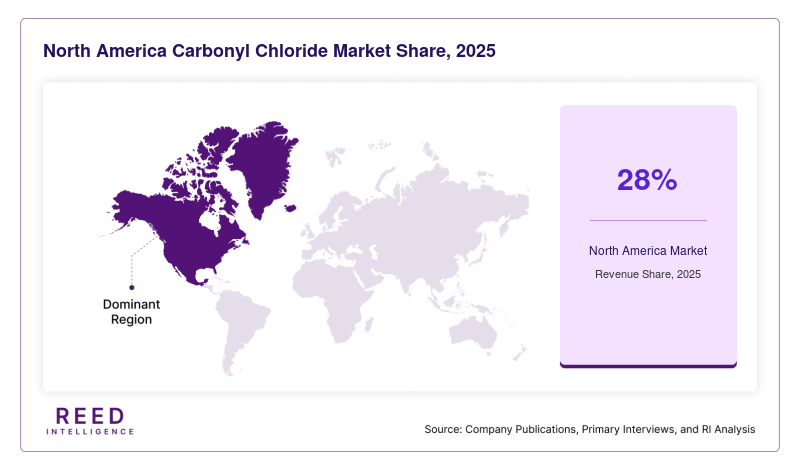
North America accounted for approximately 28% of the Carbonyl Chloride Market share in 2025 and is expected to grow at a CAGR of 6.3% during 2026–2034. The region has a well-established chemical manufacturing industry, supported by advanced technologies and strong regulatory frameworks. Demand for carbonyl chloride in North America has been driven by its application in high-performance materials and specialty chemicals.
The United States dominated the regional market due to its strong industrial base and technological advancements. The presence of major chemical manufacturers and ongoing investments in research and development have contributed to market growth. Additionally, the increasing focus on sustainable materials has encouraged the use of advanced polymers, indirectly supporting the demand for carbonyl chloride.
Europe
Europe held around 24% of the market share in 2025 and is projected to grow at a CAGR of 6.1% during the forecast period. The region’s growth has been supported by its strong emphasis on environmental sustainability and innovation in chemical processes. European manufacturers have been adopting advanced production techniques to improve efficiency and reduce emissions.
Germany emerged as the dominant country in the region, driven by its robust chemical and automotive industries. The country’s focus on high-quality manufacturing and technological innovation has supported the demand for carbonyl chloride. Additionally, the presence of leading chemical companies and research institutions has contributed to the region’s steady growth.
Asia Pacific
Asia Pacific led the market with a 42% share in 2025 and is expected to grow at the fastest CAGR of 7.5% during 2026–2034. The region’s dominance has been attributed to rapid industrialization, expanding manufacturing sectors, and increasing demand for chemicals and polymers.
China dominated the Asia Pacific market due to its large-scale chemical production capacity and strong export base. The country’s focus on infrastructure development and industrial expansion has driven the demand for carbonyl chloride. Additionally, the availability of raw materials and cost-effective labor has further strengthened China’s position in the market.
Middle East & Africa
The Middle East & Africa accounted for approximately 4% of the market share in 2025 and is projected to grow at a CAGR of 5.9%. The region’s growth has been supported by increasing investments in the chemical and petrochemical sectors.
Saudi Arabia emerged as the leading country, driven by its strong petrochemical industry and access to raw materials. The country’s strategic initiatives to diversify its economy and expand its industrial base have contributed to the growth of the carbonyl chloride market. Additionally, ongoing infrastructure projects and industrial development have further supported demand.
Latin America
Latin America held around 2% of the market share in 2025 and is expected to grow at a CAGR of 5.7% during the forecast period. The region’s growth has been driven by increasing industrial activities and demand for agrochemicals.
Brazil dominated the regional market due to its strong agricultural sector and growing chemical industry. The country’s focus on improving agricultural productivity has increased the demand for agrochemicals, thereby supporting the consumption of carbonyl chloride. Additionally, government initiatives to promote industrial growth have contributed to market expansion.
Competitive Landscape
The Carbonyl Chloride Market is moderately consolidated, with key players focusing on capacity expansion, technological advancements, and strategic collaborations. Leading companies are investing in advanced production technologies to enhance efficiency and ensure safety compliance.
BASF SE is a leading player in the market, known for its strong product portfolio and global presence. The company recently expanded its production capacity to meet the growing demand for polycarbonate and polyurethane intermediates.
Other major players include Covestro AG, Huntsman Corporation, Dow Inc., and Wanhua Chemical Group Co., Ltd. These companies are focusing on innovation and sustainability to strengthen their market position. Strategic partnerships and mergers are also common strategies adopted by market participants to expand their global footprint and enhance their product offerings.
Key Players List
- BASF SE
- Covestro AG
- Huntsman Corporation
- Dow Inc.
- Wanhua Chemical Group Co., Ltd.
- Mitsubishi Chemical Corporation
- Lanxess AG
- Solvay S.A.
- Tosoh Corporation
- Sumitomo Chemical Co., Ltd.
- Arkema S.A.
- LG Chem Ltd.
- China National Chemical Corporation
- SABIC
- UBE Corporation
Recent Developments
- BASF SE expanded its carbonyl chloride production capacity in Asia to support rising demand for polycarbonate applications.
- Covestro AG invested in advanced safety systems for on-site phosgene production facilities.
- Wanhua Chemical Group increased its MDI production capacity, indirectly boosting carbonyl chloride consumption.
- Huntsman Corporation focused on developing sustainable polyurethane solutions using improved intermediates.
- Dow Inc. strengthened its supply chain capabilities through strategic partnerships in emerging markets.
Carbonyl Chloride Market Segments
Application
- Isocyanates
- Polycarbonates
- Agrochemicals
- Others
End-Use Industry
- Chemical
- Automotive
- Construction
- Electronics
Production Method
- On-Site Production
- Centralized Production
End Product
- Polyurethane Intermediates
- Polycarbonate Resins
- Specialty Chemical Intermediates
By Region
- North America
- Europe
- APAC
- Middle East and Africa
- LATAM