Cardiac Sutures Market Size, Share & Demand Report By Product Type (Absorbable Sutures, Non-Absorbable Sutures, Antimicrobial-Coated Sutures, Braided Sutures, Monofilament Sutures), By Application (Cardiac Valve Surgery, Coronary Artery Bypass Grafting, Congenital Heart Defect Repair, Heart Transplantation, Minimally Invasive Cardiac Surgery), By End Use (Hospitals, Ambulatory Surgical Centers, Specialty Cardiac Clinics, Academic and Research Institutes), By Region & Segment Forecasts, 2026–2034
USD 3950
Market Overview
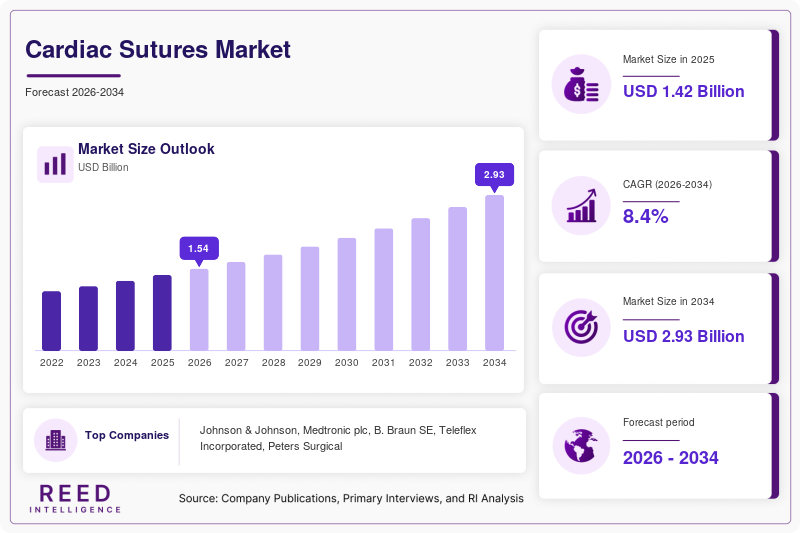
The global Cardiac Sutures Market size was valued at approximately USD 1.42 billion in 2026 and is projected to reach nearly USD 2.71 billion by 2034, expanding at a CAGR of 8.4% during the forecast period from 2026 to 2034. The market continues to expand due to the increasing volume of cardiovascular surgeries performed worldwide and the growing burden of coronary artery disease, heart valve disorders, congenital heart defects, and vascular complications. Cardiac sutures remain essential components in open-heart procedures, minimally invasive surgeries, bypass surgeries, and valve replacement operations, where precision wound closure and tissue approximation are critical for patient outcomes.
One major global factor supporting the growth of the Cardiac Sutures Market is the rising aging population. Elderly individuals are more susceptible to cardiovascular diseases and frequently require surgical intervention. Healthcare systems across developed and developing economies are also increasing investments in advanced cardiac care infrastructure, specialized surgical centers, and robotic-assisted surgical technologies. In addition, improvements in suture materials such as absorbable polymers, antimicrobial coatings, and enhanced tensile strength are supporting wider adoption among cardiac surgeons. Manufacturers are also focusing on product innovation to improve handling properties, knot security, and healing efficiency in high-risk cardiovascular procedures.
Key Highlights
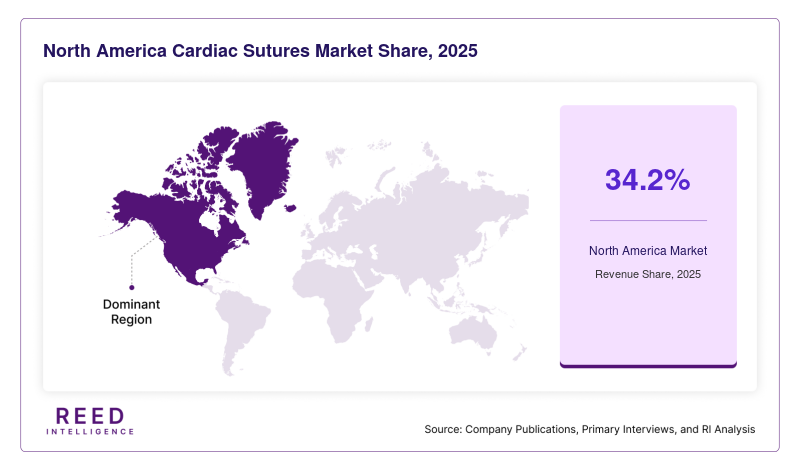
- North America dominated the market with a 34.2% share in 2025, while Asia Pacific is expected to grow at the fastest CAGR of 10.8% during 2026–2034.
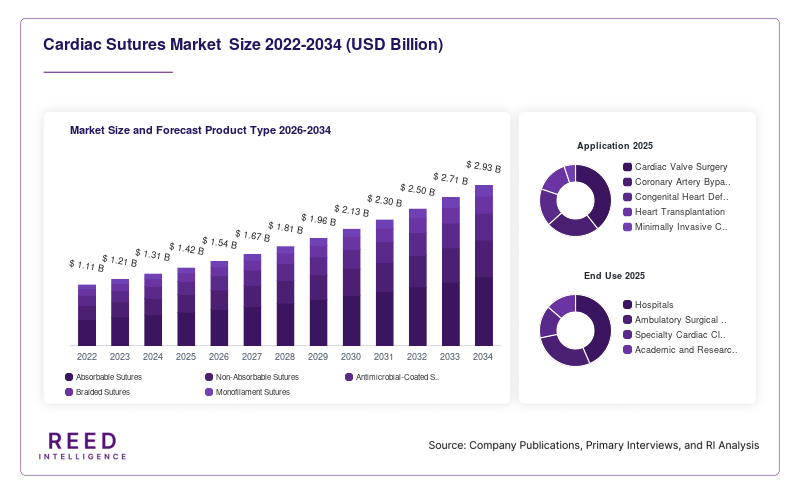
- By product type, absorbable sutures accounted for the largest share of 46.1%, while antimicrobial-coated sutures are projected to grow at a CAGR of 11.6%.
- By application, cardiac valve surgery led with a 39.4% share, whereas minimally invasive cardiac surgery is expected to expand at a CAGR of 12.1%.
- By end use, hospitals represented the dominant segment with a 63.7% share, while ambulatory surgical centers are forecast to grow at a CAGR of 10.4%.
- The United States remained the dominant country, with market values of USD 472 million in 2024 and USD 516 million in 2025.
Market Trends
Rising Adoption of Antimicrobial and Bioactive Sutures
The Cardiac Sutures Market is experiencing increasing demand for antimicrobial and bioactive sutures designed to reduce surgical site infections and improve tissue healing. Cardiac procedures involve high clinical risks, making infection prevention a critical focus area for healthcare providers. Manufacturers are introducing sutures coated with triclosan and other antimicrobial agents to minimize bacterial growth around surgical wounds. Hospitals are increasingly integrating these products into cardiac surgery protocols because postoperative infections can extend hospital stays and increase treatment costs. Surgeons also prefer sutures with improved knot security and flexibility that support precision during delicate cardiovascular procedures.
In addition, bioactive sutures that support tissue regeneration and reduce inflammatory response are gaining attention across specialized cardiac centers. The demand is especially high in developed healthcare markets where hospitals prioritize outcome-based treatment models. Product innovation in absorbable polymers and coated sutures is helping companies differentiate their offerings and strengthen their market presence. This trend is expected to continue as healthcare systems place greater emphasis on reducing complications and improving surgical efficiency.
Integration of Robotic and Minimally Invasive Cardiac Procedures
The increasing use of robotic-assisted and minimally invasive cardiac surgeries is influencing product development and procurement patterns in the Cardiac Sutures Market. Traditional open-heart surgeries are gradually being complemented by procedures involving smaller incisions, robotic platforms, and catheter-assisted interventions. These techniques require highly specialized sutures with superior handling characteristics, durability, and precision. Cardiac surgeons are increasingly selecting lightweight and high-performance sutures that support shorter operation times and improved procedural accuracy.
Hospitals are also investing in robotic surgical systems to reduce patient recovery time, minimize trauma, and improve clinical outcomes. This shift is creating demand for sutures that can perform efficiently in confined surgical environments. Manufacturers are responding by developing advanced monofilament and braided sutures optimized for minimally invasive techniques. The trend is particularly visible in urban hospitals and specialty cardiac centers where healthcare providers seek to improve operational efficiency and patient satisfaction. Continued advancements in robotic surgery are expected to create long-term growth opportunities for specialized cardiac sutures.
Market Drivers
Growing Prevalence of Cardiovascular Diseases Worldwide
The rising global incidence of cardiovascular diseases is a major factor driving the growth of the Cardiac Sutures Market. Conditions such as coronary artery disease, arrhythmias, heart failure, and valvular disorders continue to increase due to aging populations, sedentary lifestyles, obesity, and diabetes prevalence. As the number of patients requiring cardiac interventions grows, the demand for reliable surgical closure materials is increasing across hospitals and specialty surgical centers. Cardiac sutures are essential in procedures including bypass surgery, heart transplantation, and valve repair operations.
Healthcare organizations are expanding cardiovascular treatment capacities to address the growing patient burden. Governments in several countries are also increasing funding for cardiac care programs and advanced surgical facilities. Improved diagnostic technologies are enabling earlier detection of cardiovascular disorders, which contributes to higher surgical volumes. Furthermore, rising healthcare expenditure and insurance coverage in emerging economies are allowing more patients to access surgical treatment. These factors collectively support stable demand for cardiac sutures across both developed and developing healthcare markets.
Expansion of Healthcare Infrastructure and Cardiac Surgery Centers
The expansion of healthcare infrastructure and specialized cardiac treatment centers is contributing significantly to market growth. Countries across Asia Pacific, Latin America, and the Middle East are increasing investments in hospitals, surgical units, and advanced operating facilities. This expansion is improving patient access to cardiovascular surgeries and supporting the procurement of high-quality cardiac sutures. Healthcare providers are also prioritizing surgical precision and patient safety, leading to the adoption of technologically advanced suturing materials.
Private healthcare chains and medical tourism hubs are further stimulating demand for cardiac surgical products. Several hospitals are modernizing operating rooms with robotic systems and minimally invasive surgical tools, increasing the need for specialized sutures designed for advanced procedures. In addition, training programs for cardiovascular surgeons are improving procedural capabilities in emerging markets. Manufacturers are collaborating with hospitals and distributors to strengthen supply chains and expand regional product availability. As healthcare systems continue to improve, the number of cardiac procedures is expected to rise steadily, supporting long-term growth of the Cardiac Sutures Market.
Market Restraint
High Cost of Advanced Cardiac Surgery Procedures and Products
The high cost associated with advanced cardiac surgeries and premium suturing products remains a key restraint for the Cardiac Sutures Market. Specialized cardiac procedures often require sophisticated equipment, experienced surgeons, intensive postoperative care, and high-quality surgical consumables, all of which contribute to elevated treatment expenses. In several developing countries, healthcare reimbursement systems remain limited, making advanced cardiovascular procedures financially challenging for patients. As a result, hospitals in cost-sensitive markets may continue using conventional sutures instead of premium antimicrobial or bioactive products.
Price sensitivity also affects procurement decisions among public hospitals operating under constrained healthcare budgets. Smaller healthcare facilities may prioritize lower-cost alternatives rather than investing in technologically advanced sutures with enhanced performance features. In addition, fluctuating raw material costs and regulatory compliance expenses can increase manufacturing costs for medical device companies. These financial pressures may reduce product accessibility in low-income regions where cardiovascular disease prevalence is rising rapidly. For example, several regional hospitals in emerging economies continue to rely on imported cardiac sutures, leading to higher operational expenses and inconsistent supply availability. Such factors can limit broader market penetration despite increasing clinical demand.
Market Opportunities
Increasing Demand for Biodegradable and Sustainable Suture Materials
The growing focus on biodegradable and sustainable medical products presents a significant opportunity for the Cardiac Sutures Market. Healthcare providers are increasingly seeking surgical materials that support faster healing while reducing long-term complications associated with non-absorbable products. Biodegradable sutures eliminate the need for removal procedures and reduce patient discomfort, making them attractive in cardiac applications where recovery efficiency is critical. Advances in polymer science are enabling manufacturers to develop sutures with controlled absorption rates, high tensile strength, and improved tissue compatibility.
Environmental sustainability is also becoming an important consideration within healthcare procurement strategies. Hospitals and regulatory authorities are encouraging the use of eco-friendly medical materials that minimize waste generation and environmental impact. Companies investing in sustainable production technologies and bio-based materials may gain a competitive advantage in the coming years. The opportunity is particularly strong in developed regions where healthcare institutions are integrating sustainability goals into purchasing decisions. As innovation in biomaterials continues, biodegradable cardiac sutures are expected to gain wider acceptance among surgeons and healthcare providers.
Rising Growth Potential in Emerging Healthcare Markets
Emerging economies offer substantial growth opportunities for companies operating in the Cardiac Sutures Market. Countries such as India, China, Brazil, Indonesia, and Saudi Arabia are witnessing rapid improvements in healthcare infrastructure, insurance coverage, and cardiovascular treatment accessibility. Rising disposable incomes and increasing awareness regarding heart disease treatment are contributing to higher patient volumes in cardiac surgery departments. Governments are also supporting healthcare modernization initiatives and investing in specialized cardiac care centers.
Medical tourism is another factor creating opportunities in emerging markets. Patients increasingly travel to countries offering cost-effective cardiac procedures and modern healthcare facilities. This trend is encouraging hospitals to adopt advanced surgical products and maintain international quality standards. Manufacturers are establishing regional manufacturing facilities and distribution partnerships to strengthen their presence in high-growth economies. In addition, expanding physician training programs and improved availability of minimally invasive surgical technologies are supporting the adoption of premium cardiac sutures. These developments are expected to create favorable long-term revenue opportunities for global and regional market participants.
Segmental Analysis
By Product Type
Absorbable sutures accounted for the largest share of the Cardiac Sutures Market in 2024, representing approximately 46.1% of total revenue. These sutures are widely preferred in cardiovascular surgeries because they naturally degrade within the body, reducing the need for suture removal procedures and minimizing patient discomfort. Cardiac surgeons frequently use absorbable sutures in internal tissue closure applications where long-term foreign material retention may increase complication risks. The growing emphasis on faster patient recovery and improved postoperative outcomes has further strengthened demand for these products.
Healthcare providers also favor absorbable sutures because of their compatibility with minimally invasive procedures and reduced inflammatory response. Manufacturers continue investing in advanced polymer technologies to improve tensile strength, flexibility, and absorption predictability. The increasing number of coronary artery bypass graft procedures and valve repair surgeries across major healthcare markets contributes significantly to segment growth. In addition, hospitals are increasingly integrating advanced absorbable sutures into standardized cardiovascular treatment protocols to improve surgical efficiency and patient safety.
By Application
Cardiac valve surgery represented the dominant application segment in the Cardiac Sutures Market during 2024, accounting for approximately 39.4% of total market revenue. The increasing prevalence of valvular heart diseases and the growing number of valve replacement and repair procedures continue to drive demand for specialized sutures in this segment. Cardiac valve surgeries require high precision and durable wound closure materials because even minor complications can significantly impact patient outcomes. Surgeons prefer sutures with superior knot security and tensile strength to ensure procedural reliability.
The aging population is also contributing to increased demand for valve-related cardiac procedures, especially in developed countries where degenerative heart conditions are more common among elderly patients. Hospitals are adopting advanced suturing materials designed to improve tissue compatibility and reduce inflammatory response during valve surgeries. In addition, growing availability of minimally invasive valve replacement procedures is supporting the use of technologically advanced cardiac sutures. These factors collectively reinforce the leading position of the cardiac valve surgery segment within the market.
By End Use
Hospitals accounted for the largest share of the Cardiac Sutures Market in 2024, contributing approximately 63.7% of total revenue. Large hospitals remain the primary centers for cardiovascular surgeries because they possess specialized surgical teams, intensive care units, and advanced operating facilities required for complex cardiac procedures. The increasing burden of heart diseases and rising surgical volumes continue to strengthen demand for cardiac sutures within hospital settings. Public and private hospitals are also investing in robotic-assisted surgical systems and advanced infection-control technologies.
In addition, hospitals benefit from established procurement networks and long-term supplier agreements with medical device manufacturers. These institutions frequently adopt premium suturing products designed to improve patient safety and reduce postoperative complications. The expansion of specialized cardiac departments and multidisciplinary treatment centers further supports segment dominance. Healthcare systems across several countries are also increasing funding for cardiovascular treatment infrastructure, enabling hospitals to expand surgical capabilities and improve procedural efficiency.
Regional Analysis
North America
North America accounted for approximately 34.2% of the global Cardiac Sutures Market in 2025 and maintained its leading position due to advanced healthcare infrastructure and high cardiovascular surgery volumes. The region is projected to grow at a CAGR of 7.6% during the forecast period. Strong adoption of technologically advanced sutures, favorable reimbursement policies, and widespread availability of skilled cardiac surgeons continue to support market expansion. Hospitals across the United States and Canada are increasingly investing in robotic-assisted surgical systems and infection-control technologies, further driving demand for premium cardiac sutures.
The United States remains the dominant country within North America due to its large patient population and strong healthcare spending capacity. One unique growth factor supporting the market is the rapid adoption of minimally invasive cardiac procedures in major hospital networks. Healthcare institutions are prioritizing faster patient recovery and lower postoperative complications, encouraging the use of advanced monofilament and antimicrobial sutures. In addition, the presence of leading medical device manufacturers and continuous product innovation contributes to sustained regional market leadership.
Europe
Europe represented nearly 27.1% of the global Cardiac Sutures Market in 2025 and is expected to expand at a CAGR of 7.9% through 2034. The region benefits from well-established healthcare systems, rising elderly populations, and increasing awareness regarding cardiovascular disease management. Countries across Western Europe continue to invest in advanced surgical technologies and hospital modernization programs. Demand for absorbable and bioactive sutures is increasing as healthcare providers seek improved patient outcomes and reduced infection risks during cardiovascular procedures.
Germany emerged as the dominant country in the European market due to its advanced medical infrastructure and strong surgical expertise. A unique factor driving growth in Germany is the increasing collaboration between hospitals and research institutions focused on surgical innovation. Cardiac centers are actively participating in clinical studies involving advanced suture materials and minimally invasive procedures. In addition, supportive regulatory standards and rising demand for precision surgical solutions are encouraging adoption of technologically advanced cardiac sutures throughout the country.
Asia Pacific
Asia Pacific held approximately 22.8% of the global Cardiac Sutures Market in 2025 and is anticipated to register the fastest CAGR of 10.8% during the forecast period. Rapid urbanization, growing healthcare expenditure, and increasing cardiovascular disease prevalence are supporting regional market growth. Governments across China, India, Japan, and Southeast Asia are expanding access to cardiac treatment services and improving hospital infrastructure. The rising number of specialized cardiac surgery centers is also increasing procurement of advanced surgical consumables and suturing products.
China remains the dominant country within Asia Pacific due to its large population base and rapidly expanding healthcare industry. One unique growth factor in the Chinese market is the government’s continued investment in domestic medical device manufacturing and healthcare modernization programs. Local production capabilities are improving supply chain efficiency and product affordability. In addition, increasing adoption of robotic-assisted surgeries in urban hospitals is creating demand for specialized cardiac sutures with enhanced handling and durability characteristics.
Middle East & Africa
The Middle East & Africa region accounted for nearly 8.1% of the global Cardiac Sutures Market in 2025 and is projected to grow at a CAGR of 8.7% through 2034. Increasing investments in healthcare infrastructure and rising incidence of lifestyle-related cardiovascular diseases are contributing to market expansion. Countries within the Gulf Cooperation Council are establishing advanced cardiac care facilities and attracting international healthcare providers. Demand for high-quality surgical products is also increasing due to improvements in healthcare accessibility and insurance coverage.
Saudi Arabia emerged as the leading country in the regional market because of strong government healthcare initiatives and growing medical tourism activity. One unique growth factor driving the market is the expansion of specialized cardiac hospitals under national healthcare transformation programs. Healthcare authorities are investing heavily in modern surgical technologies and physician training programs to reduce dependence on overseas treatment. These developments are increasing the adoption of advanced cardiac sutures in both public and private healthcare institutions.
Latin America
Latin America captured approximately 7.8% of the global Cardiac Sutures Market in 2025 and is expected to grow at a CAGR of 8.1% during the forecast period. Rising awareness regarding cardiovascular treatment and improving healthcare infrastructure are supporting regional market development. Several countries are increasing investments in public healthcare systems and expanding access to cardiac surgery services. The region is also witnessing gradual adoption of minimally invasive surgical procedures, creating demand for technologically advanced suturing materials.
Brazil remains the dominant country in Latin America due to its relatively large healthcare sector and increasing cardiac procedure volumes. A unique growth factor supporting the Brazilian market is the expansion of private hospital networks offering specialized cardiovascular care. These facilities are adopting modern surgical technologies and advanced infection-control protocols, increasing demand for antimicrobial and absorbable cardiac sutures. Furthermore, rising partnerships between international medical device companies and regional distributors are improving product availability across the country.
Competitive Landscape
The Cardiac Sutures Market remains moderately consolidated, with several multinational medical device manufacturers competing through product innovation, strategic partnerships, and regional expansion initiatives. Leading companies focus on developing advanced sutures with improved tensile strength, antimicrobial properties, and enhanced handling performance for minimally invasive cardiac procedures. Competitive intensity is increasing as manufacturers seek to strengthen their presence in emerging healthcare markets and expand product portfolios targeting specialized cardiovascular applications.
Johnson & Johnson remains a leading participant in the market due to its broad surgical product portfolio, strong global distribution network, and continued investments in cardiovascular surgical technologies. The company recently expanded its antimicrobial suture portfolio to support infection prevention initiatives in complex surgical procedures. Other major companies including Medtronic, B. Braun, and Teleflex are also investing in research and development activities focused on bioactive materials and absorbable polymers.
Key Players
- Johnson & Johnson
- Medtronic plc
- B. Braun SE
- Teleflex Incorporated
- Peters Surgical
- Healthium Medtech
- Smith & Nephew plc
- Dolphin Sutures
- Sutures India Pvt. Ltd.
- Internacional Farmacéutica
- Boston Scientific Corporation
- W. L. Gore & Associates
- Surgical Specialties Corporation
- Riverpoint Medical
- Corza Medical
Recent Developments
- In February 2026, Medtronic plc introduced a next-generation antimicrobial cardiac suture portfolio designed for minimally invasive cardiovascular procedures.
- In August 2025, Healthium Medtech expanded its manufacturing capacity in India to strengthen supply chain efficiency for absorbable surgical sutures.
- In November 2025, Teleflex Incorporated partnered with a leading cardiac research institute to develop bioactive sutures focused on improving tissue healing outcomes.
- In March 2026, B. Braun SE launched an advanced monofilament cardiac suture line optimized for robotic-assisted surgical applications.
- In January 2026, Johnson & Johnson expanded distribution agreements across Latin America to improve accessibility of cardiovascular surgical products in regional hospitals.
Cardiac Sutures Market Segments
Product Type
- Absorbable Sutures
- Non-Absorbable Sutures
- Antimicrobial-Coated Sutures
- Braided Sutures
- Monofilament Sutures
Application
- Cardiac Valve Surgery
- Coronary Artery Bypass Grafting
- Congenital Heart Defect Repair
- Heart Transplantation
- Minimally Invasive Cardiac Surgery
End Use
- Hospitals
- Ambulatory Surgical Centers
- Specialty Cardiac Clinics
- Academic and Research Institutes
By Region
- North America
- Europe
- APAC
- Middle East and Africa
- LATAM