Career Coaching Service Market Size, Share & Trends Analysis Report By Service Type (One-on-One Coaching, Group Coaching, Online/Digital Coaching and AI-Assisted Coaching), By Application (Career Transition, Job Search & Interview Preparation, Leadership & Executive Development, Skill Development), By End User (Individuals, Corporates and Educational Institutions) Forecasts, 2026–2034
USD 3950
Career Coaching Service Market Size
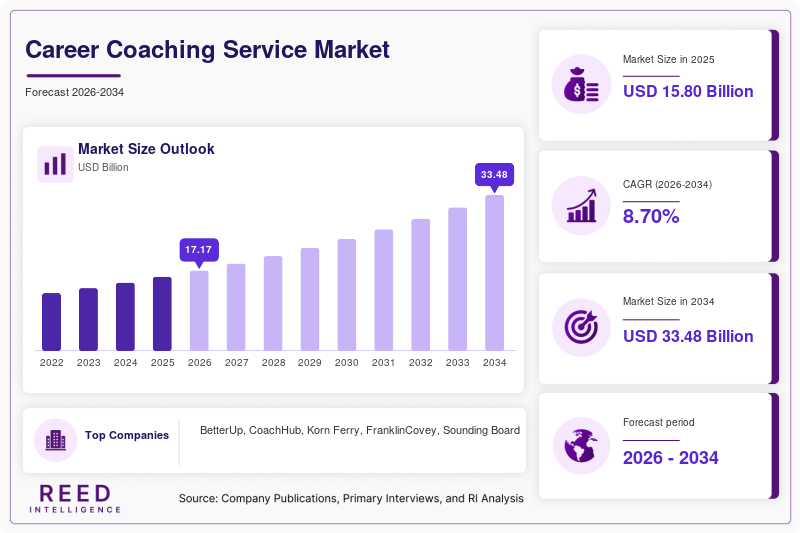
The global career coaching service market was valued at USD 15.80 billion in 2025 and is projected to grow from USD 17.17 billion in 2026 to USD 33.48 billion by 2034, registering a CAGR of 8.70% during the forecast period from 2026 to 2034.
Career coaching services provide structured guidance for individuals navigating career entry, job changes, advancement, leadership development, skill acquisition and employment transitions. Services can range from traditional one-on-one sessions to group programs, digital platforms, AI-assisted coaching and employer-sponsored career-development programs.
The underlying demand is increasingly connected to a skills-first labor market. The OECD describes career guidance as combining labor-market information, self-assessment and personalized counseling to help individuals make informed occupational and learning decisions. Its 2026 analysis identifies skills-focused guidance as an increasingly important element of career decision-making.
Career Coaching Service Market Drivers
Workforce Restructuring and Career Transitions
Changes in occupational structures are increasing the need for professional support during career transitions. AI adoption, organizational restructuring, changing skill requirements and evolving job designs can make established career paths less predictable, particularly for early-career workers and professionals moving between functions.
Gartner reported in July 2026 that 22% of surveyed CHROs said at least one business leader in their organization had stopped hiring for entry-level roles because of AI automation. The same survey found that 95% of organizations had implemented AI in some capacity during the preceding year.
Career coaching can address this transition by helping clients identify transferable capabilities, interpret changing occupational requirements, prepare for interviews and develop career-transition plans. The OECD similarly identifies career guidance as a mechanism for connecting individuals with occupational information, skills requirements and training opportunities.
Growing Employer Focus on Career Development
Organizations are increasingly treating career development as part of employee engagement, retention and workforce planning. Gartner reported that only 46% of employees in its 2023 survey felt supported in trying to grow their careers within their organizations, highlighting a gap between employee expectations and organizational career-development provision.
The gap creates a role for external coaching providers, particularly when employers need scalable support for managers, emerging leaders and employees navigating internal mobility. Gartner's 2025 research also identifies employee career development as a strategic concern for talent-management leaders.
The employer-sponsored model changes the commercial structure of career coaching because the purchasing decision can move from an individual employee to an HR, learning and development, or talent-management function.
Professionalization of Coaching Services
The coaching profession is becoming more formalized through credentialing, specialized training and standardized professional practices. The 2025 ICF study found that 73% of coaches agree clients and organizations expect credentials or certifications, while the global number of coach practitioners reached a record 122,974.
This professionalization affects career coaching because clients increasingly distinguish between informal career advice and structured coaching delivered by trained practitioners. Specialized coaches can focus on executive transitions, early-career development, job-search strategy, leadership, technology careers or industry-specific advancement.
Career Coaching Service Market Restraints
Uneven Quality and Credentialing Standards
Career coaching remains a heterogeneous service category with providers operating under different training backgrounds, credentials, methodologies and pricing structures. Although professional associations such as ICF have developed credentialing frameworks, the wider career-coaching category includes independent consultants, recruiters, career counselors, mentors and online providers.
The distinction matters because clients may find it difficult to compare service quality before purchasing. The 2025 ICF study's finding that 73% of coaches report expectations for credentials indicates that professional qualifications are becoming an important market signal, but credentialing does not eliminate differences in coaching methodology or client outcomes.
Affordability and Accessibility
One-to-one career coaching can be expensive for job seekers, students and lower-income workers, particularly when coaching is purchased without employer sponsorship. OECD research notes that private career-guidance providers can provide alternatives to public services but that disadvantaged adults may have difficulty affording private guidance without subsidies.
Digital coaching and group formats can reduce the cost per participant, but they also change the level of individual interaction. Providers therefore need to balance personalization with scalability, particularly when serving large employee populations.
Career Coaching Service Market Opportunities
AI-Assisted Career Coaching
AI is creating a new delivery model in which career guidance can be available continuously rather than being limited to scheduled coaching sessions. AI systems can support goal setting, interview preparation, reflection, job-search organization, skills identification and personalized learning recommendations.
CoachHub launched AIMY 2.0 in November 2025 after reporting more than 50,000 AI coaching conversations across 60 global enterprise clients during the first five months of AIMY's availability.
BetterUp also introduced AI coaching designed to provide employees with on-demand development support, while maintaining access to human coaches where appropriate.
This creates a hybrid service model in which AI handles continuous, lower-intensity interactions while human coaches focus on complex career decisions, behavioral change and high-stakes transitions.
Skills-First Career Development
The shift from degree-centered hiring toward skills-based workforce practices creates additional demand for career coaching. Individuals increasingly need to understand how their existing capabilities translate into occupations, identify missing skills and select relevant learning pathways.
The OECD's 2026 skills-first labor-market analysis specifically identifies career guidance as a mechanism for providing occupational information, self-assessment and personalized advice. Around 80% of 34 responding countries reported that their career-guidance systems provide information on both skills development and formal qualifications.
Career coaches can therefore expand beyond resume and interview assistance toward skills mapping, internal mobility, career-path design and continuous professional development.
Career Coaching Service Market Segmental Analysis
By Service Type
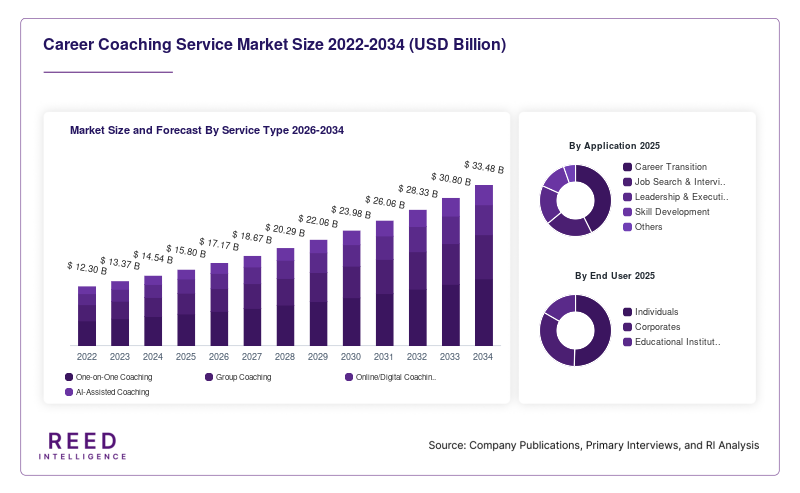
One-on-One Coaching dominates the service-type segment with approximately 51% share. Its position is supported by the high level of personalization required for career transitions, executive progression, interview preparation and complex professional decisions. Individual sessions allow coaches to adapt recommendations to a client's experience, goals, industry and personal circumstances.
AI-Assisted Coaching is projected to be the fastest-growing service category at approximately 17.8% CAGR. AI tools can provide continuous support between human sessions, automate goal tracking and deliver personalized prompts at a lower marginal cost. CoachHub's AIMY and BetterUp's AI coaching products demonstrate the shift toward combining technology with established coaching methodologies.
Online/digital coaching accounts for approximately 25% share, while group coaching contributes approximately 14%. Digital delivery has become an established operating model, with ICF reporting that 87% of coaches use video calls.
By Application
Career Transition represents the largest application with approximately 31% share. Transitions include changing employers, moving into management, switching industries, returning to work and adapting to technology-driven changes in occupational requirements.
Leadership & Executive Development is projected to be the fastest-growing application at approximately 10.6% CAGR. Employers increasingly use coaching to develop leadership capabilities and support managers during organizational change. Gartner research identifies career development and manager-supported development as continuing talent-management priorities.
Job Search & Interview Preparation accounts for approximately 27% share, while Skill Development contributes around 23%. Other applications account for approximately 9%.
By End User
Individuals hold the dominant position with approximately 56% share. Individual clients purchase coaching for career transitions, job searches, promotions, professional confidence, skill development and long-term career planning.
Corporates represent the fastest-growing end-user category at approximately 11.2% CAGR. Employer-sponsored coaching provides organizations with a mechanism for supporting employee development across management levels rather than restricting coaching to senior executives.
The 2025 ICF study found that more than half of coaching clients are employer-sponsored, reinforcing the importance of corporate purchasing in the professional coaching ecosystem.
Educational institutions account for approximately 16% share, using career-development services for students, graduates and alumni. The remaining 28% is associated with other institutional and specialized users.
Career Coaching Service Market Regional Analysis
North America Career Coaching Service Market
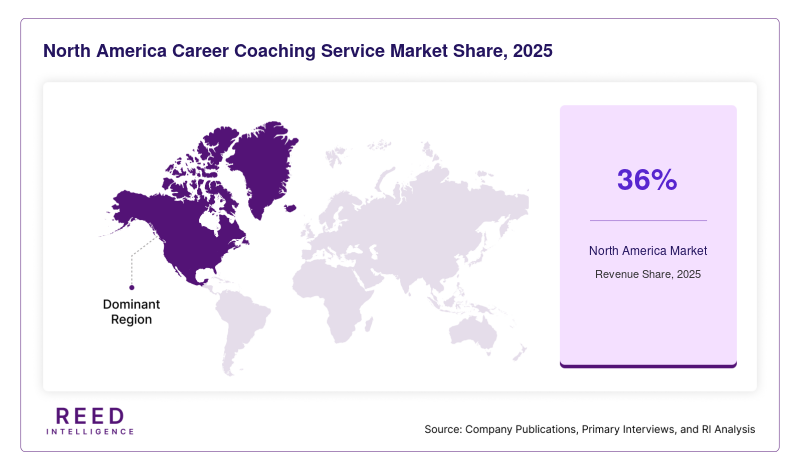
North America represents the dominant region with approximately 36% share. The region benefits from a mature professional coaching ecosystem, strong employer-sponsored coaching adoption, extensive corporate L&D spending and a large concentration of professional coaching providers.
The United States also has a well-developed market for digitally delivered coaching. ICF's 2025 research covers professional coaching across global regions and reports record practitioner numbers and revenue, while North America remains one of the established high-income coaching markets.
North America is projected to expand at approximately 7.8% CAGR during 2026–2034.
Europe Career Coaching Service Market
Europe is projected to grow at approximately 8.1% CAGR. Demand is supported by workforce mobility, corporate learning programs, professional development and growing emphasis on skills-based career pathways.
European career guidance is also influenced by labor-market transitions and changing skills requirements. OECD research emphasizes the role of guidance in connecting individuals with occupational information, skills development and training opportunities.
The region also has a strong professional coaching ecosystem, with ICF reporting substantial coaching activity across European markets.
Asia Pacific Career Coaching Service Market
Asia Pacific is projected to be the fastest-growing region at approximately 10.9% CAGR. Large working-age populations, increasing professionalization, digital coaching adoption and rising demand for career-transition assistance support regional expansion.
The region is also experiencing significant changes in workforce skills. The OECD identifies AI adoption as increasing demand for workers with stronger data-analysis, interpretation and complementary human skills, creating a broader role for career guidance and professional development services.
ICF's 2025 study reported that Asia recorded approximately 63% growth in client numbers, according to its regional analysis, indicating expanding coaching utilization.
Latin America Career Coaching Service Market
Latin America is projected to grow at approximately 10.1% CAGR. Career coaching demand is supported by professional mobility, entrepreneurship, changing employment structures and increasing use of online service delivery.
Digital coaching can broaden access beyond major metropolitan centers because clients can connect with coaches across national borders without requiring physical offices. ICF reported strong client-growth expectations in Latin America and the Caribbean, with 65% growth in client numbers identified in its 2025 study.
Middle East & Africa Career Coaching Service Market
The Middle East & Africa region is projected to grow at approximately 11.4% CAGR. Professionalization of corporate workforces, leadership-development requirements and increasing interest in career mobility are supporting demand.
ICF's 2025 study reported approximately 72% growth in client numbers in the Middle East and Africa, the highest among the regions highlighted in its analysis. The region also recorded the strongest proportion of coaches expecting revenue growth, at 71%.
Career Coaching Service Market Competitive Landscape
The career coaching service market includes global digital coaching platforms, professional coaching networks, independent career coaches, executive-development firms and technology-enabled career platforms. Competition is increasingly centered on coach quality, geographic coverage, specialization, digital delivery, employer relationships and the ability to demonstrate measurable development outcomes.
BetterUp operates a technology-enabled coaching and human-development platform combining human coaching, behavioral science and AI. Its January 2025 AI Coaching launch introduced AI-supported development at enterprise scale, while its later platform releases expanded the combination of human and AI coaching.
Key Market Players
- BetterUp
- CoachHub
- Korn Ferry
- FranklinCovey
- Sounding Board
- EZRA
- Bravely
- CoachSource
- Humu
- CareerArc
- Randstad
- ManpowerGroup
- Lee Hecht Harrison
- Right Management
- The Muse
Career Coaching Service Recent Market Developments
-
September 2026 – CoachHub: CoachHub released new research showing that only 21% of organizations described their most recent transformation as a clear success, while one in four senior leaders expected employees to adapt to organizational change. The findings reinforce the role of employee development and coaching during organizational transformation.
-
March 2026 – BetterUp: BetterUp's 2026 corporate updates continued its expansion of human and AI-supported coaching, while the company appointed Kristian Talvitie as Chief Financial Officer in May 2026 and continued developing its workforce-development platform.
Career Coaching Service Market Segments
By Service Type
- One-on-One Coaching
- Group Coaching
- Online/Digital Coaching
- AI-Assisted Coaching
By Application
- Career Transition
- Job Search & Interview Preparation
- Leadership & Executive Development
- Skill Development
- Others
By End User
- Individuals
- Corporates
- Educational Institutions
By Region
- North America
- Europe
- APAC
- Middle East and Africa
- LATAM