Cargo Charter Service Market Size, Share, Demand Report By Aircraft Type (Freighter Jets, Turboprop Cargo Aircraft, Helicopter Cargo Services), By Application (Industrial Equipment Transport, Pharmaceutical Logistics, E-commerce Shipments, Humanitarian & Emergency Relief Transport), By End-Use Industry (Manufacturing Companies, Logistics & Freight Forwarders, E-commerce Companies, Government & Defense Organizations), By Region & Segment Forecasts, 2026–2034
USD 3950
Market Overview
The Cargo Charter Service Market size is witnessing steady expansion, with the global market size estimated at approximately USD 6.42 billion in 2026 and projected to reach around USD 11.85 billion by 2034, registering a CAGR of 7.9% during 2026–2034. The growth of this market is closely tied to increasing globalization of trade, rising demand for time-sensitive logistics solutions, and the need for flexible air freight capacity in regions with limited scheduled cargo connectivity. Cargo charter services, which include on-demand aircraft leasing for freight movement, are becoming critical in industries such as pharmaceuticals, automotive, aerospace, and high-value electronics where delivery timelines are strict and conventional freight networks often face capacity constraints.
A major global factor supporting market growth is the restructuring of international supply chains following disruptions in global logistics networks. Companies are increasingly diversifying their transportation strategies and incorporating charter-based cargo solutions to reduce dependency on fixed-route air cargo systems. This shift is further strengthened by growing cross-border e-commerce activity, which demands rapid and reliable freight movement across continents. Additionally, the rise in humanitarian logistics and emergency response operations has expanded the use of cargo charter services in disaster-prone regions.
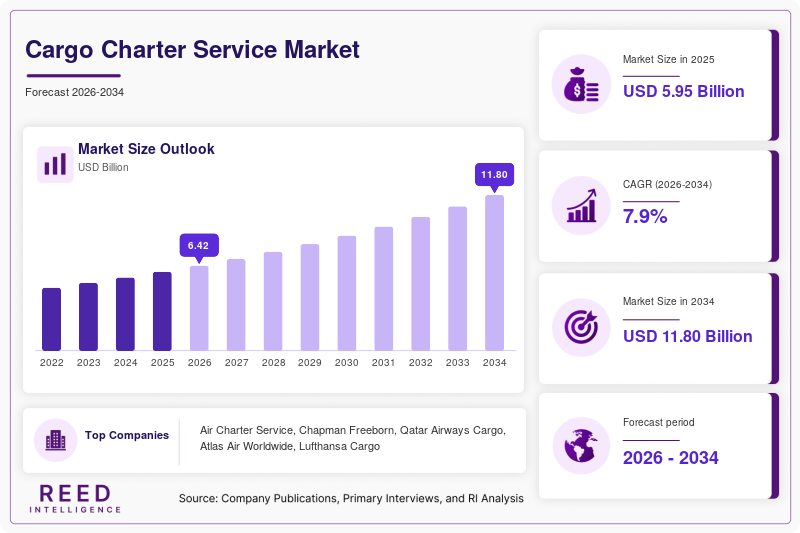
Key Highlights
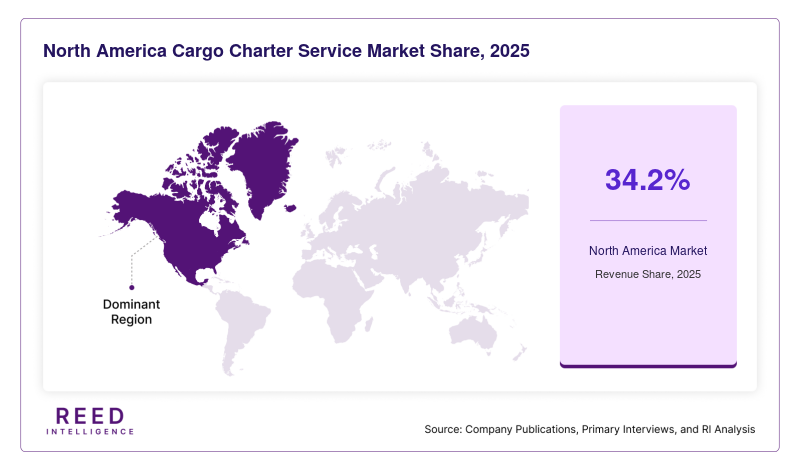
- North America dominated the market with a 34.2% share in 2025.
- Asia Pacific is expected to grow at the fastest CAGR of 11.2% during 2026–2034.
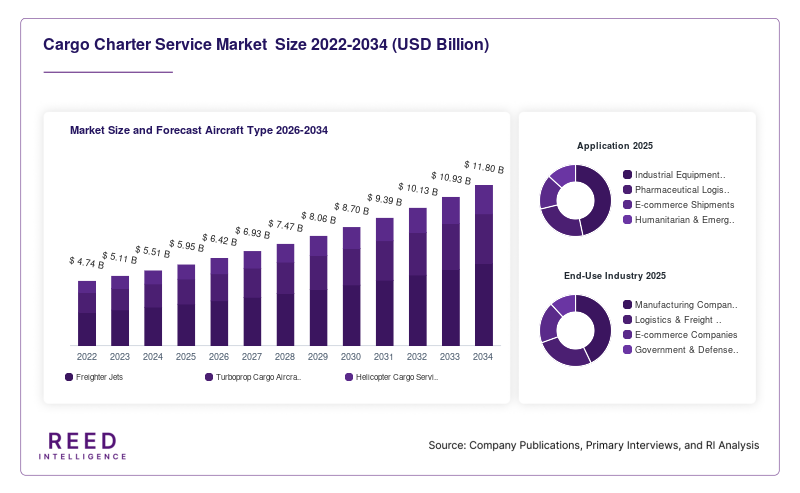
- By aircraft type, freighter jets accounted for the largest share of 42.8%, while turboprop cargo aircraft are projected to grow at a CAGR of 10.6%.
- By application, industrial equipment transport led with a 39.4% share, whereas pharmaceutical logistics is expected to expand at a CAGR of 12.1%.
- The United States remained the dominant country, with market values of USD 1.28 billion in 2024 and USD 1.41 billion in 2025.
Market Trends
Expansion of On-Demand Air Freight Solutions
One of the prominent trends shaping the Cargo Charter Service Market is the increasing preference for on-demand air freight solutions. Businesses are gradually moving away from fixed cargo schedules toward more flexible charter arrangements that allow them to respond quickly to market fluctuations. This trend is particularly visible in industries dealing with perishable goods, urgent spare parts, and high-value shipments. The adoption of digital booking platforms and real-time aircraft availability systems has simplified the chartering process, making it more accessible to mid-sized enterprises. As companies prioritize supply chain resilience, on-demand cargo charter services are expected to become a standard logistics option rather than a niche solution.
Integration of Digital Freight Matching and AI-Based Scheduling
Another key trend is the integration of advanced digital freight matching systems and AI-driven scheduling tools in cargo charter operations. These technologies help optimize aircraft utilization, reduce empty leg flights, and improve cost efficiency for operators and clients. AI-based platforms analyze demand patterns, weather conditions, fuel optimization routes, and aircraft availability to generate efficient charter solutions. This digital transformation is also enhancing transparency in pricing and reducing lead time for booking cargo aircraft. As logistics providers invest in automation and predictive analytics, the cargo charter ecosystem is evolving into a more data-driven and efficient market structure.
Market Drivers
Rising Demand for Time-Critical and High-Value Shipments
A significant driver for the Cargo Charter Service Market is the rising demand for time-critical transportation of high-value goods. Industries such as aerospace components, semiconductor manufacturing, luxury automotive parts, and pharmaceuticals rely heavily on fast and secure delivery channels. Traditional cargo networks often fail to meet urgent delivery timelines, leading companies to opt for dedicated charter services. Additionally, the growing global trade of temperature-sensitive pharmaceuticals, including vaccines and biologics, has further strengthened demand for specialized cargo aircraft equipped with controlled environments. This increasing reliance on speed and reliability is expected to sustain long-term market expansion.
Growth in Global Trade and E-Commerce Logistics Complexity
Another major driver is the continuous expansion of global trade and the increasing complexity of e-commerce logistics networks. Cross-border online retail requires rapid fulfillment cycles, especially for premium and express delivery segments. Cargo charter services offer flexibility in route planning and capacity allocation, enabling retailers to meet customer expectations in competitive markets. Furthermore, manufacturing globalization has created fragmented supply chains, where components are sourced from multiple countries. This complexity increases the need for flexible cargo solutions that can adapt to dynamic shipping requirements. As trade volumes continue to rise, cargo charter services are becoming an essential logistics backbone.
Market Restraint
High Operational Costs and Limited Fleet Availability
The Cargo Charter Service Market faces a significant restraint in the form of high operational costs associated with aircraft leasing, fuel consumption, and maintenance. Unlike scheduled cargo services, charter operations require dedicated flight arrangements, which often result in higher per-unit transportation costs. Additionally, the availability of specialized freighter aircraft remains limited in several regions, leading to capacity constraints during peak demand periods. Smaller logistics firms and emerging market participants often struggle to afford charter services regularly, restricting market penetration. These cost barriers create a dependency on large enterprises, limiting widespread adoption across all industry segments.
Market Opportunities
Expansion of Emerging Market Air Cargo Infrastructure
One of the key opportunities in the Cargo Charter Service Market lies in the expansion of air cargo infrastructure across emerging economies. Countries in Asia, Africa, and Latin America are investing heavily in airport modernization, cargo terminals, and logistics hubs. This development is expected to improve access to charter services and reduce operational bottlenecks. As manufacturing bases shift toward emerging regions, demand for flexible air freight solutions is likely to increase. Cargo charter operators can capitalize on this trend by establishing regional partnerships and expanding fleet presence in underserved markets.
Growth of Humanitarian and Emergency Logistics Services
Another promising opportunity is the growing demand for humanitarian and emergency logistics services. Natural disasters, geopolitical conflicts, and public health emergencies often require rapid deployment of essential goods, including medical supplies, food, and shelter equipment. Cargo charter services play a crucial role in ensuring timely delivery in such scenarios. Governments and international organizations are increasingly collaborating with private charter operators to enhance disaster response efficiency. This expanding role in humanitarian logistics provides a stable and socially impactful revenue stream for market participants.
Segmental Analysis
Aircraft Type Segment
Freighter jets represent the dominant subsegment in the Cargo Charter Service Market, accounting for approximately 42.8% share in 2024. Their leadership is attributed to their high payload capacity, long-haul operational capability, and efficiency in transporting bulk cargo across intercontinental routes. These aircraft are extensively utilized by large logistics operators, multinational corporations, and freight forwarders that require consistent, high-volume transportation solutions. The growing demand for cross-border trade between North America, Europe, and Asia Pacific has further strengthened the deployment of freighter jets. Additionally, industries such as automotive manufacturing, aerospace components, and electronics rely heavily on these aircraft for just-in-time supply chain operations, where delays can significantly impact production cycles and inventory costs.
Turboprop cargo aircraft are expected to emerge as the fastest-growing subsegment, registering a CAGR of 10.6% during 2026–2034. These aircraft are increasingly preferred for short-haul and regional logistics operations due to their lower fuel consumption, operational flexibility, and ability to access remote or underdeveloped airports. Growth is strongly supported by rising intra-regional trade in Asia Pacific, Latin America, and Africa, where infrastructure limitations restrict the use of larger freighter jets. Furthermore, the expansion of last-mile air logistics networks and the increasing demand for rapid delivery of essential goods in rural and island regions are significantly boosting turboprop adoption. Logistics providers are also integrating these aircraft into hybrid supply chain models to improve delivery efficiency and reduce transit times.
Application Segment
Industrial equipment transport held the dominant position in the application segment, contributing around 39.4% market share in 2024. This dominance is driven by the increasing globalization of manufacturing operations and large-scale infrastructure development projects across emerging and developed economies. Heavy machinery, construction equipment, energy sector components, and mining machinery often require specialized handling and rapid delivery, which makes cargo charter services the preferred transportation mode. The reliance on charter services is particularly high in sectors where production downtime leads to substantial financial losses. Additionally, industries operating under strict project timelines depend on air charter solutions to ensure uninterrupted supply chain continuity, especially when maritime or road transport cannot meet urgent delivery schedules.
Pharmaceutical logistics is projected to be the fastest-growing application segment, expanding at a CAGR of 12.1% during the forecast period. The increasing global distribution of vaccines, biologics, temperature-sensitive drugs, and clinical trial materials is driving strong demand for specialized air cargo charter services. These shipments require strict compliance with cold-chain regulations and real-time monitoring systems, which are more effectively managed through dedicated charter flights. The rise in global healthcare demand, aging populations, and rapid expansion of biotech research facilities further supports this growth. Additionally, post-pandemic supply chain restructuring has increased the emphasis on secure, rapid, and flexible pharmaceutical transportation networks.
End-Use Segment
Manufacturing companies accounted for the largest share of the Cargo Charter Service Market, holding approximately 44.6% share in 2024. These companies rely heavily on cargo charter services to manage global sourcing of raw materials, components, and machinery parts. The increasing complexity of manufacturing supply chains, particularly in automotive, aerospace, and electronics sectors, has intensified the need for reliable air freight solutions. Just-in-time production models have further increased dependency on time-sensitive deliveries, making charter services essential for maintaining operational continuity. Additionally, manufacturers often use cargo charters during supply chain disruptions to avoid production halts and maintain inventory stability across multiple production facilities.
E-commerce companies are expected to be the fastest-growing end-use segment, registering a CAGR of 11.5% during 2026–2034. The rapid expansion of cross-border online retail, especially in Asia Pacific and Europe, is driving demand for fast international shipping solutions. Premium e-commerce platforms are increasingly integrating cargo charter services to support express delivery models and high-value shipments. The growth of luxury retail, electronics, and fashion e-commerce segments has further increased reliance on air charter logistics. Additionally, rising consumer expectations for same-day and next-day delivery in international markets are pushing e-commerce companies to adopt flexible and scalable air freight solutions.
Regional Analysis
North America
North America held approximately 34.2% share of the Cargo Charter Service Market in 2025, with a projected CAGR of 7.1% during 2026–2034. The region benefits from a highly developed aviation infrastructure, strong presence of global logistics providers, and significant demand for time-sensitive cargo transportation. The United States and Canada collectively support a mature air freight ecosystem where cargo charter services are widely used across pharmaceuticals, aerospace, automotive, and defense sectors. Increasing reliance on nearshoring strategies and resilient supply chain frameworks has further strengthened the demand for flexible charter operations across major trade corridors.
The United States remains the dominant country in the region due to its extensive manufacturing base and global trade connectivity. A key growth factor is the rapid expansion of e-commerce fulfillment networks requiring fast and reliable air cargo solutions. Additionally, strong investment in pharmaceutical logistics, particularly temperature-controlled transportation for biologics and vaccines, is contributing to sustained demand. The presence of major charter operators and advanced airport hubs such as Memphis, Chicago, and Atlanta further enhances regional market strength.
Europe
Europe accounted for around 26.5% market share in 2025, with a forecast CAGR of 6.8% during 2026–2034. The region’s growth is supported by strong cross-border trade within the European Union and high demand for industrial and automotive logistics. Cargo charter services are widely used in Germany, France, and the United Kingdom for transporting high-value machinery, automotive components, and aerospace equipment. Strict delivery timelines and regulatory requirements in industrial sectors further encourage the use of dedicated charter flights over conventional cargo routes.
Germany leads the European market due to its strong manufacturing and export-oriented economy. A key growth factor is the increasing demand for specialized logistics solutions for automotive and industrial machinery exports to Asia Pacific and North America. Additionally, Europe’s focus on reducing supply chain disruptions and enhancing logistics resilience has led to higher adoption of flexible air charter services. Investments in digital freight platforms and sustainable aviation initiatives are also shaping regional market development.
Asia Pacific
Asia Pacific held approximately 23.1% share in 2025 and is projected to register the fastest CAGR of 11.2% during 2026–2034. The region’s rapid industrialization, expansion of manufacturing hubs, and booming e-commerce sector are key growth drivers. Countries such as China, India, Japan, and South Korea are increasingly relying on cargo charter services to support export-oriented industries and time-sensitive logistics requirements. Rising demand for electronics, automotive components, and pharmaceuticals further contributes to market expansion.
China dominates the regional market due to its massive production capacity and strong global export network. A major growth factor is the rapid rise of cross-border e-commerce platforms that require fast and flexible international shipping solutions. Additionally, increasing investments in aviation infrastructure, cargo hubs, and logistics parks across China and Southeast Asia are improving operational efficiency. The growing adoption of digital freight management systems is also enhancing market scalability and responsiveness.
Middle East & Africa
The Middle East & Africa region accounted for approximately 9.4% market share in 2025, with a projected CAGR of 8.3% during 2026–2034. The region serves as a strategic global transit hub connecting Europe, Asia, and Africa. Countries such as the United Arab Emirates and Saudi Arabia are heavily investing in aviation infrastructure, making the region a key node for international cargo charter operations. Demand is driven by oil & gas logistics, construction projects, and humanitarian relief operations across conflict-affected and disaster-prone areas.
The United Arab Emirates dominates the regional market due to its world-class logistics infrastructure and global connectivity through Dubai International Airport and Al Maktoum International Airport. A key growth factor is the increasing use of the region as a transshipment hub for global freight movements. Additionally, rising demand for humanitarian logistics services in Africa and the Middle East is significantly boosting charter flight operations.
Latin America
Latin America accounted for approximately 6.8% share in 2025, with a CAGR of 7.5% expected during 2026–2034. The region’s market growth is driven by expanding agricultural exports, mining activities, and increasing demand for rapid freight movement across large geographical distances. Countries such as Brazil, Mexico, and Chile are investing in improving air cargo infrastructure to support international trade flows. Cargo charter services are particularly important in regions where road and rail infrastructure limitations restrict efficient goods movement.
Brazil leads the Latin American market due to its strong agricultural and commodity export base. A key growth factor is the rising demand for cold-chain logistics for perishable goods such as meat, fruits, and seafood exports. Additionally, increasing integration of Latin American supply chains with North American and European markets is driving the need for flexible air freight solutions. Growing e-commerce penetration is also gradually contributing to regional demand for charter-based logistics services.
Competitive Landscape
The Cargo Charter Service Market is moderately consolidated, with leading players focusing on fleet expansion, digital booking platforms, and strategic partnerships. Key companies include Chapman Freeborn, Air Charter Service, Qatar Airways Cargo, Atlas Air Worldwide, and Lufthansa Cargo. Among these, Air Charter Service holds a strong position due to its extensive global network and diversified charter offerings. Recent developments include fleet modernization initiatives and expansion of dedicated cargo routes across Asia Pacific and North America, enhancing operational efficiency and service coverage.
Key Players
- Air Charter Service
- Chapman Freeborn
- Qatar Airways Cargo
- Atlas Air Worldwide
- Lufthansa Cargo
- Volga-Dnepr Group
- Cargolux Airlines International
- Silk Way West Airlines
- Emirates SkyCargo
- Flexport Air Charter Division
- DSV Air & Sea
- Kuehne + Nagel Air Logistics
- Maersk Air Cargo
- Antonov Airlines
- Challenge Group
Recent Developments
- In 2025, Air Charter Service expanded its global fleet access network by partnering with multiple regional aircraft operators to enhance availability of wide-body freighter aircraft across Europe, Asia Pacific, and North America.
- In 2025, Qatar Airways Cargo strengthened its charter division by introducing enhanced digital booking and real-time cargo capacity management systems to improve response time for urgent freight requests.
- In 2024, Atlas Air Worldwide increased its dedicated cargo charter operations through the acquisition of additional Boeing 747 freighter aircraft to support growing demand from e-commerce and industrial logistics clients.
- In 2024, Lufthansa Cargo expanded its specialized charter solutions for pharmaceutical and high-value goods by implementing upgraded temperature-controlled cargo handling infrastructure across key global hubs.
Cargo Charter Service Market Segments
Aircraft Type
- Freighter Jets
- Turboprop Cargo Aircraft
- Helicopter Cargo Services
Application
- Industrial Equipment Transport
- Pharmaceutical Logistics
- E-commerce Shipments
- Humanitarian & Emergency Relief Transport
End-Use Industry
- Manufacturing Companies
- Logistics & Freight Forwarders
- E-commerce Companies
- Government & Defense Organizations
By Region
- North America
- Europe
- APAC
- Middle East and Africa
- LATAM