Carrot Fiber Market Size, Share Demand Report By Type (Powdered, Soluble, Insoluble), By Application (Bakery & Confectionery, Functional Beverages, Dairy Products, Snacks, Dietary Supplements), By End-Use (Food Industry, Nutraceuticals, Cosmetics, Animal Feed), By Distribution Channel (Modern Trade, Traditional Trade, E-commerce) By Region & Segment Forecasts, 2025–2033
USD 3950
Market Overview
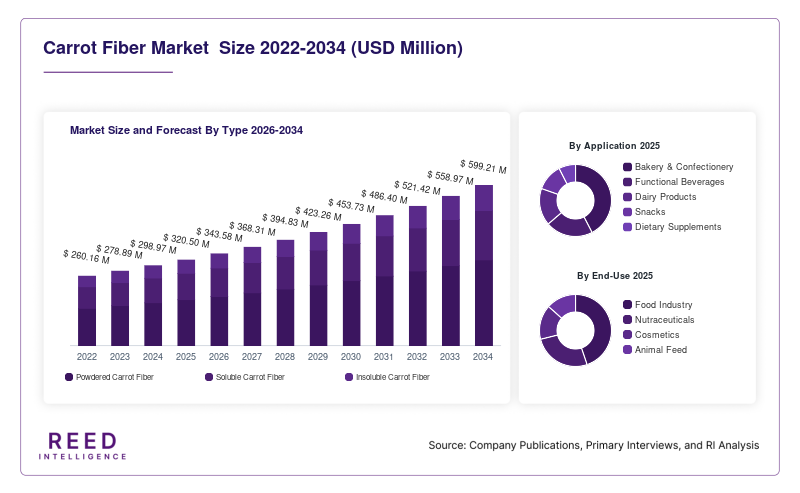
The global Carrot Fiber Market size was valued at USD 320.5 million in 2025 and is projected to reach USD 565.8 million by 2033, registering a CAGR of 7.2% from 2025 to 2034. The market growth has been primarily driven by the increasing demand for natural dietary fibers across food, nutraceutical, and cosmetic applications. Rising consumer awareness regarding gut health and the benefits of plant-based ingredients has also significantly supported market expansion.
One major global factor propelling growth is the surge in health-conscious consumers, particularly in developed and emerging economies, who are seeking functional ingredients for clean-label products. Carrot fiber, being rich in prebiotics, antioxidants, and soluble fiber, has become a preferred additive for bakery, confectionery, and beverage applications. Additionally, the rising adoption of plant-based diets and increasing incorporation of carrot fiber in weight management formulations further reinforce the market’s expansion potential.
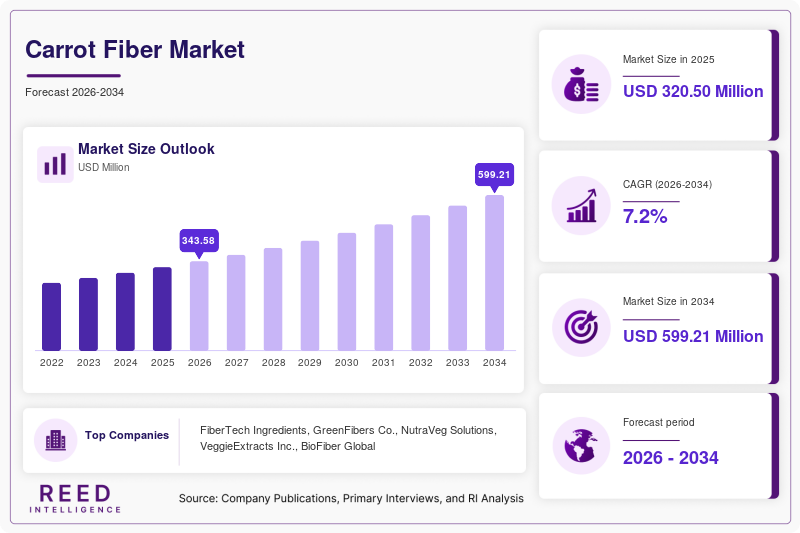
Key Highlights
- Dominant region share (2025): Europe accounted for 36.5% of the market.
- Fastest-growing region CAGR: Asia Pacific at 9.1% during 2025–2034.
- Leading subsegments: By type, powdered carrot fiber led with a 42% share; by application, bakery & confectionery dominated at 38%.
- Fastest-growing subsegments: Functional beverages with a CAGR of 10.2%; soluble fiber type with a CAGR of 8.5%.
- Dominant country: Germany had a market value of USD 55.2 million in 2025, expected to reach USD 59.8 million in 2026.
Market Trends
Clean-Label Demand
Consumer preference for naturally derived ingredients has prompted manufacturers to replace synthetic fibers with carrot fiber in processed foods, functional beverages, and dietary supplements. The clean-label trend is expected to continue driving adoption as regulatory frameworks favor transparent labeling.
Product Innovation in Functional Foods
The integration of carrot fiber into novel applications, such as high-protein snacks, bakery fortification, and plant-based meal replacements, is reshaping the market. Manufacturers are increasingly leveraging carrot fiber for its functional benefits, including moisture retention, textural improvement, and enhanced nutritional profile, fueling product diversification.
Market Drivers
Growing Health Awareness
Rising concerns over digestive health, obesity, and cardiovascular disorders are driving the demand for dietary fibers. Carrot fiber, rich in soluble fiber and antioxidants, meets the functional requirements of health-oriented formulations, encouraging adoption across global markets.
Expansion of the Functional Food Sector
The functional foods and nutraceutical segment has witnessed robust growth, offering manufacturers opportunities to incorporate natural fibers like carrot fiber. Its ability to improve texture, shelf-life, and nutritional content in bakery, beverages, and dairy alternatives is a critical driver supporting market expansion.
Market Restraint
Restraint: High Cost of Extraction and Standardization – One major challenge restraining the Carrot Fiber Market is the cost-intensive process of extracting, drying, and standardizing carrot fiber to meet industrial-grade quality. Variability in raw material supply, seasonal fluctuations, and processing costs limit large-scale adoption, particularly among small- and medium-sized manufacturers.
Market Opportunities
Emerging Plant-Based Product Lines
The growing plant-based movement offers opportunities for carrot fiber as an ingredient in meat analogs, vegan dairy, and high-fiber snacks. Its functional and nutritional properties allow companies to differentiate products in a competitive landscape.
Personalized Nutrition and Dietary Supplements
Increasing consumer interest in personalized diets and gut health solutions presents an avenue for carrot fiber inclusion in nutraceuticals, meal replacements, and targeted fiber supplements, enabling value-added formulations that cater to specific health goals.
Segmental Analysis
By Type
In 2025, powdered carrot fiber led the type segment with a 42% market share, primarily used in bakery and beverage applications for its ease of incorporation and long shelf-life. Soluble carrot fiber is expected to be the fastest-growing subsegment, projected to register a CAGR of 8.5% by 2034, owing to rising demand in functional beverages and nutraceuticals, where solubility and digestibility are critical.
By Application
Bakery and confectionery dominated in 2025 with a 38% share, driven by fiber fortification in bread, cookies, and cakes. Functional beverages will witness the highest CAGR of 10.2%, as manufacturers increasingly develop fiber-enriched drinks and smoothies targeting gut health and immune support.
By End-Use
The food industry accounted for 71% of consumption in 2025, with baked goods, confectioneries, and beverages as major consumers. The nutraceutical segment is anticipated to experience accelerated growth, projected to achieve an 11% CAGR by 2034, driven by the rising inclusion of carrot fiber in dietary supplements, protein shakes, and personalized nutrition products.
By Distribution Channel
Modern trade, including hypermarkets and supermarkets, held the dominant position in 2025 with a 53% share, owing to wide product availability and promotional campaigns. E-commerce is expected to be the fastest-growing channel, projected to expand at a CAGR of 12%, driven by increasing online grocery sales and rising consumer preference for convenient home delivery of functional ingredients.
By Geography-Specific Application
In Europe, bakery applications dominated, while Asia Pacific witnessed high growth in functional beverages and snacks, driven by consumer trends toward convenience and health benefits. Local production and collaborations with nutraceutical brands are fueling adoption in emerging APAC economies.
Regional Analysis
North America
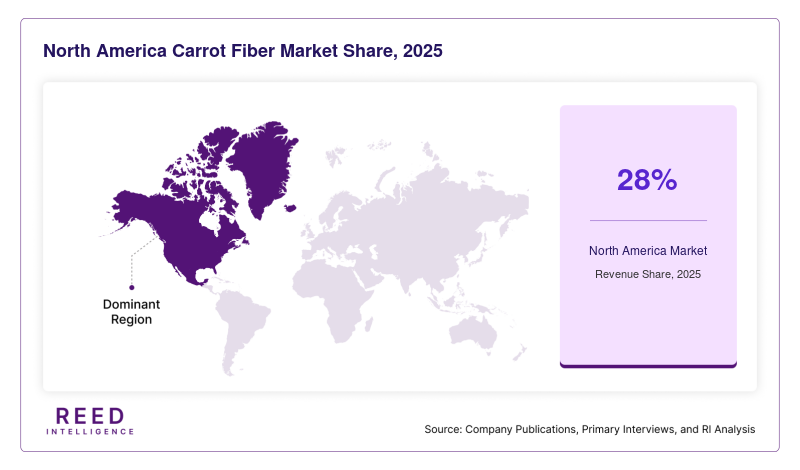
North America held a 28% market share in 2025 and is projected to witness a CAGR of 6.5% during 2025–2034. Increasing consumer focus on digestive health, dietary supplements, and functional bakery products has been the primary growth driver. The United States, as the dominant country, benefits from well-established functional food supply chains and a strong health-conscious population, fueling consistent adoption of carrot fiber across retail and industrial segments.
Europe
Europe accounted for 36.5% of the market in 2025 and is expected to grow at a CAGR of 6.9% through 2034. The region’s growth is supported by stringent dietary guidelines and high demand for natural, clean-label ingredients. Germany led the market in 2025 with USD 55.2 million, driven by consumer preference for fiber-enriched bakery and beverage products. Rising awareness of cardiovascular and digestive health continues to propel market expansion.
Asia Pacific
Asia Pacific represented 20.8% of the market in 2025, with a forecast CAGR of 9.1% during 2025–2034. Rapid urbanization, increasing disposable income, and rising adoption of functional foods are driving growth. China, as the dominant country, has experienced significant market uptake due to the expansion of e-commerce platforms and increased consumer education regarding dietary fiber benefits. Local startups are investing in carrot fiber-based snack products to meet regional demand.
Middle East & Africa
The Middle East & Africa contributed 9% to the global market in 2025 and is expected to witness a CAGR of 7.4% from 2025 to 2034. The market is emerging due to rising health awareness, government-led nutrition programs, and the adoption of fortified foods. Saudi Arabia is the dominant country in the region, driven by increasing import of functional ingredients and the development of fortified bakery products targeting health-conscious consumers.
Latin America
Latin America accounted for 6.7% of the market in 2025, with a forecast CAGR of 8.2% over the 2025–2034 period. Brazil dominates the regional market due to increasing health-conscious urban populations and government initiatives promoting fiber-rich diets. The market is further supported by growing functional beverage launches and fortified snack formulations, particularly in metropolitan centers.
Competitive Landscape
The Carrot Fiber Market is moderately fragmented, with key players focusing on strategic partnerships, R&D, and product innovation. Leading companies include FiberTech Ingredients, GreenFibers Co., NutraVeg Solutions, VeggieExtracts Inc., and BioFiber Global. FiberTech Ingredients emerged as the market leader, recently launching a high-soluble carrot fiber line targeting functional beverages and dietary supplements.
Other major players are investing in proprietary extraction technologies, enhancing fiber solubility, stability, and sensory properties to strengthen market positioning. Mergers and acquisitions, particularly in Europe and North America, are shaping the competitive landscape, enabling companies to expand regional presence and cater to growing demand in bakery, beverage, and nutraceutical sectors.
Key Players List
- FiberTech Ingredients
- GreenFibers Co.
- NutraVeg Solutions
- VeggieExtracts Inc.
- BioFiber Global
- PurePlant Ingredients
- NutriFibers Pvt. Ltd.
- VegFiber International
- HealthyCore Ingredients
- AgroFiber Solutions
- Nature’s Fiber Co.
- Global Veggie Extracts
- PlantFiber Industries
- BioVeg Extracts
- NutraVeg Global
Recent Developments
- FiberTech Ingredients launched a high-soluble carrot fiber product line in 2025 for functional beverages.
- GreenFibers Co. expanded its manufacturing facility in Germany to meet growing European demand.
- NutraVeg Solutions partnered with a major beverage company in China to supply carrot fiber for fortified drinks.
- VeggieExtracts Inc. initiated R&D to improve carrot fiber stability and taste for bakery applications.
- BioFiber Global invested in sustainable extraction technologies to reduce production costs and enhance fiber quality.
Carrot Fiber Market Segments
By Type
- Powdered Carrot Fiber
- Soluble Carrot Fiber
- Insoluble Carrot Fiber
By Application
- Bakery & Confectionery
- Functional Beverages
- Dairy Products
- Snacks
- Dietary Supplements
By End-Use
- Food Industry
- Nutraceuticals
- Cosmetics
- Animal Feed
By Distribution Channel
- Modern Trade
- Traditional Trade
- E-commerce
By Region
- North America
- Europe
- APAC
- Middle East and Africa
- LATAM