Casein Glue Market Size, Share, Demand Report By Form (Powder-based Casein Glue, Liquid Casein Glue), By Application (Woodworking, Packaging, Bookbinding, Specialty Industrial Applications), By End-Use Industry (Furniture Manufacturing, Paper & Packaging Industry, Construction,Industrial Manufacturing), By Region & Segment Forecasts, 2026–2034
USD 3950
Market Overview
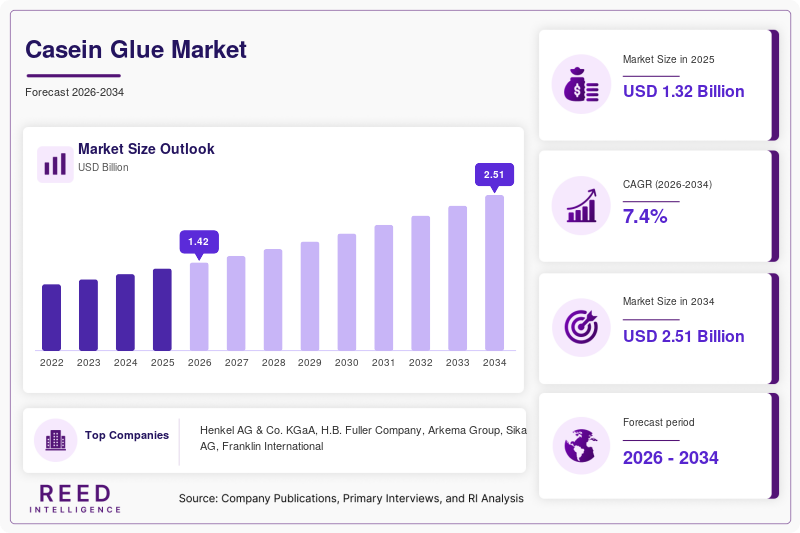
The Casein Glue Market size is projected to reach a valuation of approximately USD 1.42 billion in 2026 and is expected to attain USD 2.51 billion by 2034, expanding at a CAGR of 7.4% during 2026–2034. Growth in the market is primarily driven by the increasing shift toward bio-based and sustainable adhesive solutions across packaging, woodworking, paper conversion, and niche industrial applications. Casein glue, derived from milk protein, is gaining traction as industries transition away from synthetic adhesives due to regulatory pressure on volatile organic compounds (VOCs) and rising environmental awareness among manufacturers and end users.
A major global factor supporting market expansion is the rapid adoption of eco-friendly adhesives in the packaging and labeling sector, especially in food and beverage applications. Regulatory frameworks promoting biodegradable materials and the increasing demand for recyclable packaging have strengthened the adoption of casein-based adhesives in Europe and North America. Additionally, technological improvements in adhesive formulation have enhanced water resistance and bonding strength, making casein glue more competitive in specialized applications.
Key Highlights
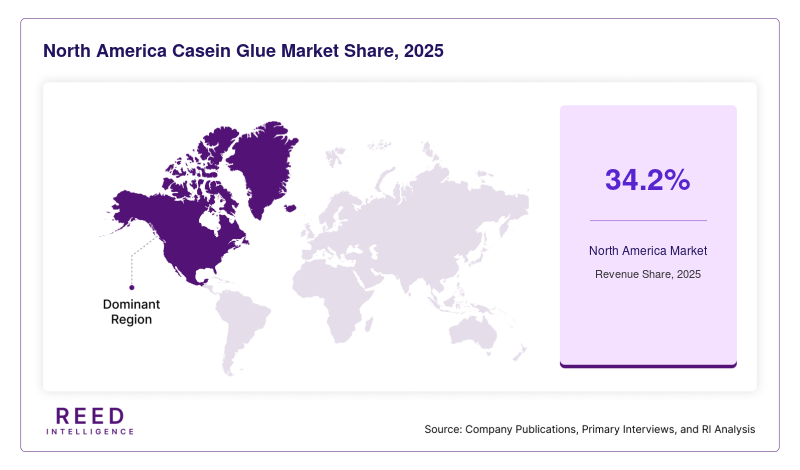
- North America dominated the market with a 34.2% share in 2025.
- Asia Pacific is expected to grow at the fastest CAGR of 11.2% during 2026–2034.
- By form, powder-based casein glue accounted for the largest share of 52.6%.
- while liquid formulations are projected to grow at a CAGR of 8.1%.
- By application, woodworking adhesives led with a 39.8% share, whereas packaging adhesives are expected to expand at a CAGR of 9.3%.
- The United States remained the dominant country, with market values of USD 310 million in 2024 and USD 335 million in 2025.
Market Trends
Rising Demand for Bio-Based Adhesive Solutions
The Casein Glue Market is witnessing increasing demand for bio-based adhesives as industries prioritize sustainability and reduced environmental impact. Casein glue, being derived from natural milk proteins, offers biodegradability and low toxicity compared to synthetic alternatives such as polyurethane and epoxy adhesives. This shift is particularly evident in packaging, woodworking, and paper industries, where regulatory pressure is driving the adoption of eco-friendly materials. Manufacturers are also investing in improving the performance characteristics of casein adhesives, such as water resistance and bonding strength, to expand their usability in more demanding industrial environments. This trend is expected to strengthen further as global sustainability targets intensify.
Technological Advancements in Adhesive Formulation
Another key trend shaping the Casein Glue Market is the advancement in formulation technologies aimed at enhancing product stability and performance. Innovations such as enzyme-modified casein, hybrid bio-adhesive blends, and improved drying processes are expanding the application scope of casein glue. These advancements help address historical limitations such as moisture sensitivity and limited shelf life. As a result, industries such as packaging and woodworking are increasingly adopting enhanced formulations for precision bonding applications. Research and development investments by adhesive manufacturers are expected to accelerate innovation, improving competitiveness against synthetic adhesives and widening industrial applicability.
Market Drivers
Expansion of Sustainable Packaging Industry
The growing sustainable packaging industry is a major driver for the Casein Glue Market. As global consumption of packaged food, beverages, and consumer goods increases, manufacturers are under pressure to adopt recyclable and biodegradable adhesive solutions. Casein glue is widely used in carton sealing, labeling, and paper-based packaging due to its natural composition and regulatory compliance with food safety standards. Governments across Europe and North America are enforcing strict regulations on plastic and chemical-based adhesives, encouraging the adoption of casein-based alternatives. This shift is expected to significantly contribute to market expansion over the forecast period.
Increasing Adoption in Woodworking and Furniture Manufacturing
The woodworking and furniture manufacturing sectors are increasingly utilizing casein glue due to its strong bonding capabilities and eco-friendly properties. It is particularly valued in applications requiring non-toxic adhesives for interior furniture, musical instruments, and decorative wood products. The rise in demand for handcrafted and sustainable furniture has further supported its adoption. Additionally, small and medium-scale woodworking enterprises prefer casein glue due to its cost-effectiveness and ease of application. This growing preference across both industrial and artisanal woodworking applications continues to drive steady demand growth in the global market.
Market Restraint
Limited Moisture Resistance and Performance Constraints
One of the primary restraints in the Casein Glue Market is its limited resistance to moisture and environmental degradation compared to synthetic adhesives. Although formulation improvements have been made, casein-based adhesives still face performance challenges in high-humidity or outdoor applications. This restricts their usage in sectors such as automotive, marine, and heavy construction. Additionally, variations in raw material quality, particularly milk protein supply, can affect consistency and bonding strength. These limitations often lead manufacturers to opt for synthetic alternatives in demanding environments, slowing broader market penetration despite rising sustainability preferences.
Market Opportunities
Expansion in Eco-Friendly Packaging Applications
The increasing demand for eco-friendly packaging presents a significant opportunity for the Casein Glue Market. With global e-commerce growth and heightened consumer awareness of environmental issues, packaging manufacturers are actively seeking biodegradable adhesive solutions. Casein glue is particularly suitable for paper-based packaging, labels, and cartons, making it an attractive alternative to petroleum-based adhesives. The rise of circular economy initiatives and government-backed sustainability programs further enhances its adoption potential. Manufacturers investing in improved formulations with enhanced durability and moisture resistance are expected to gain competitive advantage in this expanding application segment.
Growth in Specialty Industrial Applications
Another key opportunity lies in the expansion of specialty industrial applications such as bookbinding, paper restoration, and musical instrument manufacturing. Casein glue offers excellent adhesion for porous materials and is widely used in conservation and restoration activities due to its reversibility and non-toxic nature. The increasing demand for heritage preservation and artisanal craftsmanship is expected to boost adoption in these niche segments. Additionally, innovations in hybrid adhesive systems combining casein with synthetic polymers may open new industrial use cases, expanding market reach beyond traditional applications.
Segmental Analysis
By Form
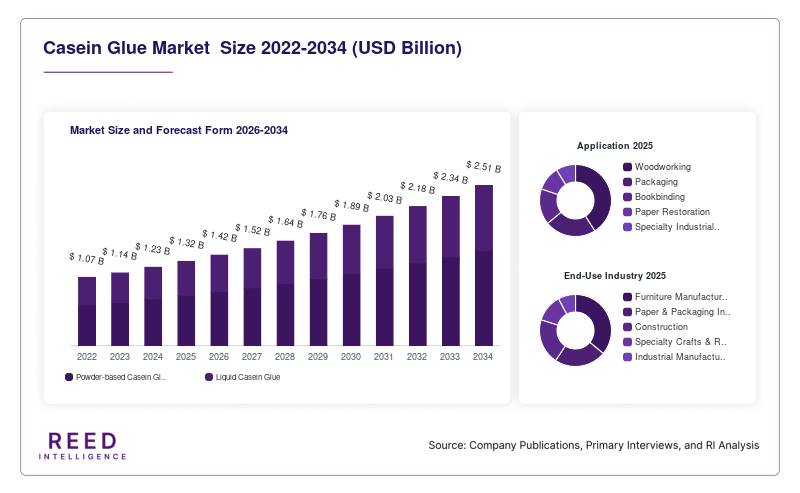
Powder-based casein glue dominated the market with a 52.6% share in 2024 due to its longer shelf life, ease of transportation, and cost efficiency. It is widely used in woodworking and packaging industries where bulk application is required. The segment benefits from stable demand in industrial adhesive applications.
Liquid casein glue is expected to grow at a CAGR of 8.1% due to its ease of application and improved formulation technologies. Enhanced dispersion techniques and improved bonding strength are driving adoption in precision applications such as bookbinding and paper restoration industries.
By Application
Woodworking adhesives accounted for a 39.8% share in 2024, supported by strong demand in furniture manufacturing and interior design industries. Casein glue is preferred for its natural composition and strong bonding with porous materials.
Packaging applications are projected to grow at a CAGR of 9.3% due to increasing demand for sustainable and recyclable packaging materials. Food-safe adhesive requirements further support adoption in carton sealing and labeling.
By End Use Industry
Furniture manufacturing held a 41.2% share in 2024 due to widespread use of casein adhesives in wood-based assembly and decorative applications. Its eco-friendly profile enhances adoption in premium furniture segments.
Paper and packaging industries are expected to grow at a CAGR of 9.7% driven by increasing e-commerce activity and regulatory pressure on sustainable packaging solutions. Casein glue’s biodegradability makes it highly suitable for this sector.
Regional Analysis
North America
North America accounted for approximately 34.2% market share in 2025 and is expected to grow at a CAGR of 6.8% during the forecast period. The region benefits from strong demand in packaging and woodworking industries, along with strict environmental regulations supporting bio-based adhesives.
The United States dominates the regional market, driven by advanced packaging manufacturing infrastructure and increasing adoption of sustainable materials in consumer goods. Growing investments in green building materials further support demand for casein glue in construction-related woodworking applications.
Europe
Europe held around 29.5% market share in 2025 and is projected to grow at a CAGR of 7.1% through 2034. The region’s stringent environmental policies and strong focus on circular economy practices support market expansion.
Germany leads the European market due to its robust woodworking and furniture manufacturing industry. The country’s emphasis on eco-certified materials and low-VOC adhesives continues to drive adoption of casein-based solutions.
Asia Pacific
Asia Pacific accounted for approximately 22%–25% of the global market share in 2025 and is expected to register the fastest CAGR of around 11.2% during the forecast period. Rapid industrialization, expanding manufacturing activities, and increasing demand for packaging materials are key factors driving growth in the region. Countries such as China, India, and Japan are witnessing rising adoption of bio-based adhesives due to growing environmental awareness and regulatory developments. The expansion of the furniture and packaging industries further strengthens regional demand.
Middle East & Africa
The Middle East & Africa region accounted for approximately 7%–8% market share in 2025 and is projected to grow at a CAGR of around 6.5% during 2026–2034. Growth in this region is supported by the gradual expansion of packaging, construction, and furniture manufacturing industries. While the market remains relatively smaller compared to developed regions, increasing awareness of sustainable materials and growing industrialization are driving adoption. Additionally, infrastructure development and rising urbanization contribute to increased demand for adhesives in construction-related applications.
Latin America
Latin America holds approximately 6%–7% share of the global Casein Glue Market in 2025 and is expected to grow at a CAGR of about 6.9% through 2034. The region’s growth is supported by increasing industrial production and rising demand for furniture and packaging materials. Countries in Latin America are gradually adopting sustainable adhesives as environmental awareness increases and regulatory frameworks evolve. The expanding e-commerce sector is also contributing to higher demand for paper-based packaging, thereby supporting casein glue adoption.
Competitive Landscape
The Casein Glue Market is moderately fragmented with the presence of several regional and global players focusing on product innovation and sustainability. Key companies include Henkel AG, HB Fuller Company, Arkema Group, Franklin International, and Sika AG. These players are investing in bio-based adhesive development and strategic collaborations to expand their market presence. Henkel AG remains a prominent leader due to its strong product portfolio and global distribution network. A recent development includes HB Fuller Company expanding its bio-adhesive production capacity to meet rising demand for sustainable packaging solutions.
Key Players List
- Henkel AG & Co. KGaA
- H.B. Fuller Company
- Arkema Group
- Sika AG
- Franklin International
- 3M Company
- Dow Inc.
- Ashland Global Holdings
- Bostik SA
- Pidilite Industries Ltd.
- Royal Adhesives & Sealants
- Paramelt B.V.
- Krahn Chemie GmbH
- Wacker Chemie AG
- Mitsubishi Chemical Group
Recent Developments
- A major adhesive manufacturer expanded its bio-based adhesive production facility in Europe to meet rising demand for sustainable packaging materials.
- Several companies introduced enzyme-modified casein formulations aimed at improving moisture resistance and bonding strength in industrial applications.
- Strategic collaborations between packaging firms and adhesive producers were established to develop fully recyclable carton sealing solutions using casein-based adhesives.
Casein Glue Market Segments
Form
- Powder-based Casein Glue
- Liquid Casein Glue
Application
- Woodworking
- Packaging
- Bookbinding
- Paper Restoration
- Specialty Industrial Applications
End-Use Industry
- Furniture Manufacturing
- Paper & Packaging Industry
- Construction
- Specialty Crafts & Restoration
- Industrial Manufacturing
By Region
- North America
- Europe
- APAC
- Middle East and Africa
- LATAM