Casing Cementation Hardware Market Size, Share & Demand Report By Type (Centralizers, Float Equipment, Stage Cementing Tools, Cementing Plugs, Others), By Application (Onshore, Offshore), By Material (Steel, Aluminum, Composite), By End-Use (Oil & Gas Companies, Drilling Contractors) & Segment Forecasts, 2026–2034
USD 3950
Market Overview
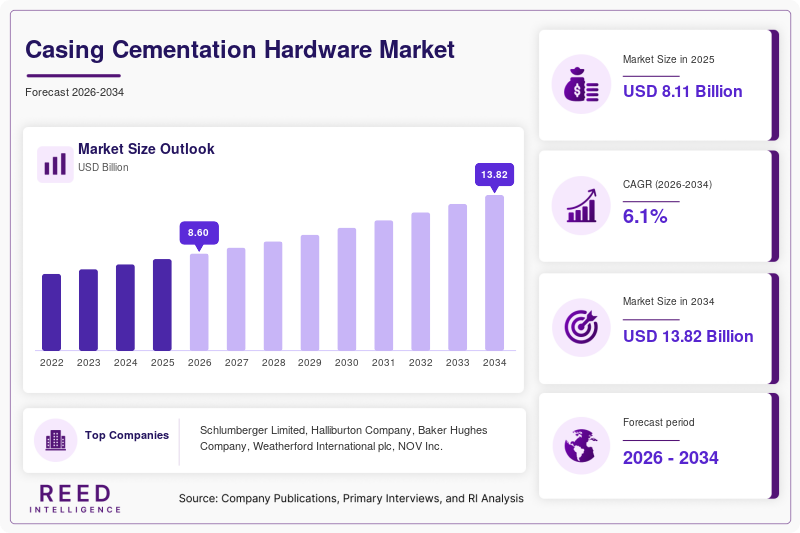
The global Casing Cementation Hardware Market size was estimated at USD 8.6 billion in 2026 and is projected to reach approximately USD 13.9 billion by 2034, expanding at a CAGR of 6.1% during the forecast period (2026–2034). The market continues to evolve as drilling environments become more technically demanding and operators prioritize long-term well integrity and cost efficiency. One of the primary global factors supporting this expansion is the steady increase in upstream oil and gas exploration, particularly in unconventional reserves such as shale basins and deepwater fields, where advanced cementation hardware is essential to maintain zonal isolation and structural reliability.
The Casing Cementation Hardware Market is also benefiting from the modernization of oilfield infrastructure and the adoption of precision-driven cementation technologies. Operators are focusing on reducing non-productive time and improving cement bonding quality, which has led to increased demand for advanced tools such as centralizers, float equipment, and stage cementing systems. Furthermore, the integration of automation and real-time monitoring is enabling better control over cementing operations, improving safety and efficiency across drilling projects.
Key Highlights
- North America dominated the market with a share of 34.7% in 2025, while Asia Pacific is expected to grow at the fastest CAGR of 7.4%.
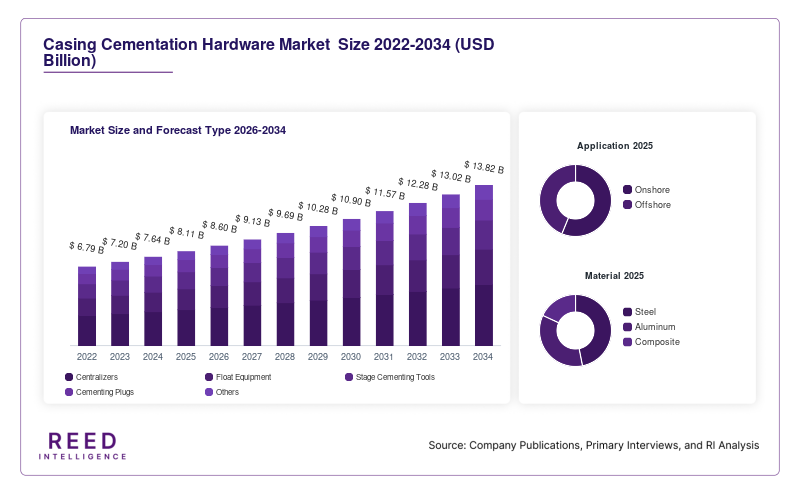
- By type, centralizers held the largest share of 28.5% in 2025, whereas stage cementing tools are projected to grow at a CAGR of 7.1%.
- By application, onshore accounted for 63.2% share in 2025, while offshore is expected to expand at a CAGR of 6.8%.
- The U.S. remained the dominant country, with market values of USD 2.6 billion in 2024 and USD 2.8 billion in 2025.
Market Trends
Adoption of Advanced Cementation Technologies
The Casing Cementation Hardware Market is increasingly shaped by the adoption of advanced cementation technologies that enhance operational accuracy and reliability. Oilfield operators are integrating automated systems and real-time monitoring tools into cementation processes to ensure optimal placement and minimize risks associated with channeling or poor bonding. These technologies enable better data-driven decision-making and improve the predictability of outcomes in complex well environments. As digital transformation accelerates across the oil and gas industry, cementation hardware equipped with smart capabilities is becoming more common, contributing to efficiency improvements and cost optimization.
Shift Toward Offshore and Deepwater Exploration
Another significant trend is the rising shift toward offshore and deepwater exploration activities. With many onshore reserves reaching maturity, energy companies are investing in offshore drilling projects that require highly durable and specialized cementation hardware. These environments demand tools that can withstand extreme pressures, temperatures, and corrosive conditions. This trend is encouraging manufacturers to develop advanced materials and designs tailored for challenging offshore applications, thereby reshaping the product landscape within the market.
Market Drivers
Rising Global Energy Demand
The growing global demand for energy remains a fundamental driver for the Casing Cementation Hardware Market. Rapid industrialization, urban expansion, and population growth in emerging economies are increasing the consumption of oil and gas resources. This has led to a surge in exploration and production activities worldwide, directly boosting the demand for cementation hardware that ensures safe and efficient well construction. As countries continue to invest in energy security, the need for reliable drilling infrastructure is expected to remain strong.
Expansion of Unconventional Oil and Gas Exploration
The expansion of unconventional resources such as shale gas, tight oil, and coalbed methane is significantly driving market growth. These resources require advanced drilling and cementation techniques due to their complex geological characteristics. The increased use of horizontal drilling and hydraulic fracturing has amplified the demand for specialized cementation hardware capable of maintaining well integrity under challenging conditions. This trend is expected to continue as operators seek to maximize resource extraction from unconventional reserves.
Market Restraint
Volatility in Oil Prices
Fluctuations in global oil prices present a key restraint for the Casing Cementation Hardware Market. Price volatility often leads to uncertainty in exploration budgets and delays in drilling projects, which directly impacts the demand for cementation hardware. During periods of low oil prices, companies tend to reduce capital expenditures, affecting market growth and limiting new project developments.
Market Opportunities
Emergence of Digital Oilfield Technologies
The adoption of digital oilfield technologies is creating new opportunities within the Casing Cementation Hardware Market. The integration of IoT devices, advanced analytics, and automation into cementation operations is improving efficiency and reducing operational risks. These technologies enable real-time monitoring and predictive maintenance, allowing operators to optimize performance and minimize downtime, thereby enhancing overall productivity.
Growing Focus on Well Integrity and Safety Standards
Increasing regulatory scrutiny and emphasis on well integrity are opening new growth avenues in the market. Operators are investing in high-quality cementation hardware that meets stringent safety and environmental standards. This trend is particularly prominent in offshore and environmentally sensitive regions, where maintaining well integrity is critical to preventing leaks and ensuring long-term operational stability.
Segmental Analysis
By Type
Centralizers dominated the Casing Cementation Hardware Market with a 28.5% share in 2025, as they play a crucial role in maintaining proper casing alignment and ensuring uniform cement distribution. Their extensive use across both onshore and offshore drilling operations contributed to their leading position.
Stage cementing tools are projected to grow at the fastest CAGR of 7.1% during the forecast period. Their ability to facilitate multi-stage cementing operations in complex well structures is a key factor driving their adoption.
By Application
Onshore applications accounted for 63.2% of the market share in 2025 due to the high volume of land-based drilling projects and relatively lower operational costs.
Offshore applications are expected to grow at a CAGR of 6.8%, driven by increasing investments in deepwater and ultra-deepwater exploration activities.
By Material
Steel dominated the segment with a 54.1% share in 2025, owing to its durability and ability to withstand high-pressure environments.
Composite materials are expected to grow at a CAGR of 7.3% due to their lightweight properties and resistance to corrosion, making them suitable for advanced drilling conditions.
By End-Use
Oil & gas companies held a dominant share of 61.7% in 2025, as they are the primary users of cementation hardware in exploration and production activities.
Drilling contractors are expected to grow at a CAGR of 6.5%, supported by the increasing outsourcing of drilling operations by major oil companies.
Regional Analysis
North America
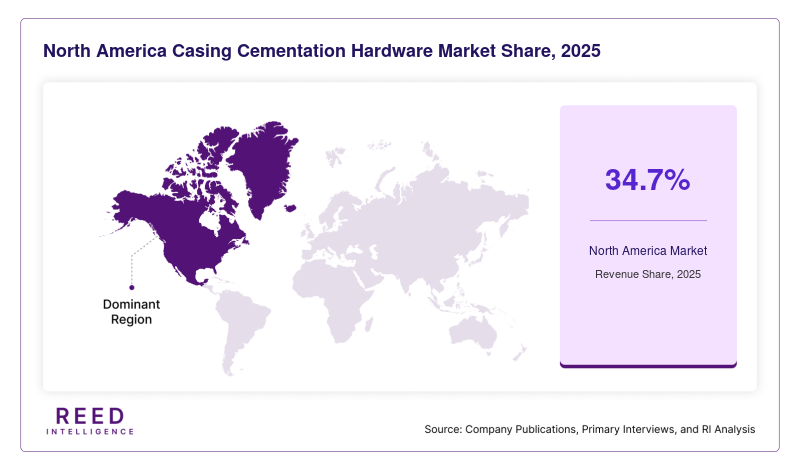
North America accounted for 34.7% of the Casing Cementation Hardware Market share in 2025 and is expected to grow at a CAGR of 5.8% during the forecast period. The region’s dominance was driven by extensive shale exploration activities in the United States, supported by advanced drilling technologies and a well-established oilfield services industry.
Europe
Europe held a market share of 18.3% in 2025 and is projected to grow at a CAGR of 5.2% through 2034. Norway emerged as the dominant country due to its strong offshore oil exploration activities in the North Sea, where efficient cementation solutions are essential for maintaining operational safety.
Asia Pacific
Asia Pacific captured 21.6% of the market share in 2025 and is expected to expand at the fastest CAGR of 7.4%. China led the region due to increasing investments in domestic oil and gas production and the growing need to reduce dependence on energy imports.
Middle East & Africa
The Middle East & Africa region accounted for 16.9% of the market share in 2025 and is projected to grow at a CAGR of 6.3%. Saudi Arabia dominated the region due to its large-scale oil production and ongoing investments in upstream exploration activities.
Latin America
Latin America held an 8.5% share of the market in 2025 and is expected to grow at a CAGR of 6.0%. Brazil led the region due to its expanding offshore exploration projects, particularly in deepwater reserves that require advanced cementation solutions.
Competitive Landscape
The Casing Cementation Hardware Market is moderately consolidated, with key players focusing on technological advancements and strategic expansion to strengthen their market positions. Schlumberger leads the market due to its extensive global presence and diversified product portfolio.
The company has recently introduced advanced cementation solutions integrated with digital monitoring technologies to enhance well integrity. Halliburton and Baker Hughes continue to expand their offerings through innovation and partnerships, while Weatherford and NOV Inc. are investing in research and development to improve product efficiency. Companies are also pursuing mergers and collaborations to enhance their capabilities and expand into emerging markets, shaping the competitive dynamics of the industry.
Key Players List
- Schlumberger Limited
- Halliburton Company
- Baker Hughes Company
- Weatherford International plc
- NOV Inc.
- Tenaris S.A.
- Hunting PLC
- Vallourec S.A.
- National Oilwell Varco
- Centek Group
- Innovex Downhole Solutions
- Magnum Oil Tools
- Packers Plus Energy Services
- Oil States International
- Forum Energy Technologies
Recent Developments
- In 2025, Schlumberger introduced a real-time cementation monitoring system to improve operational efficiency.
- Halliburton launched advanced centralizers designed for complex well environments.
- Baker Hughes expanded its manufacturing capacity in Asia Pacific to meet rising demand.
- Weatherford developed corrosion-resistant composite cementation tools for offshore applications.
- NOV Inc. invested in automated cementing technologies integrated with digital oilfield solutions.
Casing Cementation Hardware Market Segments
Type
- Centralizers
- Float Equipment
- Stage Cementing Tools
- Cementing Plugs
- Others
Application
- Onshore
- Offshore
Material
- Steel
- Aluminum
- Composite
End-Use
- Oil & Gas Companies
- Drilling Contractors
By Region
- North America
- Europe
- APAC
- Middle East and Africa
- LATAM