Cassava Flour Market Size, Share & Demand Report By Product Type (Organic Cassava Flour, Conventional Cassava Flour), By Application (Bakery & Confectionery, Ready-to-Eat Foods, Snacks & Convenience Foods), By Distribution Channel (Supermarkets & Hypermarkets, Convenience Stores, Online Retail), By End-Use Industry (Food Processing Industry, Foodservice Industry) & Regional Forecasts, 2026–2034
USD 3950
Market Overview
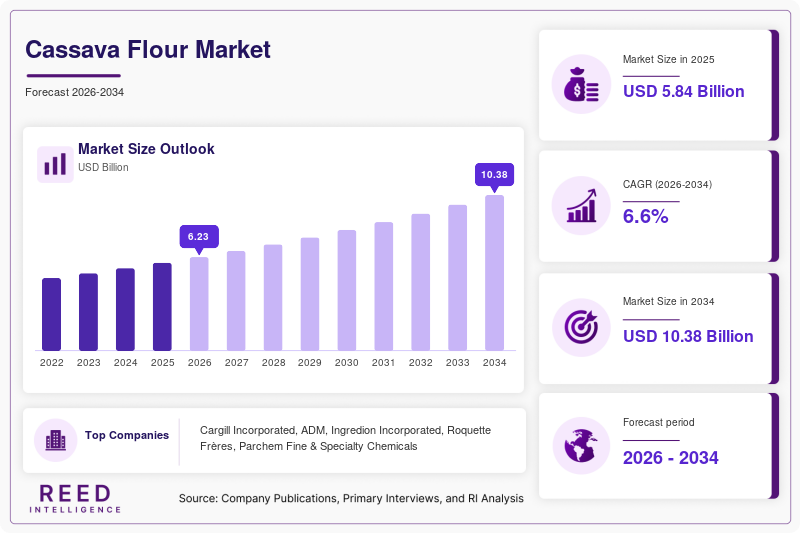
The Cassava Flour Market was valued at approximately USD 5.84 billion in 2026 and is projected to reach USD 9.76 billion by 2034, expanding at a CAGR of 6.6% during 2026–2034. The market is witnessing sustained growth due to increasing demand for gluten-free food products, rising utilization of cassava-based ingredients in bakery applications, and expanding consumer preference for clean-label food formulations. Cassava flour has gained commercial importance across food processing industries because it offers versatility, cost efficiency, and compatibility with multiple dietary requirements.
A major global factor supporting the growth of the Cassava Flour Market is the growing awareness regarding gluten intolerance and digestive health. Consumers across developed and emerging economies are increasingly shifting toward gluten-free and grain-free alternatives, particularly in bakery products, snacks, and convenience foods. Cassava flour has emerged as a preferred ingredient because it provides a neutral taste, fine texture, and functional properties suitable for food manufacturing applications. The rising adoption of alternative flours in packaged food formulations continues to support market expansion across global regions.
Key Highlights
- Asia Pacific dominated the Cassava Flour Market with a market share of 36.7% in 2025.
- North America is projected to register the fastest growth with a 7.4% CAGR during 2026–2034.
- By product type, organic cassava flour held the dominant share of 58.4% in 2025.
- By product type, conventional cassava flour is expected to grow at a 6.9% CAGR during the forecast period.
- By application, the bakery & confectionery segment accounted for the largest market share in 2025.
- By application, the ready-to-eat food segment is forecast to expand at a 7.2% CAGR through 2034.
- Thailand remained the dominant country in Asia Pacific with market values of approximately USD 612 million in 2024 and USD 658 million in 2025.
Market Trends
Rising Demand for Gluten-Free Food Products
The growing consumer preference for gluten-free diets is one of the most significant trends shaping the Cassava Flour Market. Consumers are increasingly seeking alternatives to wheat-based ingredients due to digestive concerns, food sensitivities, and changing dietary preferences. Cassava flour has gained popularity because it provides a wheat substitute suitable for bakery, snacks, and packaged food applications.
Food manufacturers are increasingly introducing gluten-free product lines that include cassava flour as a primary ingredient. Retail shelves are witnessing rising availability of cassava-based bread, cookies, tortillas, pizza crusts, and snack products. This trend is expected to continue as health-conscious consumers prioritize alternative flour options with clean-label positioning.
Expansion of Plant-Based and Clean-Label Food Formulations
The transition toward plant-based nutrition and minimally processed food products is another important trend influencing the Cassava Flour Market. Consumers are increasingly examining ingredient transparency and favoring naturally sourced food components without synthetic additives or preservatives.
Cassava flour is increasingly being used in vegan, paleo, and allergen-friendly food products due to its natural composition and processing flexibility. Manufacturers are also focusing on sustainable sourcing and organic production methods to align with changing consumer preferences. This trend is encouraging innovation across the food ingredient industry.
Market Drivers
Growth of the Global Bakery Industry
The rapid expansion of the bakery and packaged snack industry is a major driver supporting the Cassava Flour Market. Bakery manufacturers are increasingly adopting cassava flour in bread, cakes, cookies, pastries, and tortillas to diversify product offerings and address changing dietary trends.
Cassava flour offers desirable texture and moisture-retention properties that improve product quality in gluten-free baking applications. The increasing consumption of convenience bakery products across urban populations continues to strengthen demand for cassava-based ingredients in industrial food production.
Increasing Adoption of Alternative Flour Ingredients
The rising popularity of alternative flours such as almond flour, coconut flour, rice flour, and cassava flour is significantly contributing to market growth. Consumers are becoming more aware of ingredient diversity and nutritional customization, leading food companies to expand their product portfolios with non-traditional flour ingredients.
Cassava flour is increasingly preferred because of its neutral flavor profile and compatibility with multiple recipes. The growing use of cassava flour in household cooking and commercial foodservice operations is further accelerating demand globally.
Market Restraint
Price Volatility and Agricultural Supply Dependence
One of the major restraints affecting the Cassava Flour Market is the fluctuation in cassava crop yields due to climate variability and agricultural supply chain disruptions. Production of cassava roots depends heavily on weather conditions, farming practices, and regional agricultural stability. Variations in raw material availability can increase production costs and impact pricing consistency for flour manufacturers.
Market Opportunities
Expansion of Functional Food Applications
The increasing popularity of functional foods presents a strong opportunity for the Cassava Flour Market. Manufacturers are increasingly developing fortified cassava flour products containing vitamins, minerals, dietary fiber, and protein blends to target health-conscious consumers.
The growing demand for nutritional convenience foods and specialty dietary products is expected to encourage innovation in cassava-based food formulations. This opportunity is particularly strong in urban markets where consumers are willing to pay premium prices for healthier alternatives.
Growth of E-Commerce Food Distribution Channels
The rapid expansion of online grocery and direct-to-consumer food retail platforms is creating new growth opportunities for the Cassava Flour Market. Consumers increasingly purchase specialty flour products through digital channels because of wider product availability and convenience.
Food ingredient companies are expanding their online presence and collaborating with e-commerce retailers to improve product accessibility. The increasing popularity of digital food retailing is expected to strengthen market penetration in developed and emerging economies.
Segmental Analysis
By Product Type
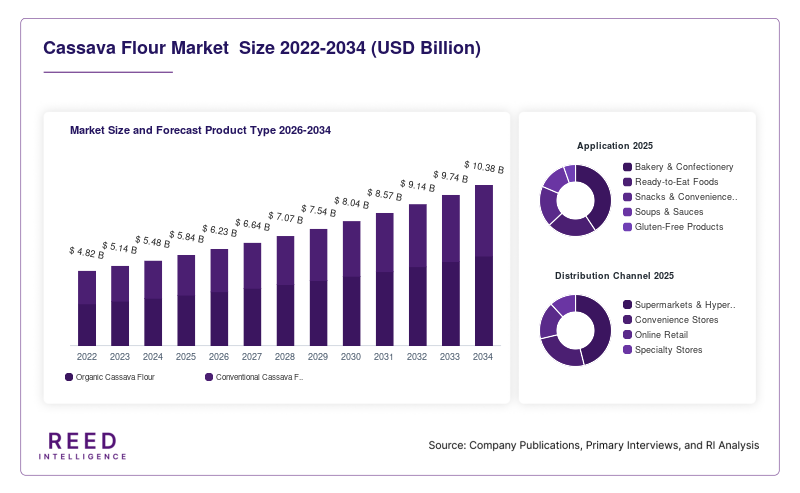
Organic cassava flour dominated the Cassava Flour Market with a market share of 58.4% in 2025. Consumers increasingly preferred organic products because of growing awareness regarding natural food ingredients and chemical-free agricultural practices. Organic cassava flour also gained popularity among health-conscious and premium food consumers.
Conventional cassava flour is projected to register the fastest CAGR of 6.9% during 2026–2034 due to its affordability and increasing use in large-scale industrial food manufacturing. Food processors are expected to continue adopting conventional cassava flour for cost-sensitive packaged food production.
By Application
The bakery & confectionery segment accounted for the largest share of 41.2% in 2025 within the Cassava Flour Market. Cassava flour is widely used in bread, pastries, cakes, cookies, and snack formulations because of its favorable texture and gluten-free functionality.
The ready-to-eat food segment is projected to expand at a 7.2% CAGR through 2034. Rising urbanization and increasing consumer demand for convenience foods are expected to strengthen the use of cassava flour in frozen meals, instant food products, and packaged snacks.
By Distribution Channel
Supermarkets and hypermarkets dominated the Cassava Flour Market with a market share of 46.5% in 2025. These retail channels offer wide product availability, organized shelf displays, and strong consumer accessibility for specialty flour products.
Online retail channels are expected to grow at a 7.6% CAGR during the forecast period due to increasing digital grocery shopping and expansion of e-commerce food platforms. Consumers increasingly prefer online purchasing for specialty and gluten-free products because of product variety and convenience.
By End-Use Industry
The food processing industry held the dominant position in 2025 with a market share of 52.7% in the Cassava Flour Market. Industrial food manufacturers extensively utilize cassava flour in bakery, snack, and packaged food applications because of its multifunctional properties.
The foodservice industry is projected to grow at a 6.8% CAGR during 2026–2034 as restaurants, cafes, and specialty bakeries increasingly incorporate gluten-free and plant-based menu offerings into their product portfolios.
Regional Analysis
North America
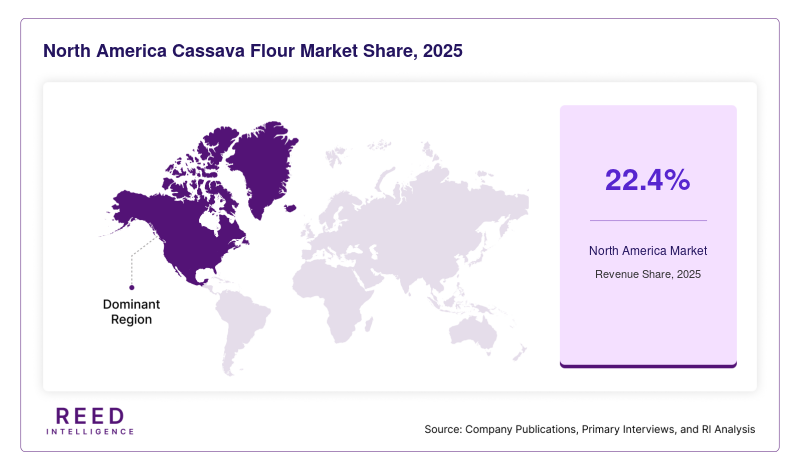
North America accounted for approximately 22.4% of the Cassava Flour Market in 2025 and is projected to grow at a 7.4% CAGR during 2026–2034. The United States dominated the regional market due to increasing demand for gluten-free bakery products and rising consumer awareness regarding alternative dietary ingredients.
Food manufacturers across North America are increasingly incorporating cassava flour into packaged snacks and bakery products to address growing health-conscious consumer preferences. The expansion of organic food retail channels also continues to support regional market growth.
Europe
Europe held a market share of 25.8% in 2025 and is expected to expand at a 6.1% CAGR through 2034. Germany remained the dominant country in the region because of rising adoption of clean-label food products and increasing demand for allergen-free bakery ingredients.
European food companies are increasingly introducing innovative gluten-free product lines to address evolving dietary trends. The region also benefits from growing consumer interest in sustainable and plant-based food ingredients.
Asia Pacific
Asia Pacific represented the largest regional share of 36.7% in 2025 and is anticipated to register a 6.8% CAGR during the forecast period. Thailand dominated the regional market because of strong cassava cultivation capacity and extensive export-oriented processing infrastructure.
The region benefits from abundant cassava production and increasing industrial applications across food manufacturing industries. Growing urbanization and rising packaged food consumption continue to strengthen demand for cassava flour products.
Middle East & Africa
The Middle East & Africa accounted for 8.1% of the Cassava Flour Market in 2025 and is projected to grow at a 6.3% CAGR during 2026–2034. Nigeria remained the dominant country due to extensive cassava cultivation and rising local food processing activities.
The increasing utilization of cassava flour in traditional foods and commercial bakery applications continues to support regional market development. Growing investments in food processing infrastructure are also contributing to market expansion.
Latin America
Latin America held approximately 7.0% market share in 2025 and is expected to expand at a 6.2% CAGR through 2034. Brazil dominated the regional market because of increasing cassava production and growing demand for alternative flour ingredients in processed food manufacturing.
The region is witnessing rising consumption of gluten-free packaged products and greater utilization of cassava flour in local bakery industries. Expanding food retail networks are further supporting regional demand.
Competitive Landscape
The Cassava Flour Market is moderately fragmented, with manufacturers focusing on product innovation, organic certification, and distribution expansion to strengthen market positioning.
Cargill Incorporated emerged as a leading participant due to its diversified food ingredient portfolio and strong global distribution network. The company recently expanded its alternative flour product line to support rising demand for gluten-free food ingredients in North America and Europe.
ADM continues to focus on plant-based ingredient development and specialty food solutions. Ingredion Incorporated is investing in cassava-derived starch and flour innovations for bakery applications. Roquette Frères remains active in clean-label ingredient development and sustainable sourcing strategies. Parchem Fine & Specialty Chemicals continues to strengthen its specialty ingredient supply capabilities across industrial and food processing markets.
Key Players List
- Cargill Incorporated
- ADM
- Ingredion Incorporated
- Roquette Frères
- Parchem Fine & Specialty Chemicals
- Otto’s Naturals
- Venus Starch Suppliers
- Thai Wah Public Company Limited
- Psaltry International Company Limited
- Grain Millers Inc.
- Natural Evolution Foods
- AGRANA Beteiligungs-AG
- Universal Starch Chem Allied Ltd.
- Kiremko B.V.
- American Key Food Products
Recent Developments
- In 2025, several food manufacturers introduced cassava flour-based bakery products targeting gluten-free consumers.
- Ingredient suppliers expanded organic cassava flour production capacity to address rising demand from clean-label food manufacturers.
- Food companies increased investment in sustainable cassava sourcing programs across Southeast Asia and Africa.
- E-commerce retailers expanded specialty flour product categories, improving accessibility of cassava flour products in urban markets.
- Manufacturers launched fortified cassava flour blends with enhanced nutritional profiles for functional food applications.
Cassava Flour Market Segments
Product Type
- Organic Cassava Flour
- Conventional Cassava Flour
Application
- Bakery & Confectionery
- Ready-to-Eat Foods
- Snacks & Convenience Foods
- Soups & Sauces
- Gluten-Free Products
Distribution Channel
- Supermarkets & Hypermarkets
- Convenience Stores
- Online Retail
- Specialty Stores
End-Use Industry
- Food Processing Industry
- Foodservice Industry
- Household Consumption
- Nutritional & Functional Foods
By Region
- North America
- Europe
- APAC
- Middle East and Africa
- LATAM