Cassia Extract Market Size, Share & Demand Report By Type (Powder Extract, Liquid Extract), By Source (Bark Extract, Leaf Extract), By Application (Food & Beverages, Nutraceuticals, Pharmaceuticals, Cosmetics & Personal Care, Others), By Distribution Channel (Direct Industrial Sales, Specialty Stores, Online Channels, Distributors & Wholesalers), By Region & Segment Forecasts, 2026–2034
USD 3950
Market Overview
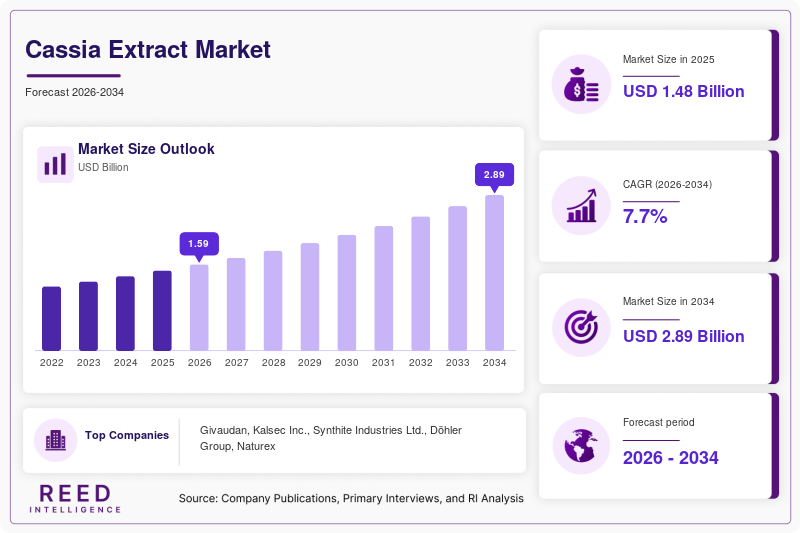
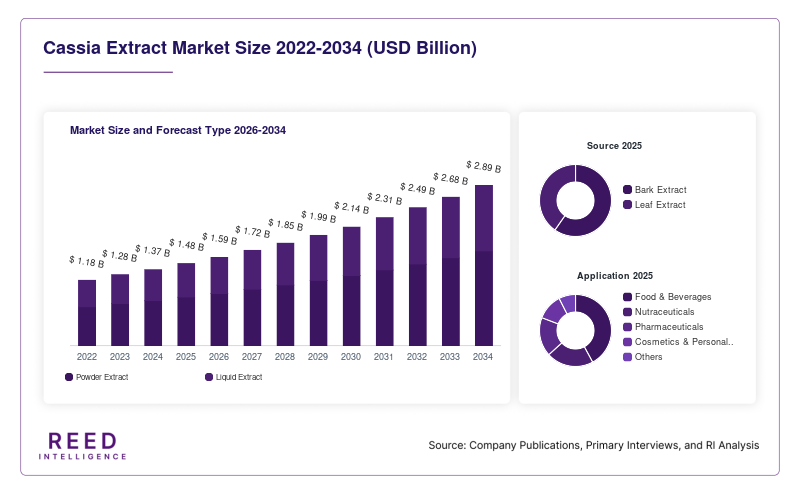
The global Cassia Extract Market size was valued at USD 1.48 billion in 2026 and is projected to reach USD 2.67 billion by 2034, expanding at a CAGR of 7.7% during the forecast period from 2026 to 2034. The market growth has been supported by the rising global preference for plant-derived ingredients across food processing, nutraceuticals, cosmetics, and pharmaceutical applications. Increasing awareness regarding botanical extracts with antioxidant and flavor-enhancing properties has encouraged manufacturers to integrate cassia extract into multiple consumer and industrial formulations.
Cassia extract, derived primarily from cassia bark and leaves, has gained wider acceptance due to its aromatic profile and functional characteristics. Food and beverage manufacturers have increasingly used cassia extract as a natural flavoring agent in confectionery, bakery, beverages, and ready-to-eat products. At the same time, pharmaceutical and nutraceutical companies have expanded the use of cassia extract in herbal formulations linked to digestion support, metabolic wellness, and immune health.
Key Highlights
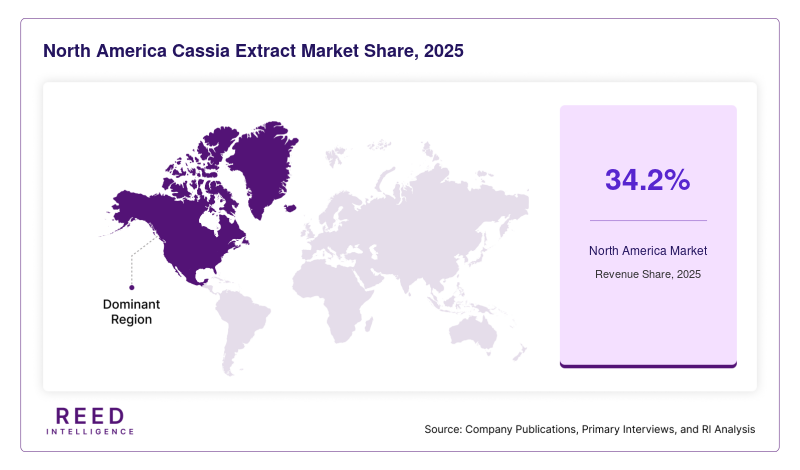
- North America accounted for 34.2% of the global Cassia Extract Market share in 2025, while Asia Pacific is projected to register the fastest CAGR of 8.9% during 2026–2034.
- By type, powder extract held the dominant market share of 57.6% in 2025, whereas liquid extract is projected to witness the fastest CAGR of 8.4% through 2034.
- By source, bark-derived cassia extract accounted for 68.1% share in 2025, while leaf-based extracts are expected to expand at a CAGR of 7.9% during the forecast period.
- By application, food and beverages dominated with 41.3% market share in 2025, while nutraceutical applications are projected to grow at a CAGR of 9.1% through 2034.
- By distribution channel, direct industrial sales represented 53.7% of the market share in 2025, while online distribution channels are expected to expand at a CAGR of 10.2% during the forecast timeline.
- The U.S. Cassia Extract Market was valued at USD 318 million in 2024 and reached USD 341 million in 2025 due to rising botanical ingredient consumption.
Market Trends
Rising Adoption of Natural Flavoring Ingredients
The growing transition toward natural food ingredients has emerged as a major trend shaping the Cassia Extract Market. Food manufacturers have increasingly replaced artificial flavoring agents with botanical extracts to align with clean-label product strategies. Cassia extract offers a warm aromatic profile suitable for beverages, desserts, confectionery, and spice blends, making it a preferred ingredient among processed food manufacturers.
Consumers have also shown greater interest in ingredient transparency and minimally processed products. This has encouraged food producers to incorporate spice-derived extracts that support both flavor enhancement and product differentiation. As global demand for natural food additives continues to increase, cassia extract suppliers have expanded production capacity and introduced standardized formulations for industrial applications.
Expansion of Herbal Wellness and Functional Nutrition
The rapid growth of herbal wellness products has significantly influenced the Cassia Extract Market trends. Nutraceutical manufacturers have increased the incorporation of cassia extract into dietary supplements, herbal capsules, immunity blends, and digestive wellness formulations. The extract’s bioactive compounds have attracted interest among wellness-focused consumers seeking plant-derived health solutions.
In addition, functional beverage producers have expanded the use of cassia extract in herbal teas, wellness drinks, and fortified beverages. The increasing availability of botanical-based products in retail and e-commerce platforms has strengthened consumer accessibility, contributing to long-term market expansion.
Market Drivers
Growing Demand from the Food Processing Industry
The expanding global food processing industry has remained a major growth driver for the Cassia Extract Market. Processed food manufacturers have increased the use of cassia extract due to its flavor-enhancing and aromatic properties. Rising urbanization and evolving dietary preferences have supported demand for packaged foods, bakery products, confectionery items, and flavored beverages.
Food companies have also focused on product innovation to meet changing consumer preferences for ethnic and spice-based flavors. Cassia extract has gained wider commercial adoption because it delivers consistent flavor concentration and longer shelf stability compared to raw spice materials.
Increasing Use in Cosmetic and Personal Care Formulations
The cosmetics and personal care sector has contributed to the growing demand for cassia extract across global markets. Personal care brands have incorporated botanical ingredients into skincare, haircare, and wellness-oriented cosmetic products. Cassia extract has gained commercial attention due to its fragrance characteristics and antioxidant properties.
Manufacturers have increasingly launched herbal cosmetic formulations targeting consumers seeking plant-derived ingredients. This shift toward botanical beauty products has strengthened the use of cassia extract in creams, lotions, essential oil blends, and aromatherapy products.
Market Restraint
Price Volatility of Raw Materials
Fluctuations in cassia bark availability and spice cultivation output have remained a major restraint for the Cassia Extract Market. Climate variability, agricultural uncertainties, and changing export regulations in producing countries have influenced raw material pricing. Such volatility has affected production costs and reduced pricing stability for extract manufacturers. Smaller producers have faced operational challenges due to inconsistent supply chains and rising processing expenses.
Market Opportunities
Expansion of Organic and Certified Botanical Products
The growing preference for certified organic ingredients presents a significant opportunity for the Cassia Extract Market. Consumers have increasingly favored products carrying organic and sustainability certifications. Manufacturers investing in traceable sourcing systems and organic processing facilities are expected to gain stronger market positioning across premium food, nutraceutical, and cosmetic industries.
The adoption of environmentally responsible farming practices is also expected to improve long-term supplier relationships and expand export opportunities in developed economies.
Rising Penetration of E-Commerce Distribution
The rapid growth of digital retail platforms is creating new opportunities for cassia extract suppliers worldwide. Online channels have enabled small and mid-sized manufacturers to reach broader customer bases across international markets. Increasing consumer access to herbal supplements, natural flavoring ingredients, and botanical wellness products through digital platforms is expected to accelerate market penetration.
In addition, e-commerce platforms have supported product customization, subscription-based wellness models, and direct-to-consumer sales strategies, which are expected to strengthen revenue generation during the forecast period.
Segmental Analysis
By Type
Powder Extract Dominated the Market
Powder extract accounted for 57.6% of the global Cassia Extract Market share in 2025. The segment maintained dominance due to its extended shelf life, easy transportation, and compatibility with dry food formulations. Powdered cassia extract has been widely used in bakery mixes, seasoning products, nutraceutical capsules, and powdered beverage blends.
Liquid Extract Will Witness the Fastest Growth
Liquid extract is projected to expand at a CAGR of 8.4% during the forecast period. The segment will experience higher demand due to increasing applications in ready-to-drink beverages, syrups, cosmetic formulations, and liquid dietary supplements. Improved solubility and formulation flexibility will continue to support segment growth across multiple industries.
By Source
Bark-Based Extract Held the Largest Share
Bark-derived cassia extract held 68.1% of the global market share in 2025. The dominance of the segment was attributed to the high concentration of aromatic compounds and essential oils present in cassia bark. Food processing companies and spice manufacturers have extensively used bark extracts in flavoring applications.
Leaf-Based Extract Will Grow Rapidly
Leaf-derived cassia extract is expected to register a CAGR of 7.9% during 2026–2034. The segment growth will be driven by increasing interest in sustainable botanical sourcing and cost-efficient extraction processes. Leaf-based extracts will gain popularity in herbal teas, cosmetic products, and wellness applications due to their mild aromatic characteristics.
By Application
Food and Beverages Led the Market
The food and beverage segment accounted for 41.3% of the global Cassia Extract Market share in 2025. The segment growth was supported by rising incorporation of spice extracts in processed foods, desserts, confectionery, and flavored drinks. Manufacturers increasingly adopted cassia extract to enhance flavor consistency and improve product differentiation.
Nutraceuticals Will Expand at the Highest CAGR
The nutraceutical segment is projected to grow at a CAGR of 9.1% through 2034. The increasing demand for botanical supplements, digestive wellness products, and immunity-support formulations will continue to drive segment expansion. Consumers seeking plant-derived health ingredients are expected to support sustained market demand.
By Distribution Channel
Direct Industrial Sales Dominated
Direct industrial sales represented 53.7% of the market share in 2025. Large-scale food processors, cosmetic companies, and nutraceutical manufacturers preferred direct procurement agreements to ensure supply consistency and quality control.
Online Distribution Will Record the Fastest Growth
Online distribution channels are projected to expand at a CAGR of 10.2% during the forecast period. Increasing digital purchasing behavior and the expansion of business-to-business e-commerce platforms will strengthen online product accessibility. Smaller brands and specialty extract suppliers are expected to benefit significantly from digital retail expansion.
Regional Analysis
North America
North America accounted for 34.2% of the global Cassia Extract Market share in 2025 and will continue to maintain significant market presence during the forecast period. The region will likely expand at a CAGR of 7.1% from 2026 to 2034 due to increasing demand for botanical ingredients in packaged foods and herbal wellness products.
The United States remained the dominant country in the region. The growth of specialty beverages and premium bakery products contributed to rising consumption of cassia extract across food manufacturing industries. U.S.-based nutraceutical companies also expanded the use of botanical extracts in immunity-focused supplements and wellness formulations.
Europe
Europe held 27.5% of the global Cassia Extract Market share in 2025 and is expected to register a CAGR of 6.8% during the forecast period. The region’s growth will be supported by strong consumer preference for natural food additives and organic cosmetic formulations.
Germany emerged as the leading country in the European market due to increasing investments in clean-label food production. The country’s advanced botanical extraction sector and strong demand for herbal nutraceuticals contributed to stable market expansion.
Asia Pacific
Asia Pacific represented 24.8% of the global Cassia Extract Market share in 2025 and is projected to witness the fastest CAGR of 8.9% through 2034. Rapid industrialization, rising disposable income, and expanding herbal product industries will continue to support regional market growth.
China dominated the regional market due to its large-scale cassia cultivation and export-oriented spice processing industry. The country’s strong agricultural base and growing domestic consumption of herbal products have strengthened regional supply chain capabilities.
Middle East & Africa
The Middle East & Africa accounted for 7.1% of the global Cassia Extract Market share in 2025 and will likely expand at a CAGR of 6.3% during the forecast timeline. Growing demand for spice-infused food products and herbal wellness solutions is expected to support market development across the region.
Saudi Arabia emerged as a major market within the region due to increasing consumer spending on premium food ingredients and imported botanical products. Expanding retail infrastructure has further improved product availability.
Latin America
Latin America captured 6.4% of the global Cassia Extract Market share in 2025 and is anticipated to grow at a CAGR of 6.5% from 2026 to 2034. The region’s market growth will be supported by rising awareness regarding herbal ingredients and expanding food processing activities.
Brazil remained the dominant country in the regional market. Increasing consumption of flavored beverages and herbal nutritional products contributed to greater adoption of cassia extract among food and wellness manufacturers.
Competitive Landscape
The global Cassia Extract Market remains moderately fragmented, with international botanical ingredient suppliers and regional spice extract manufacturers competing across multiple application industries. Companies have increasingly focused on sustainable sourcing, product purity, and customized extract formulations to strengthen their competitive positioning.
Market participants have also invested in advanced extraction technologies to improve consistency and reduce processing waste. Partnerships with food processing and nutraceutical companies have become a common strategy for long-term revenue growth.
Among the leading companies, Givaudan maintained strong market presence through its extensive botanical ingredient portfolio and global distribution capabilities. The company recently expanded its natural extract processing operations to support growing demand for plant-based flavor solutions.
Kalsec Inc. continued to focus on clean-label ingredient innovation for food applications.
Synthite Industries Ltd. strengthened its export network across Asia Pacific and Europe.
Döhler Group expanded customized botanical extract offerings for beverage applications.
Naturex increased investments in sustainable sourcing and traceability systems.
Key Players List
- Givaudan
- Kalsec Inc.
- Synthite Industries Ltd.
- Döhler Group
- Naturex
- Mane Group
- Plant Lipids
- Ingredion Incorporated
- Symrise AG
- McCormick & Company
- Akay Group
- Bio-Botanica Inc.
- Martin Bauer Group
- Indena S.p.A.
- Haldin Pacific Semesta
Recent Developments
- In 2025, Synthite Industries Ltd. expanded its botanical extraction facility to increase production capacity for spice-derived ingredients.
- In 2025, Symrise AG introduced a new range of clean-label botanical flavor solutions targeting beverage manufacturers.
- In 2024, Givaudan strengthened partnerships with sustainable cassia suppliers to improve traceability across its botanical ingredient portfolio.
- In 2025, Plant Lipids launched standardized cassia extract formulations for nutraceutical applications.
- In 2024, Döhler Group expanded research initiatives focused on natural spice extract stabilization technologies.
Cassia Extract Market Segments
Type
- Powder Extract
- Liquid Extract
Source
- Bark Extract
- Leaf Extract
Application
- Food & Beverages
- Nutraceuticals
- Pharmaceuticals
- Cosmetics & Personal Care
- Others
Distribution Channel
- Direct Industrial Sales
- Specialty Stores
- Online Channels
- Distributors & Wholesalers
By Region
- North America
- Europe
- APAC
- Middle East and Africa
- LATAM