Cast Iron Ball Valves Market Size, Share & Demand Report By Valve Type (Floating Ball Valves, Trunnion-Mounted Ball Valves, Reduced Port Ball Valves), By Application (Water and Wastewater Treatment, Oil and Gas, Chemical Processing, Power Generation, HVAC Systems, Food and Beverage Processing), By End-Use Industry (Municipal Utilities, Industrial Manufacturing, Energy and Power, Commercial Infrastructure), By Region & Segment Forecasts, 2026–2034
USD 3950
Market Overview
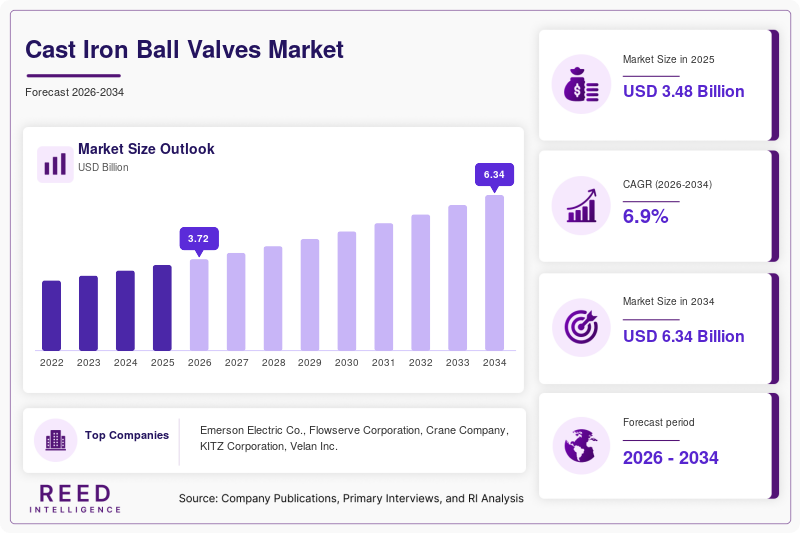
The global Cast Iron Ball Valves Market size was valued at USD 3.48 billion in 2026 and is projected to reach USD 5.92 billion by 2034, expanding at a CAGR of 6.9% during the forecast period from 2026 to 2034. Demand for cast iron ball valves continues to rise across water treatment, oil and gas, power generation, chemical processing, and municipal infrastructure industries due to their durability, corrosion resistance, and cost efficiency in medium-pressure applications. Industrial operators are increasingly prioritizing valve systems that reduce leakage rates and improve operational safety, supporting broader adoption of cast iron ball valves in automated and semi-automated flow control systems.
One of the major global factors supporting market growth is the rapid expansion of water infrastructure modernization projects across developing and developed economies. Governments and private utility operators are investing heavily in pipeline replacement programs, wastewater treatment plants, irrigation networks, and district cooling systems. Cast iron ball valves are widely preferred in these projects because they offer reliable shutoff performance, longer service life, and comparatively lower maintenance costs than alternative metallic valve materials in selected applications. Rising industrialization in Asia Pacific and the Middle East is also contributing to higher installation rates across commercial and industrial facilities.
Key Highlights
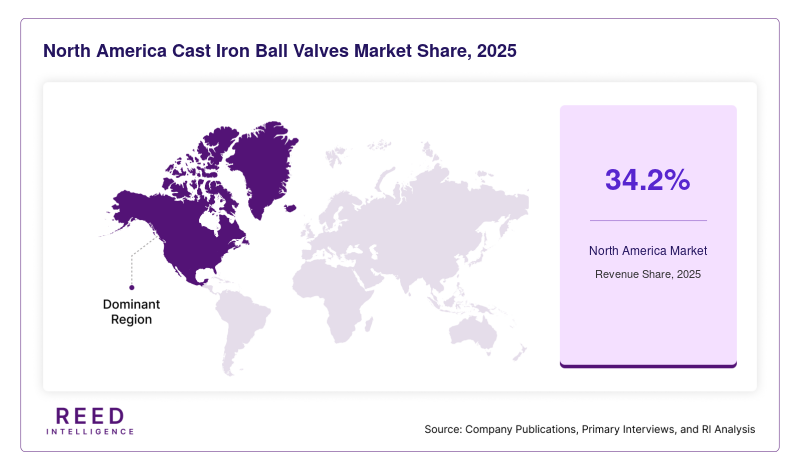
- North America dominated the market with a 34.2% share in 2025.
- Asia Pacific is expected to grow at the fastest CAGR of 8.4% during 2026–2034.
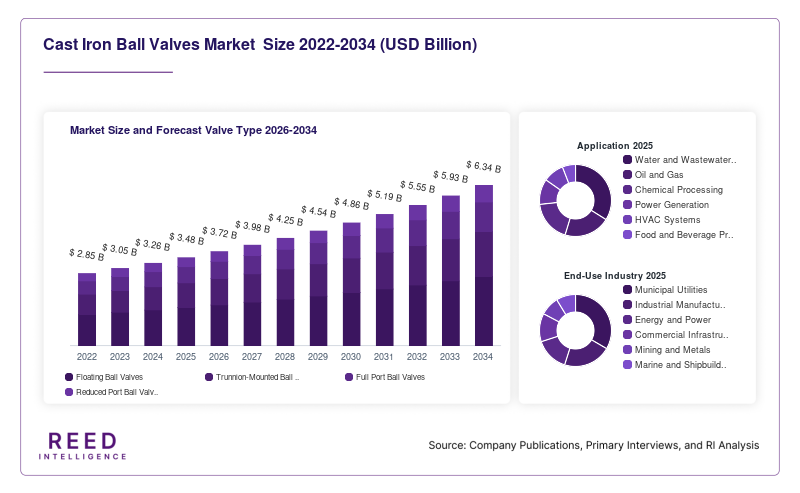
- By valve type, floating ball valves accounted for the largest share of 44.1%.
- while trunnion-mounted ball valves are projected to grow at a CAGR of 8.8%.
- By application, water and wastewater treatment led with a 39.6% share.
- whereas oil and gas applications are expected to expand at a CAGR of 8.1%.
- By end-use industry, municipal utilities held the dominant share of 36.8%, while chemical processing is anticipated to grow at a CAGR of 8.5%.
- The United States remained the dominant country, with market values of USD 710 million in 2024 and USD 762 million in 2025.
Market Trends
Integration of Smart Valve Monitoring Technologies
Industrial operators are increasingly integrating smart monitoring systems into cast iron ball valve networks to improve predictive maintenance and reduce operational downtime. The growing adoption of Industrial Internet of Things platforms across manufacturing plants, energy facilities, and water treatment infrastructure has accelerated demand for valves equipped with sensors capable of measuring pressure, temperature, leakage, and flow conditions in real time. Smart cast iron ball valves help operators identify failures before they disrupt production activities, which lowers maintenance expenses and improves asset efficiency. Manufacturers are also introducing wireless connectivity features and cloud-based monitoring solutions to strengthen operational visibility across distributed pipeline networks.
The trend is particularly visible in municipal water systems where aging infrastructure creates high maintenance risks and water loss concerns. Utility companies are investing in digitally connected valve systems that improve monitoring efficiency and support automated flow management. Integration with supervisory control and data acquisition systems is further strengthening demand for technologically enhanced cast iron ball valves. In addition, industries handling hazardous fluids are adopting smart valve systems to improve worker safety and comply with stricter operational regulations. These developments are encouraging valve manufacturers to increase research spending and develop products that combine mechanical reliability with advanced digital functionality.
Growing Preference for Corrosion-Resistant Coatings
Manufacturers in the Cast Iron Ball Valves Market are increasingly focusing on advanced coating technologies to improve valve lifespan and operational efficiency in corrosive industrial environments. Epoxy coatings, fusion-bonded coatings, ceramic layers, and polyurethane linings are becoming common additions to cast iron valve products used in wastewater treatment, marine infrastructure, and chemical processing plants. These coatings reduce corrosion risks caused by moisture, chemicals, and fluctuating temperatures, allowing end users to minimize maintenance cycles and extend replacement intervals.
Demand for coated cast iron ball valves is also increasing because industrial operators are under pressure to lower lifecycle operating costs while maintaining system reliability. Water treatment facilities in emerging economies are increasingly specifying coated valves in procurement contracts to improve infrastructure durability under continuous operating conditions. Furthermore, environmental regulations associated with leakage prevention and pipeline efficiency are encouraging industries to adopt corrosion-resistant valve solutions. Suppliers are responding by expanding their customized coating portfolios and introducing products designed for highly abrasive and chemically aggressive applications. This trend is expected to create differentiation opportunities for manufacturers competing in industrial infrastructure modernization projects.
Market Drivers
Expansion of Global Water and Wastewater Infrastructure
The rapid expansion of water distribution and wastewater treatment infrastructure is a primary driver supporting growth in the Cast Iron Ball Valves Market. Governments across Asia Pacific, North America, and the Middle East are allocating significant investments toward pipeline modernization, sewage treatment facilities, desalination plants, and irrigation systems. Cast iron ball valves are widely used in these applications because they provide dependable shutoff capabilities, easy maintenance, and compatibility with large-scale municipal piping systems. Increasing urban populations and rising water consumption are further strengthening the need for efficient valve systems capable of supporting long-distance distribution networks.
Public utility operators are also replacing aging valve installations to reduce water leakage and improve operational efficiency. In several countries, infrastructure stimulus programs include funding for upgraded flow control equipment that supports automation and energy-efficient water management practices. Industrial wastewater recycling projects are additionally creating new installation opportunities for corrosion-resistant cast iron valves. As water scarcity concerns intensify globally, investments in reliable fluid control systems are expected to remain strong, creating sustained long-term demand for cast iron ball valves across municipal and industrial applications.
Rising Industrial Automation Across Process Industries
The growing adoption of industrial automation across process industries is significantly increasing demand for advanced cast iron ball valves. Industries such as oil and gas, chemicals, pharmaceuticals, mining, and food processing are modernizing production facilities to improve operational consistency and reduce labor dependency. Automated valve systems play a critical role in regulating fluid flow, maintaining pressure stability, and supporting remote process control operations. Cast iron ball valves remain a preferred option in medium-pressure industrial environments because of their cost efficiency and mechanical durability.
Manufacturers are increasingly integrating pneumatic and electric actuators with cast iron ball valves to support automated operational requirements. These solutions allow plant operators to control fluid systems remotely and respond quickly to pressure changes or emergency shutdown situations. Automation also helps reduce product losses caused by leakage and inefficient flow control. Expanding industrial manufacturing capacity in emerging economies such as India, Vietnam, Indonesia, and Brazil is further accelerating installation rates of automated valve systems. The continued transition toward smart factories and digitally managed industrial facilities is expected to strengthen demand for technologically advanced cast iron ball valves over the forecast period.
Market Restraint
Volatility in Raw Material Prices and Competition from Alternative Materials
Fluctuating raw material prices remain a major challenge for manufacturers operating in the Cast Iron Ball Valves Market. The cost of iron ore, scrap metal, energy, and industrial coatings has experienced considerable volatility due to geopolitical tensions, supply chain disruptions, and changing trade policies. These price fluctuations increase manufacturing costs and create uncertainty in long-term procurement planning for valve producers. Smaller manufacturers often face difficulty maintaining stable profit margins because they lack large-scale purchasing capabilities and long-term supplier contracts. Rising transportation and logistics expenses are also adding pressure across the industrial supply chain.
The market is additionally facing growing competition from alternative valve materials such as stainless steel, brass, bronze, and engineered plastics. End users operating in highly corrosive or high-pressure environments are increasingly selecting premium materials that provide greater durability and broader chemical compatibility. Although cast iron valves remain cost effective in several applications, material substitution trends can limit adoption in industries requiring advanced performance characteristics. For example, offshore oil platforms and pharmaceutical facilities often prefer stainless steel valves because of strict hygiene and corrosion-resistance requirements. These competitive pressures are encouraging cast iron valve manufacturers to improve product quality, introduce protective coatings, and invest in specialized industrial applications where cast iron continues to offer strong economic value.
Market Opportunities
Rising Investments in District Energy and HVAC Infrastructure
The increasing development of district heating, district cooling, and large commercial HVAC infrastructure presents substantial opportunities for the Cast Iron Ball Valves Market. Urban development projects across Asia Pacific, Europe, and the Middle East are expanding centralized energy distribution systems to improve energy efficiency and reduce environmental impact. Cast iron ball valves are widely used in HVAC networks because they offer reliable flow control, strong thermal resistance, and cost-efficient operation for medium-pressure heating and cooling applications.
Large commercial complexes, airports, hospitals, and industrial parks are investing in energy-efficient building infrastructure that requires extensive valve installations for water circulation and temperature regulation systems. Governments are also encouraging energy conservation through green building regulations and sustainability initiatives, creating additional demand for modern HVAC control equipment. Manufacturers that develop lightweight, energy-efficient, and automated cast iron ball valves for district energy applications are expected to benefit from rising infrastructure spending. The expansion of smart city projects in developing economies is likely to create additional long-term opportunities for valve suppliers specializing in commercial infrastructure systems.
Expansion of Oil and Gas Pipeline Networks in Emerging Economies
Emerging economies are continuing to invest heavily in oil and gas transportation infrastructure, creating attractive opportunities for cast iron ball valve manufacturers. Countries across Asia Pacific, the Middle East, and Latin America are expanding pipeline networks to support rising energy consumption, industrialization, and cross-border fuel distribution. Cast iron ball valves are commonly installed in selected midstream and downstream operations because they provide dependable shutoff performance and economical installation costs for large pipeline systems.
National oil companies and private infrastructure operators are increasingly modernizing existing pipeline systems to improve safety standards and reduce leakage risks. Valve manufacturers capable of supplying corrosion-resistant and automated solutions are likely to gain competitive advantages in these projects. In addition, growing investments in liquefied natural gas terminals, refinery upgrades, and petrochemical facilities are creating broader demand for industrial valve systems. Several regional governments are also supporting domestic manufacturing capabilities to reduce import dependency, which could encourage strategic partnerships and localized production expansion among global cast iron valve suppliers.
Segmental Analysis
By Valve Type
Floating ball valves represented the dominant subsegment in the Cast Iron Ball Valves Market, accounting for 44.1% of total revenue in 2024. Their strong market position is linked to cost efficiency, compact design, and reliable shutoff performance across medium-pressure industrial applications. Floating ball valves are widely used in water treatment facilities, HVAC systems, food processing plants, and general industrial fluid handling operations because they require limited maintenance and provide effective sealing capabilities. Manufacturers also prefer these valves because of their relatively simple production process and broad compatibility with automated actuator systems. Growing investments in municipal infrastructure and industrial process modernization continue to support demand for floating ball valve products.
Trunnion-mounted ball valves are projected to register the fastest CAGR of 8.8% during the forecast period due to increasing demand from high-capacity industrial operations and energy infrastructure projects. These valves are gaining popularity because they offer improved stability, reduced operating torque, and enhanced durability in larger pipeline systems. Oil and gas operators, petrochemical facilities, and large water distribution projects are increasingly selecting trunnion-mounted valves for applications involving higher pressure levels and demanding operating conditions. Technological advancements in sealing systems and corrosion-resistant coatings are further improving performance capabilities. Manufacturers are also introducing lightweight designs and advanced automation features to strengthen adoption across industrial sectors requiring reliable long-term fluid control solutions.
By Application
Water and wastewater treatment emerged as the leading application segment in the Cast Iron Ball Valves Market, holding a 39.6% revenue share in 2024. Rapid urbanization and increasing investments in municipal water infrastructure have significantly increased demand for reliable valve systems capable of managing high-volume water flow operations. Cast iron ball valves are widely used in filtration systems, pumping stations, sewage treatment plants, and pipeline distribution networks due to their cost efficiency and strong operational durability. Public infrastructure authorities are increasingly replacing aging valve installations to reduce water losses and improve system efficiency. The growing adoption of automated water management technologies is also contributing to higher installation rates for modern cast iron valve systems.
Oil and gas applications are expected to grow at the fastest CAGR of 8.1% over the forecast period due to expanding pipeline infrastructure and refinery modernization projects across emerging economies. Cast iron ball valves are increasingly utilized in selected downstream and midstream operations where operators require dependable shutoff functionality at competitive costs. Rising investments in liquefied natural gas facilities, fuel transportation systems, and petrochemical plants are creating new opportunities for valve suppliers. In addition, industrial safety regulations are encouraging energy companies to upgrade existing flow control systems with advanced automated valve technologies. Manufacturers are responding by introducing corrosion-resistant and high-performance valve products designed specifically for energy infrastructure environments.
By End-Use Industry
Municipal utilities accounted for the largest share of the Cast Iron Ball Valves Market in 2024, representing 36.8% of global revenue. Demand from municipal operators remains strong due to ongoing investments in urban water supply systems, wastewater treatment infrastructure, and public utility modernization programs. Cast iron ball valves are commonly used in municipal applications because they offer reliable flow control, long service life, and comparatively lower operating costs than several alternative materials. Population growth and increasing urbanization are further pressuring governments to expand water distribution capacity and improve infrastructure efficiency. The adoption of smart utility management systems is also increasing demand for automated valve installations across municipal networks.
Chemical processing is expected to record the fastest CAGR of 8.5% during the forecast period as industrial facilities continue to expand production capacity and improve process automation capabilities. Chemical manufacturers require reliable valve systems that can withstand corrosive environments and maintain operational stability during continuous processing activities. Advances in protective coatings and sealing technologies are improving the suitability of cast iron ball valves for selected chemical applications. Rising investments in specialty chemicals, fertilizers, and industrial manufacturing across Asia Pacific and the Middle East are further supporting market expansion. Manufacturers are increasingly offering customized valve solutions designed for specific chemical processing requirements, helping strengthen product adoption across demanding industrial operating conditions.
Regional Analysis
North America
North America accounted for 34.2% of the global Cast Iron Ball Valves Market in 2025 and continues to maintain a leading position due to strong industrial infrastructure investments and widespread modernization of water distribution systems. The region is expected to expand at a CAGR of 5.8% through 2034, supported by steady demand from oil and gas, municipal utilities, and manufacturing facilities. Aging pipeline infrastructure across the United States and Canada is encouraging replacement of outdated valve systems with more efficient and durable cast iron ball valves. Increased spending on wastewater management projects is also contributing to market growth.
The United States remains the dominant country in the regional market due to large-scale investments in industrial automation and water infrastructure rehabilitation programs. One major growth factor is the implementation of federal infrastructure funding initiatives that prioritize modernization of municipal water systems and industrial facilities. Industrial operators are increasingly adopting automated valve technologies to improve operational reliability and comply with stricter environmental regulations. The expansion of shale gas production and petrochemical processing facilities is further supporting demand for durable valve solutions across the country.
Europe
Europe represented approximately 26.4% of the global Cast Iron Ball Valves Market in 2025 and is projected to grow at a CAGR of 5.9% during the forecast period. Market expansion is driven by industrial modernization programs, strict environmental regulations, and rising investments in district heating systems across several European economies. Utilities and industrial operators are replacing aging piping infrastructure with more energy-efficient systems, increasing demand for advanced cast iron ball valves. The region also benefits from strong adoption of automated flow control technologies in manufacturing and water treatment facilities.
Germany remains the dominant country within the European market because of its strong industrial manufacturing base and extensive process automation capabilities. A unique growth factor supporting the German market is the country’s focus on energy-efficient industrial operations and smart factory integration. Manufacturing facilities are investing in digitally connected valve systems that improve operational efficiency and reduce maintenance costs. Additionally, district heating projects and renewable energy infrastructure development across Germany are generating consistent demand for industrial-grade valve solutions.
Asia Pacific
Asia Pacific held a 24.7% share of the global Cast Iron Ball Valves Market in 2025 and is expected to record the fastest CAGR of 8.4% between 2026 and 2034. Rapid industrialization, urban infrastructure expansion, and growing investments in water treatment projects are driving strong regional demand. Countries such as China, India, Indonesia, and Vietnam are significantly expanding pipeline infrastructure, manufacturing facilities, and municipal utility systems. Increasing industrial automation across emerging economies is also accelerating adoption of cast iron ball valves in chemical processing, power generation, and industrial manufacturing applications.
China dominates the Asia Pacific market due to its extensive industrial production capacity and large-scale infrastructure development activities. One important growth factor is the country’s ongoing investment in urban water distribution and wastewater treatment projects to support rising urban populations. Industrial operators in China are increasingly adopting automated valve systems to improve production efficiency and reduce operational risks. Furthermore, the government’s focus on strengthening domestic manufacturing capabilities and industrial exports continues to support high demand for industrial valve equipment.
Middle East & Africa
The Middle East & Africa region accounted for nearly 8.1% of the global Cast Iron Ball Valves Market in 2025 and is projected to grow at a CAGR of 6.7% over the forecast period. Expansion of oil and gas infrastructure, desalination projects, and commercial construction activities are major contributors to regional demand. Governments across Gulf countries are investing in water security initiatives and industrial diversification programs, increasing installation of advanced pipeline systems and flow control equipment. Rising construction of district cooling networks is also supporting adoption of cast iron ball valves in HVAC applications.
Saudi Arabia remains the dominant country in the regional market because of large investments in energy infrastructure and industrial development projects. A unique growth factor is the country’s aggressive expansion of desalination plants and integrated industrial cities under long-term economic diversification programs. These projects require reliable valve systems capable of supporting high-volume water and industrial fluid management operations. Additionally, petrochemical facility expansion and pipeline modernization programs are generating substantial demand for corrosion-resistant cast iron valve products.
Latin America
Latin America captured around 6.6% of the global Cast Iron Ball Valves Market in 2025 and is anticipated to expand at a CAGR of 6.2% through 2034. Increasing investments in mining operations, water infrastructure, and energy distribution projects are supporting regional market growth. Countries across the region are modernizing municipal utility systems to improve water supply reliability and reduce leakage losses. Industrial expansion in sectors such as food processing, chemicals, and oil refining is also contributing to rising demand for durable valve systems.
Brazil remains the dominant country in the Latin American market because of its extensive industrial base and large energy infrastructure network. One significant growth factor is the country’s continued investment in oil refining capacity and offshore energy support infrastructure. Industrial operators are increasingly upgrading flow control systems to improve operational efficiency and comply with environmental regulations. Additionally, growing investments in agricultural irrigation networks and urban sanitation projects are supporting broader installation of cast iron ball valves across municipal and industrial sectors.
Competitive Landscape
The Cast Iron Ball Valves Market remains moderately fragmented, with global and regional manufacturers competing through product quality, pricing strategies, automation integration, and distribution network expansion. Leading companies are focusing on developing corrosion-resistant products, smart valve technologies, and customized industrial solutions to strengthen their competitive positions. Strategic partnerships with infrastructure contractors and industrial engineering firms are also becoming increasingly important for long-term market expansion.
Emerson Electric Co. continues to hold a leading position in the global market due to its broad industrial valve portfolio, strong automation capabilities, and extensive global distribution network. The company has expanded investments in digital valve monitoring technologies to support industrial automation trends. Flowserve Corporation, Crane Company, KITZ Corporation, and Velan Inc. are also strengthening their market presence through new product launches and manufacturing expansion strategies.
Key Players
- Emerson Electric Co.
- Flowserve Corporation
- Crane Company
- KITZ Corporation
- Velan Inc.
- AVK Holding A/S
- Neway Valve Co., Ltd.
- Bray International
- IMI plc
- KSB SE & Co. KGaA
- Alfa Laval AB
- Schlumberger Limited
- Powell Valves
- NIBCO Inc.
- Metso Corporation
Recent Developments
- Emerson Electric Co. expanded its industrial automation portfolio in 2025 by launching digitally connected cast iron ball valves designed for municipal water management systems.
- Flowserve Corporation announced a manufacturing capacity expansion project in Asia Pacific during 2024 to strengthen supply chain efficiency for industrial valve products.
- KITZ Corporation introduced new epoxy-coated cast iron ball valves in 2025 for corrosive wastewater treatment applications and industrial processing environments.
- AVK Holding A/S partnered with regional water infrastructure contractors in the Middle East during 2024 to support large-scale desalination and municipal pipeline projects.
Cast Iron Ball Valves Market Segments
Valve Type
- Floating Ball Valves
- Trunnion-Mounted Ball Valves
- Full Port Ball Valves
- Reduced Port Ball Valves
Application
- Water and Wastewater Treatment
- Oil and Gas
- Chemical Processing
- Power Generation
- HVAC Systems
- Food and Beverage Processing
End-Use Industry
- Municipal Utilities
- Industrial Manufacturing
- Energy and Power
- Commercial Infrastructure
- Mining and Metals
- Marine and Shipbuilding
By Region
- North America
- Europe
- APAC
- Middle East and Africa
- LATAM